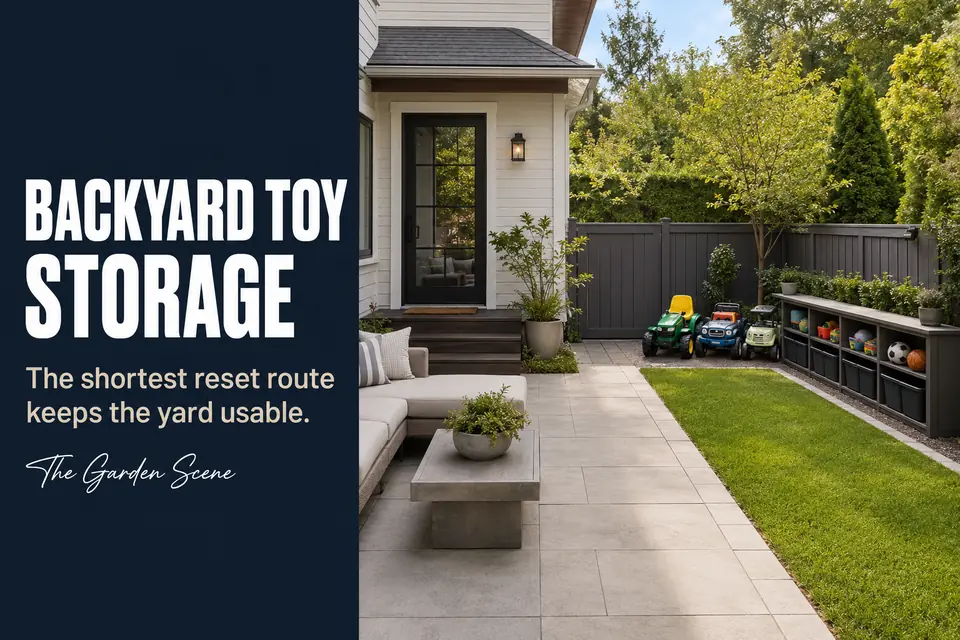
Backyard toy clutter is rarely a container shortage. It is usually a return-route mismatch. A scooter stops beside the back door, balls collect behind a lounge chair, and sand toys land at the lawn-to-patio transition because those surfaces are easier to reach than the assigned storage.
The layout should begin by protecting the surfaces that must stay active: the door approach, main patio crossing, lawn access, gate route, and movement space around occupied chairs. Storage has to fit around those areas rather than borrow space from them.
Only then should the container enter the decision. The useful return point depends on the toy’s footprint, its distance from active play, and the effort required to put it away. The correct destination must compete with the convenient wrong one.
Why Backyard Toys End Up in Walking Routes
Treat repeated drop points as route data, not random mess. Toys tend to collect where one activity ends and another begins: the edge of a patio, the bottom of a step, the corner of an outdoor rug, or the point where children pass through a door.
Play also expands beyond its intended zone. A ball game shifts toward the patio. A ride-on toy travels from the driveway into the backyard. Chalk begins near a step and spreads toward the seating area. The storage stays fixed while the real play area moves.
Observe the yard before cleanup on two or three normal-use days. Note where toys repeatedly stop rather than where they are supposed to go. This movement-first approach is also central to designing a backyard for everyday use: an occupied yard reveals routes that an empty plan cannot.
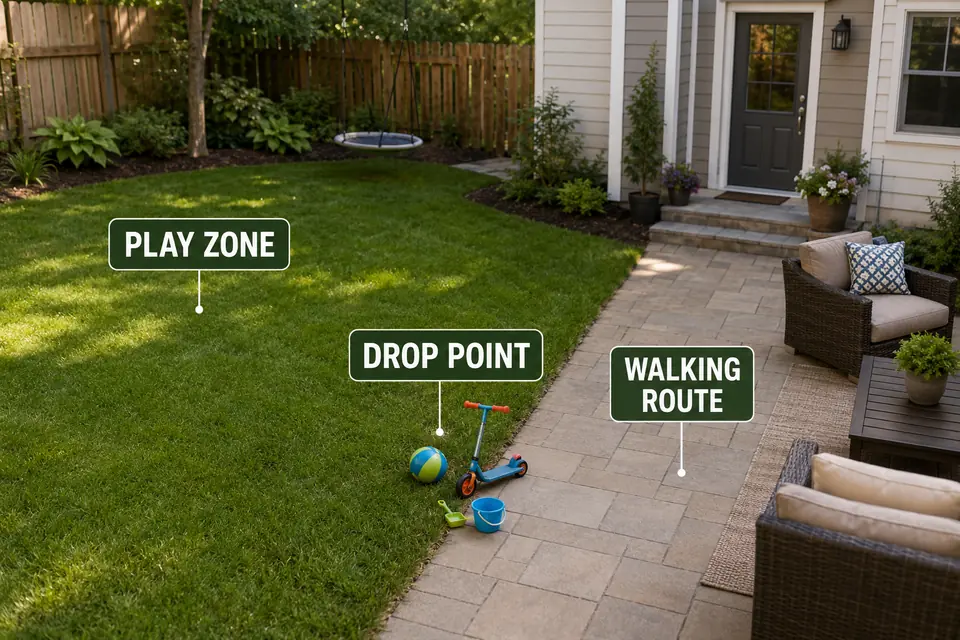
Distinguish a true route from open space that merely looks available. A strip behind a sofa may appear empty when no one is seated, but it becomes active when someone approaches the chair or pulls it away from a table. The corner beside a door disappears as usable storage space once the door swings open.
The recurring drop point shows where the reset route currently breaks. Storage does not have to sit directly on that spot, but it should be nearby, approachable from the same direction, and outside the route itself.
How Toy Size Changes the Storage Location
Choose storage by the motion required to return the toy. Several small pieces can be dropped into a shallow container without changing grip. A wagon, scooter, or large push toy needs a level approach and enough room to roll into place. Calling both categories “toys” hides the physical difference that controls placement.
Large toys need parking, not packing
Ride-on toys, wagons, oversized trucks, and rigid play equipment usually need a defined parking bay. Their return route should avoid steps, tight corners, and occupied seating. A visible boundary against a fence or wall is often more practical than a container that requires lifting.
Bats, toy tools, pool noodles, and other long items create a different footprint. They may fit against an edge, but their ends must not project into the adjacent path. Vertical storage saves floor space only when children can return the objects without complicated clips or fasteners. Otherwise, an edge-aligned horizontal position may work better.
Smaller toys need fast capture
Balls, flying discs, sand toys, chalk, and water-play pieces need broad return categories rather than carefully arranged compartments. The opening should be visible, reachable, and large enough for an untidy armful. Some unused capacity is essential because a full bin turns every reset into a repacking job.
One of the recurring storage mistakes in small backyards is forcing everything into a single large unit. That reduces the number of containers but sends objects with different footprints and return routes to the same inconvenient location.
| Toy footprint | Normal return behavior | Suitable location | Placement limit |
|---|---|---|---|
| Large ride-ons and wagons | Rolled or dragged individually | Level parking bay beside the play zone | No steps, tight turns, or chair crossings |
| Balls and medium loose toys | Carried in loose armfuls | Open bounded return point near active play | Avoid deep mixed storage |
| Chalk, sand toys, and small pieces | Gathered several at a time | Shallow, reachable capture container | Keep the container outside the footpath |
| Bats, noodles, and long toys | Carried awkwardly at one end | Vertical or edge-aligned storage | Ends must not project into the route |
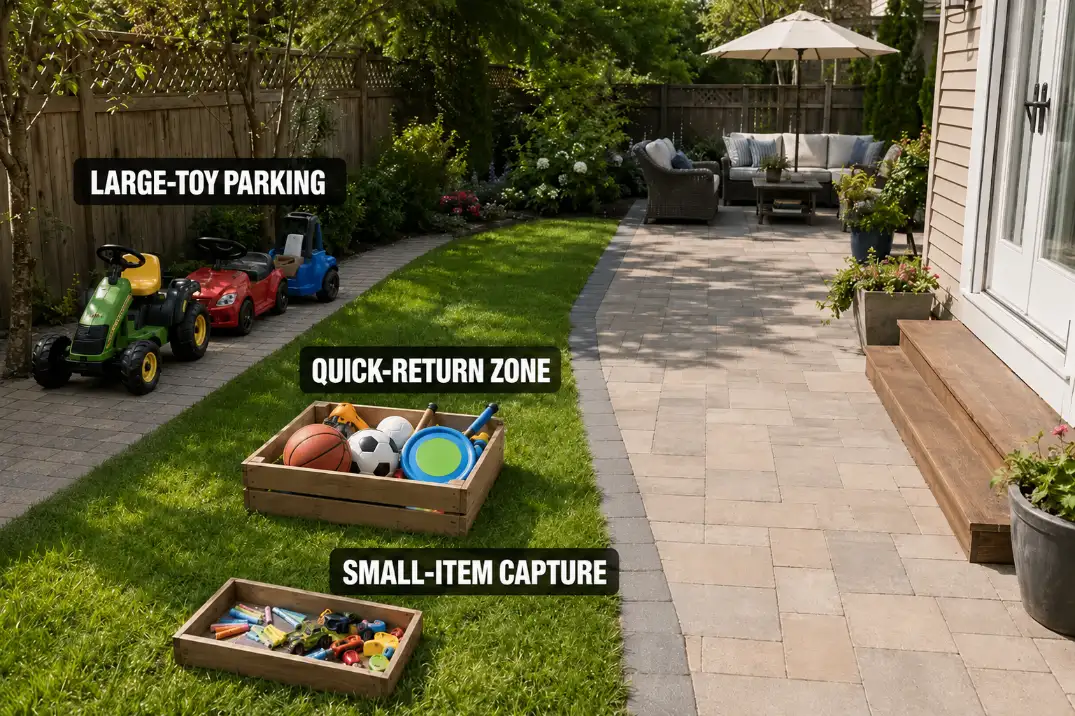
A storage point passes the test only when the object can enter at its normal handling angle. A wide toy that fits only after being rotated, lifted, or partially disassembled does not have a practical daily destination.
Where Storage Works Near Play Without Blocking Seating
Storage should intercept the play-to-reset route without occupying it. Trace the back door to the lawn, the patio to the gate, the seating area to the house, and any regular trip toward a grill, hose, or garden bed.
Protect the active edges first
The space used by seating extends beyond the furniture footprint. Dining chairs move backward. Lounge chairs are approached from the side. Someone carrying drinks may circle an outdoor sofa instead of squeezing through the narrowest gap. Storage directly behind a chair can interfere even when it does not touch the furniture.
Door and gate swings create similar temporary zones. A low toy bin beside a door may look unobtrusive but still force someone to step sideways while carrying food, cushions, or a bulky toy. These conflicts are common in patio layouts that become hard to use because the open positions of doors and furniture were never tested.
A stronger location is an inactive edge: a fence segment outside the gate approach, a wall beyond the door swing, or the side of the play zone opposite the seating entrance. The storage opening should face the person returning the toy without requiring them to stand in the main path.
Storage can sit near patio seating without entering its circulation. Leave the approach and chair-movement area open, and avoid routes that make adults carry bulky toys between occupied seats.
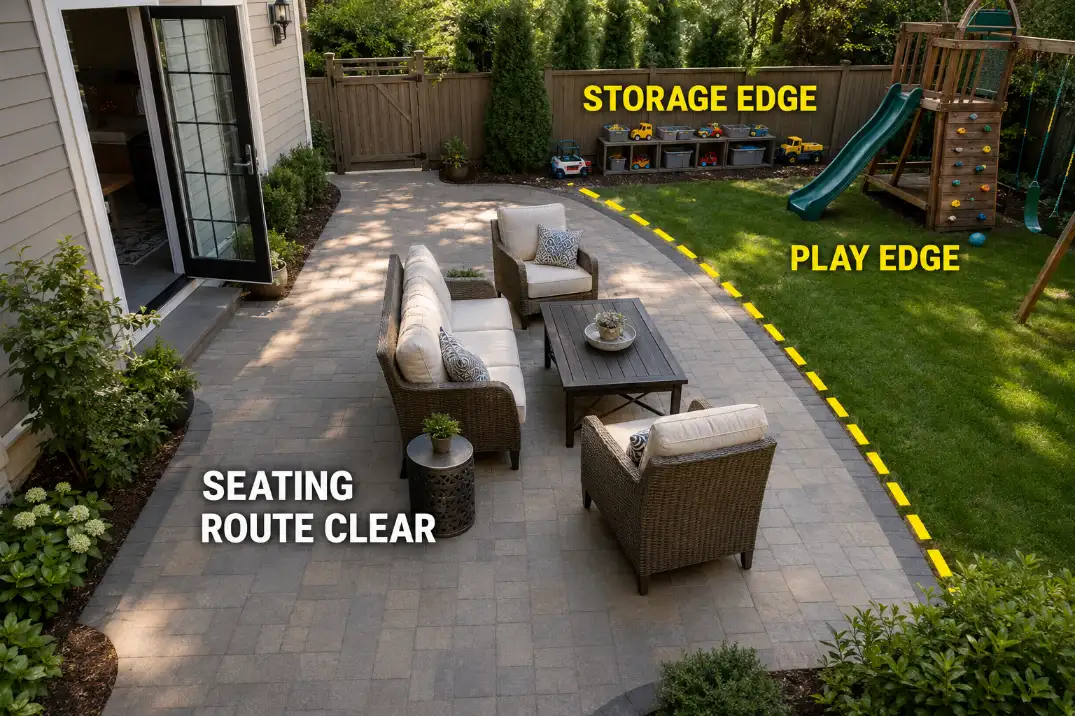
Test the proposed location while the yard is occupied. Position the chairs for use, open nearby doors or gates, and return the largest frequently used toy. If the person handling it must wait, turn sideways, or pass between seated people, the storage is still inside an active zone.
Why Lids, Bins, and Benches Fail When Too Far Away
A container fails when its access steps require more effort than leaving the toy outside. Carrying a ball across the yard may be reasonable when it can be dropped immediately into an open return point. The same distance becomes excessive when someone must set the ball down, move a cushion, raise a lid, rearrange other objects, and close everything again.
A lid that does not stay open creates two-handed work. Deep mixed bins introduce another delay because small objects disappear beneath larger ones, while returning one bulky toy may require reorganizing the contents.
Storage benches create a specific conflict between their two functions. When people are sitting on the bench or cushions cover its lid, the storage becomes unavailable while the yard is active. These outdoor storage bench problems matter more for daily toys than for items retrieved occasionally.
A shed can fail for the same reason without being poorly positioned overall. It may suit seasonal toys, backups, or equipment used with adult help while remaining too distant for balls and ride-ons used every afternoon. Storage near the house is not automatically near the play-to-reset route.
Test access during an ordinary cleanup, not when the yard is empty and every lid is unobstructed. Approach from the play zone and return the toy without setting it down in a path. Any extra holding point is a likely future pile.
How to Keep the Reset Simple for Kids and Adults
The reset should mirror the storage layout. Broad categories such as “park,” “loose play,” and “small pieces” are easier to repeat than a separate destination for every object.
Keep frequent-use storage reachable for the people expected to use it, provided the arrangement suits the children’s ages. Use labels only where the category is not visually obvious. Ride-on toys do not need labels when their parking positions are clear.
Leave open capacity in every return zone. A system that works only when objects are stacked perfectly will eventually overflow onto the nearest active surface.
Use this four-move reset:
- Park ride-ons, wagons, and other large toys in their edge positions.
- Return balls and medium loose toys to the open quick-return zone.
- Gather small pieces into their shallow capture container.
- Walk the main door-to-yard route and clear anything left beside chairs or transitions.
Finish by walking the route rather than opening every container. If the path is clear and the seating edge remains usable, the reset has done its job. A durable layout makes the correct return point the easiest place to leave the toy.
For child-specific guidance about open storage and lid design, review the American Academy of Pediatrics’ toy box safety guidance.