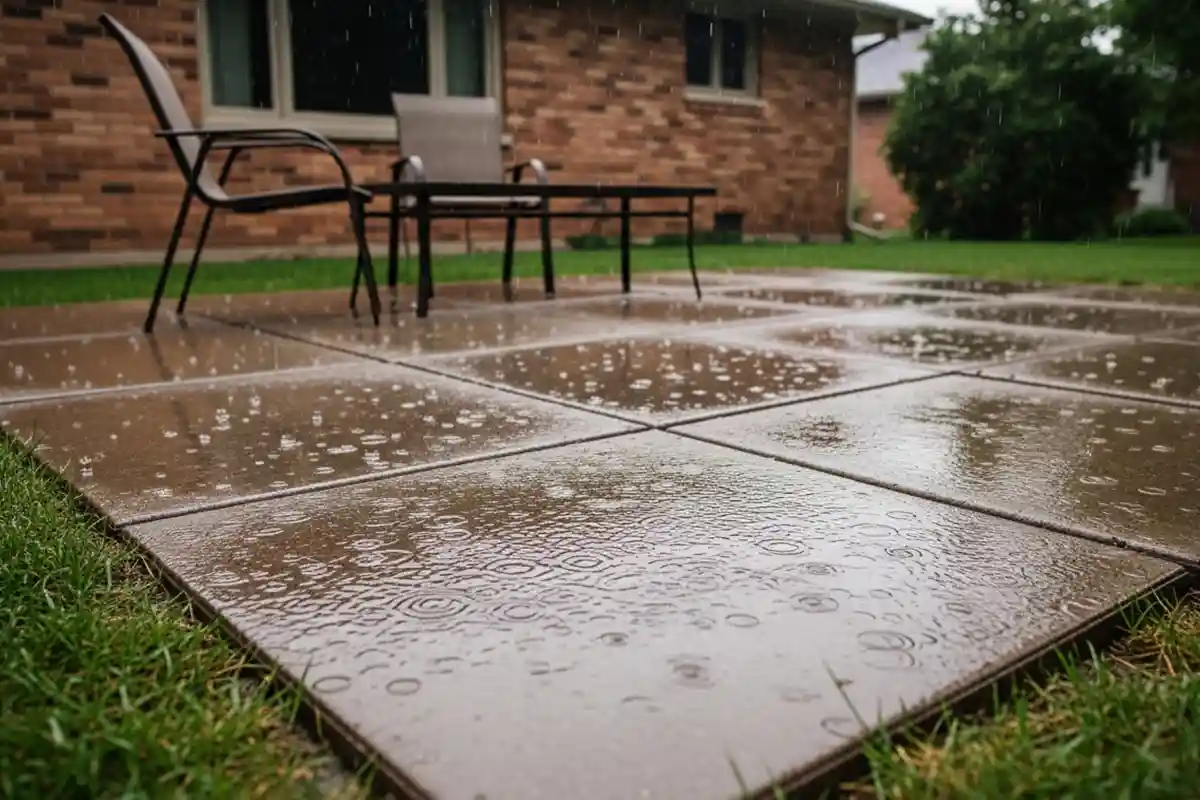
You step outside after a steady rain and notice something feels off. The surface looks dry in some spots, but near the house the concrete is darker and still damp. Nothing dramatic has happened, yet the patio does not feel like it shed water the way it should.
Most patio drainage problems begin exactly like this. There is no flood, no crack you can fit a coin into. Just small signs that repeat after every storm.
Water always looks for the lowest point. If a patio is even slightly out of balance, that pattern shows up again and again. Over time, those small repeats turn into visible wear.
Subtle Slope Errors That Direct Water Toward the House
You hose off the patio or watch rain roll across it, and instead of moving away from the house, the water creeps back toward the wall. It may only travel a few feet, but that direction matters. This is usually where patio drainage problems quietly begin.
A patio should slope gently away from the foundation. When that angle is off by even a small margin, you start seeing:
-
Water lingering along the edge closest to the house
-
Dark moisture lines near the base of siding or brick
-
Dampness near the door threshold after moderate rain
These signs feel minor at first. The surface still looks intact. Furniture still sits flat. But repeated water contact near the foundation increases pressure along basement walls or slab edges.
Over time, you might notice:
-
Fine white powder on brick (efflorescence)
-
Hairline cracks near door frames
-
Interior flooring that feels slightly cool or damp after storms
The patio itself may not look damaged, which makes the issue easy to ignore. But the direction water travels is more important than how much falls. Even light rainfall can cause long-term trouble if it consistently moves the wrong way.
Compacted Soil Beneath the Patio That Prevents Proper Absorption
You walk across the patio and hear a faint hollow sound under one section. Nothing shifts, but something feels slightly different. The problem is often below the surface, not on it.
Beneath most patios sits a compacted base layer. It keeps the surface stable, but when soil underneath is too dense—especially in clay-heavy areas—water cannot move down naturally.
Instead, moisture:
-
Sits within the base layer
-
Moves sideways rather than downward
-
Stays trapped longer than expected
In colder regions, this trapped moisture freezes and expands. That cycle can lead to:
-
Slight lifting in certain spots
-
Tiny separations between pavers
-
Edges that no longer feel perfectly aligned
The patio might look fine from a distance. But if certain areas stay damp longer after rain while others dry quickly, that uneven drying is a clue. Water is not dispersing evenly underneath.
This kind of issue develops quietly. It does not begin with visible sinking. It begins with moisture staying where it should not.
Clogged or Undersized Drain Channels
After a storm, you notice water sitting near a trench drain instead of flowing into it. The grate looks fine on top, but something is not working underneath.
Drain systems often appear adequate during light rainfall. The problem shows up during heavier storms or when debris builds up.
Common signs include:
-
Leaves stuck along the grate
-
Sediment visible inside the channel
-
Water spilling over the edge instead of entering the drain
When drains are undersized, they cannot handle combined runoff from:
-
Roof downspouts
-
Adjacent hard surfaces
-
Heavy seasonal rainfall
Water then searches for another path. It may flow across the entire patio before finding a low corner. Over time, this repeated sheet flow can wash out joint sand or soften edge restraints.
The surface may not look broken. But if you consistently see water bypassing a drain, the capacity likely does not match the load.
Low Thresholds at Doors and Transitions
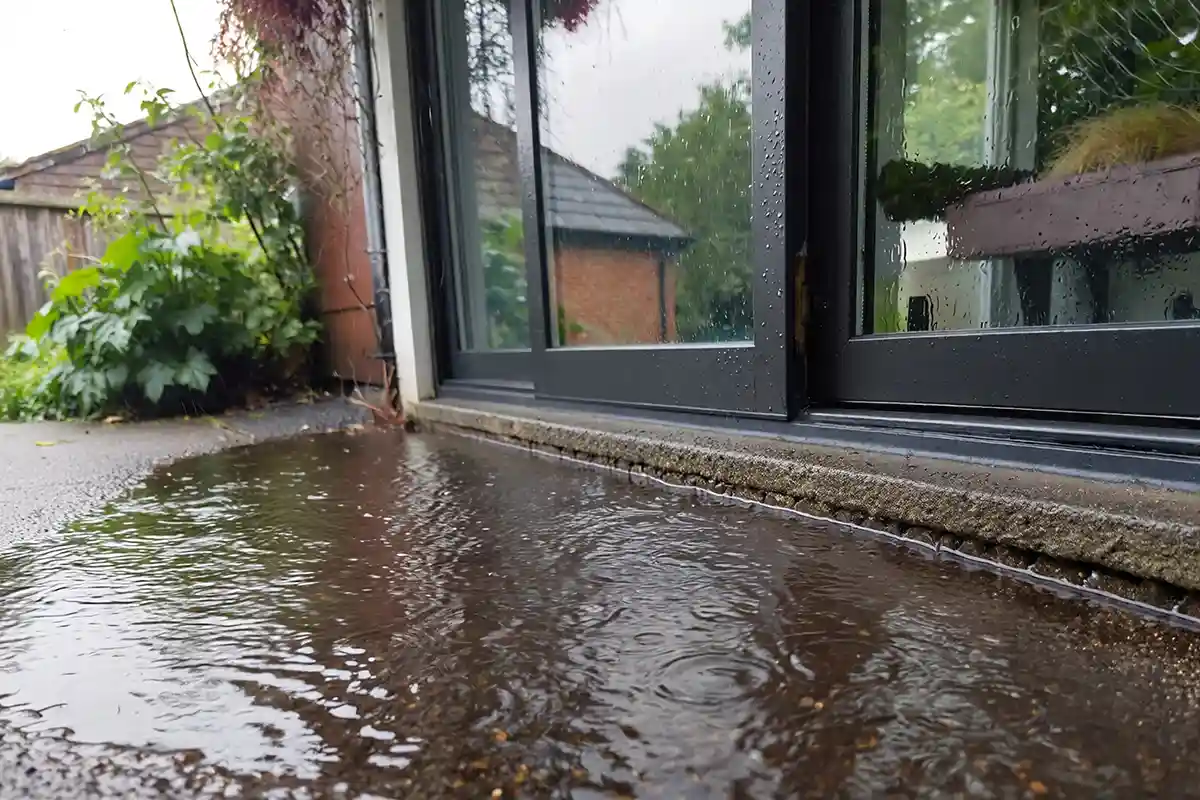
You open the sliding door after a storm and feel moisture along the track. The patio may look level, but the gap between the surface and the door sill is smaller than it should be.
When the patio sits too close to the threshold, several things happen:
-
Splash-back hits the lower door frame
-
Water presses against weatherstripping
-
Melted snow pools near the seam
Even without visible flooding, moisture can slowly work its way inward. Capillary action alone can draw water through tight gaps.
In colder climates, freeze-thaw cycles make this worse. Snow melts during the day, refreezes at night, and repeats the pattern along the same seam.
Interior signs often appear before exterior damage does:
-
Staining along flooring edges
-
Slight warping near the doorway
-
Musty smells after heavy rain
Because water entry is gradual, it is often blamed on condensation. In reality, the patio elevation may be the hidden trigger.
Hardscape Expansion Without Recalculating Water Flow
You extend the patio to fit a new dining set. The space looks better, but after the next rain, water gathers in a place that never used to stay wet.
Adding more hard surface changes how water moves. Areas that once absorbed runoff may now be covered with concrete or pavers.
This shift can cause:
-
Increased pooling along new edges
-
Runoff concentrating near retaining borders
-
Soil erosion where hardscape meets lawn
The patio may have been balanced before expansion. Once extra square footage is added, the old drainage path no longer works the same way.
Water does not adjust because the layout looks better. It follows gravity, even if the design has changed. Small shifts in slope or surface area can create patterns that repeat with every storm, slowly reshaping how the patio performs year after year.
Downspouts That Discharge Directly Onto the Patio Surface
You hear the rain hit the gutter, then a steady splash on the patio below. One corner darkens faster than the rest, and water spreads outward in a fan shape. The patio is not the source of the water, but it absorbs the force every time it storms.
When a downspout empties straight onto concrete or pavers, the impact repeats in the exact same location. Over time, that repeated discharge leads to:
-
Joint sand washing out near the splash zone
-
Circular stains where water lands first
-
Shallow depressions forming under constant flow
During heavier rainfall, roof runoff combines with surface rain. That added volume often exceeds what the patio slope was designed to handle. Water then travels across the entire surface before finding a low edge.
If you consistently see one darker strip stretching across the patio after storms, the downspout is shaping that pattern. The surface may look solid, but concentrated roof discharge slowly changes how water behaves across it.
Inadequate Perimeter Drainage Along Retaining Edges
You step near the patio border and notice the soil behind the edge stones feels soft days after rainfall. The surface of the patio seems fine, but the area along the perimeter tells a different story.
When a patio sits slightly below surrounding grade, retaining edges must allow water to escape. If they do not, moisture builds up behind them. Early signs often include:
-
Soil that stays damp longer than the rest of the yard
-
Small gaps forming between edge blocks
-
Slight outward shifting along the border
Water trapped behind a retaining edge increases pressure over time. That pressure can push materials outward or create minor cracking along the patio’s edge.
This becomes more noticeable in sloped yards where runoff naturally moves downhill. If that water stops at the border instead of passing through, the patio becomes part of a larger drainage bottleneck.
Why does my patio feel slippery even when it looks dry?
You walk outside on a bright afternoon. The surface looks clean and dry, yet your shoe slides slightly. That small, unexpected slip often raises questions before you see any visible water.
A patio can feel slick even when puddles are not present. A thin moisture film may remain on the surface, especially in shaded areas where evaporation slows.
What makes a patio slick if there is no standing water? A light moisture layer can sit on the surface and reduce traction without being visible.
Does morning dew make concrete slippery? Yes. Dew creates a thin coating that affects grip until sunlight fully dries it.
Can algae grow even if I never see puddles? Yes. Algae forms in spots that stay damp longer, particularly in shade.
Why do certain shoes make it feel worse? Smooth soles provide less traction on slightly damp stone or concrete.
Does temperature change how the surface feels? Yes. Cool surfaces dry more slowly, so they may stay slick longer than expected.
Can bright sunlight hide thin moisture? It can. Glare sometimes masks small damp areas that still affect footing.
When the patio feels slippery but looks dry, the issue often relates to uneven drying rather than visible pooling. Water may be draining slowly in certain sections without forming obvious puddles.
Comfortable patio design depends on surfaces that remain stable and dry enough for everyday use.
When a Patio Feels Slippery but Looks Dry
| Trigger Moment | Surface Reaction | What It Tells You About Drainage | Risk Pattern Over Time |
|---|---|---|---|
| Early morning step outside | Slight slide before full sunlight | Moisture is evaporating unevenly | Repeated damp zones may develop algae |
| Walking from shade into sun | Texture suddenly feels smoother | Shaded areas are retaining thin moisture | Uneven drying creates traction differences |
| After light rainfall, no puddles visible | Surface feels cool to the touch | Water is lingering in micro depressions | Freeze-thaw stress in colder seasons |
| After cleaning the patio | Grip feels reduced when damp | Residue interacts with moisture film | Slip risk increases in humid weather |
Surface Materials That Trap Water Instead of Shedding It
After a storm, you notice scattered dark spots across the patio. They are not deep puddles, just shallow areas that stay wet longer than the rest. Those darker circles often show where the surface holds water.
Certain materials and installation patterns create small depressions. This usually happens when:
-
Pavers are not set perfectly level
-
Bedding layers settle unevenly
-
Textured finishes trap moisture in ridges
These minor low points extend how long moisture remains on the surface. In colder climates, trapped water expands during freeze cycles. In humid areas, damp patches encourage algae growth.
You might observe:
-
One section consistently darker than others
-
Slight color variation between slabs
-
Moss forming in shaded joints
The material itself may be durable. The issue is how evenly it sheds water.
Common Patio Surfaces and Their Water Behavior
| Surface Type | Why Water Lingers | What You Typically Notice After Rain | Long-Term Impact Pattern |
|---|---|---|---|
| Textured Concrete | Micro grooves hold thin moisture layers | Dark patches that dry unevenly | Surface staining and slip risk |
| Uneven Pavers | Slight settling creates shallow depressions | Small puddles in repeated locations | Joint erosion and shifting |
| Natural Stone Slabs | Irregular surface planes trap runoff | One slab darker than surrounding | Freeze-thaw edge cracking |
| Porous Concrete | Absorbs water before releasing it slowly | Surface feels cool long after rain | Internal moisture cycling |
| Poorly Compacted Base | Water cannot drain evenly underneath | Hollow sound or soft-feeling spots | Localized sinking or lifting |
Poor Integration Between Lawn Irrigation and Hardscape+
You turn on the sprinkler for the lawn and later find the patio edge damp, even though it has not rained. That repeated wetting often goes unnoticed because it feels routine.
Irrigation overspray introduces moisture on a schedule. Over time, that pattern can lead to:
-
Damp perimeter soil softening the base
-
Joint sand erosion near the lawn line
-
Increased weed growth between pavers
Unlike rainfall, irrigation happens several times a week. If water lands in the same area repeatedly, the patio edge rarely dries completely.
At first, you may only notice that one strip feels cooler or slightly darker. But steady overspray shifts moisture patterns gradually, contributing to drainage imbalance that builds over seasons.
Freeze-Thaw Cycles That Expose Hidden Drainage Weaknesses
The first cold snap arrives after a week of rain. The patio looked fine in October, but by late winter one corner feels slightly raised underfoot. That subtle shift often traces back to water that never fully drained before temperatures dropped.
When moisture sits beneath concrete or between pavers, freezing temperatures expand it. That expansion pushes upward and outward, stressing joints and edges. Over several seasons, this cycle can lead to:
-
Slight vertical lifting in isolated sections
-
Widened hairline cracks
-
Edges that no longer align perfectly
The damage rarely appears evenly across the surface. Areas that stay damp longer are usually the first to move. Once one section begins to shift, new low spots form, and those spots collect more water during the next rain.
In colder climates, winter does not create drainage problems. It reveals the ones that were already there. A patio that dries evenly after storms tends to stay stable. One that holds hidden moisture slowly changes shape under seasonal pressure.
Hairline Cracks and Efflorescence as Early Warning Signs
You notice faint white residue near a joint or a thin crack stretching across the slab. It is easy to dismiss as cosmetic. Yet these small surface details often show where moisture has been traveling for some time.
Efflorescence appears when water moves through concrete, carrying dissolved salts to the surface. It confirms that moisture is passing through the slab rather than simply across it. Even if the patio looks dry after rain, internal pathways may still be active.
Hairline cracks can follow uneven moisture patterns. When one section remains damp longer than another, expansion and contraction happen at different rates. Over time, this uneven stress may lead to:
-
Fine branching cracks
-
Slight widening of existing lines
-
Edges that feel sharper under bare feet
These early signs often show up before visible pooling. The patio may still feel solid overall, yet the surface is signaling that water is not moving predictably.
Soil Erosion Along Patio Edges
After a heavy storm, you see mulch washed away from one side of the patio. A small gap forms between the concrete and the lawn. That exposed strip is often where water leaves the surface with more force than expected.
When runoff exits in a concentrated path, it carries soil with it. Repeated over many storms, this leads to:
-
Visible channels in nearby planting beds
-
Thinning mulch layers
-
Exposed base material along the patio edge
As soil recedes, lateral support weakens. Pavers may settle slightly at the edge, or concrete corners may begin to chip. The erosion is not just cosmetic. It reflects how water is being funneled rather than dispersed.
Correcting this often involves redistributing how runoff leaves the patio. When water exits evenly instead of through a single outlet point, surrounding soil remains more stable over time.
Decorative Additions That Block Natural Water Flow
A new outdoor rug, a heavy planter, or a built-in seating base changes how the patio feels. After the next rain, water gathers just upstream of that addition. The design looks better, yet moisture now pauses where it once moved freely.
Objects placed without considering slope can interrupt drainage paths. Even small changes can cause:
-
Shallow pooling behind planters
-
Damp zones under outdoor rugs
-
Darkened patches near built-in features
Built-in benches or low walls can trap moisture behind them if no relief points exist. The patio surface might dry, while water remains hidden along edges or seams.
When decorative upgrades align with the original grading logic, water continues to move predictably. When they conflict with it, new damp areas emerge in places that previously dried without issue.
Small Regrading Adjustments That Change Water Behavior
You might not notice the adjustment immediately. A slightly altered edge, a subtle reshaping of soil along the border, or a modest correction to slope can shift how water travels across the surface.
In practice, improvements often look like:
-
Water no longer lingering near the house
-
Even drying patterns after rainfall
-
Reduced erosion along the perimeter
These changes are not dramatic renovations. They are targeted corrections that realign the patio with gravity instead of fighting it.
Sometimes the shift happens beneath the surface. Adjusting base material in a low section or redistributing bedding under pavers can remove a recurring puddle. The space begins to behave differently after storms, even though the overall layout appears the same.
Near the end of a rainy week, small observations begin to add up:
-
The patio dries at roughly the same pace across the surface.
-
No single corner consistently looks darker than the rest.
-
The door threshold feels dry even after heavy rain.
-
Mulch remains in place along the patio edges.
-
Footing feels stable regardless of the shoes being worn.
-
Winter frost does not leave one section raised higher than another.
- When these moments feel familiar, it usually means drainage is working quietly in the background.
From there, attention shifts away from reacting to water problems and toward preserving balance. As seasons change, the patio no longer feels like a surface that must be watched after every storm. It becomes a stable part of the outdoor space, supporting daily use without drawing attention to itself.
For a deeper technical understanding of how water affects foundations and exterior surfaces over time, the U.S. Environmental Protection Agency provides clear guidance on moisture management and structural impact: https://www.epa.gov