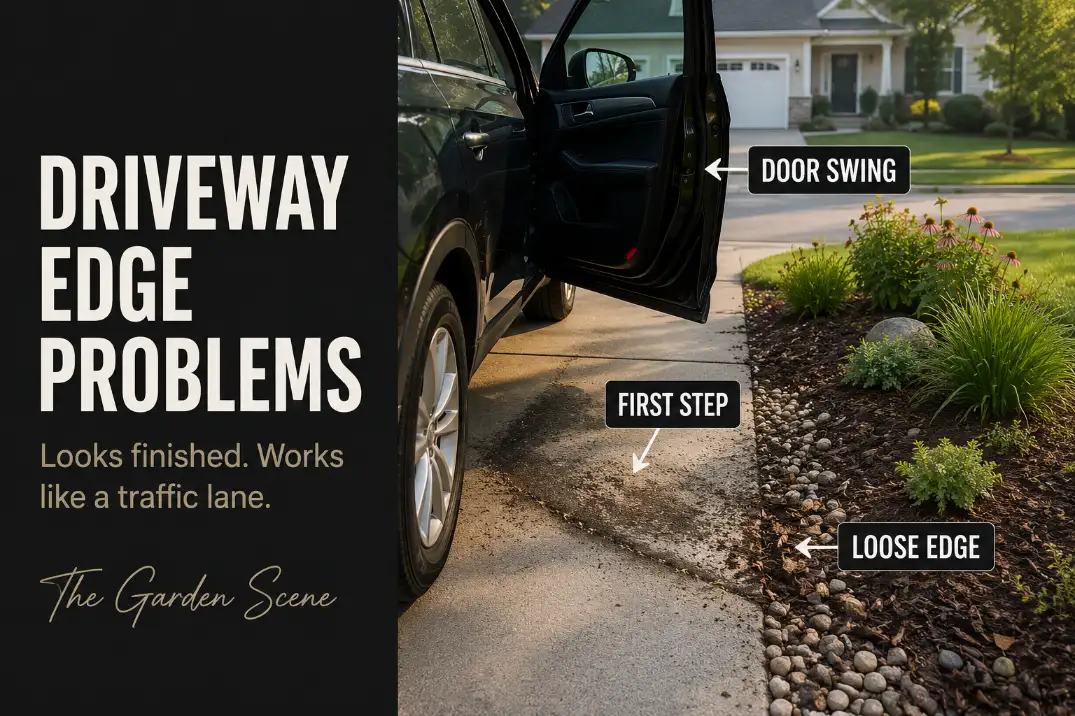
A driveway edge usually fails because it is treated like decoration when it actually works like a pressure zone.
The same narrow strip often has to absorb car door swing, the first step out of the vehicle, tire scuffs, loose mulch movement, and driveway runoff.
When that strip is only 8–12 inches wide and filled with soft mulch or fragile plants, it starts breaking down fast.
The first useful check is not the edging style. Park the car, open the doors, watch where feet land, and look after the next rain.
If material reaches the concrete within 24 hours of a storm, if the worn strip is wider than 6 inches, or if the same plants get hit more than once in a growing season, the edge is not just messy.
It has the wrong job. The fix starts by separating use, water, containment, and planting instead of asking one decorative border to handle all four.
The Edge Takes the Abuse
It is a border only on paper
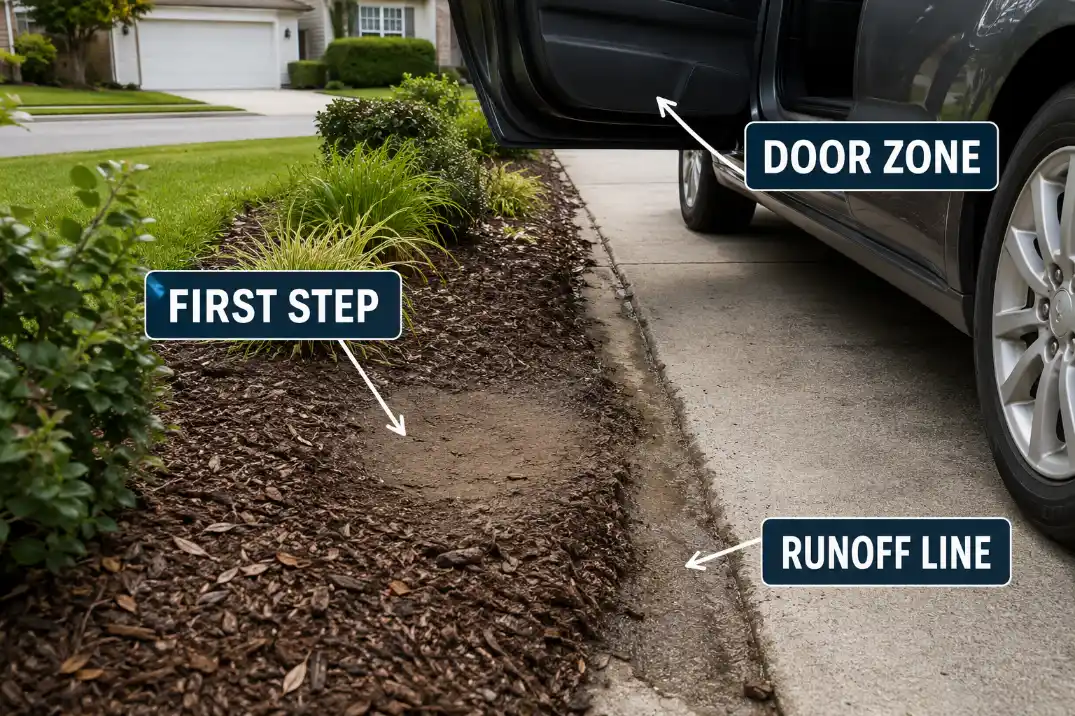
A clean driveway edge may look like a simple line between concrete and landscaping. In daily use, it is where passengers step out, delivery drivers cut across, trash bins roll past, tires drift slightly, and blowers push debris.
That is why the most common driveway edge problems are not caused by the wrong color of mulch or the wrong stone. They are caused by pressure landing in a strip that was designed only to look finished.
The most likely failure pattern is usually this: a soft planted or mulched bed begins too close to the driveway, the first 12–18 inches get used anyway, and the edge slowly becomes ragged.
A metal or plastic border may hide the problem for a while, but it cannot stop people from stepping where the layout gives them no better option.
Read the pressure before choosing the material
Before replacing anything, identify the main force acting on the edge:
- Door pressure: damage lines up with parked-car doors.
- Foot pressure: one corner or strip is flattened where people naturally step.
- Water pressure: mulch, silt, or gravel fans out after rain.
- Tire pressure: the edge is shaved, rutted, or pushed outward.
- Maintenance pressure: blowers or mowing repeatedly move loose material.
That read matters because the fixes are different. A door-pressure edge needs landing space. A water-pressure edge needs grading or drainage. A loose-material edge needs containment. A crushed-plant edge needs setback, not another plant.
Car Doors and Foot Traffic
Door swing needs real space
Many car doors need about 30–36 inches of usable swing and body room, especially when someone is carrying groceries, a child seat, a backpack, or work gear.
If the planting bed begins immediately at the driveway, the first step usually lands in mulch or plants. The yard may look polished from the street, but it fails during the ordinary act of getting out of the car.
This is why driveway edge design should be checked from the parked vehicle, not from a landscape photo.
The same access logic behind Driveway Landscaping With Car Door Clearance applies here: the edge beside the driveway is not leftover space. It is part of the arrival route.
The first step decides the edge
Foot traffic does not follow the neatest bed line. It follows the easiest route between the car, front door, mailbox, curb, garage, and sidewalk. If the shortest comfortable route clips the bed corner, that corner will keep failing.
A firm 18–24 inch landing strip beside the driveway often solves more than a new plant palette. That strip can be flush pavers, compacted gravel, a mow strip, or a durable low surface that accepts occasional stepping.
If the driveway also doubles as the main route to the front door, the problem overlaps with the planning issues in Front Yard Design for Driveway and Front Door Access.
Pro Tip: Open the car doors before planting. If the door swing or first step lands inside the bed, move the planting line back before spending money on tougher plants.
Rock and Mulch Spreading
Loose material fails when it sits too high
Mulch and rock do not stay clean just because they are attractive. They need a pocket. Mulch usually behaves best at about 2–3 inches deep, but it should not be mounded above the driveway edge.
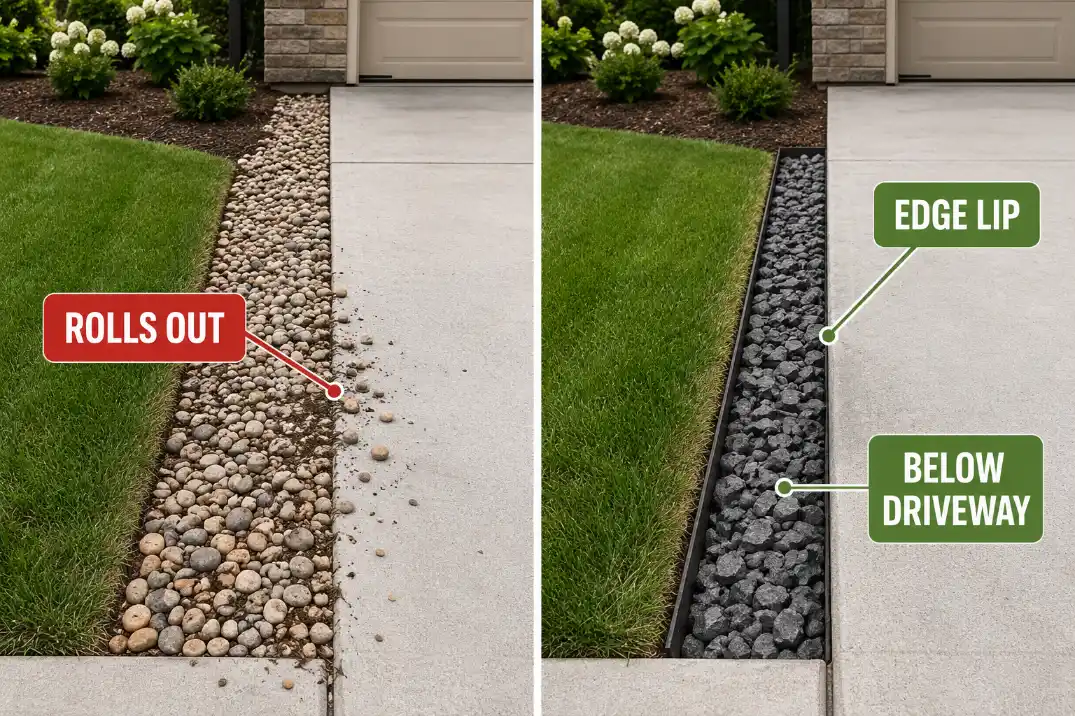
Decorative rock also needs containment, especially when it sits next to concrete that gets foot traffic, water flow, and blower force.
The quickest sign of a weak edge is material on the driveway after normal use. If mulch crosses the concrete after one rain, water is moving it.
If gravel appears weekly after mowing or blowing, the edge is too shallow, too loose, or too high. Rounded pea gravel is especially mobile. Angular gravel in the 3/8- to 3/4-inch range usually locks together better, but even that needs a firm edge lip.
More material often makes it worse
The obvious fix is to add more mulch or more rock. That often wastes time. Extra material raises the surface closer to the driveway, so shoes, tires, water, and blowers have more loose material to push out. The bed looks refreshed for a few days, then the driveway edge looks messy again.
A better fix is usually to lower the loose material, firm the base, and create a stop that resists sideways movement.
If rock is also spreading into the lawn, the same containment problem is at work in Front Yard Gravel or Rock Spreading Into Lawn. The driveway version simply gets more abuse because it also handles cars and foot traffic.
| Edge signal | What is really causing it | Better edge response | What not to do |
|---|---|---|---|
| Mulch reaches driveway after rain | Water is carrying loose material | Lower mulch and correct flow | Keep topping up mulch |
| Gravel appears on concrete weekly | Stone is too mobile or uncontained | Use angular stone with a real edge lip | Switch colors only |
| Plants break along driveway side | Planting is inside the contact zone | Move plants back 18–24 inches | Replant the same spot |
| Edge line leans after winter | Shallow edging or freeze-thaw movement | Reset with deeper anchoring | Add a taller loose border |
| Soil stays soft after 48 hours | Compaction or poor drainage | Fix water movement first | Plant into wet soil |
Plants That Get Crushed
The plant may not be the problem
Crushed plants along a driveway are often misread as a plant-choice issue. Sometimes the plant is too brittle or too wide, but the more likely problem is placement. A healthy plant can still fail if it sits where car doors, shoes, tires, or trash bins hit it every week.
The first 12–18 inches beside a busy driveway should usually be treated as a contact zone, not the main planting zone. Low groundcovers, hard strips, compact gravel, or open space can handle that role better than small shrubs or soft perennials.
Taller or more decorative plants usually work better set back 18–24 inches from the concrete, where they can grow without being brushed constantly.
Replanting stops making sense when the route stays the same
If the same spot gets flattened twice in one season, replanting is not a fix. The route is making the decision. This is especially common near mailboxes, front walks, school pickup driveways, and narrow suburban driveways where passengers exit on the planted side.
The same logic applies when people cut across a front yard corner. The issue is not always that the plant is weak; sometimes the path is too persuasive.
In that case, the solution may look more like a visible stepping point or redirected route, similar to the traffic problem in Front Yard Plants for Sidewalk Shortcut Traffic.
Drainage Along the Driveway
Water reveals the low edge
Drainage problems along the driveway often show up as messy mulch, loose stone, or weak plants, but those are symptoms. The mechanism is water moving across an impervious surface and dumping energy into the soft edge.
Check the strip 30 minutes after rain, then again the next morning. If the same fan of mulch, silt, or rock appears each time, the driveway is delivering runoff to that point.
Standing water for more than 24 hours is a stronger warning sign than a little surface mess. Soil that remains soft after 48 hours in normal weather usually means the edge is compacted, poorly graded, or receiving more water than the bed can absorb.
Foot traffic and occasional tire pressure can make that worse by reducing pore space in the soil, so water moves sideways instead of soaking in.
Climate changes the failure pattern
In Florida or the Southeast, heavy rain can expose a weak driveway edge in one storm. In northern states, freeze-thaw cycles can loosen shallow edging, while snowmelt and deicing salt can stress turf and plants along pavement.
In dry Arizona or other hot climates, the edge may fail less from washout and more from heat reflected off concrete, dry soil, and shallow roots near the driveway.
The priority still stays the same: fix water movement before beautifying the edge. A taller border can hold material briefly, but it can also trap water against the driveway.
If the edge damage starts after every storm, Driveway Runoff and Front Yard Drainage is the more important problem to solve before choosing a decorative finish.
A Cleaner, Safer Edge
Build the use strip first
A cleaner driveway edge is designed in the right order: use strip first, water second, containment third, planting last. That order prevents the classic mistake of installing a narrow beautiful bed exactly where the front yard needs a landing zone.
For many homes, the strongest fix is a firm 18–30 inch transition beside the driveway. This can be a flush paver strip, compacted gravel band, stone edge, concrete mow strip, or durable low planting that tolerates occasional stepping. The goal is not to make the edge look harder. The goal is to give daily use somewhere to land.
Match the fix to the pressure
Grass works only where the edge drains well and receives light contact. Mulch works in protected beds with enough depth and a clear border.
Rock works when it sits below the driveway surface and has strong containment. Pavers or a hard strip work best where people step out of cars every day.
If the border itself keeps moving, the issue may be installation depth, soil movement, or repeated impact rather than surface choice.
That is where the repair logic in Front Yard Edging Keeps Shifting becomes more useful than simply buying a different edging style.
The routine fix stops making sense when maintenance becomes constant. Blowing rock off the driveway every week, replacing crushed plants every season, or rebuilding the same washed-out mulch line after every heavy rain means the edge is not under-designed cosmetically. It is under-designed functionally.
Questions People Usually Ask
Should a driveway edge be grass, mulch, rock, or pavers?
Use grass only where the edge drains quickly and gets light contact. Use mulch for protected planting beds. Use rock where the material can sit below the driveway surface with a firm edge lip. Use pavers or another hard strip where passengers step out of cars daily.
Is metal edging enough to stop driveway edge problems?
Metal edging helps when the main problem is a weak bed line or loose mulch migration. It is not enough when door swing, foot traffic, tires, or runoff are the main force. Those problems need landing space, drainage correction, or a wider transition zone.
When should drainage be fixed before landscaping?
Fix drainage first when water stands longer than 24 hours, carries mulch or gravel after normal rain, cuts the same channel more than once, or leaves soil soft after 48 hours. Planting into that edge usually delays the failure instead of solving it.
For broader runoff planning near hard surfaces, see Penn State Extension’s introduction to rain gardens.