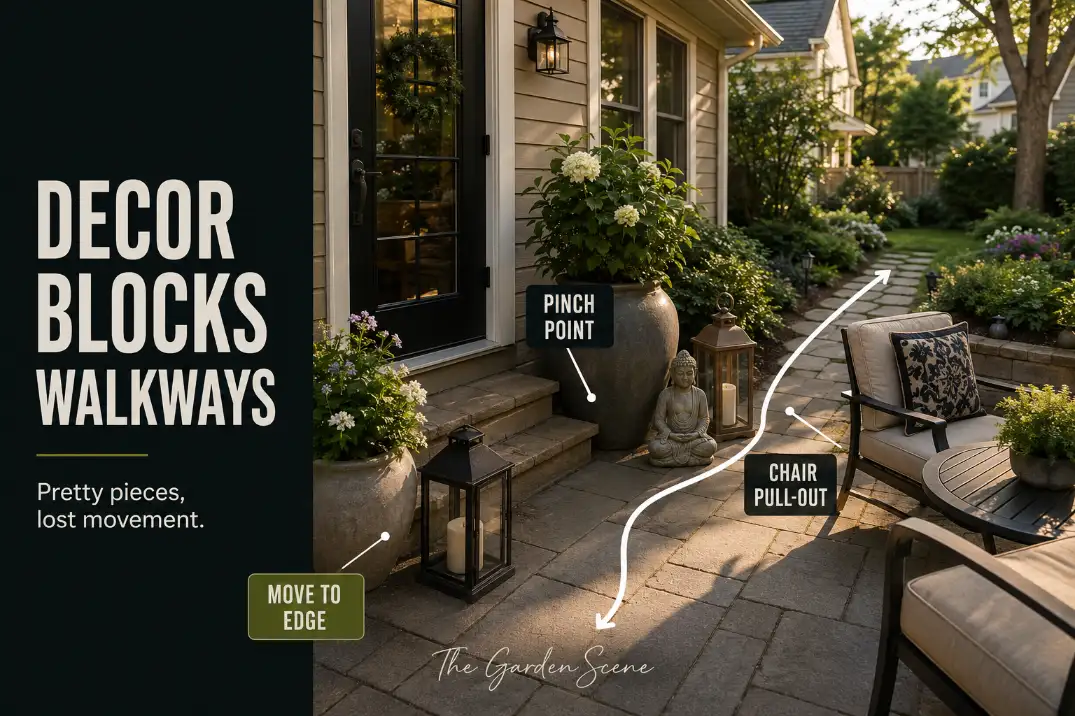
Garden decor becomes a walkway problem when it reduces usable movement space.
The warning signs are usually clear: the route drops below about 30–36 inches, a chair cannot pull out cleanly, a turning zone feels tight, or low decor sits near doors, steps, and daily foot traffic.
The issue is not whether the pot, lantern, or statue looks attractive. The issue is whether it steals the space people need to move without thinking.
A patio can look finished in a photo and still fail in daily use if the remaining opening drops to 24–28 inches, or if people have to look down every time they pass.
This is different from ordinary visual clutter. Clutter makes a space feel busy. Circulation conflict makes the space harder to use.
The best fix is usually not buying smaller decor. It is protecting the no-decor route first, then styling the edges.
Decor vs Circulation Paths
Protect the route before styling the edge
Garden decor should be placed after the walking route is protected, not before. A walkway is not only the hard surface underfoot.
It also includes the space people need to pass, turn, carry things, pull chairs back, and recover balance if they misstep.
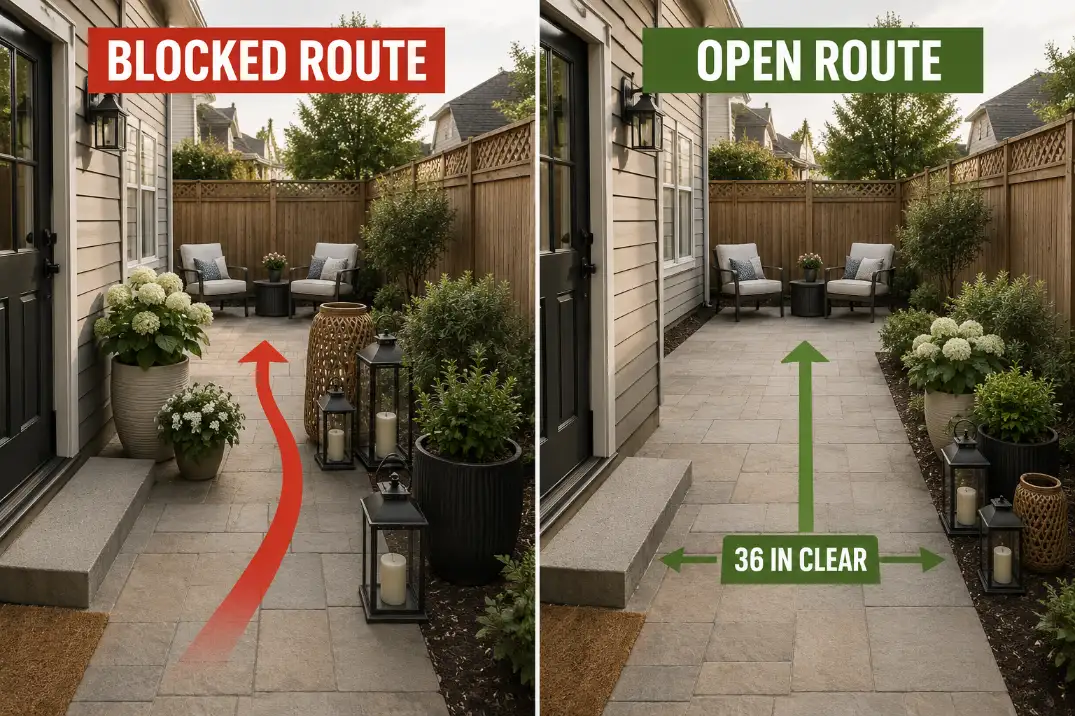
A 36-inch-wide path can stop functioning like a 36-inch path when a planter leans into it, a lantern sits near the foot line, or a decorative pot squeezes the gap between a chair and a planting bed.
Once the usable opening drops below about 30 inches on a primary route, the space starts feeling managed instead of effortless.
That is why Keep Patio Entry Clear matters before any styling choice.
The first few feet outside a door handle more daily movement than most decorative corners do: food, cushions, trash bags, hoses, pet leashes, and deliveries all pass through that zone.
The photo test is not enough
The most common misread is judging decor while standing still. A planter can look balanced from the lawn, a pair of pots can frame a walkway beautifully, and a small lantern can feel charming beside a chair. But a layout can pass the photo test and fail the carrying test.
A better test is movement. Walk the route with both hands full. Pull out the chair. Open the gate. Step through at night.
If you turn your shoulders, brush foliage, kick a saucer, or slow down to avoid a low object, the decor is no longer just decoration. It has become friction.
Use this quick clearance check before keeping decor near a path:
- Keep about 36 inches of clear walking width on primary routes.
- Treat anything below 30 inches as a pinch point, not a design detail.
- Leave 24–36 inches behind chairs that need to pull out.
- Keep the first 3–5 feet outside a back door as clean as possible.
- Test the route for 48 hours before adding more pieces.
- Recheck the same route after dark, when low decor is harder to read.
A short pinch may be acceptable on a low-use garden path. It is a bigger problem on the route between the house, seating area, grill, gate, or trash zone because those routes are used repeatedly.
Common Walkway Pinch Points
Doors, turns, and chair backs fail first
The most important pinch points are rarely the widest open areas. They are the places where movement changes: back doors, patio entries, gate latches, stair turns, chair backs, grill corners, and narrow side-yard bends.
A pot placed 18 inches from a back door may look welcoming, but that same spot may also need room for the door swing, a person stepping out, a dog moving through, and someone carrying a tray. If the route feels tight before anyone reaches the seating area, the patio starts with a use problem.
This is the same failure pattern behind Garden Decor Looks Good Online but Feels Wrong: the scene is arranged for one attractive view, but the real movement line is not protected.
Turning zones need more space than straight paths
Straight walking is easy to underestimate. Turning is easier to ruin. A person carrying a watering can, serving tray, grocery bag, or folded chair uses a wider arc than someone walking straight with empty hands.
That is why corners and gates are poor places for loose decor. A 3-foot side path may sound workable, but a 14-inch pot with foliage spread can leave only 20–24 inches of practical space near a turn. On paper the walkway still exists. In daily use, the turning zone has been stolen.
Step edges are even less forgiving because a small object can change both foot placement and visibility. A low lantern beside a level patio may be only annoying. The same lantern near a step, landing, or door threshold becomes a decision point people have to notice every time.
Replacing one pot with a smaller pot often wastes time here. If the object still sits inside the turning arc, the problem remains. The better fix is to move the decorative moment outside the turn completely.
Pro Tip: Test any narrow corner while carrying something with both hands. If you have to twist your shoulders, pause, or look down to clear the object, the decor belongs somewhere else.
Decorative Pots That Reduce Usable Space
Judge the real footprint, not the pot base
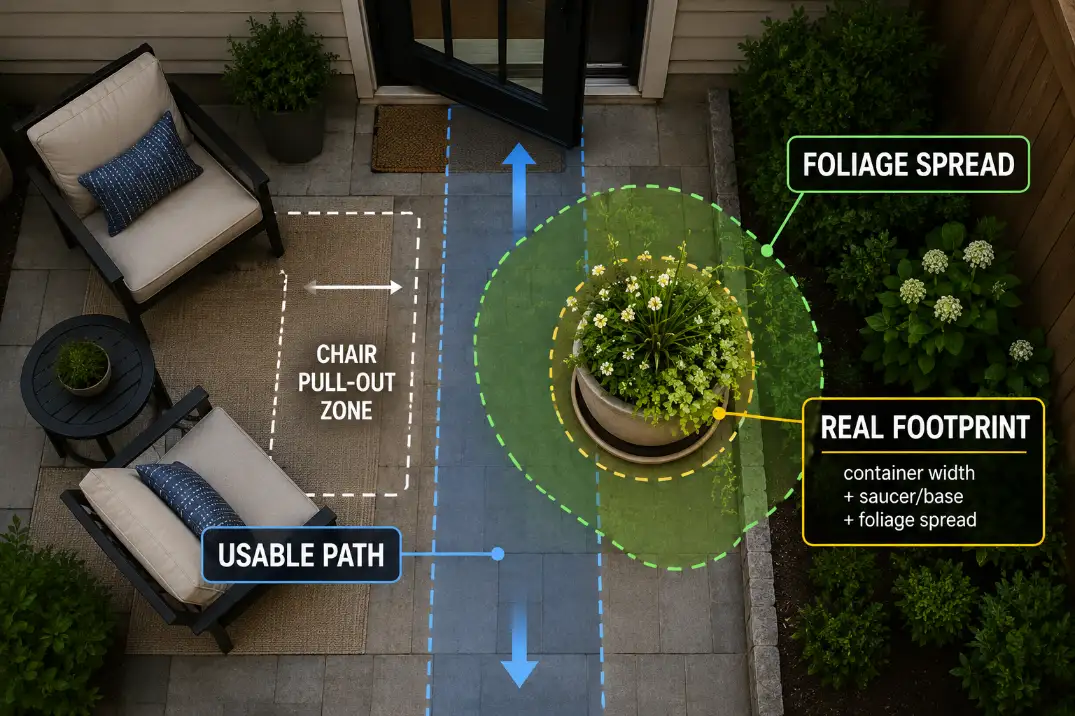
A decorative pot should be judged by its full spread, not by the diameter of its base. This is where many outdoor layouts quietly lose usable space.
A 16-inch pot can easily need 22–28 inches once the rim, saucer, soil mound, plant spread, and leaning stems are included.
In warm or humid summer conditions, fast-growing plants can push farther into a route within 3–4 weeks. The pot did not move, but the usable path got smaller.
Pairs create an even sharper problem. Two matching pots on either side of a walkway can look intentional, but they also create a gate.
If the clear opening between them drops below about 30 inches, the pair begins acting less like decor and more like a barrier.
A stronger setup usually places one larger pot or grouped feature along one edge instead of using two objects to squeeze the path from both sides.
Low decor creates a different kind of blockage
Tall objects are usually obvious. Low objects are easier to miss. Small lanterns, solar stakes, decorative bowls, frog statues, edging stones, and short pots can disappear against mulch, gravel, shadow, or patterned pavers.
This matters most near step edges, door landings, and evening routes. A low lantern that looks obvious at noon may be hard to see at 8:30 p.m. when patio lighting creates uneven shadows.
If people naturally look toward the door, guests, grill, or seating area, they are not looking down for a small object beside their foot line.
This is one condition homeowners often overestimate: visibility. If an object is only safe because everyone has to remember it is there, it does not belong in the walking zone.
Safe Clearance Around Seating and Paths
Plan for chair movement, not just furniture size
Seating clearance should be planned as movement space, not just furniture space. A chair that fits when pushed in may fail once someone sits down, angles their legs, or gets up while another person walks behind them.
A dining chair usually needs about 24 inches just to pull out. If the route behind it is also used for walking, 36 inches is a better target.
Decor placed behind chairs is risky because it often looks harmless when the set is empty and becomes a blocker only when people actually use the patio.
That makes Outdoor Dining Chair Clearance more important than visual symmetry. Chair movement determines where decorative edges can begin.
| Outdoor zone | Better clearance target | Problem signal | Best decor move |
|---|---|---|---|
| Main walkway | About 36 inches clear | People turn sideways | Move decor to one edge |
| Short low-use garden path | 30–36 inches clear | Feet brush plants | Use low planting, not loose pots |
| Behind dining chairs | 36 inches if walked behind | Chairs hit containers | Keep decor outside pull-out space |
| Door landing | Clear first 3–5 feet | The exit feels crowded | Style beyond the landing |
| Seating corner | Open knee and side space | Guests avoid one chair | Use one larger edge feature |
Vertical decor is not always the answer
The standard advice is to “go vertical” or “choose compact pieces.” That can help when the route is already functional.
It does not help when the base of the object still sits inside the walking line, chair pull-out zone, or turning arc.
At that point, routine styling stops making sense. Do not keep trying to decorate a path that should stay empty. Move the design moment to a fence line, wall, planting edge, patio corner, or visual endpoint where people do not naturally walk.
For households with older adults, kids, deliveries, or frequent guests, clearance deserves even more weight. A route that feels acceptable to one careful homeowner may feel unstable to someone carrying bags or walking at dusk.
The same logic behind Safe Garden Paths for Seniors That Feel Stable applies here: predictable open space matters more than decorative detail.
A Better Way to Place Garden Features
Start with a no-decor route
The better layout starts with a no-decor route, then builds one controlled feature zone outside that route. Walk from the house to the seating area, grill, gate, hose, trash area, and garden bed.
Notice which lines are used more than once a day. Those routes should stay open before any styling decision happens.
Then look for edge zones: fence corners, planting-bed backs, wall edges, unused patio corners, and spots beside fixed features where people do not naturally walk. These are stronger places for garden decor because they add atmosphere without stealing movement.
This approach also prevents the “small pieces everywhere” problem. Many small objects do not make a yard feel designed. They make the eye stop too often.
If the patio already feels visually busy, Garden Decor in Small Yards Looks Cluttered is usually the better next problem to solve.
Build one feature instead of many interruptions
A better garden feature has a clear home. Instead of placing pots beside every path, lanterns near every chair, and ornaments in every empty gap, choose one edge-based feature. That might be a large planter group near a fence, a small vertical trellis at the end of a view, or a contained decor cluster beside a planting bed.
The goal is not to remove personality. It is to keep personality from landing in the walking route.
A good feature zone usually passes three tests: it is visible from the seating area, it does not reduce the main path below about 36 inches, and it does not interfere with chair pull-out, door swing, or maintenance access. If it fails one of those tests, the placement is probably wrong even if the object itself is attractive.
Use the 48-hour friction test
Before making the setup permanent, outline the object footprint with painter’s tape, small stones, or temporary markers. Include the real footprint, not just the pot base. Then live with it for 48 hours.
If people step over it, kick it, move around it awkwardly, or avoid one chair because of it, the decor is in the wrong zone. If nobody notices it as an obstacle, the placement is probably safe enough to refine.
Garden decor works best when it finishes the outdoor layout instead of fighting it. A lantern beside a seating edge can feel warm.
The same lantern in a walking route feels annoying. A large planter can anchor a patio corner. The same planter beside a narrow gate becomes a daily obstacle.
The final question is not “Does this look good here?” It is “What use does this spot need to protect?” If the spot protects circulation, chair movement, access, visibility, or safety, leave it open. If the spot is visible but unused, that is where decor can do its job.
The strongest outdoor spaces often feel calmer after this edit. They do not lose character. They lose friction. Once the paths are open, every remaining decorative piece looks more intentional because it is no longer competing with movement.
For broader official guidance on clear accessible routes, see the U.S. Access Board’s guide to accessible routes.