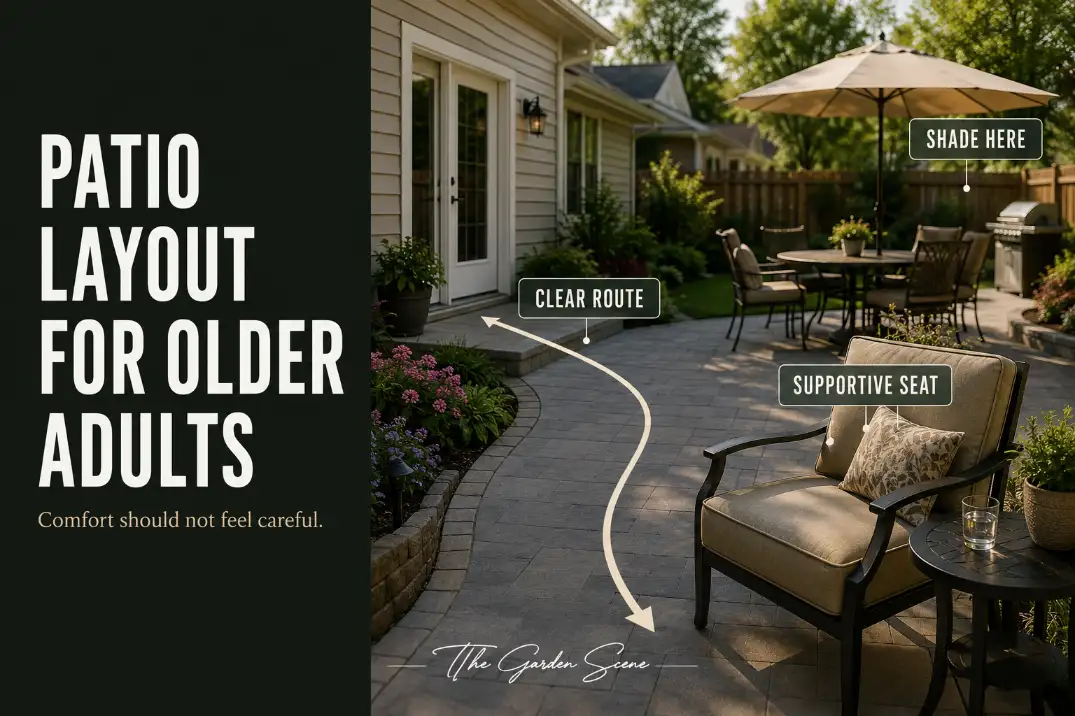
The best patio layout for older adults starts with one clear 36–42 inch route, one supportive shaded chair, a reachable side table, and a stable surface before extra seating is added.
Most patios do not fail because they are too small. They fail because the route narrows once chairs are pulled back, the best-looking seat is too low to leave easily, or the shaded area lands away from the chair people actually use.
Start by checking three things: the open path from the back door, the effort required to stand from the main chair, and whether the table and shade support that same seat.
A route that falls below about 30 inches after furniture is active is not just tight; it changes how carefully someone has to move.
That is different from a patio that only feels visually crowded. A small patio can still work well if every piece supports the same movement pattern.
Clear Paths Before More Seating
Plan around the active route
The first priority is not the seating count. It is the route that remains after the patio is actually being used. Chairs tucked neatly under a table, ottomans pushed in, and planters arranged along an edge can make a patio look open in a photo.
The real test comes when someone sits down, pulls a chair back, places a drink on a table, and needs to walk back inside.
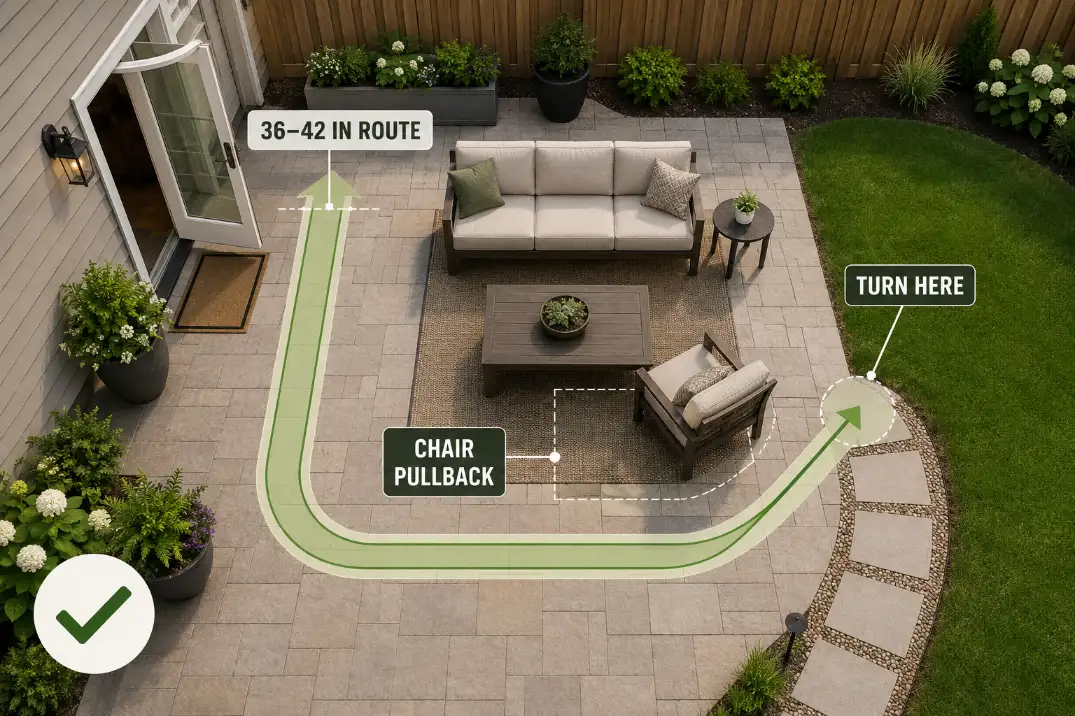
For older adults, the main route should be simple enough to follow without careful foot placement. The strongest path usually runs from the back door to the best chair, then from that chair to the table, yard, grill area, or garden edge without a sideways shuffle.
A 36-inch clear route is a useful minimum. Around doors, turns, chair exits, and places where someone may pause, 42 inches feels more forgiving.
The same route-first logic matters in general patio planning, but it becomes more important with age because small interruptions add up.
The entry area is often the first place to fix, and Keep Patio Entry Clear shows why the first few feet outside the back door usually decide whether a patio feels easy or annoying.
Surface stability belongs in the first decision
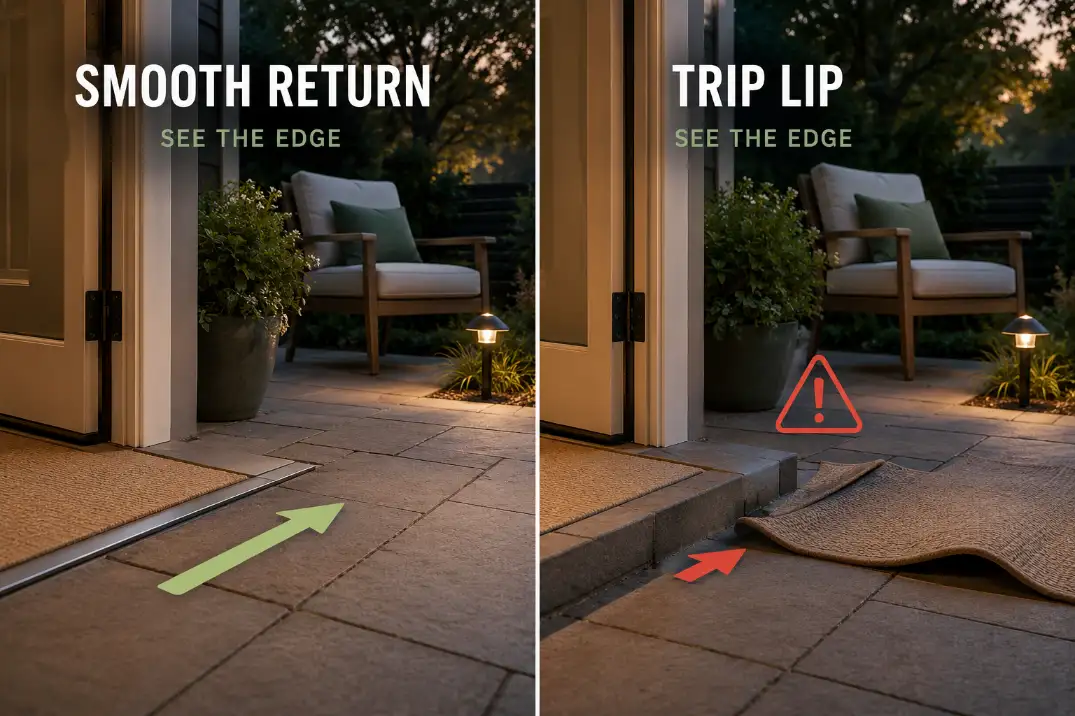
A clear path is not only about width. It also has to feel firm, stable, and predictable underfoot. Loose gravel, uneven pavers, curled outdoor rugs, raised thresholds, slick sealed concrete, and soft ground at the patio edge can make a route feel less safe even when it looks wide enough.
A 1/2-inch raised lip may not look dramatic, but it can change the way someone steps, especially when carrying a drink, using a cane, or returning indoors after dark.
If a person slows down at the same spot every time, the visible symptom is caution. The underlying mechanism is an unstable transition.
Pro Tip: Walk the route with one hand carrying a drink and the other hand unavailable. If the layout suddenly feels harder, the patio is relying too much on balance and attention.
Chairs That Are Easy to Leave
The best chair is not always the softest one
For older adults, the best patio chair is usually the one that is easiest to leave. Deep cushions, low lounge frames, and soft seats often feel inviting for the first few minutes, but they can make standing harder after 30 or 45 minutes outdoors.
A practical seat height is often around 18–20 inches from the patio surface. A wider usable range may be about 17–22 inches depending on body size, leg strength, and cushion firmness, but very low lounge chairs are usually less forgiving.
The problem is not comfort while seated; it is the stand-up motion. If the knees sit too high, the cushion sinks, or the chair lacks arms, the body has to work harder in the first second of standing.
Firm arms matter because they give the user a steady point to press against. A simple outdoor dining chair with arms may be more usable than a deep lounge chair if it lets the person sit, pause, and stand without rocking forward.
For a broader accessibility-focused layout, Accessible Outdoor Space Ideas explains how route, surface, seating, and support need to work together instead of being treated as separate upgrades.
Watch for the chair that only works once
The most overestimated feature is cushion softness. The most underestimated feature is chair stability. A chair that slides on pavers, rocks on an uneven slab, or sinks into a soft rug creates effort every time someone uses it.
A useful test is simple: stand up from the main chair three times in a row without using the table. If the movement becomes harder each time, the chair is not the right primary seat for an older-adult patio layout.
Shade Near the Best Seat
Shade the sitter, not the empty floor
Shade should land where the older adult actually sits, not where the patio happens to look centered. In many backyards, the hardest comfort window is the 2 p.m. to 5 p.m. stretch, when afternoon sun reaches the main seating area and stored heat rises from concrete, pavers, siding, walls, or nearby fencing.
A large umbrella can still fail if its shadow falls behind the chair, the pole interrupts the walking route, or the base sits where feet need to land during standing.
The better question is not “Is the patio shaded?” It is “Is the best seat shaded during the hours someone actually wants to sit outside?”
That distinction prevents a common waste of money: buying a larger shade product without changing where the shade falls.
A smaller offset umbrella, wall-mounted canopy, or shade sail may work better than a center-pole umbrella if it keeps the route open and the seat comfortable.
When shade equipment starts blocking movement, Add Patio Shade Without Blocking Walkways is a better planning step than simply choosing the biggest canopy or umbrella available.
The shade base should not become the new hazard
Umbrella bases, canopy legs, and low planter weights can become trip points if they sit between the back door and the main chair. This matters most near the chair exit zone. When someone stands, they need a clear place for both feet before taking the first step.
If a base has to sit close to the chair, keep it outside the foot placement zone rather than in the walking lane. The shade should make the patio easier to use, not add another object that has to be remembered every time someone walks back indoors.
If the patio needs a category-level shade upgrade, Best Patio Umbrellas for Small Backyards can support the buying decision, but the layout should still come first. The right umbrella is not only about canopy diameter. It is about where the shade lands, where the base sits, and whether the path stays clean.
Tables Within Natural Reach
Reach should not require leaning
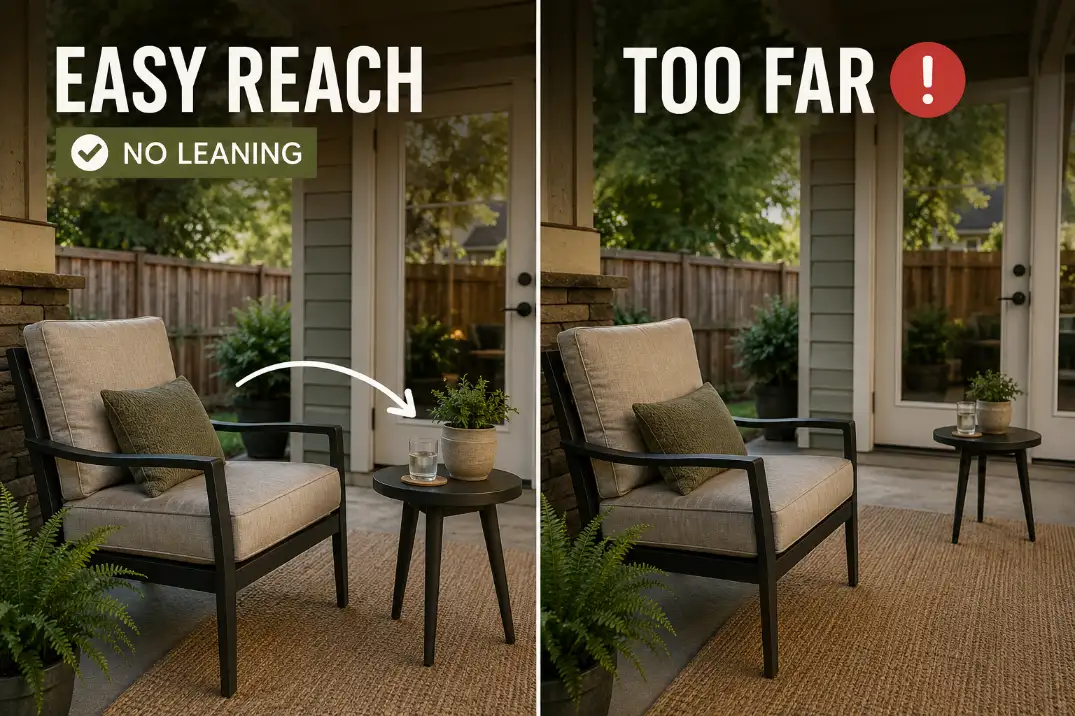
A side table should support the chair, not compete with it. The useful position is usually beside the stronger arm side, slightly forward of the chair arm, and close enough for a drink, phone, book, glasses, or medication case to be reached without twisting.
A practical reach zone is often within 12–18 inches of the seated hand. Once the table is about 24 inches away, it may still look close in a layout photo, but it often requires leaning forward or reaching across the body. That is not a flexibility issue. It is a furniture placement issue.
Large coffee tables often create this problem. They make the seating group look complete, but they also place an obstacle in front of the knees and feet.
For older adults, one stable side table can be more useful than a centered table that turns every stand-up movement into a negotiation.
| Patio Element | Better Choice | Watch For |
|---|---|---|
| Main path | 36–42 inches clear | Chairs, planters, or bases shrinking it below 30 inches |
| Main seat | Firm, stable, 18–20 inches high | Low, deep, soft, or armless seating |
| Side table | 12–18 inches from the seated hand | Reaching, twisting, or leaning over knees |
| Shade | Lands on the best seat during use hours | Covers empty floor or blocks the route |
| Surface transition | Smooth, visible, and low-lip | Raised edges, curled rugs, or uneven pavers |
| Furniture corners | One clean exit side | Sitter trapped between table, wall, and chair |
Avoid Tight Furniture Corners
Leave one clean exit side
A tight furniture corner may look efficient because it uses the patio edge. The problem appears when someone has to stand, turn, and step out from the seat. If a chair is boxed in by a wall, table, planter, railing, or another chair, the hardest movement happens in the tightest space.
This is especially common with dining sets. The table fits, but the active chairs do not. Once people sit down and chairs pull back, the usable footprint expands.
Outdoor Dining Chair Clearance explains this mistake well because the table is rarely the real issue. The chair movement is.
For an older-adult patio, the main chair should have at least one open exit side. The sitter should not have to back out diagonally, slide around a table leg, or ask someone else to move before standing.
When removing one chair is not enough
The standard fix is to remove one chair or push the set closer to the wall. That helps only if it actually opens the exit route. If the chair still faces a narrow turn between the table and another object, the furniture type is wrong for the space.
At that point, a simpler layout may work better: one supportive primary chair, one companion chair, one side table, and a clear route between them. Fewer pieces can make the patio more usable, especially when the user values comfort over seating capacity.
Make the Return Route Safe at Night
The trip back indoors matters as much as the trip out
A patio may feel fine in daylight and become less comfortable after sunset. Older adults need to see surface edges, door thresholds, chair legs, table corners, and changes in level without glare shining into their eyes.
Bright overhead light is not always the safest answer. Glare can flatten detail and make the patio harder to read. A low path light, step light, soft wall light, or warm light near the return route often does more practical work than a harsh fixture over the seating area.
If the patio connects directly to a back door, Patio Layouts for Back Door Seating can help refine the door-to-seat relationship, especially when the first few feet outside the house feel awkward.
Fix hesitation, not just darkness
A good test is to watch where someone slows down. If they hesitate at the threshold, around an umbrella base, beside a rug edge, or near a chair leg, the issue may be layout clarity rather than lack of light.
This is where many patios fail quietly. The person can still use the space, but every return trip requires attention. Over time, that small friction reduces how often the patio gets used.
What Changes With a Walker or Mobility Aid
Stop arranging furniture and start planning the route
If a walker, cane, wheelchair, or caregiver assistance is part of daily use, the patio should no longer be planned as a furniture arrangement first. It should be planned as a route with furniture placed around it.
The 36-inch clear path becomes a real minimum, not a nice target. Turning areas, door landings, chair exit zones, and surface transitions matter more than symmetry.
A layout that works for a steady adult may still feel frustrating if a walker has to angle around an umbrella base or if the main chair sits too close to a wall.
This is also where decorative rugs become questionable. A rug may visually soften the patio, but if it curls, shifts, bunches, or hides an uneven surface, it works against the main goal. The same is true for lightweight side tables that tip or slide when bumped.
The routine fix stops making sense when movement still feels careful
If the patio has already been decluttered, the main chair has arms, and the shade is in the right place, but the space still feels careful to use, the next fix is probably not another accessory.
It may be a surface correction, threshold adjustment, different furniture footprint, or a more direct route from the door.
That is the decision line: when the user still has to think through every step, the layout has not yet done its job.
Questions People Usually Ask
How wide should a patio path be for older adults?
A 36-inch clear route is a useful minimum for older adults, and 42 inches is better near doors, turns, chair exits, and places where someone may pause. If the route drops below about 30 inches after furniture is in use, the patio is likely too tight for easy daily movement.
What patio chair height is best for older adults?
Many older adults do better with a firm, stable chair around 18–20 inches high, with steady arms and a cushion that does not sink deeply. The exact fit depends on body size and mobility, but very low lounge chairs usually make standing harder.
Is a bigger patio set better for older adults?
Usually not. A bigger set often adds more chair legs, table corners, and route conflicts. One excellent supportive chair, one companion seat, a reachable side table, shade, and a stable route can outperform a larger set that makes movement careful.
The Patio Should Feel Easy Before It Looks Full
A patio layout for older adults should not begin with the maximum number of seats. It should begin with the movement that happens every time someone uses the space: open the door, walk out, sit down, set something nearby, stay shaded, stand up, and return inside.
That simple loop decides more than decoration, furniture style, or patio size. A layout with fewer pieces can feel more generous if the path is clear, the main chair supports standing, the side table sits within natural reach, the shade lands where it matters, and the surface does not ask for careful steps.
The best result does not look clinical. It looks calm, comfortable, and ordinary. The difference is that nothing important is fighting the person who wants to use it.
For broader technical guidance on clear accessible routes, see the U.S. Access Board guide to accessible routes.