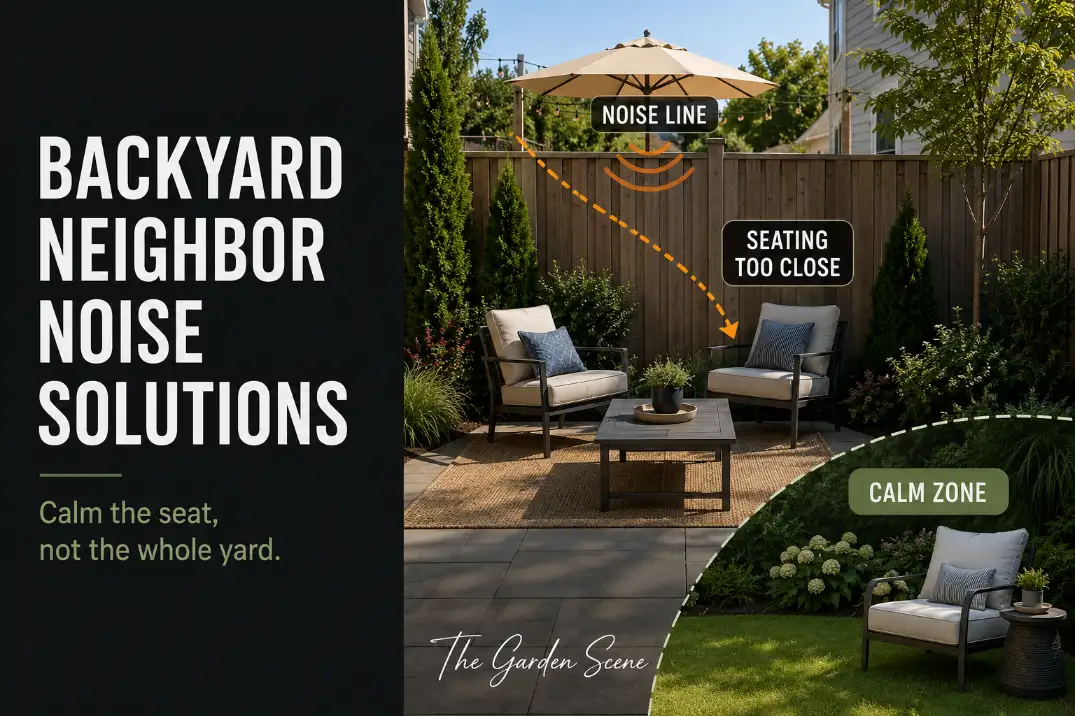
Backyard neighbor noise is usually solved by calming the seating area, not by trying to silence the entire yard.
The best first move is to take the chair out of the direct fence-line sound path, then place one dense screen, planting layer, or water feature where it actually affects what people hear while sitting.
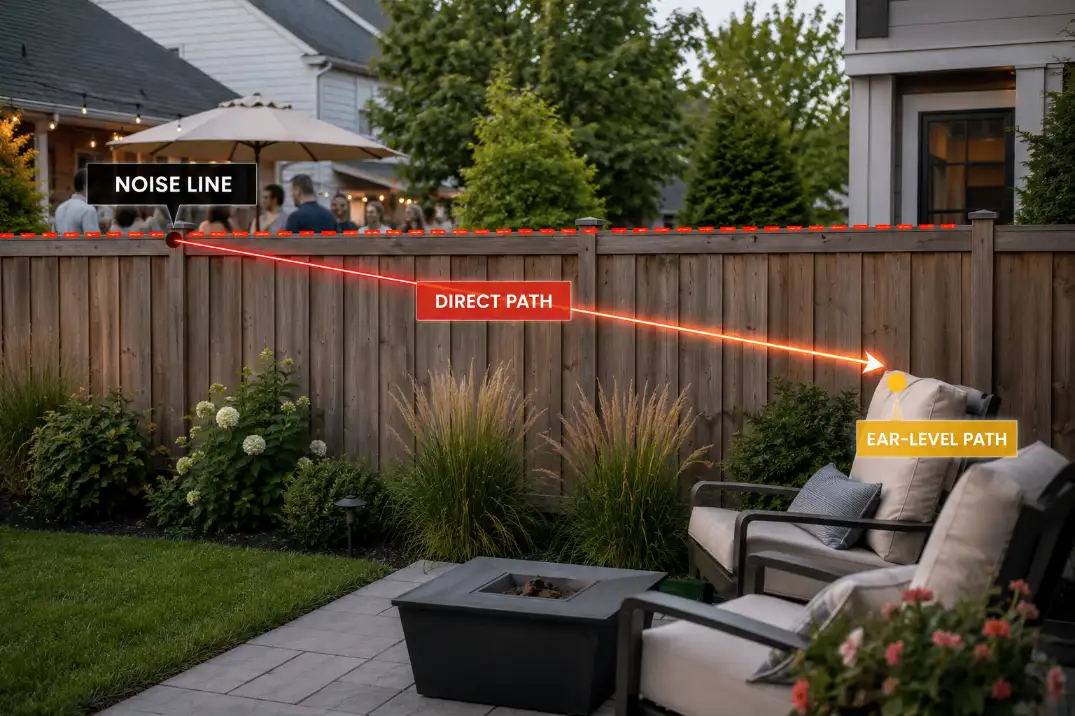
Start with three checks: where the sound comes through, how close your chairs are to that fence, and whether anything interrupts the direct path at seated ear height, roughly 3 to 4 feet above the ground.
If the loudest noise comes from one neighbor patio, grill area, dog run, or pool equipment pad, do not treat the full fence as equal. A focused fix near the active noise line often does more than a thin decorative treatment across the whole boundary.
Find the Shared Noise Line
The loudest edge is not always the longest edge
Most homeowners look at the entire fence and assume the whole property line needs screening. That is where money gets spread too thin.
Neighbor noise usually concentrates along one active line: a dining table, grill station, garage work area, hot tub, side gate, play zone, dog run, or mechanical equipment pad.
Sit where you normally relax and listen for several minutes at the time the problem actually happens. Evening conversation after 6 p.m. behaves differently from a short daytime burst of mowing, barking, or delivery activity.
If one fence section feels noticeably louder from the chair, that is the first line to solve.
The useful question is not “How do I make my backyard quiet?” It is “Which sound path reaches the seat I use most?”
Match the solution to the noise type
Different neighbor sounds need different first moves. Water sound can help with voices, but it will not erase sharp barking or loud music.
A dense screen may help with a direct patio conversation line, but it may do less if the sound comes from an elevated deck above the fence.
| Neighbor noise type | Better first move | Why it matters |
|---|---|---|
| Voices from a patio or table | Shift seating + dense screen + water near chairs | Improves the listening zone where conversation happens |
| Dog barking near the fence | Solid barrier first | Sudden sharp sound is harder to mask with water |
| Music or outdoor TV | Distance and dense barrier | Low, steady sound carries through light gaps |
| Pool pump or HVAC noise | Barrier aligned to equipment line | Mechanical sound often comes from one fixed source |
| Occasional mowing or tools | Layout or timing adjustment | Overbuilding for short noise can waste money |
This is the first place to be selective. A weekend-only mower does not deserve the same fix as a neighbor patio that affects dinner several nights a week.
Seating Too Close to the Fence
The first 4 feet are usually the weakest place to sit
A fence-side chair feels efficient in a small backyard, but it puts your ears close to the sound source and leaves no room for a buffer. In many suburban yards, the most uncomfortable seating is within the first 3 to 4 feet of the shared fence, especially when the neighbor’s patio or driveway sits on the other side.
That does not mean every chair needs to move to the middle of the lawn. Even a modest inward shift can help if it creates space for a screen, planter, hedge, outdoor sofa back, or storage bench between the sound line and the listener.
This is why layout often beats buying more plants first. If the chairs stay pressed against the fence, the new planting has no depth and no real job.
Keep the calm zone usable
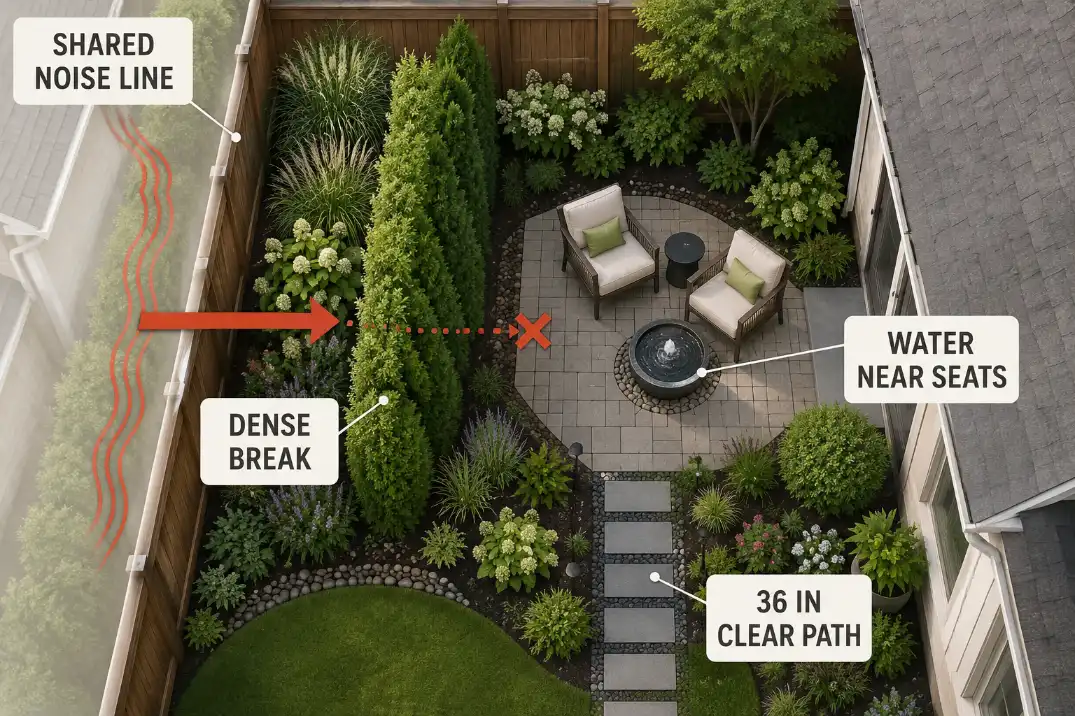
A quieter chair position is not automatically a better layout. You still need about 36 inches of clear walking space along the main route from the back door, grill, steps, or side gate.
If the quieter arrangement forces people to squeeze behind chairs, the yard will feel awkward even if the sound improves.
This is a common shared-fence mistake: the seating, privacy screen, and access path all compete for the same narrow strip.
If your backyard already feels pinched along the property line, Backyard Layout Mistakes in Shared Fence Yards explains why fence-side placement often creates noise, privacy, and flow problems at the same time.
Pro Tip: Move the chair first, then place the screen. If the new seat position feels calmer before you buy anything, the screen has a real job to do.
Planting That Softens Sound
Plants help most when they add mass and comfort
Planting is useful, but it is often overestimated as a sound blocker. A loose row of upright shrubs with open gaps underneath may soften the view without changing the sound enough to matter.
Dense mixed planting works better because it reduces the bare, exposed edge and softens the feeling of sitting beside a hard fence.
The strongest planting layer is usually mixed: evergreen shrubs for year-round mass, ornamental grasses or perennials for texture, and small trees or tall shrubs where overhead privacy matters.
In colder northern states, deciduous planting may lose much of its privacy value for several months, so relying only on leafy summer growth can disappoint.
If you want a backyard privacy layer without building a full fence, Backyard Privacy Ideas Without a Fence is a useful companion because the best noise layouts often borrow from privacy design: block the active sight-and-sound line first, then soften around it.
Hard surfaces can make the fence line feel louder
Sometimes the problem is not only the neighbor’s noise. It is how your yard reflects it. A large concrete patio, bare wood fence, stucco wall, metal furniture, or empty corner can make voices and sharp sounds feel more exposed.
Planting helps here even when it does not “block” sound. A 24- to 36-inch-deep bed, mulch layer, outdoor rug, vine-covered panel, or dense planter group can reduce the hard, bare feeling around the seating pocket.
That does not turn shrubs into a sound wall, but it can make the area feel less echoey and less exposed.
The symptom is “I hear my neighbors.” The mechanism is often an open sound path plus hard surfaces around the listener.
Screens That Add Privacy Too
Solid sections outperform decorative gaps
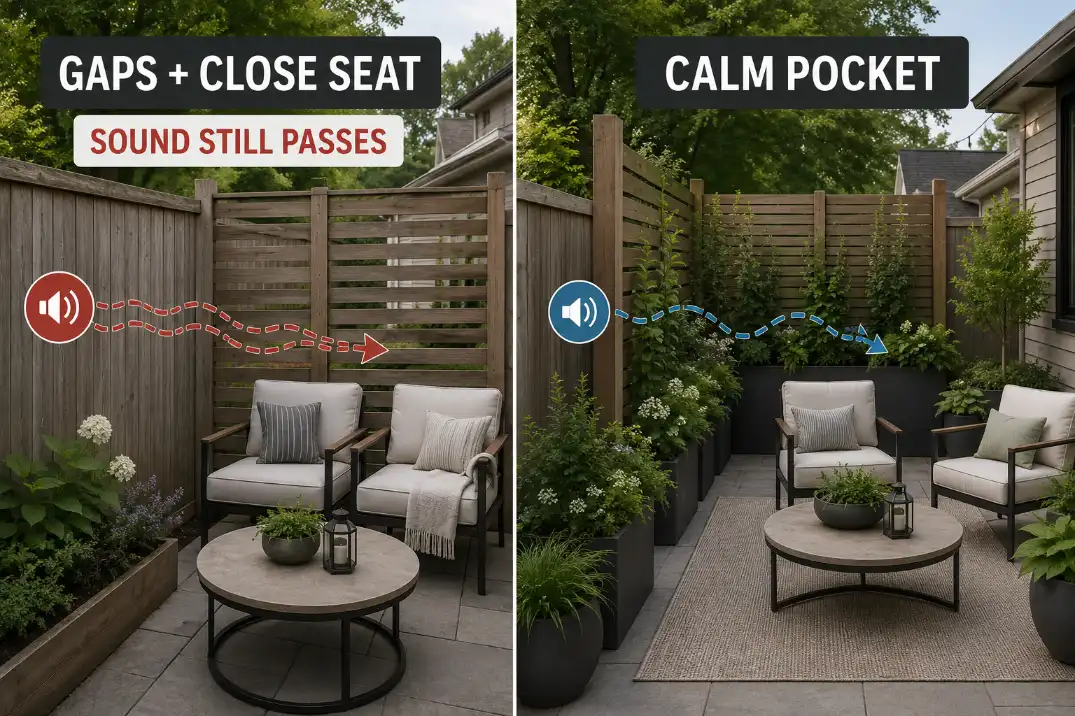
A screen works best when it blocks the direct line between the noise source and the seating area. A decorative slatted panel may look attractive, but if you can easily see through it from chair height, sound will pass through the same weak zone.
For neighbor noise, the most useful screen is often 5 to 6 feet tall near the active section, with the densest part aligned to seated ear height. It does not need to look heavy, but it does need to behave like a barrier.
Open lattice may improve privacy from a distance, but if the sound path still has gaps at seated ear height, it behaves more like decoration than a noise break.
One dense screen section in the right place may do more than a long, light, open panel that runs along the entire fence. The mistake is buying length when the yard needs placement and density.
When the standard screen stops making sense
A screen stops making sense when the sound source is higher than the screen, far to the side, or spread across multiple neighbor zones. A second-story deck, raised hot tub, uphill patio, or elevated neighbor balcony may send sound over a typical fence-line screen.
In that case, the better move may be a taller side-framed seating pocket: a pergola side panel, vine-covered trellis, tall planter group, or partial outdoor-room layout that shields the seat from the active direction.
This is not about enclosing the whole yard. It is about giving the main seating area one protected side.
The same logic applies if the neighbor noise is brief. Building a heavy barrier for an occasional short mowing pattern is usually overkill.
But if noise affects dinner, reading, or conversation several evenings per week, a focused barrier near the seating area becomes more reasonable.
For yards where noise comes from more than one exposed edge, Outdoor Noise Buffer Ideas can help you think beyond a single fence panel and build a stronger buffer sequence.
Water Features as Sound Cover
Place sound where people sit
Water features do not block neighbor noise. They cover and compete with it. That distinction matters. A fountain placed across the yard may look good from the patio, but its sound may miss the listening zone.
A smaller fountain 3 to 8 feet from the seating often helps more than a larger feature across the yard. For neighbor voices, a steady mid-volume water sound is usually better than a tiny trickle or an aggressive splash.
If guests have to speak louder over the fountain, the feature has become another noise problem.
Water works best for steady voices and general background activity. It is weaker against sharp barking, loud bass, or sudden tool noise. That does not make it useless; it just means it should support the calm zone rather than carry the whole solution.
Match the feature to the noise pattern
A wall fountain can work well on a narrow patio where the wall or fence sits close to the seating. A bubbling urn or medium-flow patio fountain works better beside chairs.
A pondless waterfall may fit a wider backyard edge, but it can feel too big for a tight seating corner.
For a deeper look at matching water sound to seating distance and noise type, see Best Outdoor Water Features for Softening Yard Noise. The important point here is placement: water belongs near the calm zone, not wherever the yard has an empty decorative spot.
Pro Tip: Test the idea with a portable speaker playing steady water sound near the seating for about 15 minutes. If the seat feels calmer, a real water feature has a clear purpose.
Calm Zones Away From Neighbors
Build one good pocket instead of fixing every edge
The strongest backyard neighbor noise solution is usually a calm zone, not a full-yard silence plan. Pick the place where you actually sit for coffee, dinner, or evening conversation.
Then improve that pocket with distance, a direct-path break, dense planting, softer surfaces, and water sound if it fits.
This is especially useful in small yards. A 10-by-12-foot patio can feel calmer if the seating faces inward, the sofa back or planters shield the fence side, and the loud edge sits behind a dense screen. The yard does not need to feel private from every angle for the main seat to work.
Do not confuse privacy with quiet
Privacy and quiet often overlap, but they are not identical. A yard can look screened and still sound exposed if the screen has gaps, the chairs are too close to the fence, or the neighbor’s activity sits above the barrier.
A yard can also feel calmer without perfect privacy if the seating is turned away from the noise and supported by planting and water sound.
This is why many standard backyard privacy fixes fail: they treat the fence line as the problem instead of the listening position.
If your current fixes look good but still do not change how the space feels, Backyard Privacy Problems: Fixes That Fail helps separate visual screening from the deeper layout issue.
Quick Backyard Neighbor Noise Checklist
- Sit in the problem chair and identify the loudest fence section.
- Check whether your ears are within about 3 to 4 feet of the shared fence.
- Move seating inward if it creates room for a real buffer.
- Use dense screens where the noise line is direct, not across the entire yard.
- Add evergreen or mixed planting to soften exposed hard edges.
- Place water sound 3 to 8 feet from the seating, not across the yard.
- Keep at least 36 inches of main walkway clearance after changes.
Questions People Usually Ask
Can plants really block neighbor noise?
Plants can soften the edge and improve comfort, but they usually do not block neighbor noise the way a solid barrier does. Dense, layered planting helps most when combined with a screen, layout shift, or water sound.
Is a taller fence always the best solution?
Not always. A taller fence helps only if it interrupts the direct sound path. If the seating is still pressed against the fence or the neighbor noise comes from above, a taller fence may disappoint.
Should I put a fountain by the fence or by the chairs?
Put it near the chairs. The point is to improve what people hear while sitting. A fountain beside the fence may not help if its sound does not reach the listening zone clearly.
What is the cheapest useful first step?
Move the seating first. If the chair feels calmer farther from the shared fence, then screens, planters, or water features can be placed with much better judgment.
When a backyard fix depends on a screen behaving like a real barrier, the Federal Highway Administration is a useful reality check on why gaps and broken sound paths matter.