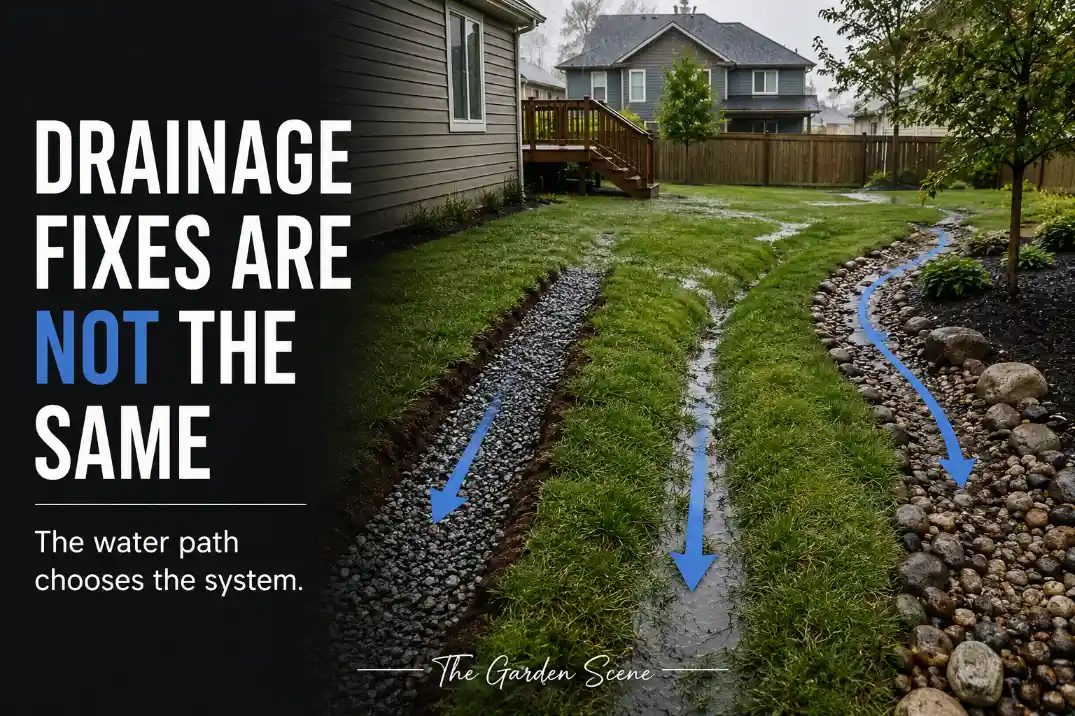
A French drain, swale, and dry creek bed solve different drainage problems. A French drain handles water moving through saturated soil. A swale shapes water that is already moving across the surface. A dry creek bed protects and guides a repeated runoff path so water does not tear through mulch, soil, or planting beds.
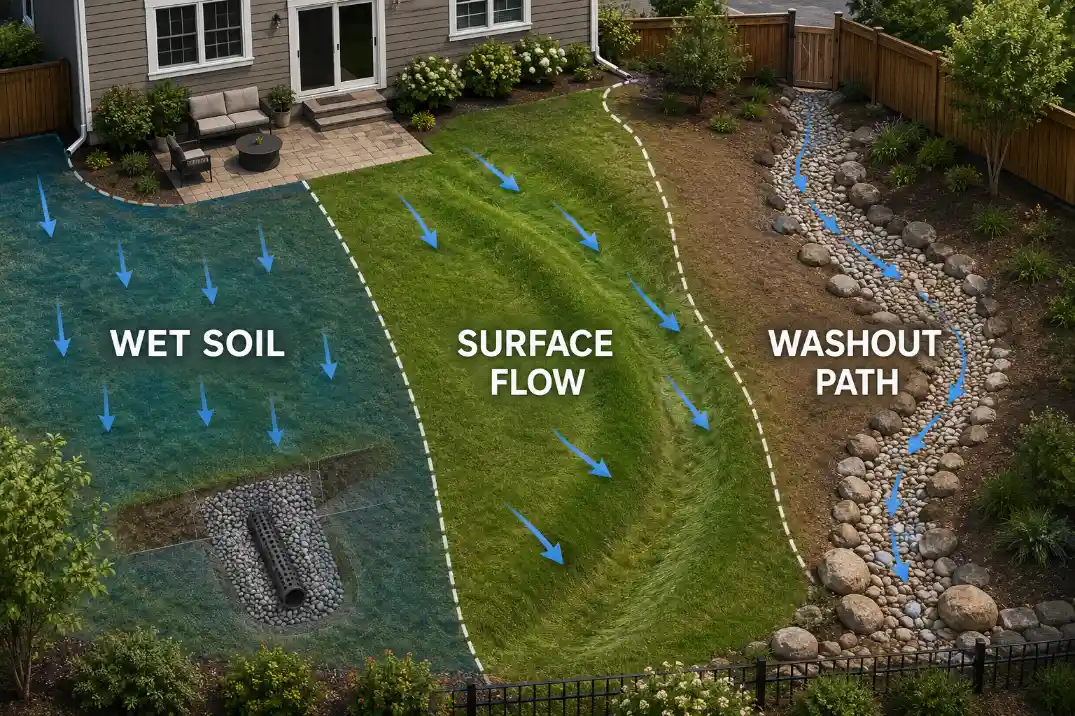
The first check is not which option looks best. It is where the water is. If water crosses the lawn during rain, start with surface flow. If the lawn stays soft 24–48 hours after the rain ends, look at soil saturation.
If the same strip washes out after every 1–2 inch storm, the problem is usually runoff energy, not just standing water. The wrong fix costs more because it treats the visible mess while leaving the water path untouched.
Three Different Drainage Jobs
The fix depends on the water path
A French drain is a buried collection system. It gives subsurface water a lower route out of the wet area. It can help when water sits in the soil, moves through a slope, or keeps a strip of lawn soft long after surface water has disappeared.
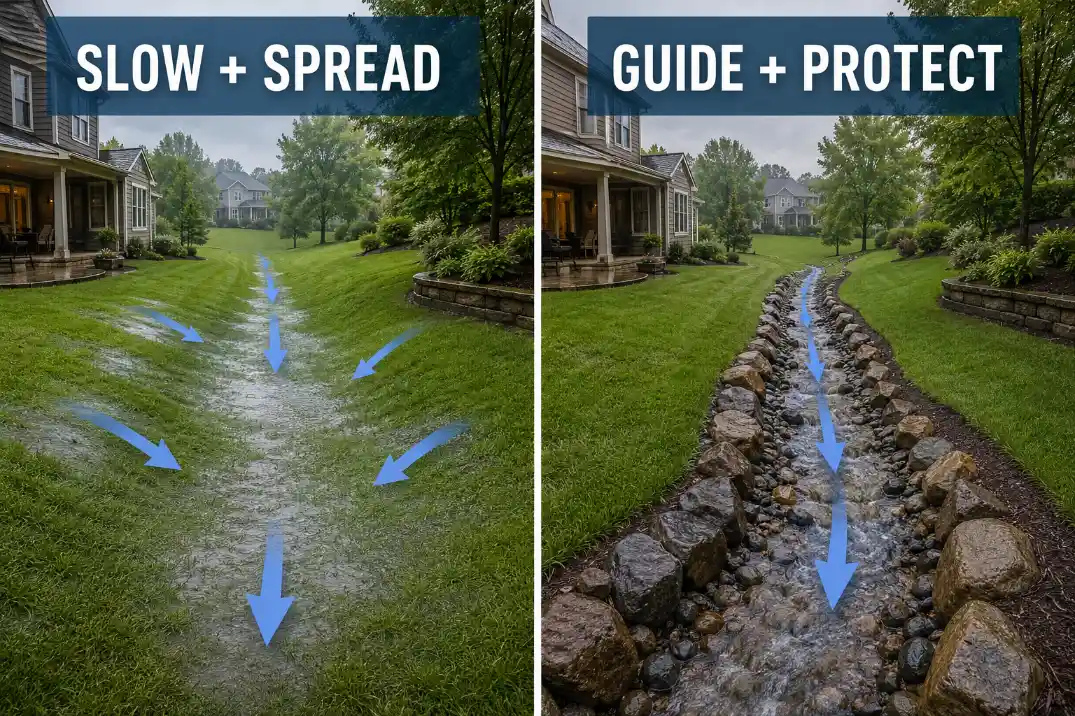
A swale is a surface-shaping fix. It is a shallow, broad channel that moves visible runoff gently across the yard. A good swale does not look like a trench. It looks like a slight landform that gives water direction without creating erosion or mowing problems.
A dry creek bed is a protected surface route. It works where water already has a visible path and that path needs stone, shape, and stability. It may look decorative, but when it works well, it is doing a drainage job.
In real yards, the mistake is often not choosing the wrong material. It is judging the problem after the rain instead of watching the water move during the rain. The movement shows the job; the leftover puddle only shows where the water stopped.
For a broader starting point, a yard drainage solution guide can help separate wet-lawn symptoms from grading, downspout, patio, and slope problems before you choose a specific system.
The three quick checks
Look at the yard during active rain, not only the next morning. Moving water tells you the job. Leftover puddles only show where water stopped.
Then check recovery time. If the surface dries but the soil still feels spongy after 1–2 days, the problem may be below the surface. If the water disappears quickly but leaves ruts, exposed soil, or displaced mulch, the issue is flow speed.
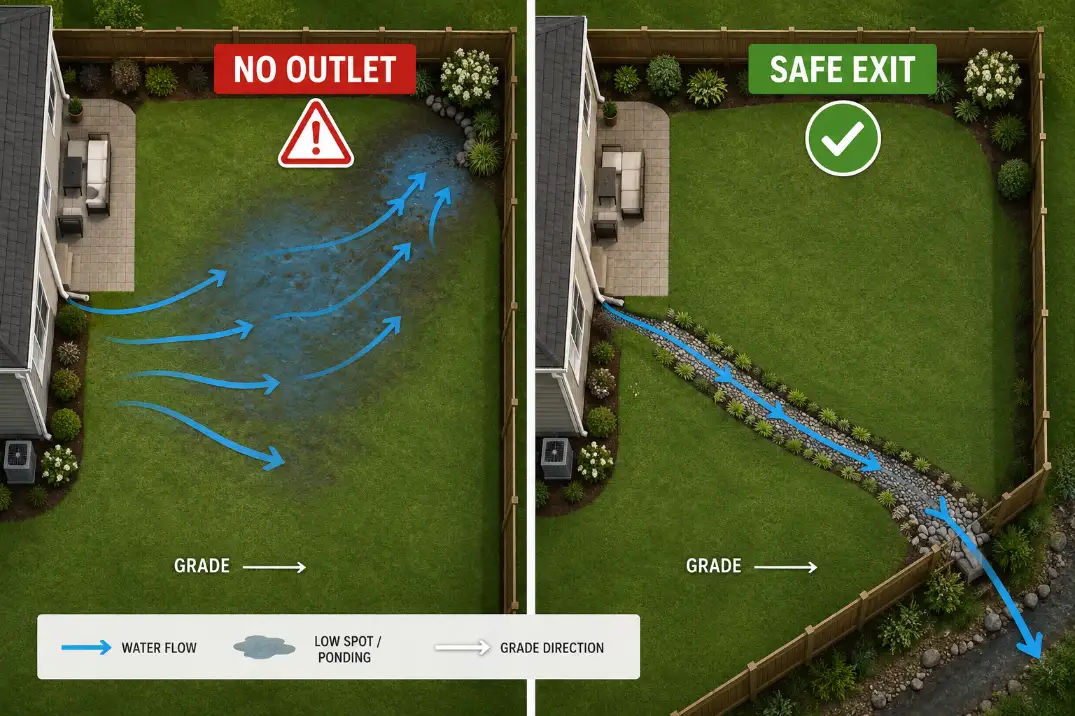
Finally, check the outlet. Every drainage fix needs somewhere safer and lower for water to go. A beautiful dry creek bed, a neat swale, or a 4-inch buried pipe can all fail if they end in another low spot.
Before You Choose, Test the Yard
Watch one storm before digging
The most useful test is simple: observe the yard during a real rain. If water sheets across the lawn from an uphill neighbor, driveway, or patio edge, a buried French drain is probably not the first move. You need to intercept or reshape surface flow.
If there is no obvious surface flow but the ground stays wet, press a screwdriver or soil probe into the lawn the next day. Soft soil several inches down suggests saturation. Hard topsoil with water skimming across it suggests compaction or surface sealing instead.
A French drain becomes more logical when water can actually enter the trench and move toward a lower discharge point. It becomes less logical when water is skipping across compacted topsoil before it ever soaks in.
Use a drain-rate check
A basic soil drain-rate check can prevent the wrong installation. Dig a small test hole in the wet area, fill it with water, and watch how fast it drops.
If water drains slower than about 1 inch per hour, poor infiltration is part of the problem. If the hole barely drops after several hours, the yard may need a real outlet rather than another surface-level cosmetic fix.
The outlet test matters just as much. If the planned discharge point is not lower than the wet area, the system is not ready. Adding more pipe, gravel, or stone will not overcome a flat exit.
Pro Tip: If the wet area is fed by a downspout, fix the roof-water discharge first. A drainage feature built downstream of a bad downspout often becomes an expensive way to chase a problem that should have been reduced at the source.
When Water Moves Underground
French drains solve saturated soil
A French drain is strongest when water is moving through the soil rather than across the lawn. It usually includes a sloped trench, perforated pipe, clean drainage stone, and filter fabric. The trench collects water and gives it a lower path out.
A residential French drain trench is often around 12–24 inches deep, depending on the site, soil, and available outlet. The pipe still needs fall. A common target is about 1% slope, or roughly 1 inch of drop over 8 feet. Without that fall, the drain may hold water instead of moving it.
The strongest sign is slow recovery. If the yard looks better on the surface but still feels sponge-soft 24–48 hours later, a French drain may fit the mechanism. In clay-heavy yards, this slow recovery signal usually matters more than the size of the puddle during the storm.
Where French drains waste money
A French drain is often the wrong first fix for visible runoff. If water is crossing the yard during rain, the problem is moving over the surface. A buried pipe may catch some water later, but it will not stop the flow path that is causing washout, patio flooding, or soil movement.
It also disappoints when the outlet is weak. A pipe that ends in another low area only relocates the wet spot. This is the point where a routine fix stops making sense: if the proposed drain cannot discharge safely and legally, the installation should pause.
French drains also need maintenance access. The outlet should stay visible and clear. If sediment, roots, or crushed pipe block the system, the yard may slowly return to the same wet pattern.
When Surface Flow Needs Shaping
Swales work with visible runoff
A swale is the better choice when water is already moving across the surface. It catches, slows, and redirects runoff before it spreads across a patio, cuts through a lawn, or pushes mulch downhill.
A good swale is broad enough to be stable. It may only be a few inches lower than the surrounding grade, but it needs a continuous path. A swale with a low pocket in the middle becomes a long puddle.
Swales are especially useful where runoff comes from an upper slope, driveway edge, side yard, or neighboring grade. On steeper sites, the order matters: slow the water before it cuts deeper.
That is why fixing slope drainage and erosion usually starts with flow direction and soil protection, not decoration.
Swales have space and site limits
Homeowners often underestimate how much room a swale needs. A narrow trench is not a swale. It may concentrate water and create erosion faster than the original sheet flow.
A swale becomes harder to rely on when the slope is too steep, the soil is highly compacted, or the only route sends water toward a foundation, sidewalk, driveway, or neighbor.
It also needs careful placement around utilities, septic areas, wells, and foundation zones. If the only available route creates a new safety or property-line problem, the swale is not ready yet.
Turf can handle occasional shallow flow, but once grass thins and bare soil appears, the swale has become an erosion route. If the flow is frequent and concentrated, the swale may need reinforcement, planting, stone check areas, or a dry creek section where water energy is highest.
When Dry Creek Beds Help
Functional creek beds follow water, not the eye
A dry creek bed is useful when water already has a repeated surface route. The job is to make that route stable. It should guide runoff, protect soil, reduce mulch washout, and make the drainage path look intentional.
The key distinction is simple: a decorative creek bed follows the eye; a functional creek bed follows the water. If the bed is placed where water does not naturally move, it may look good in dry weather and do almost nothing during a storm.
If the water path is not visible during rain, the creek bed may be landscaping, not drainage. That does not make it wrong, but it changes the purpose. A drainage creek bed should be judged by whether it controls water, not whether it fills an empty planting bed nicely.
A dry creek bed usually works best with a shaped base, fabric separation, mixed rock sizes, and larger stone where water enters. Small decorative gravel alone is weak at the impact point below a downspout or slope. The first heavy storm can scatter it.
When roof water is part of the problem, trace the source first. If gutters are dumping water into planting beds, downspouts flooding backyard planting beds may be the more important diagnosis before choosing a creek bed, drain, or swale.
Where dry creek beds fail
A dry creek bed fails when it is used to hide a wet low spot with no exit. Stone does not make water disappear. If the area is a closed bowl, the bed may collect sediment, weeds, and hidden standing water.
It also fails when the bed is too small for the flow. If water jumps out during a 1-inch storm, the path is too narrow, too flat, blocked, or missing a clean exit. The fix is not more decorative stone. The fix is a better route, better width, or better outlet.
Dry creek beds need maintenance too. Leaves, sediment, and small stones can collect where the flow slows. After major storms, the most important check is not whether the bed still looks neat; it is whether the entry point, lowest channel, and outlet are still open.
Where Each Fix Fails
The outlet is the real test
Most drainage fixes fail at the outlet. A French drain without a lower discharge point stays wet. A swale aimed into a flat fence line ponds. A dry creek bed that ends in lawn simply moves erosion from one place to another.
The visible wet area gets the attention, but the discharge point decides whether the repair works. If the exit cannot accept water during a storm, the design is incomplete.
This matters even more near hardscape. When water collects along paving, doors, or seating areas, the problem is usually slope and discharge, not just surface material.
A guide to patio drainage layout problems is more relevant when the wet zone is tied to a patio edge or walkway.
Compare the real decision factors
| Yard condition | Most likely mechanism | Better first fix | Common weak fix |
|---|---|---|---|
| Lawn stays soft 24–48 hours after rain | Subsurface saturation | French drain with a real outlet | Decorative dry creek bed |
| Water visibly crosses the lawn during rain | Surface runoff | Swale, grading, or flow interception | Buried pipe alone |
| Mulch or soil washes out repeatedly | Concentrated surface flow | Dry creek bed or reinforced flow path | Adding more mulch |
| Water sits beside patio or walkway | Bad slope or blocked discharge | Regrade and redirect | More stone at the edge |
| Wet low spot has no lower exit | Closed drainage bowl | Outlet plan or regrading first | Any isolated feature |
| Fix must be low-disruption | Surface shaping may be simpler | Swale if space allows | Deep trenching without diagnosis |
| Long-term issue is clogging or sediment | Maintenance access matters | Visible outlet and cleanable path | Hidden system with no inspection point |
The Wrong Fix Costs More
Cost follows diagnosis
French drains usually create more disruption because they require trenching, pipe, stone, fabric, and a discharge point. They can be worth it when the problem is truly subsurface water. They are wasteful when the real issue is surface runoff.
Swales can be less invasive, but they need enough room to be broad and gentle. A cramped swale squeezed into the wrong strip may create mowing issues, erosion, or a new puddle.
Dry creek beds often look like the easiest upgrade because they are visible and attractive. But a functional creek bed is not just rock on fabric. It needs the right route, entry control, stone sizing, and an outlet.
The costliest pattern is repeating small fixes after every storm: replacing mulch twice a season, adding gravel to the same washout, reseeding the same flow line, or extending a pipe into another low spot. Those are signs the water path has not been solved.
Mixed yards may need layered fixes
Some yards need more than one solution, but each part should have a different job. Surface runoff from an upper slope may need a swale. The concentrated crossing through a planting bed may need a dry creek bed. A separate saturated strip beside a fence may need a French drain.
Layering works when the jobs are clear. It fails when every feature is asked to solve every water problem.
If runoff is already cutting across outdoor living space, sloped yard runoff cutting across a patio is a better model than treating the problem as a generic wet-lawn issue.
Questions people usually ask
Can a dry creek bed replace a French drain?
Not when the problem is saturated soil. A dry creek bed handles visible runoff and erosion. A French drain handles water that can enter a buried trench and move to a lower outlet.
Is a swale better than a French drain?
A swale is better for surface flow. A French drain is better for subsurface water. The better choice depends on where the water moves, not which system sounds stronger.
Can one yard need all three?
Yes, but not for the same water problem. One yard can need a swale for uphill runoff, a dry creek bed for a concentrated surface route, and a French drain for a separate saturated zone.
For broader official guidance on residential stormwater swales and runoff handling, see Virginia Cooperative Extension.