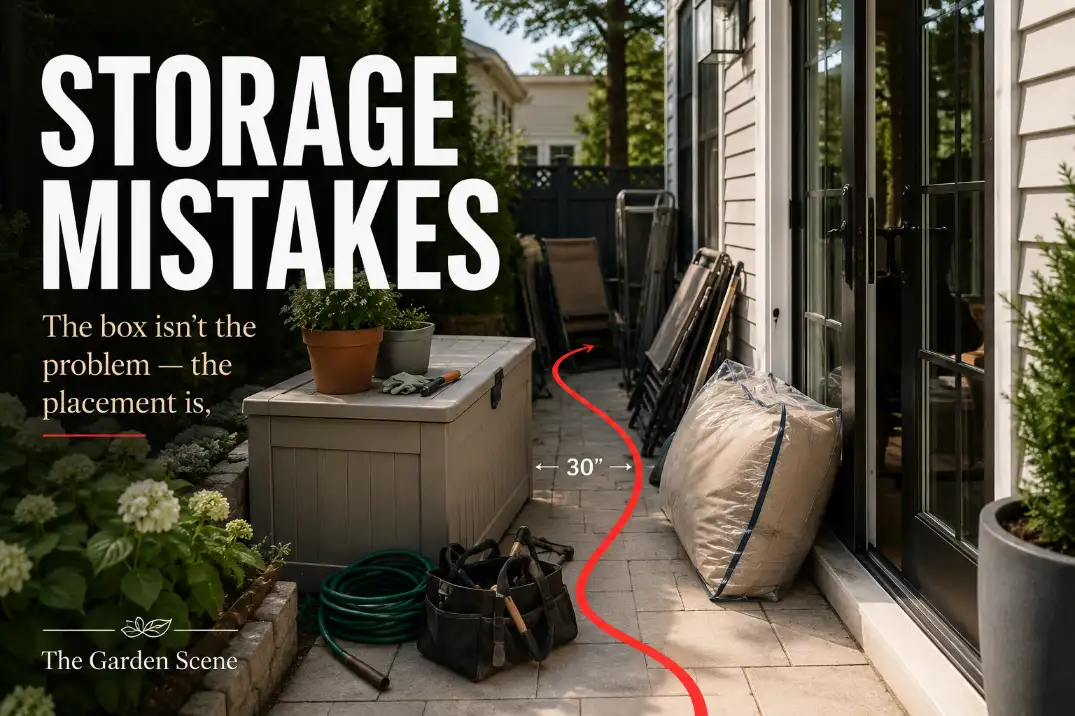
Small backyard storage usually fails in three ways: it blocks movement, uses the wrong container for the job, or traps moisture around items that were supposed to be protected.
The first check is not how much storage you own. It is whether the main route from the back door to the seating, grill, gate, hose, or garden beds still holds about 30–36 inches of clear space.
The second check is access. If you need to move three things to reach one tool, the storage system is already failing. The third check is moisture: cushions, gloves, fabric covers, and wood-handled tools should not still feel damp 24–48 hours after rain or cleaning.
That is different from ordinary clutter. A few visible items can be harmless; poorly placed storage changes how the whole yard works.
Most Common Small Backyard Storage Mistakes at a Glance
- Buying a deck box before protecting the main walking route.
- Using the patio as the default storage zone instead of the fence line, side yard, or perimeter.
- Choosing one large box for tools, cushions, toys, and seasonal supplies together.
- Storing damp cushions or fabric in closed “weather-resistant” containers.
- Forgetting clearance for doors, chair movement, grill lids, and storage lids.
- Hiding tools so well that people stop putting them away.
- Storing chemicals, food-like materials, or heat-sensitive items outside without proper protection.
The 7 Storage Mistakes That Shrink Small Backyards
Most storage mistakes in a small backyard are not about owning too much stuff. They are about putting storage in the one place the yard needed to stay open.
Mistake 1: Buying the Box Before Protecting the Path
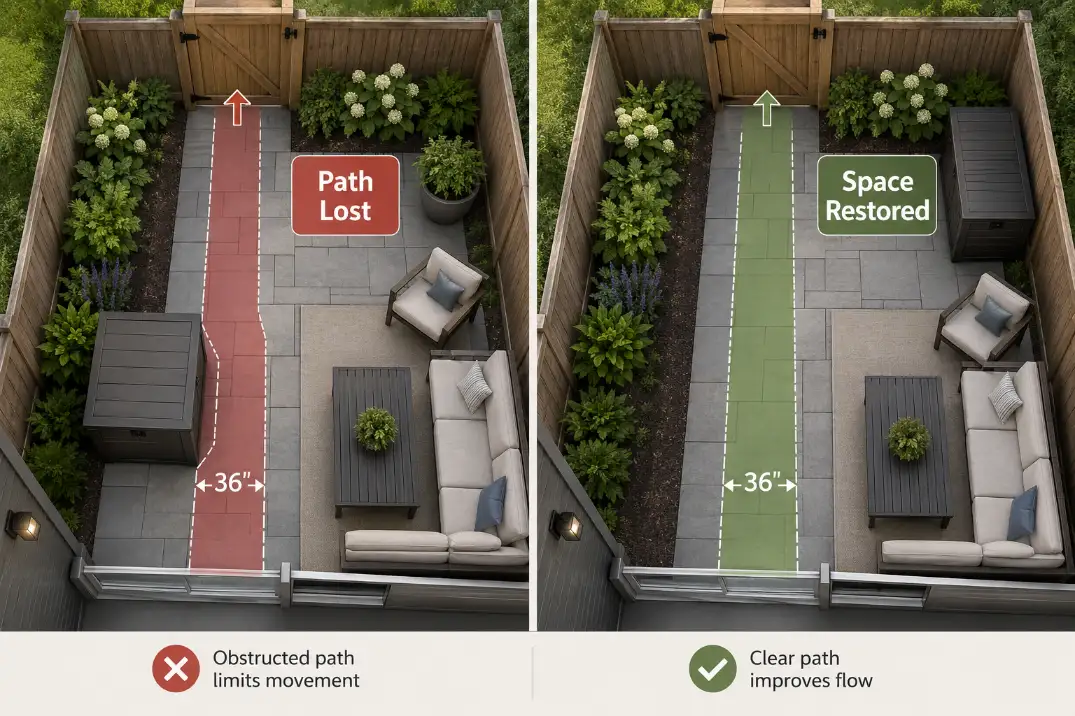
The most common mistake is choosing a deck box, bench, or cabinet before mapping movement. A storage box can look compact online and still wreck a small patio once it has to coexist with chair legs, door swings, grill lids, gate access, and foot traffic.
A main path should stay close to 36 inches wide where possible. A secondary path can sometimes work at 24–30 inches, but once the route drops below about 30 inches, people start turning sideways, stepping onto planting beds, or dragging chairs around corners.
This is why a large 60-inch storage bench can be worse than two smaller pieces. The big bench may hold more, but if it consumes the cleanest edge of the patio or blocks the route to the side yard, it turns storage into an obstacle.
A slimmer cabinet along a fence often stores less but preserves the yard’s usable shape.
For a more layout-first approach, Best Backyard Storage Layouts for Small Spaces is the better next step because it starts with where storage belongs before product size takes over.
Mistake 2: Using the Patio as a Storage Dump Zone
The patio feels convenient, so it becomes the default storage zone. Cushions land there. Toys land there. Bags of soil sit there “for the weekend” and stay for 2 months.
In a small backyard, the patio is usually the highest-value square footage. It is where people sit, cook, step outside, move furniture, and pass through. Storage should support that use, not compete with it.
Keep the first 3 feet around the back door as clear as possible. Also protect the space where chairs slide back, usually 18–24 inches behind the seat. If a storage box forces chairs, people, pets, or the route to the gate into the same narrow strip, it is in the wrong place even if the patio still looks tidy.
Pro Tip: Tape the footprint of a future storage box on the patio for 48 hours. If you keep stepping around the tape, the real storage piece will feel even more annoying.
Mistake 3: Choosing One Big Box for Too Many Item Types
One oversized box sounds efficient. It often becomes a pile.
Large deck boxes work best for bulky, similar items: cushions, outdoor covers, pool toys, or folded blankets. They work poorly when they hold pruners, gloves, fertilizer, extension cords, kids’ toys, hose nozzles, and chair covers together.
The warning sign is simple: if you regularly move three or more items to reach one thing, the box is not organized storage. It is hidden clutter.
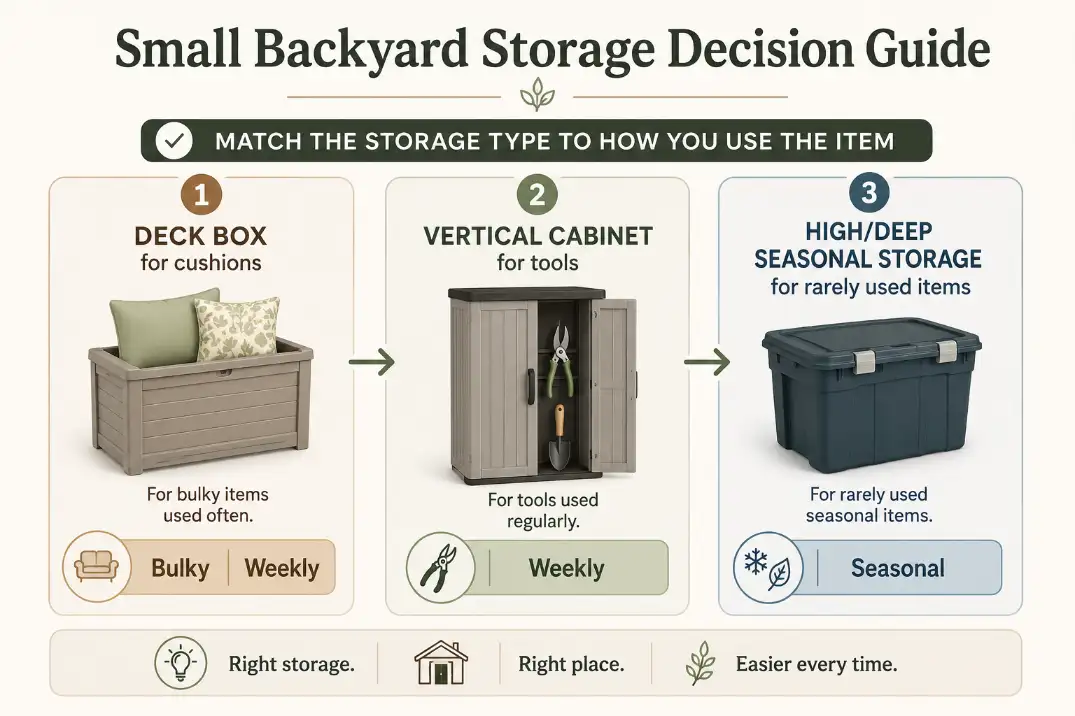
A better system separates storage by use frequency. Weekly items need one-step access. Monthly items can sit behind a door. Seasonal items can go higher, deeper, or farther from the patio. That split often matters more than total storage capacity.
If the real problem is visible tools and supplies, How to Hide Backyard Tools and Supplies Without Adding More Clutter fits that situation better than adding another oversized container.
Mistake 4: Storing Damp Items in “Weather-Resistant” Containers
Weather-resistant does not mean moisture-proof. It also does not mean safe for damp fabric, cardboard packaging, untreated wood handles, or seed packets.
Closed storage can protect items from direct rain while still trapping humidity.
In humid Florida, shaded Midwest yards after spring storms, or coastal California areas with marine moisture, a sealed box can stay damp inside long after the patio surface looks dry.
In northern states, freeze-thaw cycles can also warp cheaper lids and create small gaps where meltwater enters.
A healthy storage setup dries between weather events. A failing one smells musty, leaves condensation under the lid, or keeps fabric damp after 24–48 hours. When that happens, the fix is not automatically a more expensive box.
The better move may be raising the box 1–2 inches, moving it out of a splash zone, letting cushions dry first, or choosing storage with better airflow.
What People Usually Misread First
The visual mess is not always the real problem. A small backyard can survive a visible hose reel or a few tools on a rail. It struggles more with hidden storage that blocks movement, traps moisture, or takes too long to use.
Cosmetic Clutter Is Not the Same as Functional Clutter
A hose reel may look less polished than a concealed hose box, but if it keeps the hose off the ground and easy to use, it may be the better choice. A closed cabinet may look cleaner, but if everyone leaves tools beside it because opening it is awkward, the cabinet is failing.
This is where many decluttering fixes waste time. They improve the photo but not the yard. The goal is not to make every object disappear.
The goal is to make the right objects easy to use without shrinking the patio, blocking the fence line, or making the route to the gate harder.
Capacity Is Often Overestimated
Storage capacity looks helpful until the footprint steals the best part of the yard. A deck box that is 50–60 inches wide and 25–30 inches deep can consume a major edge of a small patio. If it opens from the top, it may also need another 12–18 inches of comfortable access space.
That does not make large storage wrong. It belongs at the end of a route, against a long perimeter, near a service area, or under a windowless wall. It is weaker beside a sliding door, between the seating and grill, or anywhere people already pass through.
For patios where storage has slowly crowded out daily function, How to Reduce Patio Clutter Without Losing Function gives a more practical way to decide what deserves to stay close.
Choose the Storage Type by the Failure
The right storage piece depends on what is actually going wrong. Buying by capacity alone is one of the fastest ways to make a small backyard feel smaller.
Deck Boxes: Best for Bulky, Similar Items
Deck boxes are useful for cushions, outdoor covers, pool toys, and soft goods that need quick seasonal access. They are less useful for tools and small supplies because everything drops into one deep cavity.
In a small backyard, a 70–120 gallon deck box is often enough unless it can sit cleanly along a perimeter. Larger boxes need more careful placement because the footprint and lid access can dominate the patio.
Storage Benches: Useful Only If They Replace Seating
A storage bench makes sense when it replaces a separate chair, not when it becomes one more bulky object. The seat should be comfortable enough to use, usually around 17–19 inches high, and the lid should open without moving cushions, chairs, or side tables.
If nobody would naturally sit there, do not buy the bench for the word “bench.” Choose a box, cabinet, or vertical organizer instead.
When the storage need overlaps with seating, Outdoor Storage Benches That Solve Small Patio Problems is a better product-focused path than choosing by gallon capacity alone.
Vertical Cabinets and Rails: Better for Tools
For pruners, gloves, trowels, brooms, hose nozzles, and small supplies, vertical storage often beats deep storage. A 12–18 inch deep cabinet, wall rail, or slim organizer keeps frequent-use items visible without taking over the floor.
The caution is bottleneck depth. A 24-inch deep cabinet in a narrow side yard can be just as disruptive as a deck box. Slimmer storage usually works better when the yard is tight.
The Mistake of Storing the Wrong Things Outside
Some storage mistakes are not about layout. They are about putting the wrong material in the wrong environment.
Items That Should Not Sit in Ordinary Outdoor Storage
Do not treat an outdoor box like a garage. Propane cylinders, gasoline cans, oily rags, and heat-sensitive chemicals do not belong in closed patio storage exposed to summer sun.
Pool chemicals, fertilizers, and pest products also need controlled access, especially in homes with children or pets.
Birdseed and pet food can attract rodents if stored in weak plastic bins. Cardboard packaging softens and molds quickly. Fabric cushions stored damp can mildew even inside a weather-resistant box.
In freezing climates, liquids and cheaply sealed containers can split or leak after repeated freeze-thaw cycles.
This is the point where routine storage stops making sense. If the item is flammable, food-like, chemical, moisture-sensitive, or attractive to pests, it needs more than a convenient backyard container.
Quick Diagnostic Table
| Storage Mistake | Warning Sign | Better Move |
|---|---|---|
| Oversized deck box | Main path drops below 30 inches | Shift to perimeter or use slimmer storage |
| Mixed clutter box | You move 3+ items to reach one thing | Split by weekly, monthly, seasonal use |
| Damp cushion storage | Musty smell after 24–48 hours | Dry first, ventilate, or raise the box |
| Bench used only as storage | Nobody actually sits there | Use a cabinet or deck box instead |
| Storage beside the door | Door, lid, or chair swing conflicts | Move storage to fence or wall edge |
| Tools buried in bins | Tools get left outside anyway | Use hooks, rails, or shallow vertical storage |
The Better Storage Order for Small Backyards
The best order is not buy, fill, and hide. It is route, sort, place, then contain.
First, Protect the Routes
Mark the routes that matter: door to seating, door to grill, door to gate, hose to planting beds, trash path, and any regular dog or kid traffic. These routes are the backyard’s operating system.
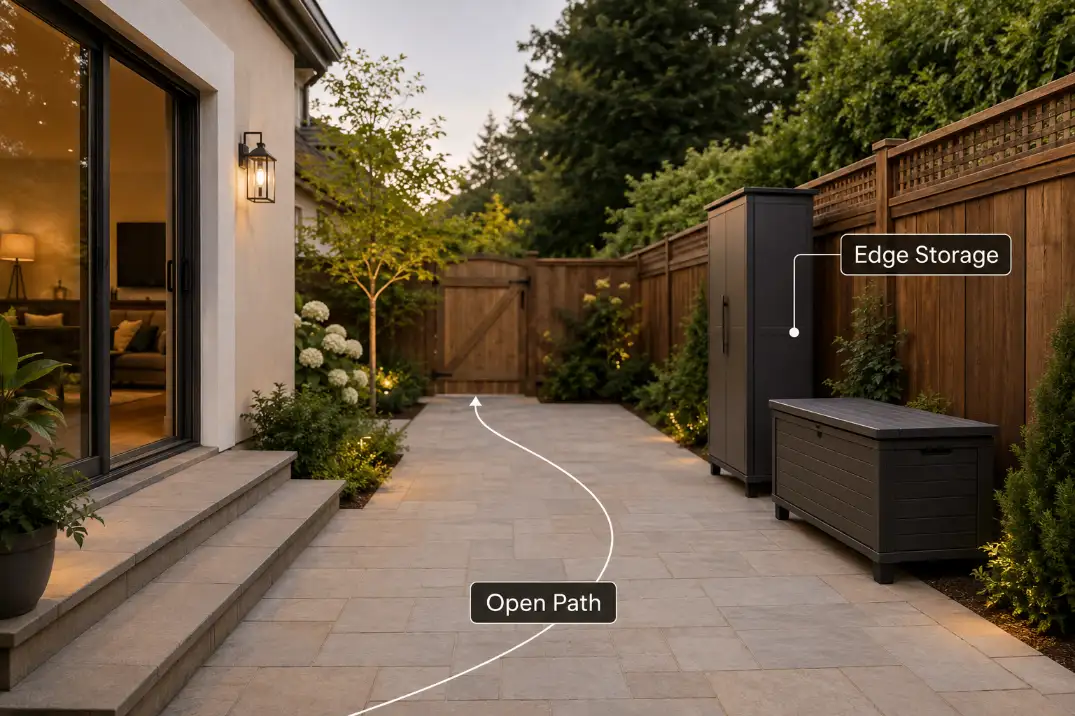
Storage should live beside them, not inside them. A small backyard can tolerate visible storage better than blocked movement.
Second, Sort by Use Frequency
Separate items into weekly, monthly, and seasonal groups before buying anything. Weekly items deserve shallow, visible, easy access. Monthly items can go behind doors. Seasonal items can go into larger boxes, upper shelves, or less convenient corners.
This step often reduces the need for new storage because the problem was not total volume. It was the wrong item in the wrong access zone.
Third, Match the Fix to the Failure
If tools are leaning everywhere, choose a rail, hooks, or a slim vertical cabinet. If cushions are getting damp, improve drying and airflow before buying a larger box.
If the patio feels tight, move storage to the perimeter before downsizing furniture. If toys spread across the yard, use a low container children can actually open and close.
For small patios where the product choice still matters, Best Small Patio Storage Solutions can help narrow the type without turning the yard into a storage display.
Questions People Usually Ask
Is one shed better than several smaller storage pieces?
Only if the shed has a clear job and the yard can absorb the footprint. A shed works for bulky seasonal gear, lawn equipment, and tools that should not live near seating. Several smaller storage pieces often work better when the items are used in different parts of the yard.
Should outdoor cushions stay in a deck box all season?
They can, but only if they go in dry and the box stays dry inside. If the cushions smell musty, feel damp, or show dark spots, the box is trapping moisture. Let them dry first and avoid compressing damp fabric for more than a day.
How much storage is too much for a small backyard?
Storage is too much when it protects objects better than it protects the yard’s use. If the main path falls below 30 inches, chairs cannot slide back, or one storage item blocks access to another, the system has crossed from helpful into restrictive.
Final Takeaway
Small backyard storage should protect the route before it hides the stuff. The best setup may not be the largest, most invisible, or most expensive one.
It is the one that keeps movement open, gives frequent-use items fast access, lets damp materials dry, and avoids turning the patio, side yard, or fence line into a storage aisle.
For broader official guidance on moisture control, see the EPA’s guide to mold, moisture, and your home.