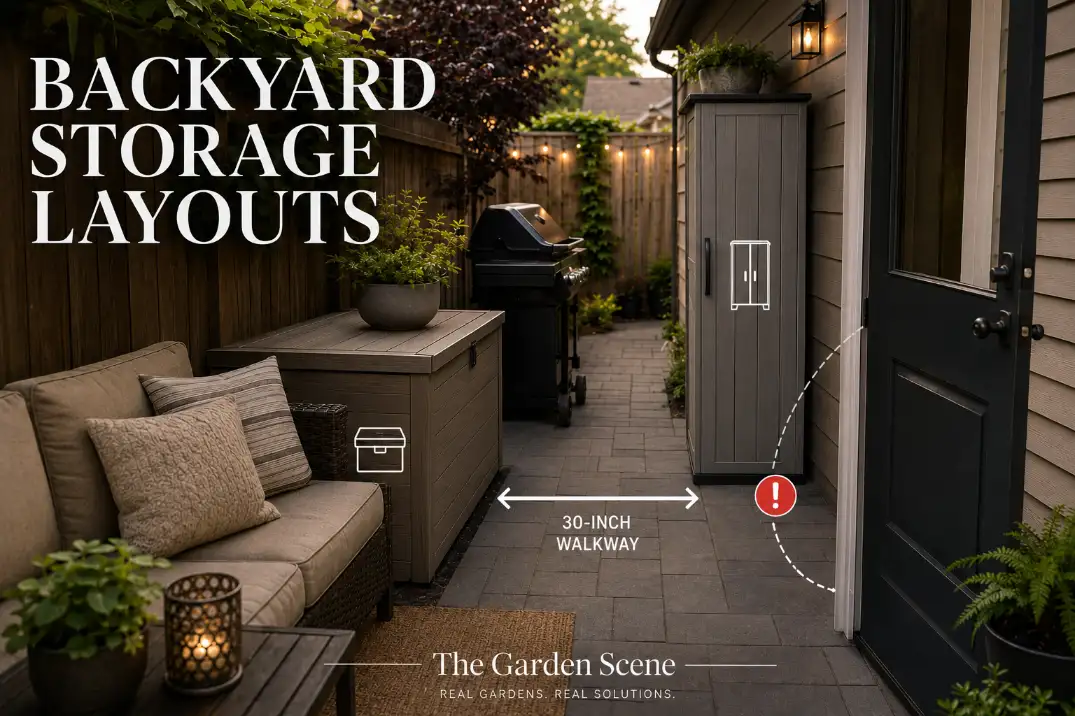
Small backyard storage usually fails because the storage is placed where leftover space appears, not where the backyard actually functions.
The best layout is not the one with the most containers. It is the one that keeps the center open, puts weekly-use items within 6 to 10 feet, and moves dirty or seasonal gear out of the social zone.
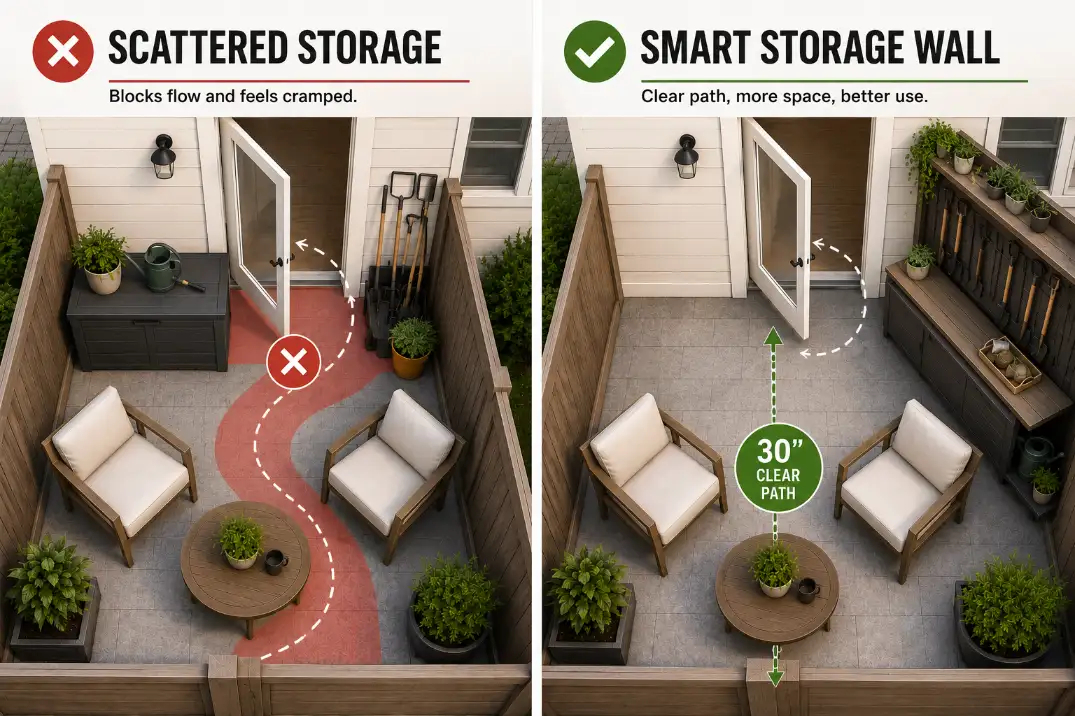
Start with three checks: whether the main walking path stays at least 30 inches wide, whether storage doors or lids can open without blocking seating, and whether the items inside match the nearby activity.
A deck box beside the chairs may look convenient, but if it narrows the path or forces people to step around the grill, it is not saving space. It is stealing flow.
That is the difference between a storage idea and a storage layout. A storage idea hides objects. A storage layout protects movement first, then assigns each container a job.
Choose the Layout by What Is Stealing Space
Before choosing a cabinet, deck box, bench, or shed, identify the thing that is actually making the backyard feel smaller. In small outdoor spaces, the visible clutter is often only the symptom.
The underlying problem is usually blocked circulation, poor access, or storage placed in the main sightline.
| What is stealing space? | Best storage layout | Avoid |
|---|---|---|
| Main walkway feels tight | Side-wall storage run | Deck box beside the traffic path |
| Patio center feels crowded | Corner anchor layout | Scattered small bins |
| Seating area lacks storage | Bench-storage edge | Separate box behind chairs |
| Tools and soil look messy | Service-zone storage | Keeping dirty gear near seating |
| Sliding door view feels blocked | Offset storage outside the sightline | Tall cabinet directly opposite the door |
| Grill and dining compete | Vertical cabinet near grill edge | Mixing grill tools with cushions |
This table matters because small yards punish vague storage. A 100-gallon box, a tall resin cabinet, and a storage bench can all be useful in the right place. In the wrong place, each one becomes another obstacle.
The Best Layout Starts With Use Frequency
Storage should not be arranged by item category alone. It should be arranged by how often each item moves.
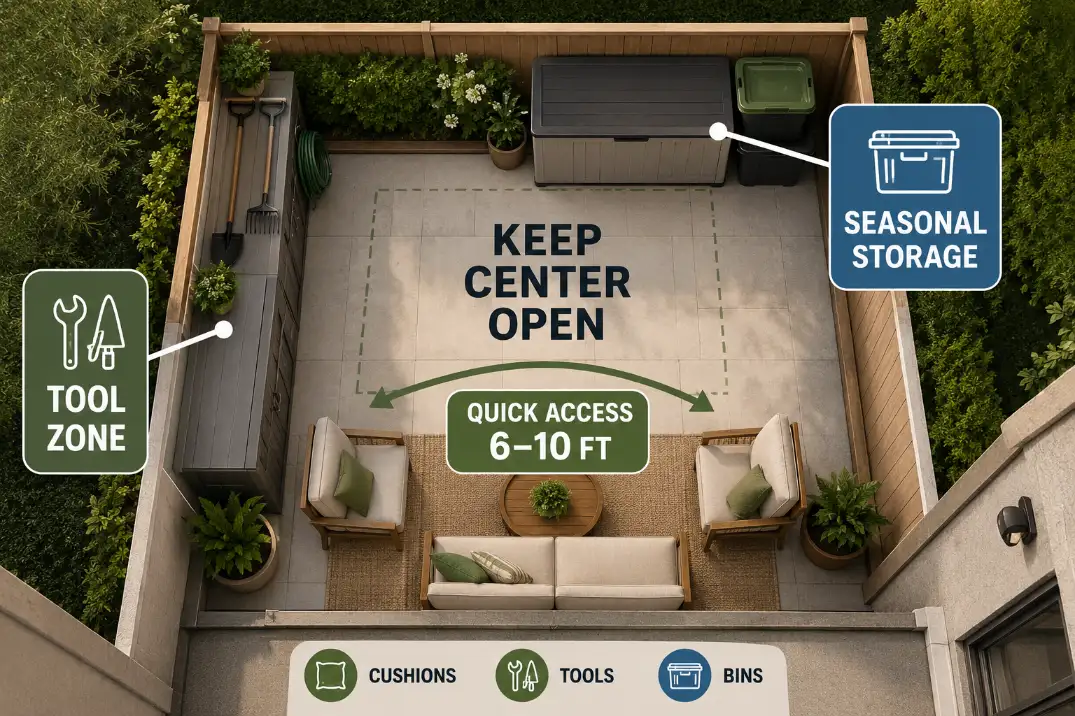
Keep weekly-use items within 6 to 10 feet
Cushions, grill tools, pet toys, small pruning tools, and outdoor throws should live close to the zone where they are used. If people need to cross the yard every time they want a cushion, the system will break within a week or two.
The result is familiar: cushions left on chairs, tools leaning near the door, and a deck box that technically exists but does not change behavior.
A small patio usually works better when quick-access storage sits within 6 to 10 feet of seating or cooking, but outside the main walking lane. If the patio already feels crowded before storage is added, the smarter move may be to store off the patio to free space before choosing another deck box or cabinet.
Push seasonal and dirty items farther out
Soil bags, extra pots, hose attachments, snow-melt buckets, rarely used garden tools, and spare planters do not deserve prime patio space. These items can move to a shed wall, side-yard cabinet, fence-mounted rack, or narrow storage zone near the service path.
A common overestimate is how often everything needs to be close. Most backyard items are not daily-use items. If something is touched once every 2 to 4 weeks, it can live farther from the seating area without hurting usability.
For patios where clutter already eats into seating, the better first move is often not buying another container but reducing what sits in the open.
The logic is similar to Reduce Patio Clutter Without Losing Function: keep function visible, but move storage mass out of the social zone.
Four Backyard Storage Layouts That Actually Work
There is no single best layout for every small backyard. The right choice depends on whether the space is patio-dominant, lawn-dominant, grill-focused, or shaped by a narrow side yard. Still, most small spaces fall into one of four workable patterns.
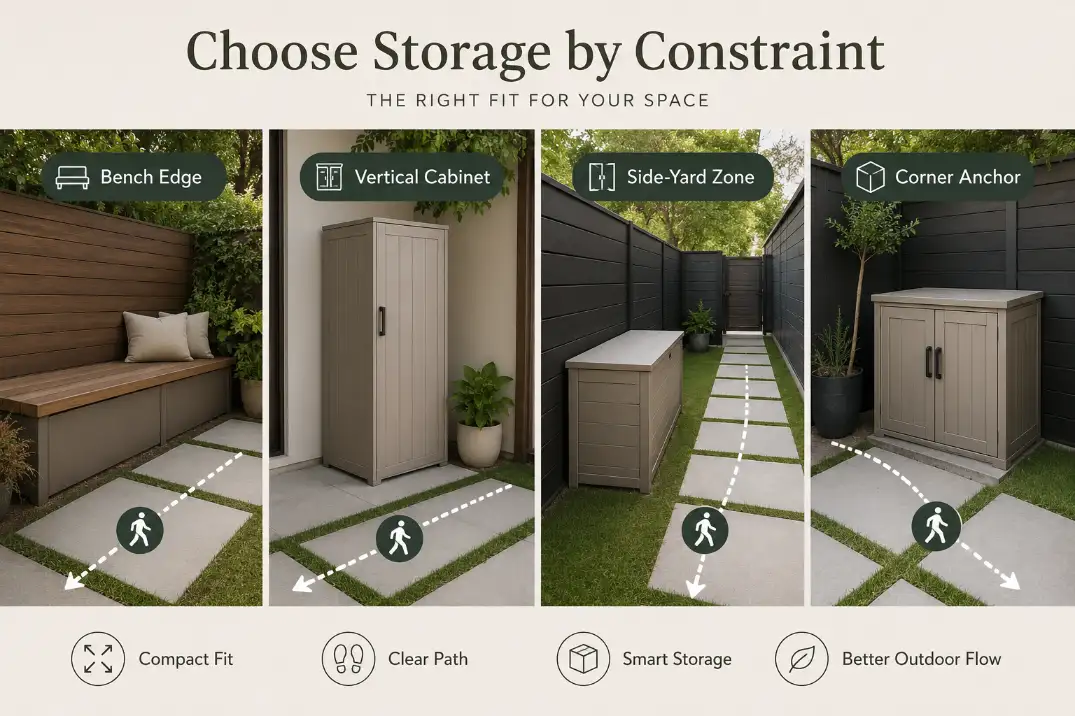
1. The side-wall storage run
This is usually the strongest layout for small patios and townhouse backyards. A slim cabinet, wall-mounted tool rack, or narrow deck box runs along one side boundary instead of sitting near the middle of the patio.
Use this when the backyard has a fence, garage wall, retaining wall, or house wall that does not need to stay visually open. The goal is to turn one edge into a storage spine while keeping the center open.
A side-wall run works best when units stay under about 18 to 24 inches deep. Deeper storage can still work, but only if the patio has enough width to preserve a 30- to 36-inch walkway after the doors or lids open.
Pro Tip: Before buying a cabinet, tape its footprint on the patio and mark the door swing. Many layouts fail because the closed cabinet fits, but the open cabinet does not.
2. The corner anchor layout
A corner anchor places one larger storage piece in the least useful corner of the yard. This can be a vertical cabinet, compact shed, tall resin unit, or covered tool organizer.
This layout is better than scattering three small boxes around the patio. One larger vertical piece often creates less visual clutter than multiple low containers because it concentrates storage mass in one predictable place.
The corner anchor is especially useful for yards where the main view is from a sliding glass door. Place the storage outside the first sightline when possible. If the cabinet is the first thing seen from inside the house, it will make the whole backyard feel more utilitarian, even if the square footage has not changed.
3. The bench-storage edge
Storage benches work best when they replace seating, not when they are added behind seating. A 48- to 60-inch storage bench can hold cushions, throws, pool towels, or small toys while also giving the patio a finished edge.
This is the right layout when the patio needs occasional seating but cannot afford a separate box and chairs. It is also one of the few storage moves that can improve the look of the space instead of just hiding objects.
The wasteful version is adding a bench where nobody naturally sits. If the bench faces a blank fence, blocks the grill path, or sits too far from the conversation zone, it becomes a decorative box with a backrest. A better approach is to use the bench to complete a seating corner or define the outer edge of the patio.
If your layout points toward seating storage, do not choose by gallon size first. Choose by lid clearance, seat height, cushion depth, and whether the bench replaces a chair.
That is where Best Outdoor Storage Benches and Deck Boxes for Small Patios becomes the more useful comparison, because the wrong product can save storage space while still making the patio harder to use.
4. The service-zone layout
Some yards should keep storage off the patio almost entirely. If there is a side yard, garage-side strip, back gate, or narrow area beside the house, use it as a service zone for tools, soil, watering gear, and dirty items.
This is often the best layout for families who use the patio for dining or lounging. It keeps the social area clean and lets the less attractive gear live near the route where maintenance actually happens.
The only caution is drainage. A service zone that stays wet for more than 24 to 48 hours after rain is a poor place for cushions, cardboard packaging, fertilizer, or metal tools. In humid Florida yards or shaded Midwest side yards, airflow matters more than hiding everything tightly against the fence.
When Built-In Storage Beats Movable Boxes
Movable storage is better for renters, changing layouts, and patios where the furniture plan is not settled yet. But in a small backyard that already has a stable seating edge, built-in or semi-built-in storage can look cleaner and waste less space.
Use built-in storage when the edge is permanent
A built-in bench, under-seat cushion drawer, or fence-side storage band works best when the patio edge is not likely to change. Instead of adding a separate box behind the furniture, the storage becomes part of the furniture line.
This is where small patios can start to feel more intentional. A storage bench along one edge, a slim cabinet at the end, and a clear central walking path often look calmer than several freestanding containers, even if the actual storage capacity is similar.
Skip built-ins when access is still changing
Built-in storage is not automatically better. If the grill moves seasonally, kids’ toys change every year, or the yard doubles as a work area, fixed storage can become a constraint. In that case, use movable cabinets or modular boxes until the activity pattern is stable.
The point is not to make everything permanent. The point is to stop using portable storage as a substitute for layout decisions.
Match the Storage Type to the Layout
The object matters less than the job it performs. A deck box, cabinet, bench, and wall rack each solve a different problem.
| Storage type | Best placement | Best for | Watch out for |
|---|---|---|---|
| Slim vertical cabinet | Side wall or corner | Tools, sprays, gloves, grill accessories | Door swing blocking a path |
| Medium deck box | Edge of seating zone | Cushions, toys, towels | Lid clearance and visual bulk |
| Storage bench | Patio edge | Seating plus soft goods | Uncomfortable seating depth |
| Wall tool rack | Fence, garage, shed wall | Long-handled tools | Exposed tools looking messy |
| Narrow shed | Side yard or rear corner | Seasonal and dirty gear | Blocking light or drainage |
| Rolling cart | Grill or potting zone | Flexible task storage | Becoming permanent clutter |
Deck boxes are overused in small yards
Deck boxes are popular because they are simple, but they are not always the best small-space answer. A 100- to 130-gallon box can consume roughly the same footprint as a small loveseat. If the patio is only 8 by 10 feet, that footprint is not minor.
Use a deck box when you need dry, quick-access storage for bulky soft items. Do not use it as a default catchall for tools, chemicals, soil, and outdoor toys. Mixed storage usually becomes chaotic because the most-used items sit on top while dirty or awkward items sink to the bottom.
Vertical storage often beats horizontal storage
When the patio is tight, vertical storage usually wins. A tall cabinet uses wall height instead of floor spread, hides awkward tools better, and keeps small items easier to sort. The tradeoff is access: tall cabinets need enough clearance for doors, shelves, and safe reaching.
For small patios under about 120 square feet, one vertical unit plus one seating-integrated storage piece often works better than two deck boxes. That combination separates tool storage from comfort storage, which keeps both easier to use.
If the main problem is not layout but choosing the right container type, Best Small Patio Storage Solutions is a better next step because it compares the storage products by constraint rather than by style.
Tool storage needs a different rule
Long-handled tools, sprays, gloves, pruners, and garden supplies usually belong in vertical storage, not in a cushion box. A deck box makes these items harder to see and easier to bury. A cabinet or tool organizer keeps them upright, separated, and away from soft goods.
That matters in small yards because tool clutter spreads quickly. If rakes, brooms, and hose attachments keep leaning against the fence, the more useful comparison is Best Backyard Storage Cabinets and Tool Organizers, not another general patio storage box.
What People Usually Misread First
The visible clutter is the symptom. The underlying mechanism is usually friction: items are too hard to put away, storage is too far from the task, or the container is placed where opening it is annoying.
“More storage” is not always the fix
Adding another bin often makes a small backyard worse. It creates one more footprint, one more lid, and one more object to walk around. If the patio already has less than 30 inches of clear passage between furniture and storage, more storage will probably intensify the problem.
That is why many small-space fixes start with avoiding the Backyard Storage Mistakes That Ruin Patio Flow rather than buying a larger container.
The better first move is to separate items into three groups:
- Used weekly and worth keeping close
- Used monthly or seasonally and worth moving out
- Damaged, duplicated, or rarely used and not worth storing outside
That third group matters. Small spaces punish “just in case” storage. Keeping an extra hose, five half-used soil bags, broken planters, and two backup cushions can consume the exact space that would have made the patio feel usable.
Hiding everything can backfire
Readers often overestimate how much visual concealment they need. A fully hidden setup sounds ideal, but if every item sits behind a heavy lid or deep cabinet door, the most-used tools will end up outside again.
Readers also underestimate moisture. In coastal California, humid Gulf areas, and shaded northern yards after snowmelt, tightly packed storage can trap damp air.
If cushions smell musty after 2 or 3 days inside the box, the problem is not just the cushion fabric. It is usually poor drying time before storage, weak ventilation, or a container sitting in a damp zone.
A Practical Layout Order for Small Backyards
The most reliable order is not “buy storage, then arrange it.” It is path, zone, container, then concealment.
Step 1: Protect the walking path
Keep the main route from the door to seating, grill, gate, or lawn at least 30 inches wide. If two people often pass each other, 36 inches is better. Anything narrower may still be physically passable, but it will feel cramped once someone carries food, cushions, tools, or a laundry basket of pool towels.
This is where many attractive layouts fail. They photograph well empty, then break during real use.
Step 2: Assign one storage job per zone
Do not make one cabinet serve every backyard function. Put cushion storage near seating, grill storage near cooking, tools near the service path, and seasonal items away from the patio. When storage is tied to use, people are more likely to put items back.
For yards where tools and supplies are the main visual problem, Hide Backyard Tools and Supplies Without Adding Clutter goes deeper into keeping utility items accessible without turning them into the main view.
Step 3: Choose the smallest container that preserves behavior
A container that is too small fails because items spill out. A container that is too large fails because it invites junk. The useful middle is enough capacity for the specific category, with about 10 to 20 percent spare room so items can be returned without repacking the box every time.
That spare room is not wasted space. It is what keeps the system usable after the first weekend.
Step 4: Stop when the layout starts stealing function
A routine fix stops making sense when storage begins removing the very activity the backyard is supposed to support.
If a storage bench replaces the only comfortable chair, if a cabinet blocks grill prep, or if a deck box forces the dining table off-center, the layout is not efficient. It is just organized obstruction.
Small-space storage should make the backyard easier to use within 30 seconds of stepping outside. If it makes setup slower, the fix is too heavy.
Best Layout by Backyard Shape
Narrow rectangular yard
Use one side-wall storage run and keep the opposite side visually lighter. Avoid placing storage across the short end if it makes the yard feel like a corridor. Long narrow patios especially need uninterrupted movement, so storage should hug one edge rather than create pinch points.
Square patio
Use a corner anchor plus storage bench edge. Square patios can feel crowded quickly because furniture, grill, and storage compete for the same center. Keeping storage in one corner and one edge leaves the middle visually calm.
L-shaped patio
Use the inside corner for storage only if it does not interrupt turning movement. L-shaped patios often fail when the short leg becomes a dumping zone. A better approach is to keep one leg social and the other leg functional: seating on the wider side, storage on the narrower service side.
Patio with a sliding glass door
Do not place the largest storage object directly opposite the door. That turns storage into the backyard’s focal point. Shift it left or right of the main sightline, then keep the first 3 to 4 feet outside the door clear so the transition feels open.
Townhouse or fence-lined backyard
Use height carefully. Vertical cabinets, wall hooks, and slim shelving can work well because the yard already has strong boundary lines. The mistake is filling every fence panel with gear. Choose one storage wall and let the other side breathe.
Small yard with kids or pets
Keep toy storage low and fast to open, but keep sharp tools, chemicals, fertilizers, and grill accessories in locked or higher storage. A deep cabinet for daily toys usually fails because kids will not repack it neatly. A low edge box for toys and a separate vertical tool cabinet is usually more realistic.
Questions People Usually Ask
Is a shed worth it in a small backyard?
A shed is worth it only if it moves bulky or dirty items out of the living zone without blocking light, drainage, or access. In many small yards, a narrow cabinet or side-yard storage run performs better than a full shed because it solves the problem without becoming the dominant structure.
Should cushions be stored inside or outside?
Outdoor cushion storage works when the cushions are dry before they go in and the box has enough airflow or weather protection. If cushions stay damp for more than 24 hours, storing them in a sealed box can make odor and mildew worse. In rainy seasons, indoor or garage storage is often safer.
What is the biggest storage mistake in small backyards?
The biggest mistake is placing storage where the eye and feet both need open space: near the door, beside the main chair path, or in the center edge of the patio. The best storage layout usually feels quieter because it protects movement before it hides objects.
A good layout makes the backyard easier to use within 30 seconds of stepping outside. The walkway stays open, the most-used items are close, and dirty or seasonal gear does not compete with seating.
The layout is working when storage disappears into the edges, not because it is invisible, but because it no longer interrupts the way the backyard is used.
For broader official guidance on storing garden chemicals safely, see the U.S. Environmental Protection Agency.