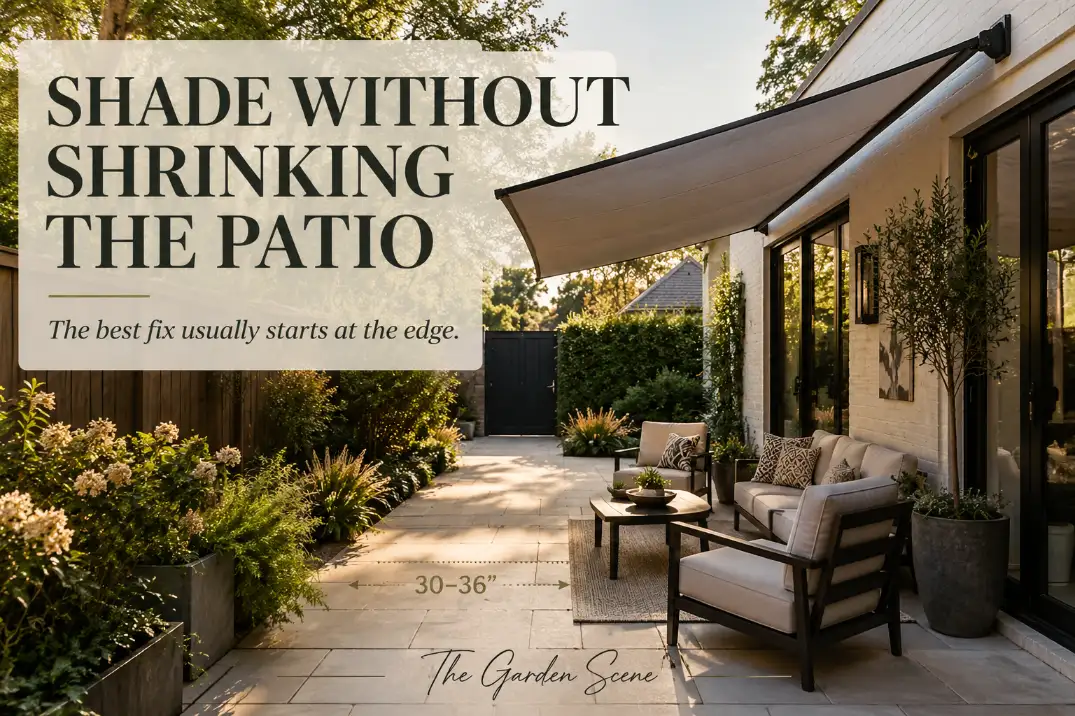
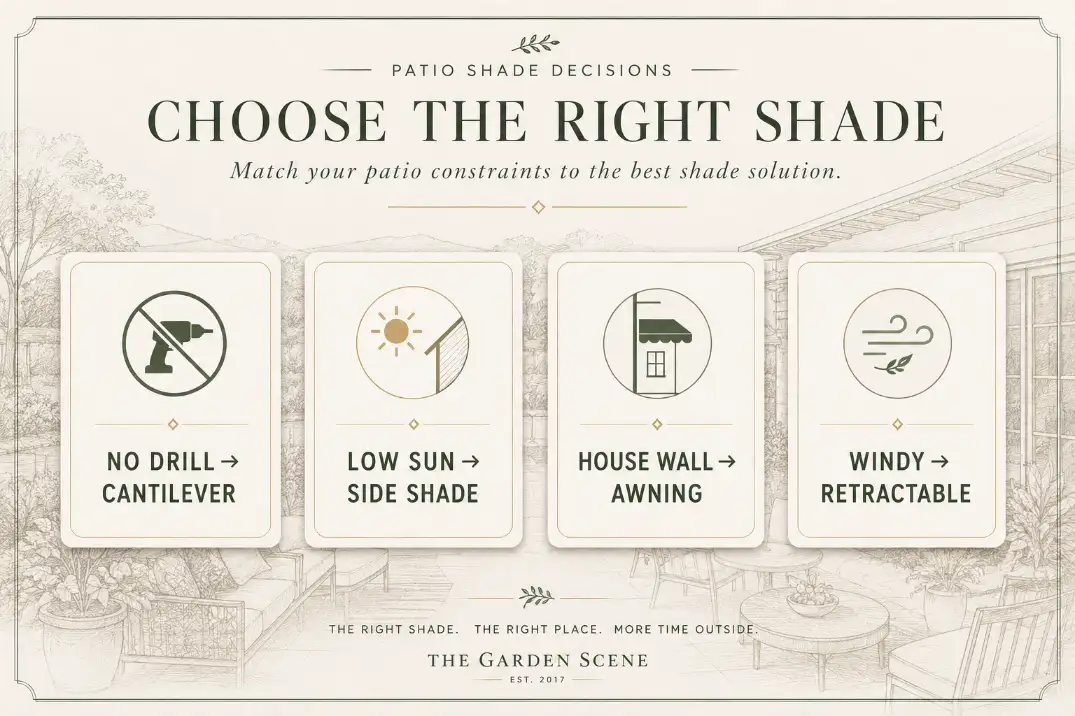
For most small patios, the best shade option is a wall-mounted retractable awning if the patio touches the house, a cantilever umbrella if you need a removable setup, or a side roller shade if the real problem is low afternoon sun.
The goal is to shade the seats without putting posts, bases, ropes, or fabric edges where people need to walk.
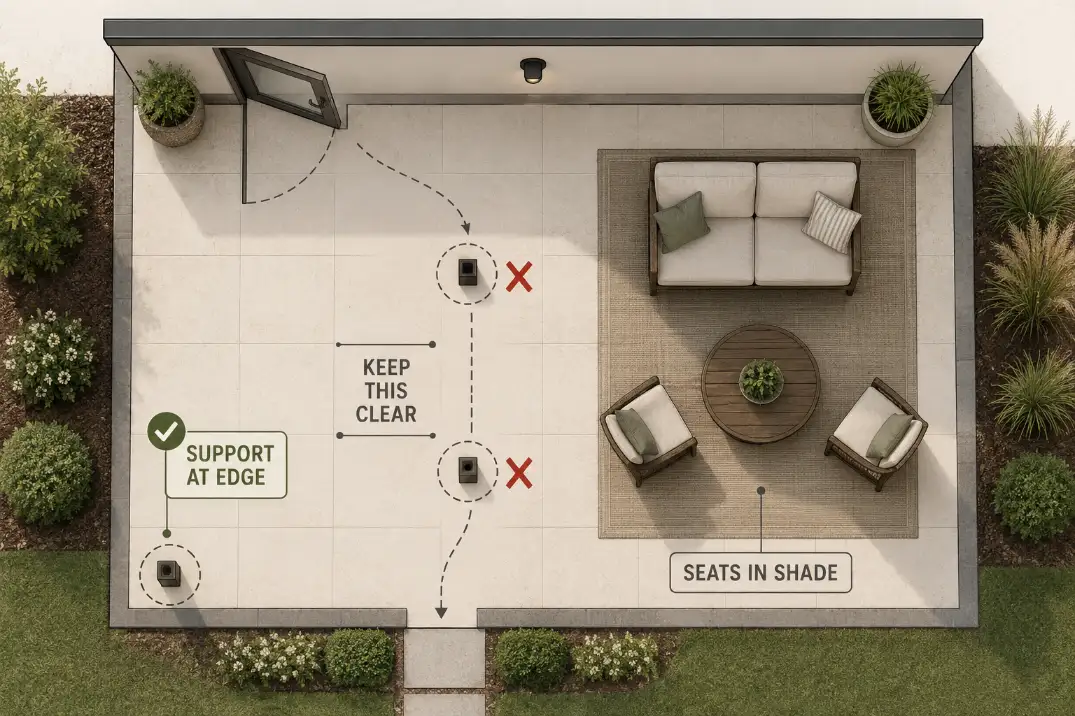
Start with three checks: keep one clear route at least 30–36 inches wide, shade the seating area during the hours you actually use it, and keep the support structure out of the main furniture footprint.
A small patio can work well with only 50–70% of the slab shaded if the shade lands in the right place. It can feel cramped with full coverage if the hardware cuts through the center.
Best Shade Choice by Small-Patio Constraint
The right shade choice depends less on the product name and more on the constraint. A renter, a west-facing patio, and a dining-only patio do not need the same fix.
| Small patio need | Best first choice | Usually avoid | Why it works |
|---|---|---|---|
| Best overall floor-saving shade | Wall-mounted retractable awning | Center-pole umbrella | Adds shade without floor clutter |
| Best removable option | Cantilever umbrella | Oversized pop-up canopy | Moves the pole toward the edge |
| Best no-drill rental option | Weighted cantilever umbrella or freestanding screen | Wall-mounted awning | Avoids permanent attachment |
| Best apartment patio option | Clamp-on umbrella or outdoor roller shade | Large shade sail | Fits narrow exposure better |
| Best west-facing patio fix | Side roller shade or angled sail | Flat overhead-only canopy | Blocks low afternoon sun |
| Best windy patio option | Retractable awning or fixed pergola | Loose canopy tent | Reduces flapping and instability |
| Best dining patio option | Table umbrella or awning | Offset base behind chairs | Preserves chair pullback space |
The most common mistake is choosing the product with the biggest canopy. On a small patio, the better question is: Where does the support land?
What “Open” Really Means on a Small Patio
Open does not mean empty. It means the patio still has a clean path, usable furniture, and visual breathing room after shade is added.
The clearance test that matters
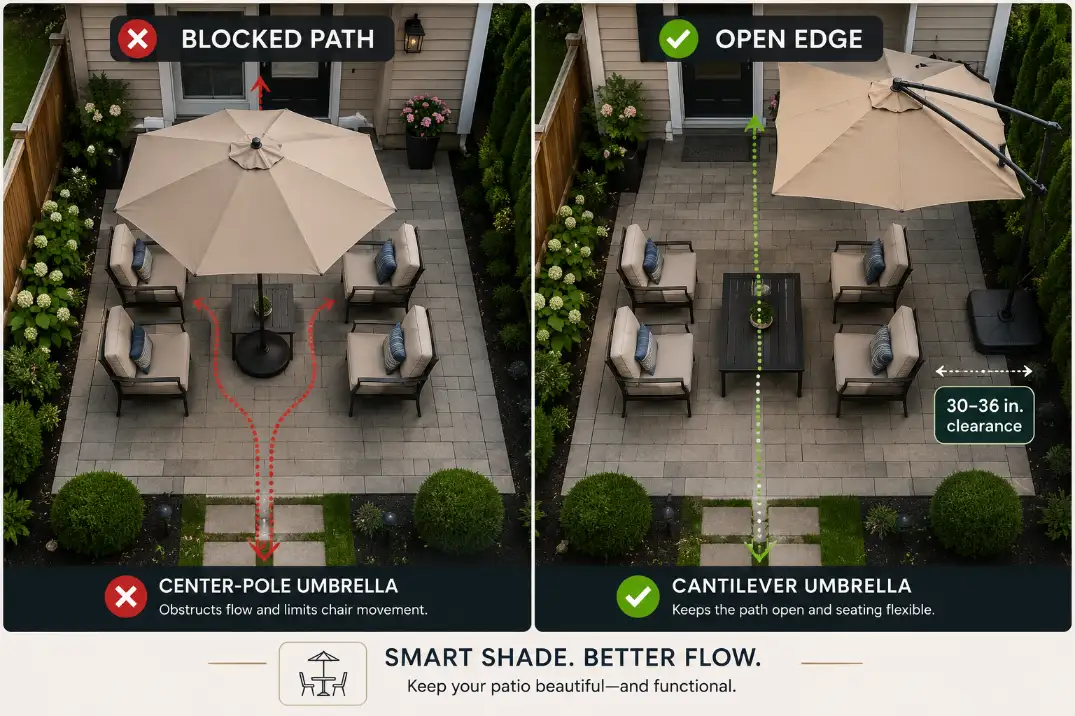
A working patio route needs about 30 inches of clear width at minimum. At 36 inches, movement feels much easier, especially when people are carrying plates, drinks, cushions, or grill tools.
If a shade base narrows the route to 20–24 inches, people start turning sideways or shifting chairs around it.
This is why many umbrellas disappoint. The canopy looks right from above, but the base lands exactly where feet and chair legs need to move.
If that is happening, the issue is not umbrella size; it is support placement. That failure pattern is explained more deeply in Why a Patio Umbrella Is Often the Wrong Shade Solution.
Shade timing beats full coverage
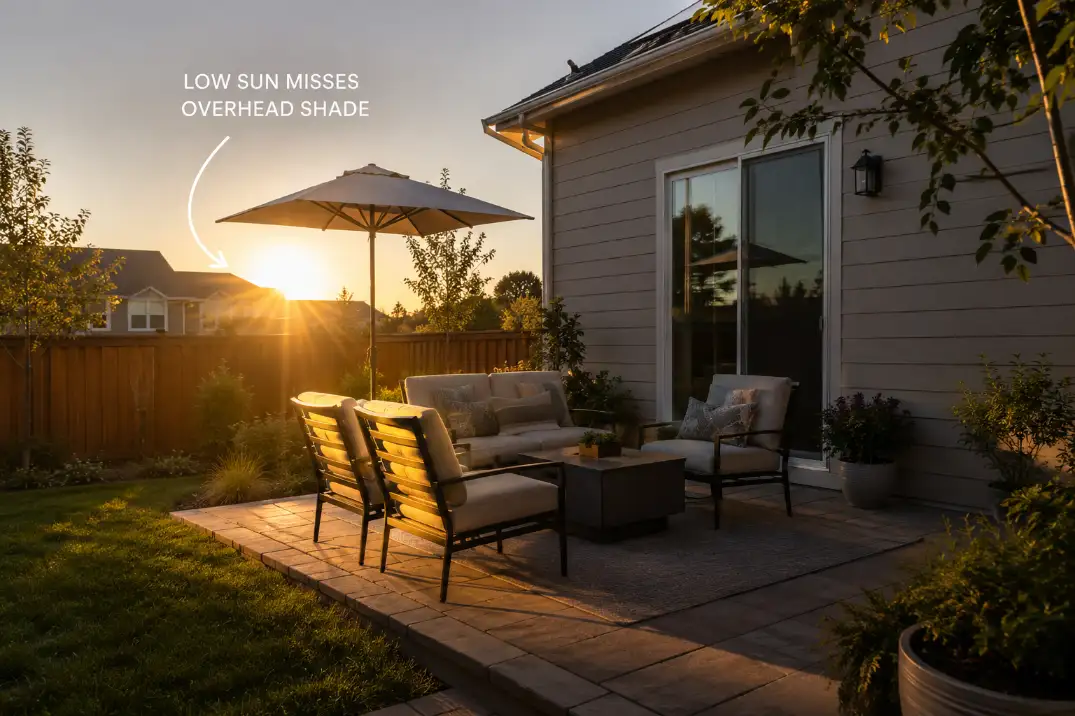
The most useful shade is the shade that arrives when the patio is actually used. A breakfast patio may need shade from 8 a.m. to 11 a.m. A west-facing patio may be uncomfortable from 3 p.m. to 6 p.m., even if it looks shaded at noon.
Flat overhead shade often fails late in the day because the sun comes in from the side. That is why a small side screen can sometimes outperform a much larger umbrella.
Pro Tip: Mark the shadow line with chalk or painter’s tape at the time you normally sit outside. One 10-minute check in real sun is more useful than judging from product photos.
The Best Shade Options When Floor Space Is Limited
The best shade options for small patios keep their weight, posts, and attachment points outside the active zone.
Wall-mounted retractable awning
A retractable awning is often the cleanest solution when the patio sits directly against the house. It creates shade without floor posts, and it can retract when you want winter sun, open sky, or storm protection.
For many small rectangular patios, a 10- to 12-foot-wide awning with an 8- to 10-foot projection can cover the seating area without crowding the patio.
The mounting is the important part. An awning should attach to structural framing, masonry, or properly designed supports, not just siding.
If the front edge hangs too low, the floor may stay open but the patio can still feel compressed. Aim for a comfortable walking edge, often around 7 feet or higher where people pass underneath.
Cantilever umbrella
A cantilever umbrella is usually better than a center-pole umbrella when the patio is used for lounging, mixed seating, or flexible furniture. The pole and base sit off to the side while the canopy reaches over the chairs.
The base is still the limiting factor. Some cantilever umbrella bases are 30–40 inches wide or require multiple weighted plates. If the base must sit in the walkway, the umbrella loses its advantage. The best placement is along a fence, house wall, planting bed, or outside patio corner.
Shade sail attached to perimeter anchors
A shade sail can work well when the anchor points already exist or can be placed outside the usable area. A triangular sail is especially useful because it can shade one seating corner without creating a heavy roof over the entire slab.
The common mistake is hanging the fabric too low or too loose. A sagging sail makes the patio feel temporary and closed in. The lowest walking edge should usually stay near or above 7 feet, and the sail needs real tension. Fence boards alone are usually not reliable anchor points for a tensioned sail.
Shade also interacts with airflow. A patio can be shaded and still feel uncomfortable if fabric, walls, or screens trap warm air around the seats.
That relationship between shade, seating, and breeze is especially important in humid areas, and it is explored further in How Backyard Layout, Shade, Seating, and Airflow Work Together.
Outdoor roller shades for low sun
Outdoor roller shades are underrated on small patios because they solve a different problem than overhead shade. They are best when the sun comes in low from the west or southwest and hits people under the edge of a canopy.
A roller shade works well on a covered patio, balcony, pergola side, porch opening, or wall-adjacent frame. It uses vertical space instead of floor space, which is exactly what a tight patio needs.
Outdoor curtains when you already have a frame
Outdoor curtains can help with glare, privacy, and late-day sun if the patio already has a pergola, covered roof edge, or strong side frame. They are not usually the best first shade purchase for a completely open patio because they need something stable to hang from.
The key is restraint. One curtain panel on the sun side can be useful. Curtains wrapped around three sides of a small patio can block airflow and make the space feel smaller.
Slim pergola with open rafters
A pergola is not automatically too large for a small patio. A slim frame can work when the posts land on the perimeter and the roof treatment stays visually light. Open rafters, narrow louvers, or a retractable fabric panel usually feel better than a heavy solid roof.
The line is crossed when posts take away usable corners. On a 10×10 patio, four bulky posts can reduce chair pullback and make the corners feel dead. If dining chairs cannot slide back 24–30 inches without hitting a post, the pergola is controlling the patio instead of supporting it.
Best No-Drill Shade Options for Renters and Apartments
Renters, condo owners, and townhome residents often need shade without drilling into siding, masonry, balcony rails, or shared fencing. The best removable options still keep weight and hardware near the edge.
Weighted cantilever umbrella
This is usually the strongest no-drill option for a ground-level rental patio if there is room for the base along an edge. It gives better furniture flexibility than a table umbrella and avoids permanent attachment.
The tradeoff is footprint. A removable solution still needs stability, so the base may be large. If it blocks the only route from the door to the yard, choose a smaller canopy or a different shade direction.
Clamp-on balcony umbrella
For small apartment patios or balconies, a clamp-on umbrella can work if the railing is sturdy and the property rules allow it. It is best for narrow sun exposure, not full patio coverage. The canopy should tilt, because balcony shade often needs to block angled sun rather than overhead heat.
Do not force this solution on weak railings or exposed upper floors. Wind loads are more noticeable above ground level, and a small umbrella can become unstable quickly if left open in gusts.
Freestanding screen
A freestanding outdoor screen can block low sun without covering the entire patio. It is useful when the problem is late-afternoon glare, not midday heat. If the sun is hitting faces, chair backs, or the dining table from the side, a bigger roof may not solve the real problem.
Shade Options by Cost, Installation, and Floor Impact
| Shade option | Typical US cost range | Installation difficulty | Floor impact |
|---|---|---|---|
| Table umbrella | $75–$300 | Easy | Low if centered in table |
| Cantilever umbrella | $200–$900+ | Easy to medium | Medium to high base footprint |
| Shade sail kit | $50–$300 | Medium | Low if anchors are outside patio |
| Freestanding screen | $100–$600 | Easy | Medium along one side |
| Outdoor roller shade | $100–$800+ | Medium | Very low if mounted to frame |
| Retractable awning | $300–$2,500+ | Medium to pro-level | Very low floor impact |
| Small pergola kit | $700–$5,000+ | Medium to pro-level | Depends on post placement |
The cheaper option is not always the more practical one. A $100 umbrella that blocks the door path is a worse small-patio choice than a more expensive awning or roller shade that leaves the floor open.
What People Usually Get Wrong
Small-patio shade decisions often fail because the visible symptom and the underlying mechanism are not the same thing. The symptom is heat or glare. The mechanism is usually shade angle, support placement, trapped air, or poor mounting.
Bigger shade is not always better
A larger canopy can make a small patio feel smaller if it drops too low, darkens the whole space, or requires a larger base. More coverage can also push furniture inward, which defeats the point of adding comfort.
This is especially common when people buy the biggest umbrella that fits the slab instead of the best umbrella for the traffic path.
Low sun is not an overhead problem
West-facing patios often need angled shade, a side roller shade, an outdoor curtain, or a tilting canopy. A flat overhead umbrella may work at noon and fail at 5 p.m.
That difference matters because many people use patios after work, not during peak midday sun.
For patios hit by strong afternoon exposure, the shade angle matters more than the product category. A deeper look at that sun pattern appears in Best Patio Shade Solutions for Afternoon Sun.
Plants help, but rarely solve the whole problem
Large containers, small trees, and tall shrubs can soften glare and make a patio feel better, but they are slow and imprecise as primary shade. A 6-foot potted tree may cast useful shade only during a narrow part of the day, while the container itself may take up 18–24 inches of floor width.
Plants are best as support players: glare control, privacy, cooling near edges, and visual softness.
Shade fabric performance still matters
For seating areas used in peak sun, look for outdoor fabric designed for UV exposure. Darker fabric can reduce glare but may feel warmer underneath. Lighter fabric can feel brighter and cooler but may allow more glare. In humid regions, breathable shade is usually more comfortable than a heavy enclosure.
Before You Buy Permanent Shade
Permanent shade can be the best solution, but only when the site can support it.
Check the mounting surface
A shade sail, awning, or pergola is only as good as its attachment points. Tensioned fabric pulls on anchors. Retractable awnings create leverage. Pergolas need stable posts and proper connections.
Do not treat a fence board, thin fascia, or decorative trim as a structural anchor. If the shade depends on tension or projection, the mounting surface should be confirmed before the product is chosen.
Check wind exposure
In windy yards, smaller and tighter is often better than larger and looser. Loose sails flap, pop-up canopies shift, and umbrellas become annoying or unsafe if left open during gusts.
Retractable shade is useful because it can disappear when conditions change. A fixed pergola can also work if it is properly built. The weak choice is a temporary canopy left up for weeks as if it were a permanent roof.
Check HOA, landlord, and permit rules
Some permanent shade structures may require HOA approval, landlord permission, or local permit review, especially when attached to the house. This is common with awnings, pergolas, roof extensions, and anything visible from shared areas.
If approval is uncertain, start with removable edge-supported shade rather than drilling first and asking later.
Compact Decision Checklist
Use this before buying shade hardware:
- Can one route stay at least 30 inches wide after the shade base or post is placed?
- Will dining chairs still have about 24–30 inches of pullback space?
- Does the shade hit the seats during the actual use window, not only at noon?
- Is the lowest fabric edge around 7 feet or higher over walking areas?
- Can the support sit at an edge, wall, fence line, or outside corner?
- Does the patio need side shade for low sun instead of more overhead shade?
- Will wind, HOA rules, rental limits, or seasonal storage change the best option?
If two options are close, choose the one with fewer floor obstructions. On a small patio, openness usually fails at the ground plane before it fails overhead.
What Changes by Climate and Exposure
Climate changes how shade feels, especially when the patio is small and airflow is limited.
Humid and rainy regions
In humid climates such as Florida and parts of the Southeast, shade that blocks airflow can make the patio feel heavy. Outdoor fabric, cushions, and rugs also need drying airflow after rain.
If the patio still feels damp 24 hours after a normal summer shower, ventilation may be the issue, not just shade coverage.
Outdoor dining areas are especially sensitive because people sit in one place longer. A setup that shades the table but traps heat around the chairs can feel worse than partial shade with better airflow.
This is why Shade Mistakes That Make Outdoor Dining Less Comfortable matters for tight patios.
Dry and hot regions
In dry climates such as Arizona or inland California, radiant heat from concrete, pavers, walls, and fences can matter as much as direct sun. A canopy may shade the chairs but still leave the patio feeling hot if surrounding surfaces store heat all afternoon.
Angled shade, lighter surfaces, side screening, or planting near the edge may help more than simply increasing canopy size.
Cold-winter regions
In northern states, removable or retractable shade often makes more sense than a permanent fabric installation. Winter sun can be valuable, and snow or ice can damage lightweight shade systems. If the shade has to come down for 4–5 months of the year, choose hardware that detaches cleanly.
Questions People Usually Ask
What is the best shade for a small patio without taking up floor space?
A wall-mounted retractable awning usually saves the most floor space when the patio touches the house. If wall mounting is not possible, use a side-mounted cantilever umbrella, outdoor roller shade, or freestanding screen positioned along the patio edge.
What is the best no-drill shade for an apartment patio?
A clamp-on balcony umbrella, weighted cantilever umbrella, or freestanding screen is usually the safest starting point. Always check lease rules, balcony railing strength, and wind exposure before using anything that clamps, leans, or extends beyond the railing.
Is a shade sail or cantilever umbrella better for a small patio?
A shade sail is better when you have strong perimeter anchors and want the floor completely open. A cantilever umbrella is better when you need a removable option or cannot attach hardware to the house, posts, or fence structure.
Do retractable awnings need permits?
Sometimes. Permit rules depend on local code, size, attachment method, HOA rules, and whether the awning changes the exterior structure. Before buying a permanent awning, check local requirements and any neighborhood or landlord restrictions.
The Best Overall Choice
For most small patios that need to stay open, the best shade option is an edge-supported system: a wall-mounted awning, a perimeter-tied shade sail, a cantilever umbrella placed outside the traffic lane, or a side roller shade that blocks low sun without occupying the floor.
A center umbrella still works when the patio is mainly a dining space and the table controls the pole. Plants help with glare and softness, but they rarely solve overhead heat by themselves.
Pop-up canopies are useful for occasional events, not daily patio comfort.
The best small-patio shade protects the seats, keeps the route clear, and pushes the structure toward the edges. That is what lets the patio feel cooler without feeling smaller.
For broader context on how shade and vegetation reduce outdoor heat around paved spaces, see the U.S. Environmental Protection Agency’s guidance on using trees and vegetation to reduce heat islands.