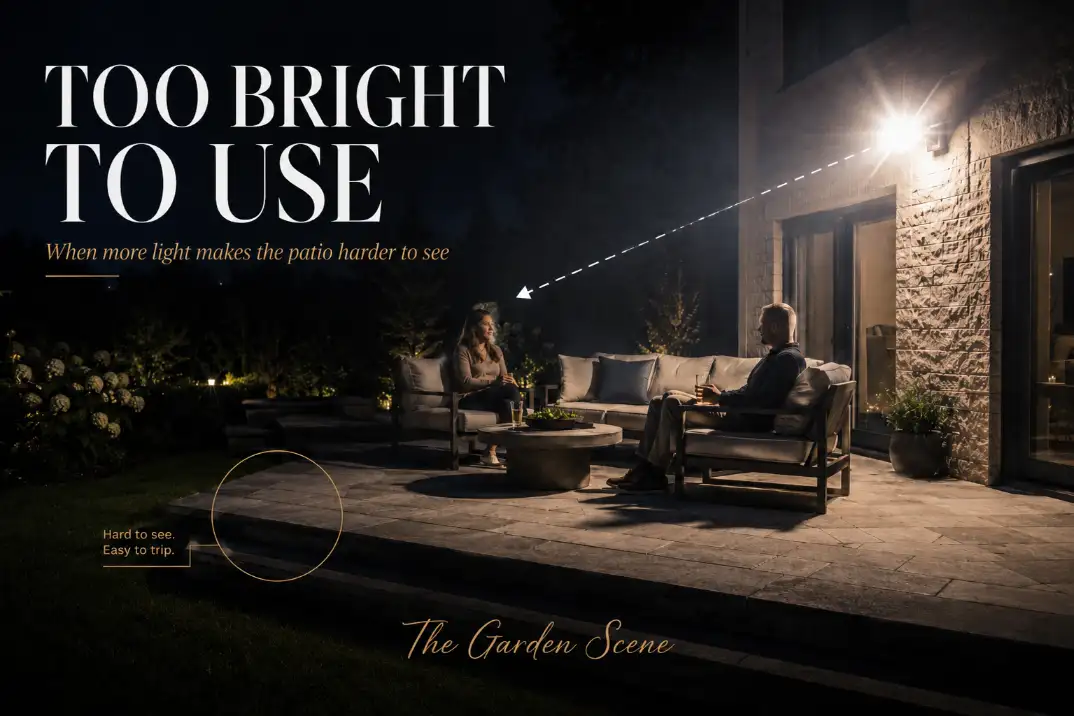
Backyard lighting plans usually make outdoor spaces hard to use because they solve the wrong problem. The yard may not be too dark. It may be too uneven, too glaring, or lit in places that do not help people move, sit, cook, or see steps.
Start with three checks after dark: sit in the main chair, walk from the back door with one hand occupied, and look for exposed bulbs between 4 and 6 feet high. If a fixture makes you squint from 10 feet away, it is not helping visibility.
This is different from a backyard that simply needs more light. A bad plan can have plenty of brightness and still hide chair legs, step edges, grill handles, and patio borders. The useful distinction is this: darkness is a shortage of light; glare is light that actively reduces what you can see.
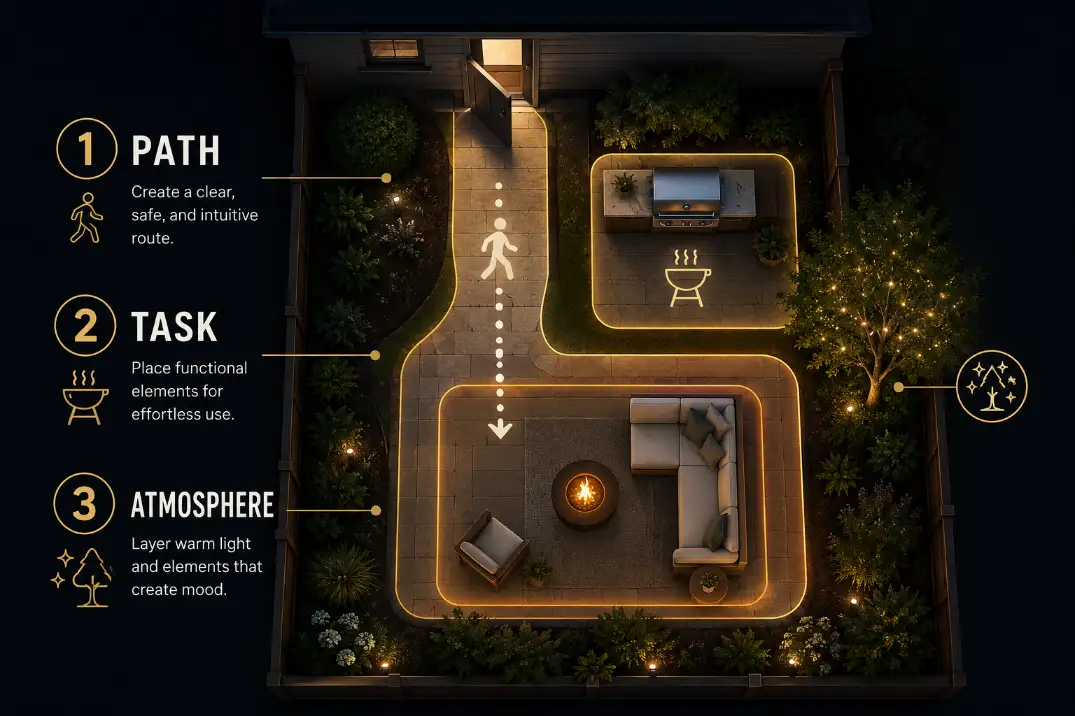
A good backyard lighting plan follows use. Movement comes first, task areas second, atmosphere third. When that order gets reversed, the yard may look polished from the kitchen window but feel awkward once people are outside.
The Main Problem Is Usually Contrast, Not Darkness
A single bright fixture can make a patio look finished while making it harder to use. Your eyes adapt to the brightest point in the scene, so the areas around it seem darker by comparison. That is why a 2,000-lumen floodlight above a patio door can make a table glow while the step down from the slab nearly disappears.
The eye-level test beats the fixture count
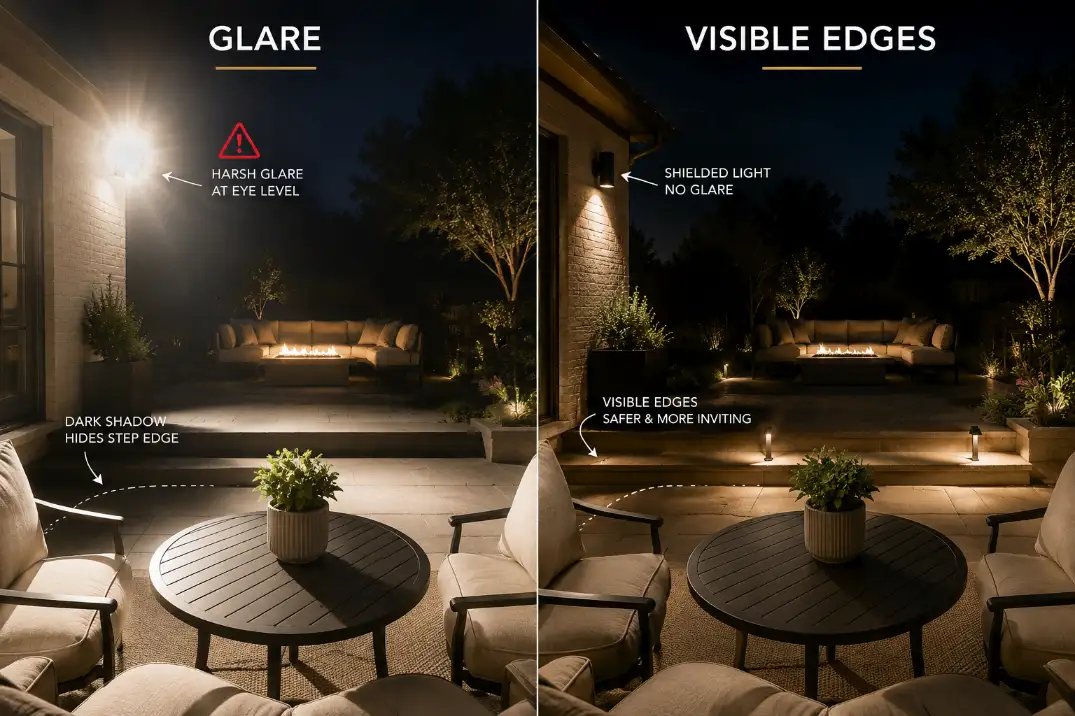
Count fixtures only after checking where the light hits. Sit where people actually sit. Stand where people actually walk. If the bare bulb, bright lens, or LED array is visible from normal eye level, the fixture is probably creating glare.
This is common with exposed sconces, low-hung string lights, wall packs, and floodlights aimed outward. The patio may look bright in a phone photo, but the better test is whether someone can sit for 60 seconds without looking away from the light, then stand and walk across the patio without slowing down.
For a more layout-first approach, the guide to best backyard lighting layout for patios at night is useful because it treats lighting as part of how people move through the space, not just as decoration.
Brightness can flatten the yard
Overlighting removes depth cues. When every surface is washed in the same bright light, the eye has less help reading edges, changes in level, and distance. Some shadow is useful. The problem is uncontrolled shadow next to harsh brightness.
A healthier plan uses lower, shielded sources to mark important transitions: step edges, path turns, gate latches, grill surfaces, and the space around furniture legs. Those areas matter more than the center of a blank fence.
The 10-Minute Night Test Before Buying Anything
Do this before replacing bulbs, adding solar lights, or ordering more string lights. It usually shows whether the real issue is placement, brightness, control, or layout.
Walk the routes people actually use
Turn on only the existing lights. Walk from the back door to the main seating area, then from the seating area to the grill, gate, trash area, storage box, or hot tub. Carry a plate, drink, or phone so the test feels like normal use.
If you slow down near a step, hose, planter, furniture corner, or surface change, that spot is a lighting priority. A small shielded light within 12 inches of a step edge may solve more than a bright fixture 15 feet away.
Sit where the discomfort happens
Spend 60 seconds in each main seat. Look toward the house, the table, and the yard. The uncomfortable seat is often not the darkest one. It is the seat facing a wall light.
If one chair feels exposed or tiring, check whether light is hitting that person’s face directly. Seating light should soften faces and reveal surfaces. It should not shine into eyes.
Turn off the brightest fixture
This is the fastest way to separate darkness from contrast. If turning off the brightest light makes the patio feel calmer or easier to read, the plan is overpowered, not underlit.
That tells you the next move: lower the output, shield the source, change the aim, or replace the fixture with a wider, softer light before adding anything new.
Match the Fixture to the Job
Many backyard lighting plans fail because fixtures are chosen by style first. A fixture can look right on the house and still be wrong for the task.
| What needs lighting | Better choice | Common wrong choice | Why it fails |
|---|---|---|---|
| Step edge | Shielded step or low path light | High floodlight | Casts glare and shadows across the tread |
| Dining table | Soft overhead or diffused nearby light | Exposed sconce behind guests | Lights faces harshly instead of the table |
| Grill prep | Focused task light near the work zone | Patio door light | Creates body shadow at the grill |
| Path turn | Low light near the turn | Even row along a bed | Lights decoration instead of the decision point |
| Gate latch | Small focused downlight | Broad security light | Overlights the fence but misses the hand task |
| Accent tree | Narrow, controlled spotlight | Main patio fixture | Makes scenery brighter than the usable area |
Floodlights are usually overused
Floodlights have a place near side yards, driveways, utility zones, and security areas. They are usually poor primary patio lights. Their wide beam can hit faces, windows, fences, and reflective surfaces before it helps someone walk safely.
If a floodlight is needed, aim it down and across the target zone, not outward into the yard. The goal is controlled coverage, not maximum spread.
Path lights should mark decisions
Path lighting does not need to look like a runway. Spacing lights every 6 to 8 feet can work along a simple walkway, but spacing is less important than placement. A turn, step, narrow passage, or surface change deserves more attention than a perfectly even row.
This is where lighting overlaps with layout. If furniture blocks the natural path, lighting can only compensate so much. The advice in patio furniture layout by size helps because a clear route is easier to light than a cramped one.
Decorative Lighting Should Not Lead the Plan
String lights, uplights, lanterns, and fence lighting can make a yard feel finished, but they do not automatically make it easier to use. The mistake is asking decorative lighting to solve functional problems.
Accent lighting comes third
The order should be movement first, task second, atmosphere third. When accent lighting comes first, the yard may have glowing trees and dark steps. That looks intentional from indoors but feels annoying when someone carries food outside.
A good accent light should not become the brightest thing in the yard unless the yard is being viewed, not used. If a tree canopy is brighter than the table, grill, or path, the plan is upside down.
String lights need height and control
String lights work best when they are high enough to stay out of direct eye line and dim enough to act as soft ambient light. Low, bright bulbs over a table create a row of glare points. After 20 to 30 minutes outside, those exposed bulbs often feel more noticeable because the eyes have adjusted.
Warm light in the 2700K to 3000K range usually feels more comfortable for patios than cool white light. Cooler light can work for utility or security areas, but around dining and conversation it often feels stark, especially near pale concrete, glossy tables, or light-colored siding.
Pro Tip: Before adding another fixture, temporarily reduce the brightest one. If the patio improves, the problem was contrast, not shortage.
The Best Lighting Plans Use Separate Zones
A backyard can have the right fixtures and still feel wrong if everything turns on at full brightness together. Control is part of usability.
Seating, paths, task areas, and security should behave differently
Path lights may work well on a timer. Seating light usually benefits from a dimmer. A grill light should turn on only when someone is cooking. A side-yard security light may need a motion sensor.
These zones serve different jobs. Conversation does not need the same brightness as cleaning a grill. A hot tub route does not need the same coverage as a side gate. Turning everything on together often makes the yard feel less comfortable, not more complete.
Motion lights are not patio lights
Motion lights are useful for gates, trash areas, side yards, and blind corners. They are usually irritating around dining and lounging areas. A fixture that snaps on during conversation makes the patio feel exposed.
If motion lighting is near the patio, aim it downward and keep the sensor from catching ordinary movement in the seating area. It should support safety without interrupting the space.
When Simple Fixes Stop Making Sense
At some point, changing bulbs and adding plug-in lights stops being the right repair. The signal is usually safety, weather exposure, or repeated failure in the same spot.
Permanent cords are a warning sign
Outdoor-rated extension cords can help with temporary setups, but they should not become the backbone of a backyard lighting plan. If cords cross walking routes, run under rugs, sit near irrigation spray, or stay outside for months, the lighting issue has become an electrical and trip-hazard problem.
Hardwired fixtures, new exterior outlets, buried cable routes, and line-voltage changes should be handled by a qualified electrician. Low-voltage systems are more homeowner-friendly, but transformer location, cable routing, weather exposure, and connection quality still matter.
Wet surfaces make glare worse
A patio that feels usable when dry can become harder to read after rain, irrigation, or coastal moisture. Smooth concrete, sealed pavers, composite decking, and glossy tables can reflect light back toward the eye.
In humid Florida yards or rainy Midwest summers, a fixture that seemed acceptable on a dry night may become harsh after the surface is wet.
If the space gets harder to use after watering or a storm, the answer is usually better shielding and lower-angle light, not more brightness.
Drainage problems can make this worse by creating dark puddles and reflective low spots, which is why patio drainage layout problems belong in the same usability conversation.
The Neighbor-Window Test
A lighting plan can feel bright to you and intrusive to everyone else. That matters in suburban yards, HOA neighborhoods, and tight side lots where patio lights point toward bedroom windows, decks, or second-story views.
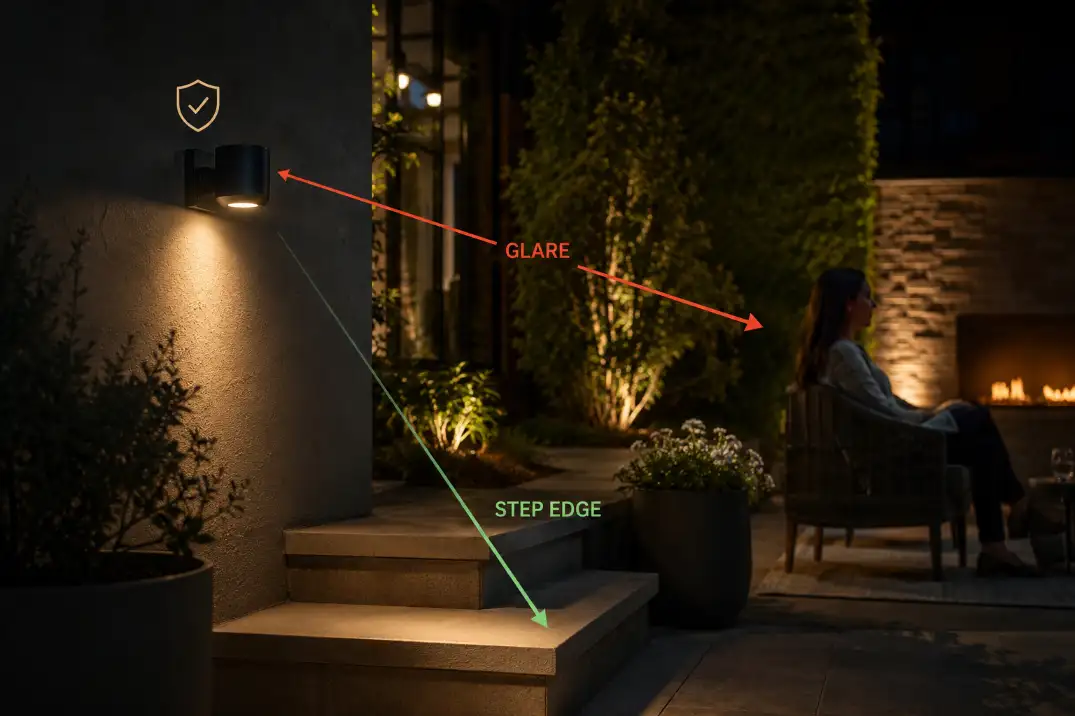
If the bulb is visible, shielding matters
Stand near the property line or look from an upstairs window if possible. If the bare bulb or bright lens is visible, the fixture is probably spilling light beyond the area it needs to serve. Reducing wattage may help, but shielding and aim usually matter more.
A light that illuminates the fence more than the walking surface is not working hard enough for the people using the patio. It is creating brightness without enough utility.
Security lighting should be controlled, not huge
Security lighting is often overestimated. A harsh floodlight may feel protective, but if it blinds the person walking through the space, it has a practical flaw. Controlled downward light near entries, gates, and blind corners is usually more useful than blasting the entire backyard.
For close lots, aim fixtures inward and downward. The goal is to see your own route clearly without sending light into neighboring windows.
What Homeowners Usually Overestimate
Brightness is the big one. A brighter bulb is the easiest purchase, but it is rarely the best first fix. If a fixture is unshielded or badly aimed, more lumens make the problem louder.
Symmetry is another. Equal spacing looks tidy in a plan, but real backyard use is uneven. A step deserves more lighting than a blank fence panel. A grill handle matters more than the middle of a shrub bed.
Decorative impact is overestimated, too. A yard can look impressive from indoors and still feel clumsy outside. Lighting should be judged from the places people sit, stand, cook, and walk, not only from the window view.
What Homeowners Usually Underestimate
Fixture aim is underestimated because the adjustment looks small. Moving a beam a few degrees downward can matter more than replacing the fixture. The difference between lighting a person’s eyes and lighting the ground in front of them is often tiny on the wall and obvious in use.
Maintenance also gets ignored. Plant growth, mulch splash, dust, pollen, sprinkler overspray, and dirty lenses can reduce useful output over a season. During heavy growing months, check lenses and plant clearance every 2 to 3 months. A path light hidden behind ornamental grass is not really a lighting failure. It is a maintenance failure.
The patio layout itself can be the hidden problem. If a grill, sectional, or dining set blocks the main route, lighting will not fully fix the discomfort. In that case, solve the circulation problem before dressing up the space. The broader guide to what to fix first when a backyard is hard to use follows the same priority: fix movement before cosmetics.
Practical Fix Order That Usually Works
1. Reduce the harshest source
Start with the fixture that bothers your eyes first. Try a lower-lumen bulb, warmer color temperature, frosted lens, shield, dimmer, or downward aim. If reducing that fixture makes the patio more comfortable, do not add more lights yet.
2. Mark steps, turns, and edges
Add light where the ground changes. Step edges, patio borders, narrow side routes, and turns deserve priority because they affect safety and confidence. This matters even more near wet surfaces, dark pavers, and multi-level patios.
3. Add task light only where work happens
A grill or prep table needs focused light in the 2 to 3 feet around the work surface. It does not need the whole patio to brighten. Keep task lighting separate when possible so the cooking zone can function without making the seating area harsh.
4. Add atmosphere last
Once people can move, sit, cook, and clean up comfortably, decorative lighting becomes easier to judge. This is where string lights, tree uplights, lanterns, and accent fixtures make sense. If they compete with the functional lights, dim them or use fewer.
For larger planning mistakes that overlap with this issue, backyard lighting mistakes that ruin outdoor spaces at night can help separate a fixture problem from a bigger layout problem.
Questions People Usually Ask
Should backyard lighting be warm or cool?
Warm light is usually better for patios, dining, and seating. Around 2700K to 3000K tends to feel more comfortable and less harsh than cool white light. Cooler light can work in task or security areas, but it should be aimed carefully.
Are solar path lights enough?
They can be enough for simple route guidance, but they are weak fixes for steps, grill work zones, and glare problems. In shaded yards, short winter days, or dusty dry climates, solar output may fade earlier than expected.
How many backyard lights are too many?
There is no perfect number. The better test is whether each light has a job. If a fixture does not help with movement, task visibility, safety, comfort, or a deliberate accent, it may be adding visual noise instead of function.
The Bottom Line
Backyard lighting plans make outdoor spaces hard to use when they confuse brightness with visibility. The usual failure is not a dark yard. It is glare at eye level, uneven contrast, overlit decoration, and underlit movement routes.
The strongest fix is to test the space at night, reduce the harshest source first, then light steps, turns, seating surfaces, and task zones in that order. A few shielded, well-aimed fixtures will usually outperform a brighter plan that makes the patio look lit but feel uncomfortable.
For broader official guidance on efficient lighting choices, see the U.S. Department of Energy.