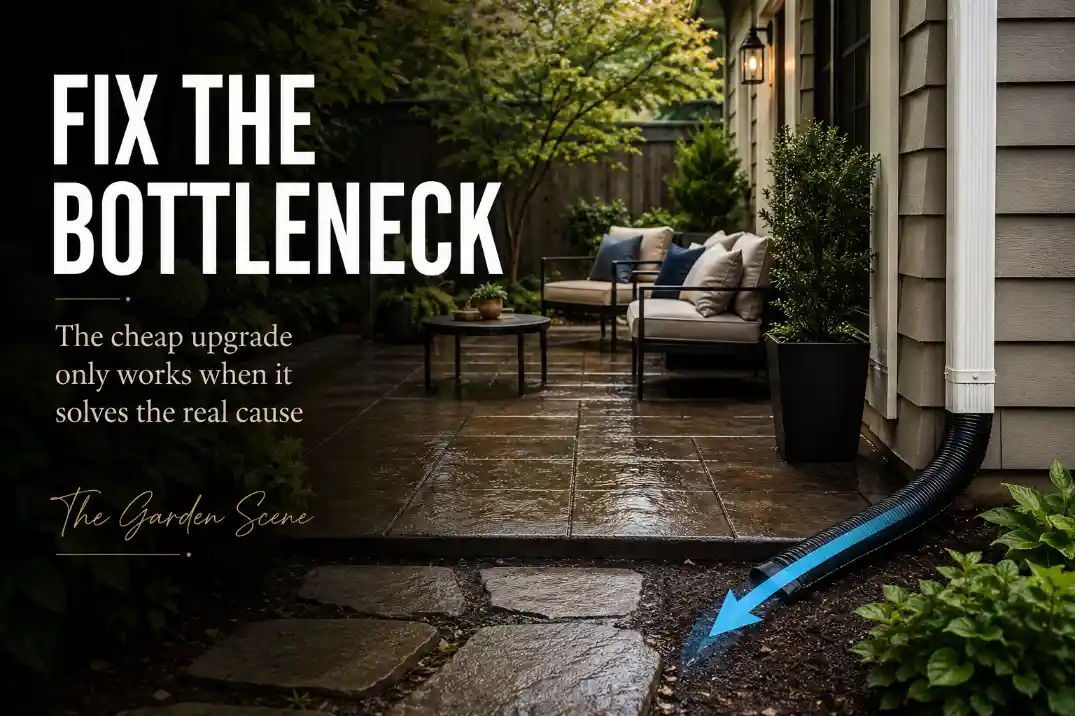
The best low-cost patio and backyard fixes are not the upgrades that make the space look finished first. They are the fixes that remove the thing making the space hard to use: water near the house, a blocked walking route, muddy traffic paths, hot afternoon exposure, slippery surfaces, or seating that technically fits but does not function.
Start with three checks. Does the patio dry within 24–48 hours after normal rain? Is the main walking route at least 30 inches wide? Can chairs pull out without blocking the door, grill, or steps? If the answer is no, the problem is functional before it is decorative.
That distinction matters because many cheap backyard purchases are cheap only at checkout. A rug over damp concrete, a larger dining set on a tight patio, or loose gravel on a runoff path can create more maintenance than it solves.
The right low-cost fix is usually smaller, more targeted, and chosen around the failure pattern already showing up in the yard.
Quick Answer: Which Fix Should You Buy First?
If water controls the patio, start with runoff control
If water collects near the foundation, under furniture legs, or across the patio edge, buy drainage help before comfort items. The first useful category is usually a downspout extension, splash block, gravel drainage strip, or surface correction—not a rug or new chair set.
If the patio feels cramped, fix the furniture footprint
A small patio often needs less furniture, not better furniture. Benches, folding chairs, nesting tables, and narrower dining sets usually outperform bulky conversation sets when clearance is limited.
If the yard turns muddy in the same place, stabilize the route
Bare dirt between the patio and gate, grill, shed, or side yard is a traffic pattern. Treat it like a path. Gravel, stepping stones, compacted crushed stone, or mulch paths can be useful when they follow the route people already use.
If you are deciding between water control and layout changes, the guide on whether to fix drainage or layout first is a good companion because the wrong first purchase often hides the actual bottleneck.
Fix Water Problems Before Buying Patio Decor
Downspout extensions solve more than they look like they solve
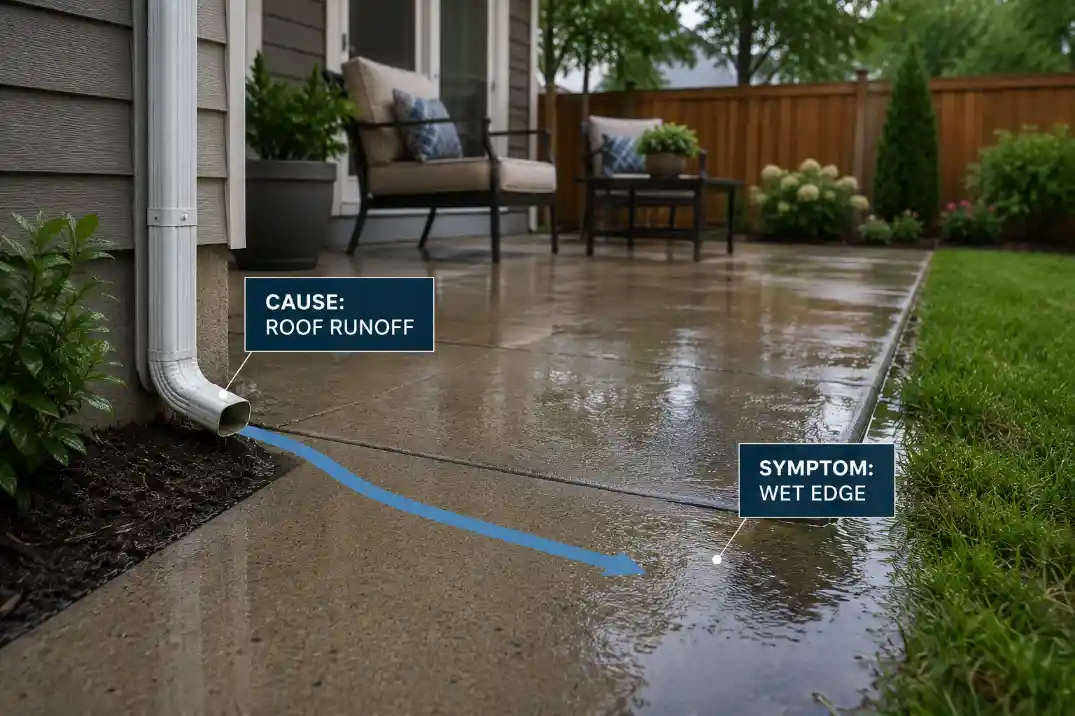
A short downspout dumping water beside a patio can make a backyard feel damp, buggy, dirty, and unfinished. In a 1-inch rain, roof runoff can send a surprisingly large volume of water into one small area.
If that water lands at the patio edge, the puddle is only the visible symptom. The real problem is concentrated runoff arriving faster than the surface can shed or absorb it.
For many homes, the lowest-cost useful fix is a downspout extension that carries water at least 4–6 feet away from the patio and foundation, as long as it sends water toward a safe lower area and not toward a neighbor, walkway, or basement-prone wall.
Splash blocks help with mild splashback, but they are not enough when water is actively crossing the patio.
Look for an extension that fits common 2×3 or 3×4 inch downspout outlets, holds its shape during flow, and can be moved for mowing. Hinged or roll-out styles work well where lawn equipment needs access.
Rigid extensions are better where the line can stay in place without becoming a trip hazard.
If the wet edge begins at the downspout, do not start with patio mats, gravel bags, or an outdoor rug. Start by moving the roof water away; a downspout extension is the cheapest product category that actually changes the cause.
BEST FIRST FIX FOR ROOF RUNOFF
Downspout Extension
Best for patios that stay wet where roof water exits near the house.
It moves concentrated runoff away before it spreads across seating, paths, or planting edges.
Look for 4–6 ft reach, 2×3 or 3×4 inch outlet compatibility, hinged or flexible construction, and crush-resistant shape.
🔴 SHOP downspout extensions
When a drainage accessory is not enough
A downspout extension helps when the water source is obvious and concentrated. It does not fix a patio that slopes toward the house, a sunken paver field, or a yard grade that sends stormwater across the slab.
If the same puddle remains into the next day after ordinary rain, or algae keeps forming in one spot, the issue may be grade, base failure, or surface pitch.
That is where a routine cheap fix stops making sense. If you keep buying mats, rugs, gravel bags, or edging after every storm, the purchase is no longer solving the problem.
The better decision may be partial regrading, lifting sunken pavers, or correcting the water path. The article on patio water pooling against the house goes deeper into that higher-risk version of the problem.
Fix the Furniture Layout Before Adding More Seating
Clearance matters more than seat count
The most common patio buying mistake is overvaluing how many people can sit and undervaluing how people move. A dining chair usually needs about 30–36 inches behind it to pull out comfortably. A main walking route should stay around 30 inches wide, and 36 inches is better where people carry food, cushions, or tools.
That means a four-chair set can be the wrong purchase on a patio that technically has room for the table but not for the chairs in use. The symptom is “the patio feels too small.” The mechanism is blocked circulation.
In tight spaces, better low-cost categories include narrow benches, folding patio chairs, armless stackable chairs, nesting side tables, or compact bistro tables. A bench along one edge can create seating without needing clearance on every side. Folding chairs let extra seating appear only when needed.
This is why patio furniture layout by size is often more useful than a generic furniture-buying guide. The same set can work well on a 12×16 patio and become a daily obstacle on a 9×12 patio.
The best seating category for cramped patios
If the patio only feels small when chairs are pulled out, the fix is not a larger set or more decor. Browse compact patio seating first, especially narrow benches or folding chairs, because those categories add seating without permanently taking over the walking lane.
Choose benches when one side of the patio can stay fixed. Choose folding chairs when the patio switches between dining, grilling, and open floor space. Look for seat depths around 18–24 inches, rust-resistant frames, outdoor-safe fabric or resin, and pieces that leave at least a 30 inch walking route.
When movement is the main failure, compact seating is the category to browse before larger patio sets.
BEST FIT FOR CRAMPED PATIOS
Compact Patio Seating
Best for small patios where loose chairs block doors, grill access, or walking routes.
It adds usable seating without forcing the whole patio to behave like a permanent dining room.
Look for narrow benches, folding chairs, armless frames, 18–24 inch seat depth, and weather-resistant materials.
🔴 SHOP folding patio dining chairs
Stabilize the Paths People Already Use
Bare dirt is usually a traffic signal
A worn strip between the patio and gate is not just a lawn problem. It is the yard showing where a surface is needed. The same pattern often appears beside grills, around sheds, along fence lines, and near side-yard access.
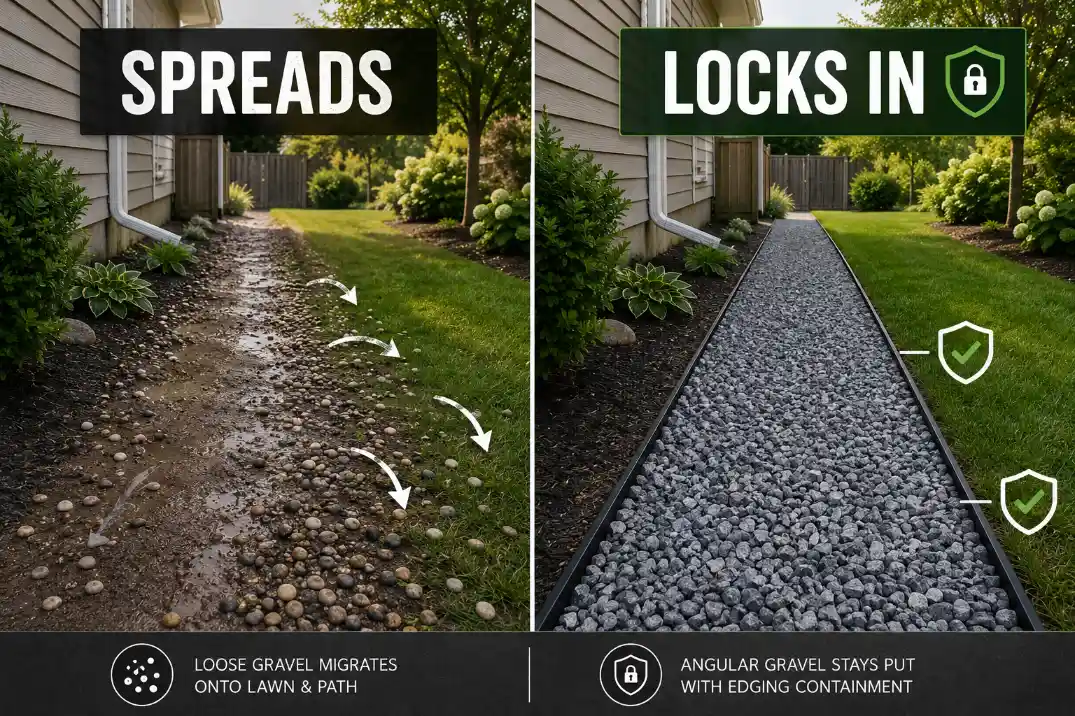
The low-cost fix should match the traffic. Stepping stones work for light use. Mulch can work for soft garden paths that do not receive heavy runoff. Angular gravel or compacted crushed stone is better for repeated foot traffic, trash bins, wheelbarrows, and pet routes.
Round pea gravel is one of the most overestimated cheap materials. It looks clean at first, but it rolls underfoot and spreads without strong edging. Angular gravel locks together better and feels more stable. For a basic footpath, plan roughly 2–3 inches of compacted gravel; for heavier repeated use, 3–4 inches is more realistic.
If the path is muddy because people keep walking there, gravel path materials are usually a stronger buy than another attempt to reseed the same worn strip. The key is choosing angular material and edging together, not buying decorative stone alone.
BEST FIX FOR MUDDY TRAFFIC ROUTES
No-Dig Landscape Edging
Best for gravel paths between patios, gates, grills, sheds, and side yards.
It keeps gravel contained so the path stays cleaner, firmer, and less likely to spread into grass.
Look for flexible edging, included stakes, 2–5 inch height, and enough length for both sides of the path.
🔴 SHOP no-dig landscape edging
Add Comfort Only After the Space Works
Shade is the seasonal upgrade that can be worth buying early
Shade is one of the few comfort upgrades that can immediately change how often a patio gets used during backyard season. Concrete, pavers, and composite surfaces can feel punishing in direct afternoon sun, especially in hot, dry regions of the Southwest or humid summer climates in the Southeast.
But shade products fail when the category does not match the exposure. A lightweight umbrella with a small base is frustrating in a windy yard. A shade sail needs strong anchor points and tension. A pop-up canopy can work for occasional use, but it is usually too bulky for everyday patio living.
For a small patio with one main seating area, a tilting patio umbrella with a properly weighted base is often the best first category. For a longer patio with secure posts or walls, a shade sail may make more sense. In windy coastal or open suburban yards, anchoring should matter more than canopy size.
Pro Tip: Treat anchoring as part of the shade purchase. A cheap shade product with weak anchoring is not a cheap fix in a wind-exposed yard.
Once drainage and clearance are already working, shade becomes the first comfort purchase that can change daily use immediately.
For most small patios, start with a tilting umbrella and a base heavy enough for the canopy size before looking at pergolas, sails, or permanent covers.
BEST SEASONAL COMFORT FIX
Patio Umbrella With Base
Best for usable patios that become uncomfortable during direct afternoon sun.
It cools the seating zone without committing to a permanent roof, pergola, or built structure.
Look for tilt adjustment, UV-resistant fabric, a base matched to canopy size, and wind-appropriate anchoring.
🔴 SHOP market patio umbrella with base
Lighting should solve movement before mood
String lights can make a backyard feel warmer, but they do not always make it safer or easier to use. The useful first lighting purchase is usually path lighting, step lighting, or a fixture near the grill zone.
The goal is not to flood the yard. It is to make the walking surface readable from about 6–10 feet away without glare. Solar lights are fine for low-risk paths with enough sun exposure. Low-voltage lights are usually better where brightness needs to be consistent, especially in shaded yards or northern states with short winter days.
Do not buy lighting only for the patio edge if the actual dark spot is the transition between patio and lawn. The trip point matters more than the decorative line.
Avoid the Cheap Fixes That Hide the Problem
Outdoor rugs over damp patios
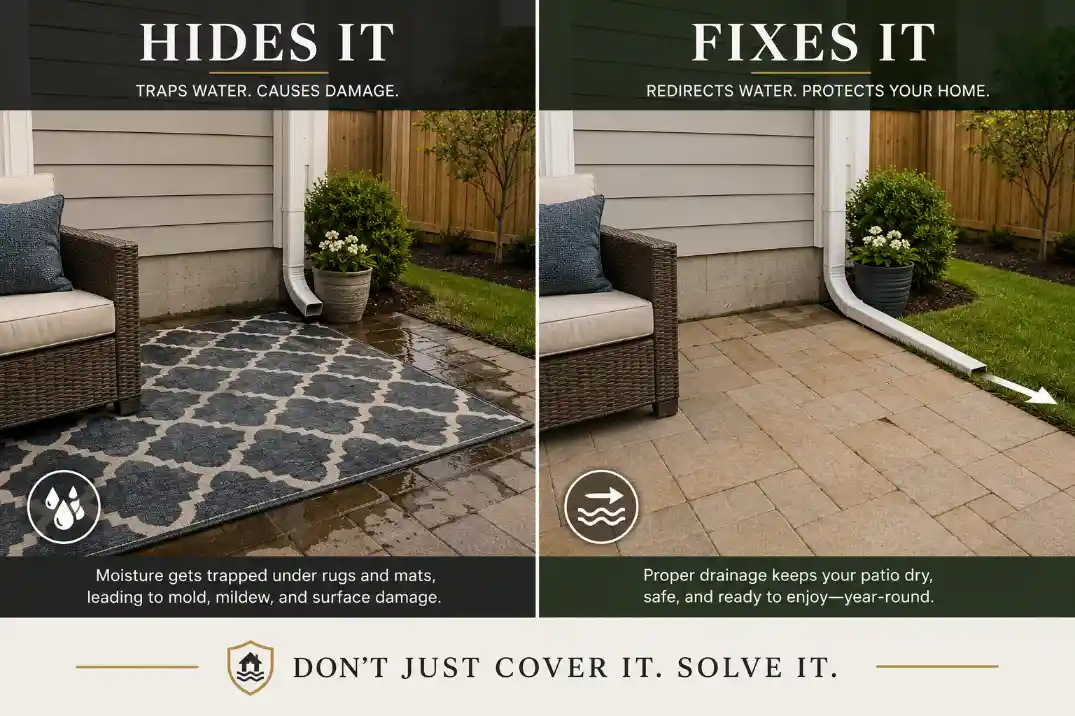
Outdoor rugs are not bad products, but they are often bought too early. If a patio stays damp for more than 48 hours after normal rain, a rug can trap moisture, hide algae, and make cleaning harder. In humid climates, the problem can show up quickly as odor, discoloration, or slick spots underneath.
Use a rug after the patio dries reliably, not before. Choose breathable outdoor materials and avoid covering known low spots.
Light edging where water is moving
Plastic edging, small stones, and thin metal strips can make a bed or gravel area look tidy, but water flow exposes weak containment fast. If mulch or gravel moves after every heavy rain, the failure is not only the border. It is slope, runoff, or material choice.
The condition homeowners commonly underestimate is repeated water energy. A border that looks fine in dry weather may fail after three or four storm cycles because it was never built to resist flow. If this keeps happening, backyard drainage and erosion control products may be more relevant than another decorative edge.
Strong cleaners when the surface needs traction
A slippery patio can come from algae, sealer gloss, poor drainage, worn texture, or shaded dampness. Cleaning helps when the problem is surface film. It does not solve a patio that keeps getting wet or a glossy coating that becomes slick every time it rains.
If the surface is solid, not flaking, and mainly slippery after moisture or organic buildup, a patio-safe cleaner or traction treatment can help. If the slab is uneven, peeling, or holding water, diagnose the surface before buying treatments. The product has to match the surface material, or it can discolor stone, dull a sealer, or leave patchy texture.
Quick Buying Checklist Before You Spend
- Does the fix solve water, movement, surface stability, heat, lighting, or traction?
- Will the space still work after chairs are pulled out?
- Does the product match local exposure: freeze-thaw, humidity, desert sun, coastal moisture, or wind?
- Can it stay in place during mowing, storms, pets, and daily traffic?
- Does it reduce maintenance, or does it add something else to clean, reset, store, or replace?
- If the problem returns after 1–2 heavy rains, is the product too light for the condition?
Best Low-Cost Fixes by Budget Range
Under $50
This range is best for targeted corrections: basic downspout extensions, furniture glides, storage hooks, cleaning supplies, a few stepping stones, or small solar lights. These are worthwhile when the underlying patio or yard is mostly sound.
$50–$150
This is often the strongest value range. Better umbrella bases, compact benches, gravel and edging for short paths, small storage boxes, patio-safe cleaners, and starter lighting can all make a real difference.
Over $150
Be more selective here. Once the fix costs more than a simple furniture piece, it should solve a repeated problem, not just improve appearance. If several issues compete for the same budget, backyard problems worth fixing first can help sort what deserves money now and what can wait.
Final Verdict
Buy the fix that removes the bottleneck, not the one that makes the yard look more finished in photos. If water is present, start with runoff control. If movement is blocked, change the furniture footprint.
If mud appears in the same route, stabilize the path. If the space already works but gets avoided in afternoon sun, a patio umbrella with a proper base is the seasonal comfort upgrade that makes sense.
The most reliable low-cost backyard upgrades are not complicated. They are properly matched. A downspout extension belongs where roof water is the source.
Compact patio seating belongs where clearance is the problem. Crushed gravel belongs where traffic keeps wearing the same route. Shade belongs after the patio is already usable.
For broader official guidance on directing water away from homes, see the University of Minnesota Extension.