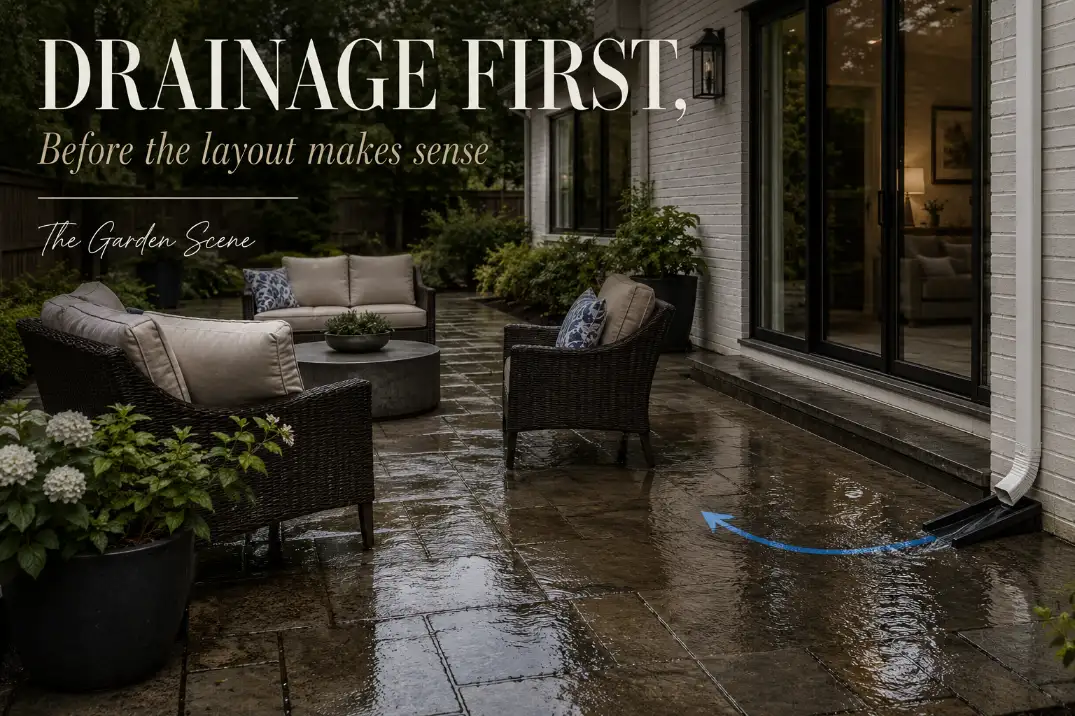
A patio with both drainage and layout problems should usually be solved in this order: water first, furniture second.
Fix drainage first if water reaches the house, crosses the main walking path, sits under furniture legs, or remains in puddles longer than 24–48 hours after normal rain.
Fix layout first only when the patio drains away from the house, dries within the same day, and the discomfort is clearly caused by furniture clearance.
That distinction matters because a cramped layout is often just the symptom. The mechanism is usually a wet, sloped, settled, or unstable section of patio that silently shrinks the usable footprint.
A 12-by-16-foot patio can behave like a much smaller patio if the outer 3 feet are wet, muddy, or awkward to walk across.
Before buying smaller furniture or expanding the slab, find out whether the patio is actually usable from edge to edge.
The First Decision: Drainage First or Layout First?
The fastest way to avoid wasting money is to separate surface discomfort from water behavior. A table blocking a door is a layout problem. A table blocking the door because everyone keeps pulling it away from a puddle is a drainage problem.
Fix drainage first when water changes how the patio is used
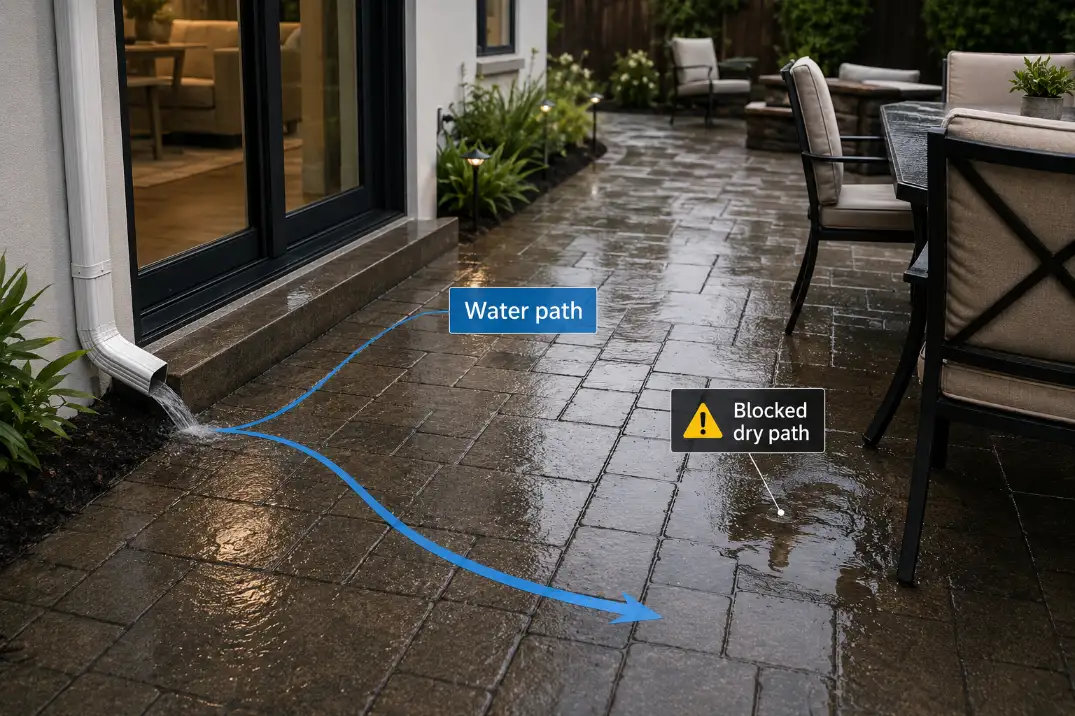
Drainage takes priority when water affects the house, the surface, or the path people naturally use. Standing water near siding, sliding doors, basement walls, crawlspace vents, or foundation planting beds should outrank every furniture decision. So should water that repeatedly occupies a chair zone, grill zone, or walkway.
A useful threshold is depth and duration. A shallow wet mark that dries in a few hours may be normal. A puddle more than about 1/4 inch deep in a walking or seating area is functionally important, especially if it remains the next day. If water still sits after 48 hours in ordinary weather, the patio has moved beyond cosmetic nuisance.
Fix layout first only when the surface is already stable
Layout can come first when the patio drains away from the house, has no soft or rocking edges, and dries evenly. In that case, the issue is usually furniture scale, door clearance, or a poor circulation path.
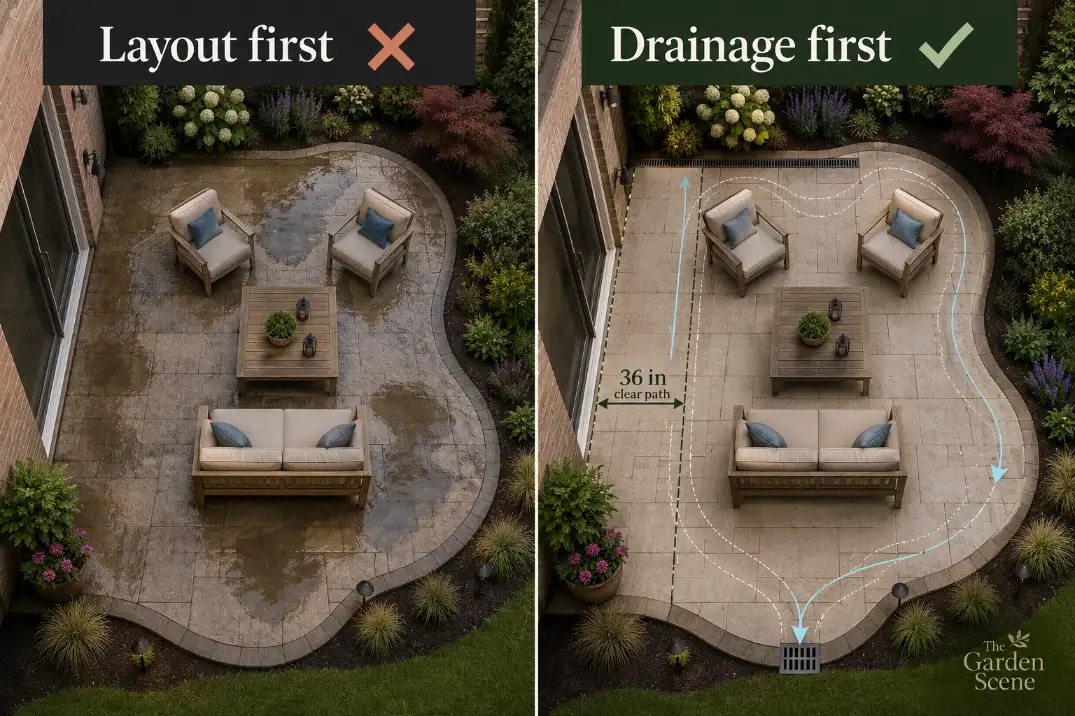
A main patio route usually needs about 36 inches of clear width. Secondary movement can sometimes work at 24–30 inches, but that becomes tight near dining chairs, grills, and sliding doors. If the surface is dry and stable, those measurements matter more than drainage repairs.
| What you see | Solve first | Why it matters |
|---|---|---|
| Water near the house or door | Drainage | Moisture risk outranks furniture comfort |
| Puddle in the main walking route | Drainage | The usable patio footprint is smaller than it looks |
| Dry patio but chairs block movement | Layout | Furniture clearance is the real problem |
| Rocking pavers or settled slab edges | Drainage/base | Layout cannot stabilize a failing surface |
| Even dampness with no puddles | Layout or maintenance | Shade or surface texture may be the issue |
What People Usually Misread
The most common mistake is blaming patio size before checking the dry footprint. Homeowners often assume they need a smaller sectional, a round table, or an extension when the real problem is that one edge of the patio has become unusable.
Patio size is often overestimated as the problem
Adding 3 or 4 feet of patio can help only if the added space stays dry and stable. If the current water path is still active, a larger patio may simply become a larger wet surface.
That is why layout advice works best after drainage is understood. A guide like Patio Furniture Layout by Size becomes much more useful once you know how much of the patio is actually dry enough to furnish.
Furniture also distorts the diagnosis. A deep outdoor sofa may take 36–40 inches before anyone sits down. Add a coffee table and a walkway, and a small patio can feel crowded fast. But if the furniture has drifted inward because the outer edge stays wet, the sofa is not the original failure.
Water at the house edge is often underestimated
Water near the house deserves the least patience. If the patio pitches toward a sliding door, siding, foundation wall, or basement window well, do not solve the furniture plan first.
Water against the structure can cause staining, rot risk, soil saturation, freeze-thaw movement, and threshold problems.
If this is the main symptom, the issue is closer to Patio Water Pooling Against the House than a normal layout problem. The layout may be awkward, but the repair priority is moisture control.
Pro Tip: After a real rain, mark the edge of the wettest area with chalk or painter’s tape. Check it again after 6 hours and 24 hours. The shrinking pattern tells you whether the patio is drying evenly or trapping water in a specific low zone.
Read the Water Source Before Choosing a Fix
Drainage fixes fail when they are chosen by product name instead of water source. A French drain, channel drain, dry well, or paver reset can all be right in one situation and useless in another.
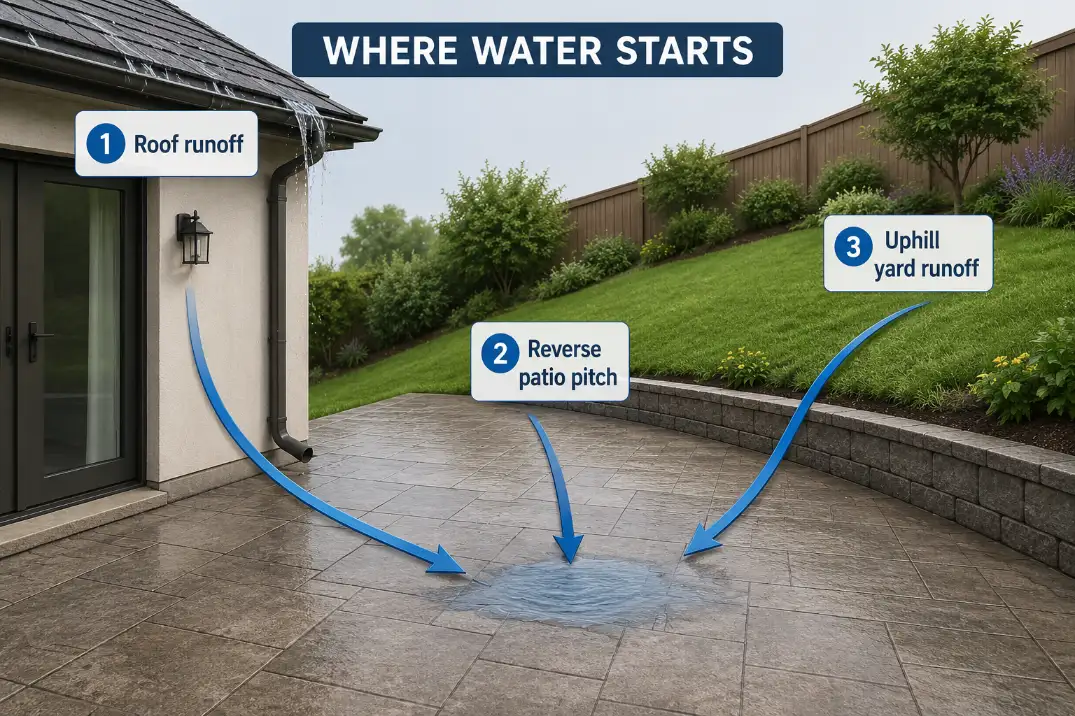
Roof runoff is usually the easiest win
Downspouts are one of the first things to check because they can overload an otherwise decent patio. If a downspout ends 2–3 feet from the patio edge, water may be pushed straight into the seating or walking zone during every storm.
Extending the downspout is often simple, but the discharge point matters. Sending water into a mulch bed that washes out, toward a fence line, or onto a neighbor’s property is not a real solution. The water needs a safe outlet where it can spread, infiltrate, or be carried away without creating another problem.
Yard runoff is a bigger sequencing problem
If the yard slopes toward the patio, solve that before surface cosmetics. Runoff from the high side can cut across pavers, wash gravel into joints, and keep the patio edge soft. In that situation, the question is not which furniture arrangement looks best. It is how to intercept or redirect water before it reaches the patio.
This is where sequence becomes expensive if it is wrong. The logic in Fix Slope, Drainage, and Erosion in the Right Order applies because erosion, grade, and drainage need to be handled before the finished patio layout can hold up.
Patio pitch is the surface-level test
A patio generally needs a slight fall away from the house, commonly around 1/8 to 1/4 inch per foot, depending on the surface and site. Too little pitch leaves water sitting. Too much pitch makes chairs rock, tables feel uneven, and dining uncomfortable.
The direction matters more than the exact number. A modest slope away from the house is normal. A reverse slope toward the house is not.
Which Drainage Fix Fits Which Failure?
| Fix | Best for | Weak when |
|---|---|---|
| Downspout extension | Roof water dumping near the patio | The yard grade still sends water back |
| Re-slope or regrade | Water moving toward the house or sitting broadly | There is no safe discharge path |
| Paver lift-and-reset | Localized settling or low spots | The base is washing out repeatedly |
| Channel or trench drain | Water crossing a hard surface at a predictable line | The outlet is poorly planned |
| French drain | Subsurface or edge water moving through soil | Surface water needs immediate capture |
| Catch basin or dry well | Concentrated runoff from a low point | Soil drains too slowly or volume is too high |
| Permeable paver rebuild | Repeated surface water where infiltration is possible | The base is not designed for storage and flow |
The fix that changes the outcome is the one that changes the water path. Sealing concrete, adding an outdoor rug, sweeping in more joint sand, or buying taller-legged furniture may reduce annoyance for a season, but none of those changes correct reverse pitch, base washout, or runoff from above.
New Patio or Older Patio? The Cause Usually Changes
A new patio with drainage problems points to a different failure than a patio that became worse over several years. This is a useful distinction because it changes how much patience a routine fix deserves.
New patios usually point to installation geometry
If the patio has held water since the first season, look first at pitch, threshold height, downspout placement, and whether the surrounding grade traps water. A new patio should not require furniture workarounds just to stay usable after rain.
This is also where surface choice matters. Concrete can be durable, but a broad reverse pitch is hard to hide. Pavers can be reset, but only if the base and edge restraint are sound.
Gravel may drain well, but it can create unstable furniture legs if it migrates or ruts under traffic. In wet yards, surface choice and base design are closely linked, which is why Best Patio Materials for Wet Backyards belongs in the planning conversation before a replacement is chosen.
Older patios usually point to movement or blocked escape routes
If the patio worked for years and then started pooling, the likely causes are settlement, clogged edges, root movement, paver base washout, added hardscape nearby, or a changed runoff path.
A neighbor’s new drainage, a new walkway, a raised planting bed, or compacted soil along the edge can all change where water goes.
In northern states, freeze-thaw cycles make small low spots worse over time. In humid Florida backyards, slow drying can disguise the difference between normal dampness and real pooling.
In dry Arizona conditions, persistent puddles are more suspicious because the climate should help the surface dry faster.
Rebuild the Layout Around the Recovered Dry Footprint
Once drainage is corrected, do not plan from the total patio dimensions. Plan from the dry, stable, walkable footprint.
Protect the main route first
The path from the house to the yard, grill, steps, or gate should stay open before furniture is placed. Around sliding glass doors, keep the route especially clean because people naturally step straight out before turning.
If the layout fights that movement, the patio will feel crowded even when the furniture technically fits.
For patios where doors and walkways drive the whole furniture plan, Patio Layouts With Sliding Glass Doors and Walkways is the better next step after drainage is corrected.
Use clearance numbers as limits, not decoration
Aim for about 36 inches on the main path. Behind dining chairs, 36 inches is also a useful target where people need to pull out and pass. Near doors, grills, and stairs, 30–36 inches keeps the patio from feeling like an obstacle course.
When the recovered dry zone is small, do not force dining and lounging into the same footprint. One complete zone usually works better than two compromised zones.
A compact dining setup or one strong seating group can feel calmer than a crowded patio with every function squeezed in.
For narrow patios, this matters even more. A long rectangular patio may look generous on paper, but if the walkway is broken or the furniture blocks the natural route, it can feel worse than a smaller square patio.
That is why Small Rectangular Patio Layout and Flow should be used after the drainage boundary is clear.
What You Can Fix Yourself and What Usually Needs a Pro
Some early checks are worth doing before calling anyone. Others become risky because they affect the house, patio base, or buried drainage path.
Reasonable DIY first steps
You can usually observe the water path, extend a downspout, clear drain grates, remove debris from patio edges, measure rough slope with a long level, and temporarily move furniture out of the wet route. These steps help you see the real failure without committing to a major repair.
A simple slope check can be revealing. Place a long level or straight board on the patio and compare the fall over several feet. You are not trying to engineer the final repair; you are checking whether water has a reason to move the wrong way.
Professional help makes sense when structure or base is involved
Call sooner when water moves toward the house, when the patio edge is washing out, when pavers keep sinking after small repairs, when a concrete slab has broad reverse pitch, or when a drain needs a buried discharge route. Those are not furniture problems.
A routine fix stops making sense when the same symptom returns after one season. If paver joints are refilled and the same low area opens again, the base is probably moving.
If a rug hides a wet spot but the patio smells musty or stays slick, the rug is extending the problem. If a sealer makes water bead but the pitch still sends it toward the door, the surface looks better while the mechanism remains unchanged.
The Bottom Line
Solve drainage first when water affects the house, the patio base, the main walking route, or the places where furniture legs need to sit.
Solve layout first only when the patio is already stable, drains away from the house, and dries within a reasonable window.
Most frustrating patios are not simply too small. They are partly unusable. Recover the dry, stable footprint first, then build the furniture plan around the space that actually works.
For more practical guidance on keeping roof runoff and surface water away from the house, see the University of Minnesota Extension guide to basement moisture causes and solutions.