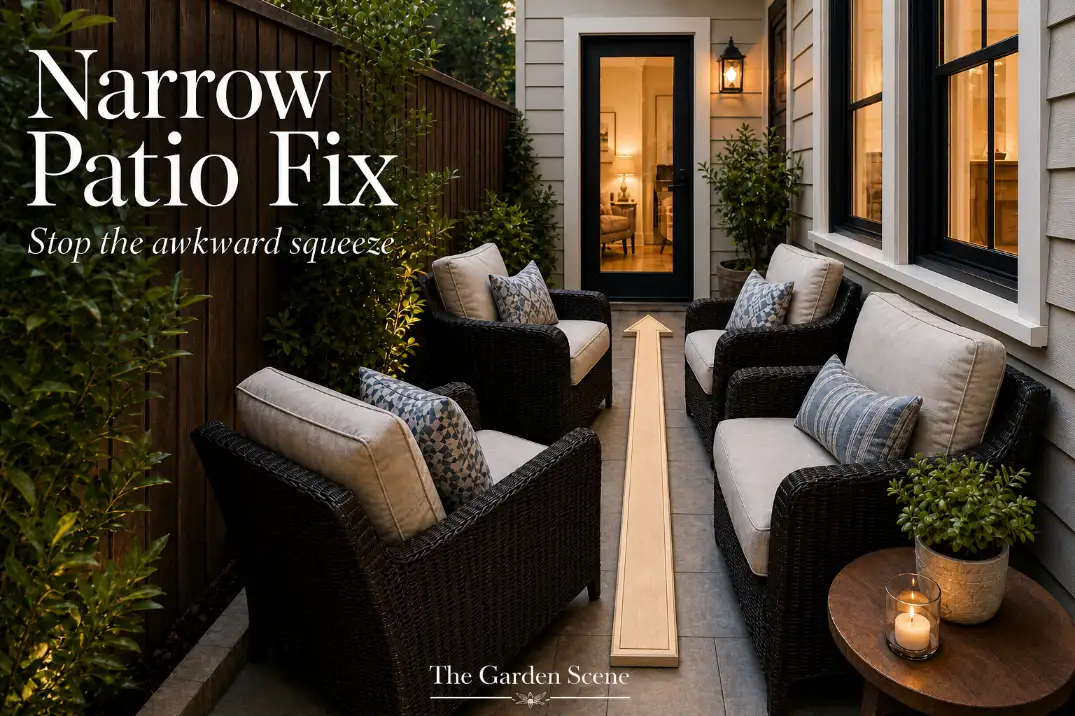
The least awkward long narrow patio layout usually keeps traffic on one side, anchors furniture along one long edge, and avoids seating that faces directly across the tight width.
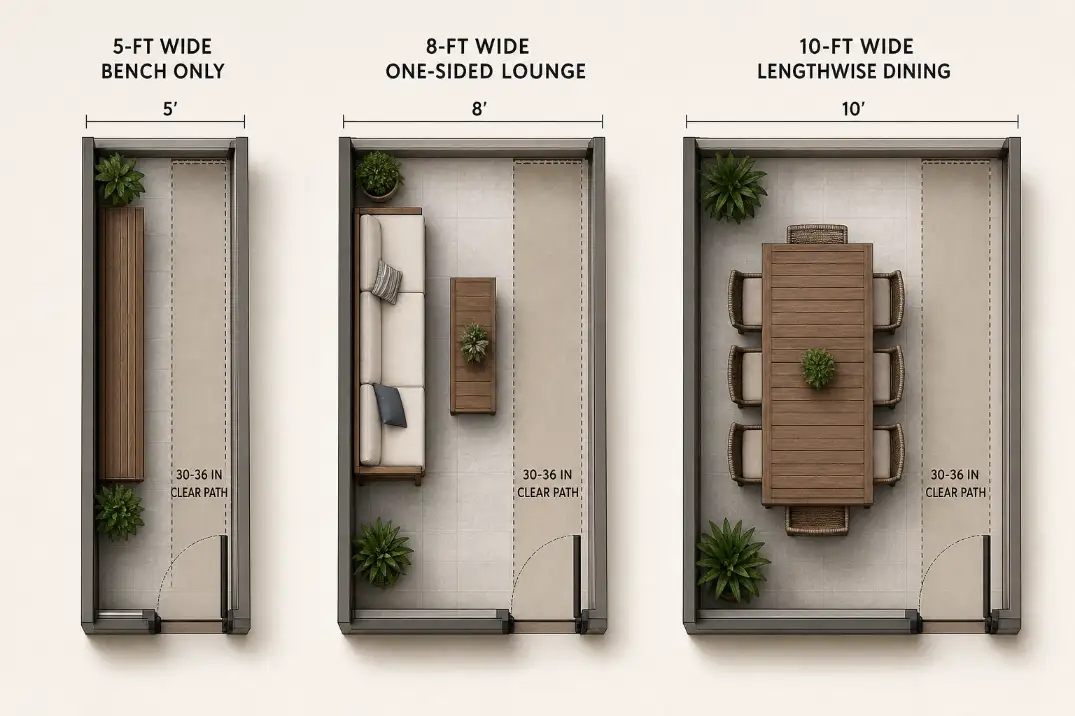
Start with three checks before buying anything: keep the main walking path at least 30 inches wide, preserve 36 inches near doors or dining chairs, and be cautious with lounge furniture deeper than 32 to 34 inches on patios under 8 feet wide.
This is not the same problem as a tiny square patio. A small square patio runs out of total area. A long narrow patio often has enough square footage, but the width gets consumed by chair pull-back, coffee tables, planters, and furniture arms.
The symptom is “this looks awkward.” The mechanism is usually broken circulation.
Start With the Walking Lane
A long narrow patio works when movement feels obvious. If someone has to turn sideways to reach a chair, carry plates around a table, or step over a rug corner, the layout is asking too much of the space.
30 inches is workable, 36 inches is comfortable
A 30-inch path is the practical minimum for casual movement. A 36-inch path feels better anywhere people pass each other, carry food, enter from a sliding door, or move around a dining table. Once the open route drops below about 24 inches, the patio starts to feel like a hallway filled with furniture.
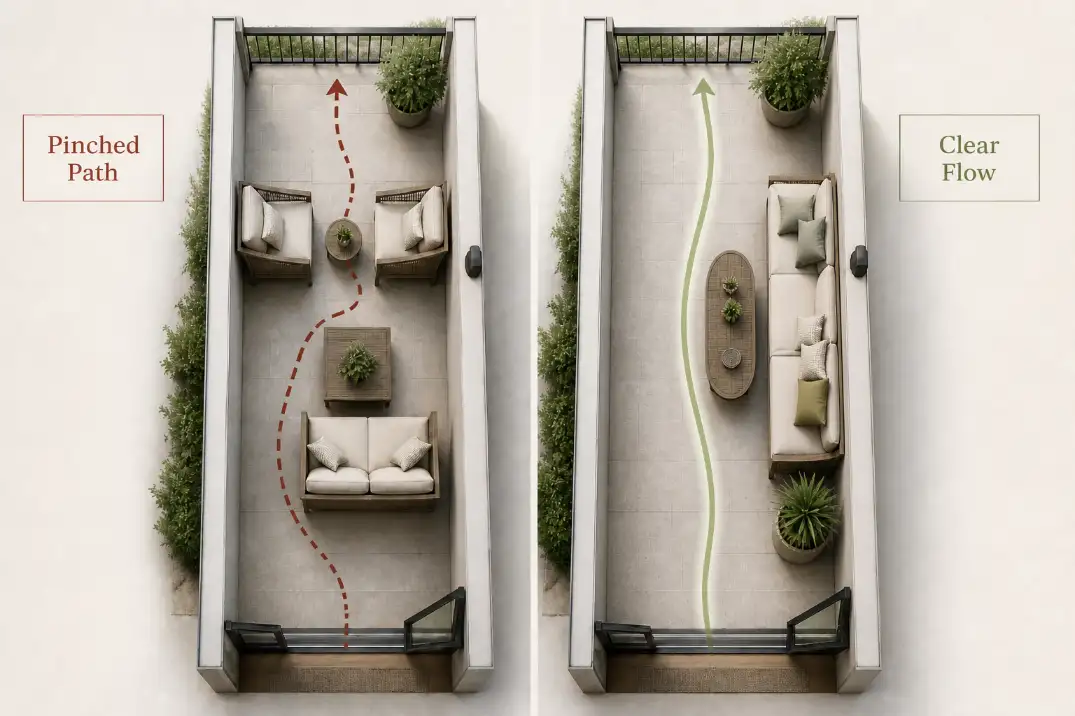
That threshold is more useful than trying to make both sides match. Two weak 20-inch gaps on either side of a centered furniture group are worse than one clear 36-inch route along one edge.
Why symmetry usually fails
The common showroom layout — sofa on one side, two chairs opposite, coffee table in the middle — rarely works on a narrow patio. A 34-inch-deep sofa, a 20-inch coffee table, and a 30-inch-deep chair already consume 84 inches before legroom or walking space is counted.
On a 7-foot-wide patio, that means the layout may technically fit but fail in real use. The furniture is not the only thing taking up space. Bodies, pulled-out chairs, cushions, and table clearance all count.
Pro Tip: Tape the furniture footprint on the patio and leave it for 24 hours. Walk through it with a tray or laundry basket before deciding the layout works.
Best Long Narrow Patio Layouts by Width
Use patio width to rule out bad ideas early. Length gives you options, but width decides whether a furniture arrangement will feel natural or forced.
| Usable patio width | Best layout choice | Usually avoid | Practical threshold |
|---|---|---|---|
| 4–5 feet | Café ledge, narrow bench, planting edge | Lounge set or dining set | Do not force seated groups into this width |
| 6–7 feet | One-sided bench or slim loveseat | Opposing chairs across the width | Keep one continuous 30-inch path |
| 7–9 feet | Slim sofa plus one movable chair | Deep sectional or bulky club chairs | Watch furniture deeper than 32–34 inches |
| 9–11 feet | Lengthwise dining or lounge zone | Centered round dining table | Preserve 36 inches near chair pull-back |
| 12+ feet but very long | Two zones along the length | One stretched furniture line | Split if patio length exceeds about 18–20 feet |
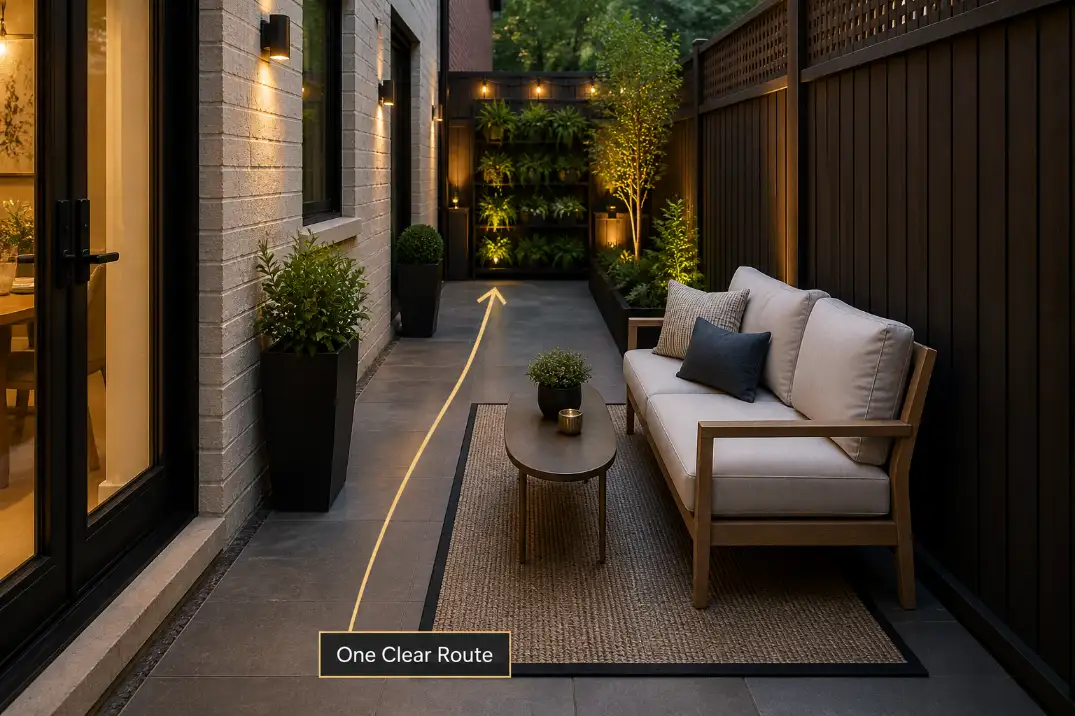
A narrow patio does not have to stay empty down the middle, but it does need a route that does not keep changing width. That is why many successful layouts use one long edge as the furniture anchor.
The same principle shows up in 9×12 Patio Layout Ideas for Narrow Spaces, where the patio works better when circulation is treated as part of the design instead of leftover space.
Layout Ideas That Actually Work
The best narrow patio arrangements are not complicated. They reduce chair movement, keep the path legible, and avoid making the patio serve too many jobs at once.
The 6-foot side-yard patio layout
For a 6-foot-wide patio, think bench, slim loveseat, or café ledge. Place the seating tight to one long side and use a small round side table or wall-mounted shelf instead of a central coffee table.
This width is not friendly to a full conversation set. Two chairs facing a loveseat may look complete in a product image, but they often leave no relaxed way to walk through the space.
The 8-foot dining strip layout
For an 8-foot-wide patio, a rectangular table placed lengthwise usually beats a round table. Put a bench on the fixed side near the wall, railing, or planting edge, and use chairs only on the open side.
Allow about 7 feet of length for a compact four-person dining setup once chairs are pulled out. If the route behind the chairs falls below 30 inches, the table is too large or the chairs need to be simplified. Before choosing a table, the more detailed spacing rules in Patio Dining Set Space can help prevent a dining area that only works when no one is sitting in it.
The long covered patio layout
A long covered patio or narrow back porch often fails when it is treated like one room. Instead, divide it into small zones: a sitting area near the best view, a dining or coffee spot near the door, and open breathing room between them.
The key is to divide visually, not physically. Use a rug change, lighting shift, or planter at the far end rather than placing furniture across the width like a barricade.
The 20- to 24-foot split-zone layout
Once a narrow patio gets longer than about 20 feet, one continuous furniture line can feel like a waiting room. Split the length into two uses. Dining can sit near the kitchen door, while a lounge chair or loveseat can live farther out.
Leave the walking lane on the same side through both zones. Switching the path from left to right halfway down the patio creates the same awkwardness as clutter, even if the furniture is technically small.
Premium Layout Ideas for Long Narrow Patios
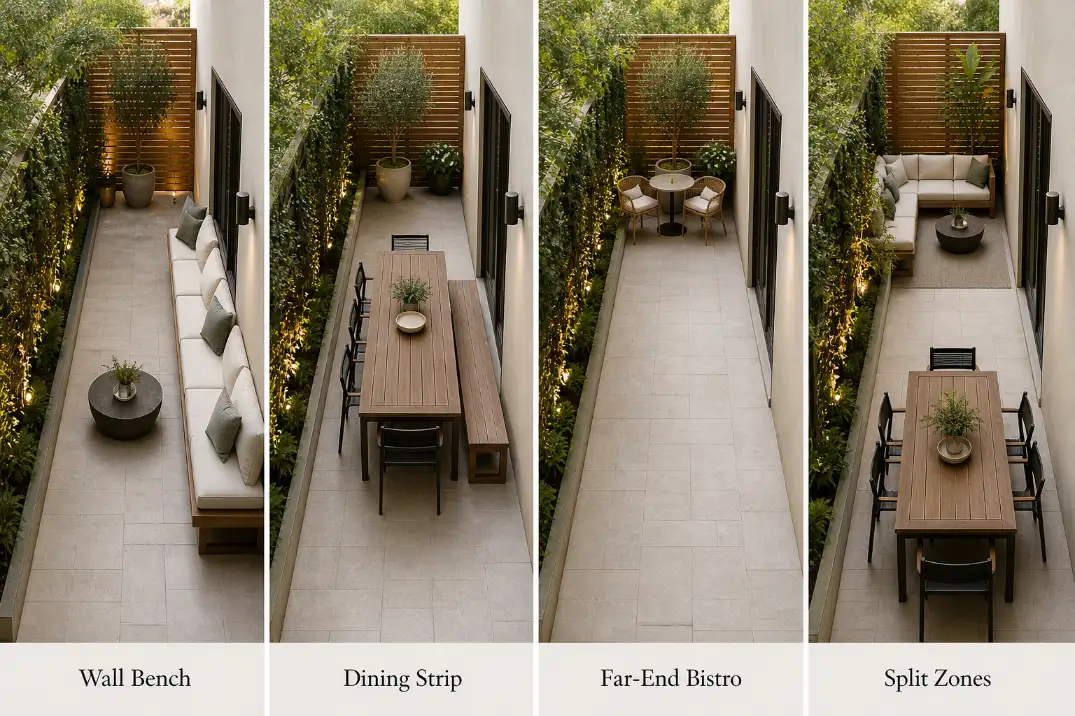
The ideas below are not separate decor themes. Each one solves a specific narrow-patio problem: width pressure, awkward traffic, unused length, or a patio that feels like a corridor. Use them as visual decision points before choosing furniture.
Idea 1: Wall bench lounge
A wall bench layout is the safest option when the patio is only 6 to 7 feet wide. It keeps the seating on one long edge and leaves the opposite side open for movement. This works best with one small side table, not a full coffee table.
Idea 2: Dining strip
The dining strip works when outdoor meals matter more than lounging. A rectangular table runs with the length of the patio, while a bench sits on the tighter side. Chairs stay on the open side so the pull-back zone does not block the only route.
Idea 3: Far-end bistro
A far-end bistro setup gives the patio a destination instead of making it feel like a passageway. Keep the middle clear and place a small two-seat table at the far end, especially if the patio is visible from the kitchen or living room.
Idea 4: Split zones
For patios around 20 to 24 feet long, split zones usually feel better than one stretched seating line. Put dining near the house and a quieter lounge or reading spot farther out. The important rule is to keep the walking lane on the same side through both zones.
Furniture Choices That Make or Break the Space
In a long narrow patio, furniture depth matters more than seat count. A smaller number of correctly scaled pieces almost always beats a full set that consumes the route.
Slim depth matters more than compact labels
“Small-space” furniture can still be too deep. Treat lounge chairs over 34 inches deep as risky unless they sit at the far end or against a wall with no route behind them.
A slim loveseat around 28 to 32 inches deep may be more useful than two oversized chairs. The patio often feels more generous with fewer pieces because the walking lane stays clean. This is also why Deep Seating on Small Patios is worth considering before choosing thick-cushioned furniture that looks comfortable but eats the whole width.
Benches beat chairs when pull-back space is limited
Benches work because they do not sprawl. A bench can sit tight to a wall, fence, planter, or house wall, and people slide in rather than pulling a chair back 24 to 36 inches.
For dining, a bench on the tight side and chairs on the open side is often the most efficient arrangement. For lounging, a built-in or freestanding bench can create a clean line along the patio instead of several chair backs interrupting the view.
Round tables are not always the small-space answer
Small round side tables are useful because they remove sharp corners. Round dining tables are different. They push chairs outward in every direction, which can break the only clear path on a narrow patio.
For dining, rectangular or oval tables placed lengthwise usually perform better. For coffee tables, keep the depth around 14 to 18 inches if the table sits near the walking lane. A 24-inch-deep coffee table may sound modest, but on a narrow patio it can turn an easy route into a daily sidestep.
More Long Narrow Patio Ideas That Look Finished
Once the layout is functional, the patio still needs design direction. These ideas should support the clear route, not decorate over a bad furniture plan.
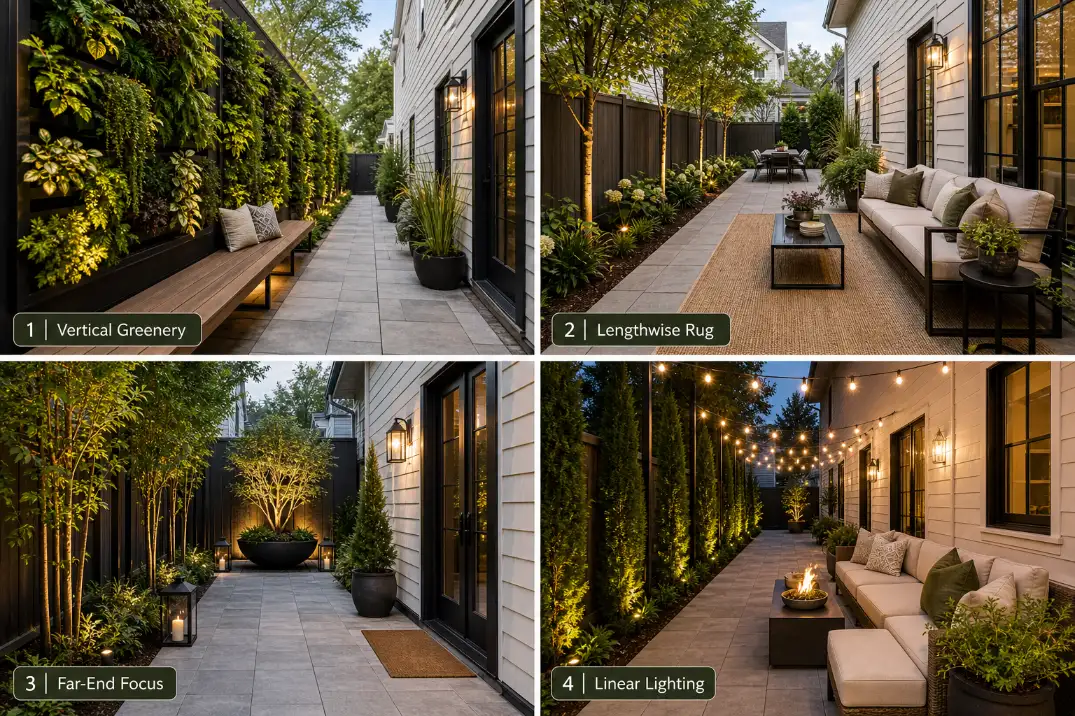
Vertical greenery
Use tall narrow planters, trellises, or wall-mounted planting instead of wide pots. The greenery softens the patio without stealing the walking lane.
Lengthwise rug
A rug can make a narrow patio feel intentional when it runs with the space or sits fully inside the seating zone. Avoid rugs that split the walking path in half.
Far-end focus
A tall planter, lantern pair, small water feature, or wall panel at the far end gives the patio a destination. This is especially useful when the patio is visible from inside the house.
Linear lighting
String lights, railing lights, or wall sconces should reinforce the length of the patio. Lighting that follows the route helps the narrow shape feel planned rather than accidental.
Mistakes That Make Narrow Patios Feel Awkward
The weakest layouts usually come from reasonable ideas applied to the wrong shape. These are the ones to question first.
Matching sets facing across the width
A matching sofa-and-two-chair set is often too rigid for a narrow patio. It creates a social arrangement, but it also places furniture on both sides of the tightest dimension.
A better version is usually a loveseat along one side with one movable chair at an angle. That gives you conversation without locking the entire width into furniture.
Planters in the walking lane
Large pots are useful for softening a narrow patio, but alternating them left-right along the route makes the patio feel like an obstacle course. Keep planters mostly on one side or at the far end.
This is a condition people underestimate. A 16-inch planter does not sound large, but if it sits inside a 36-inch route, the usable path instantly drops to 20 inches.
Rugs that split the route
Outdoor rugs can help a narrow patio look finished, but only if they clarify zones. A rug that sits half under the seating and half in the walking path creates a visual and physical interruption.
Run the rug lengthwise or keep it fully inside the seating zone. Do not use the rug to pretend a too-large furniture group fits.
Oversized sectionals
Sectionals work on narrow patios only when one side can sit tight to a wall or railing and the open side still preserves the path. Otherwise, the return section becomes a barrier.
This is where the routine fix stops making sense. Buying a “compact sectional” does not solve the issue if the L-shape blocks circulation. In many cases, the better choice is a straight sofa or bench plus one flexible chair. For a broader look at pieces that quietly crowd outdoor rooms, Patio Furniture Mistakes in Small Backyards covers the same failure pattern from a small-space angle.
When a Full Furniture Layout No Longer Makes Sense
A patio that is only 4 to 5 feet wide should not be forced into a complete outdoor room. That width is often better as a café ledge, grill landing, bench-only perch, or planted edge. Trying to fit a sofa, table, and chairs into that space usually produces a patio that photographs better than it lives.
The same is true when every function competes for the only route. If the grill lid blocks the walkway, dining chairs hit the wall, or the door opens into the seating area, the problem is not styling. The patio has too many jobs.
At that point, subtraction is the upgrade. Remove one category: dining, lounging, storage, or oversized planting. The idea is not to make the patio empty. It is to let the remaining function work cleanly. If the space already feels crowded, Remove Patio Furniture From a Cramped Space is often more useful than adding another small table or chair.
Quick Checklist Before You Buy Furniture
- Measure the narrowest usable width, not the full slab.
- Keep the main walking path at 30 inches minimum.
- Preserve 36 inches near doors, grills, and dining chairs.
- Treat lounge furniture over 34 inches deep as risky in tight layouts.
- Use benches where chair pull-back would block the route.
- Avoid opposing seating if it leaves only 24 inches or less between pieces.
- Test the layout with tape, boxes, or cardboard before ordering large furniture.
The Least Awkward Narrow Patio Formula
The best long narrow patio layout has one primary use, one continuous route, and one furniture edge doing most of the work. A 7-foot-wide patio can feel comfortable with a slim loveseat, narrow oval table, and one movable chair.
The same patio can feel cramped with a deep sofa, square coffee table, and two matching chairs.
Do not judge the layout by how much furniture fits. Judge it by how naturally people move through it. If someone can step outside, reach a seat, pull out a chair, and walk to the far end without dodging furniture, the narrow shape stops feeling like a flaw. It starts feeling intentional.
For broader landscape planning guidance, see University of Minnesota Extension.