A 9×12 patio fails differently from a normal small patio. The problem is not the 108 square feet on paper; it is the 9-foot width after chairs pull out, a door opens, and someone needs to walk through.
A 30- to 36-inch walking lane should stay clear, dining chairs need at least 24 inches of pullout space, and the first 30 to 36 inches outside the door should not become a furniture pinch point.
That is why the best 9×12 patio furniture layouts usually run with the 12-foot length instead of fighting the short side. A 12×12 patio can forgive a centered table or deeper seating. A 9×12 patio usually cannot.
The layout has to choose a primary job: dining, lounging, two-person use, or compact cooking support.
Quick Answer: Best 9×12 Layout by Use Case
| Your main use | Best layout | Why it works on 9×12 |
|---|---|---|
| Four-person outdoor meals | Lengthwise rectangular dining table | Uses the 12-foot side and protects one walking lane |
| Family dining in tight space | Bench + narrow table | Removes chair pullout on one side |
| Coffee, drinks, and two-person meals | Bistro table + two lounge chairs | Keeps the center lighter |
| Conversation and relaxing | Shallow loveseat + compact chairs | Avoids sectional bulk |
| Dining with a grill nearby | Dining or bistro layout with grill on outer edge | Keeps heat and traffic out of the main route |
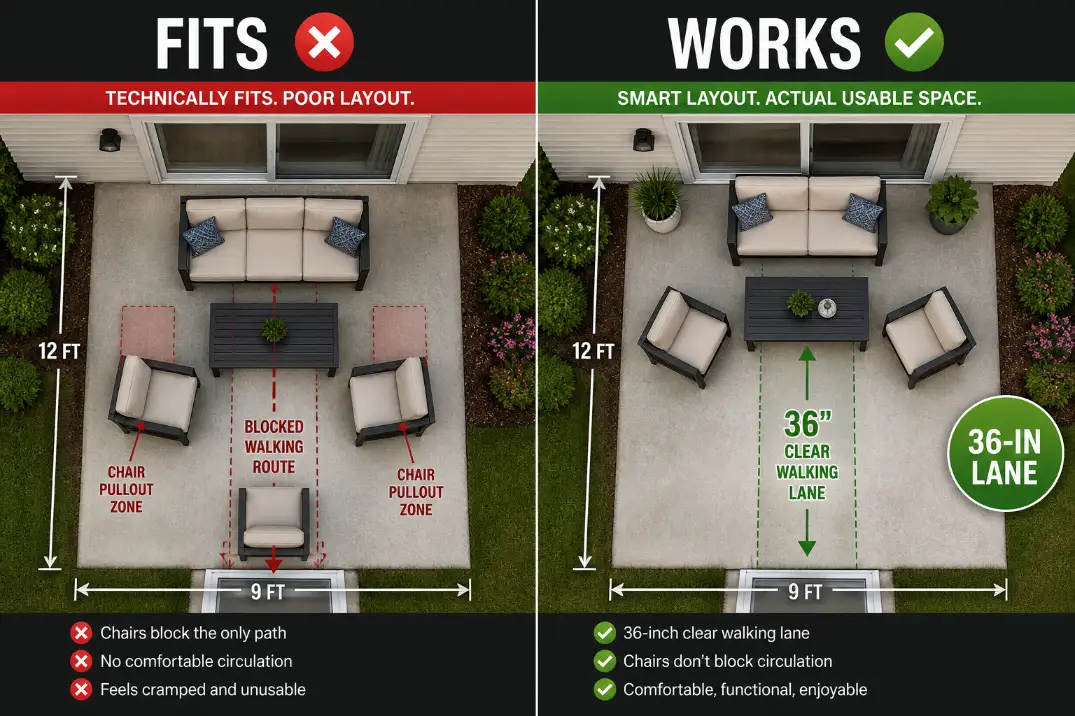
The best overall starting point for most narrow 9×12 patios is a lengthwise layout with one open side. If that 30- to 36-inch lane disappears, the furniture plan is probably too crowded, even if every piece technically fits.
Why 9 Feet Disappears So Fast
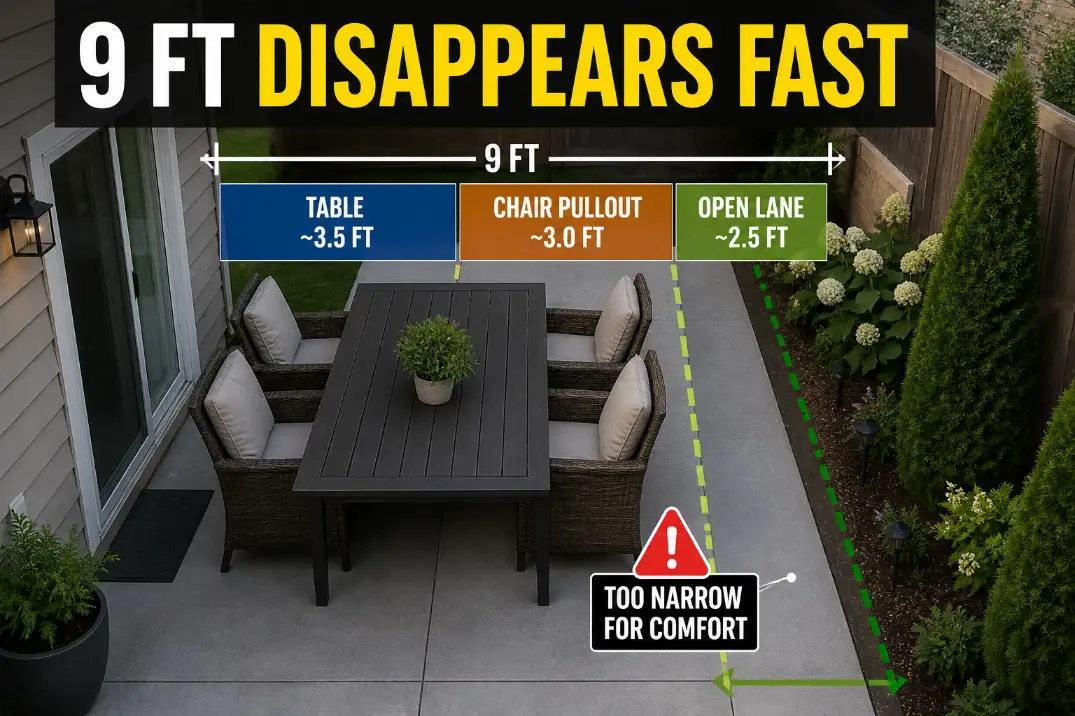
The 12-foot length gives you room to arrange. The 9-foot width is where the layout breaks.
A typical outdoor dining chair may be 24 to 28 inches deep when tucked in, but closer to 36 inches when pulled back. Add a 30- to 34-inch table and another chair on the opposite side, and most of the 9-foot dimension is already spoken for.
If you also add a planter, storage box, grill cart, or door landing, the patio starts to feel blocked.
This is the part people usually misread: the visible furniture footprint is not the real footprint. The real footprint is the furniture in use.
The 9×12 clearance rule
Use these numbers before buying furniture:
- 30 inches: minimum passable walking lane
- 36 inches: noticeably more comfortable walking lane
- 24 inches: tight but usable dining chair pullout
- 30 inches: better dining chair pullout
- 16–18 inches: practical bench depth
- 12–18 inches: safe range for a slim console or serving ledge
- 34–36 inches: upper practical depth for many lounge pieces
Below about 24 inches of open movement space, the patio may still photograph well, but it will feel annoying in daily use.
This is also why advice for larger patios does not always transfer. A layout from a 10×12 patio furniture layout for dining and lounging may look close, but that extra foot of width can be the difference between a real walking lane and a sideways squeeze.
The four layouts below are the most reliable ways to use a narrow 9×12 footprint because each one gives the 9-foot side a specific job instead of overloading it.
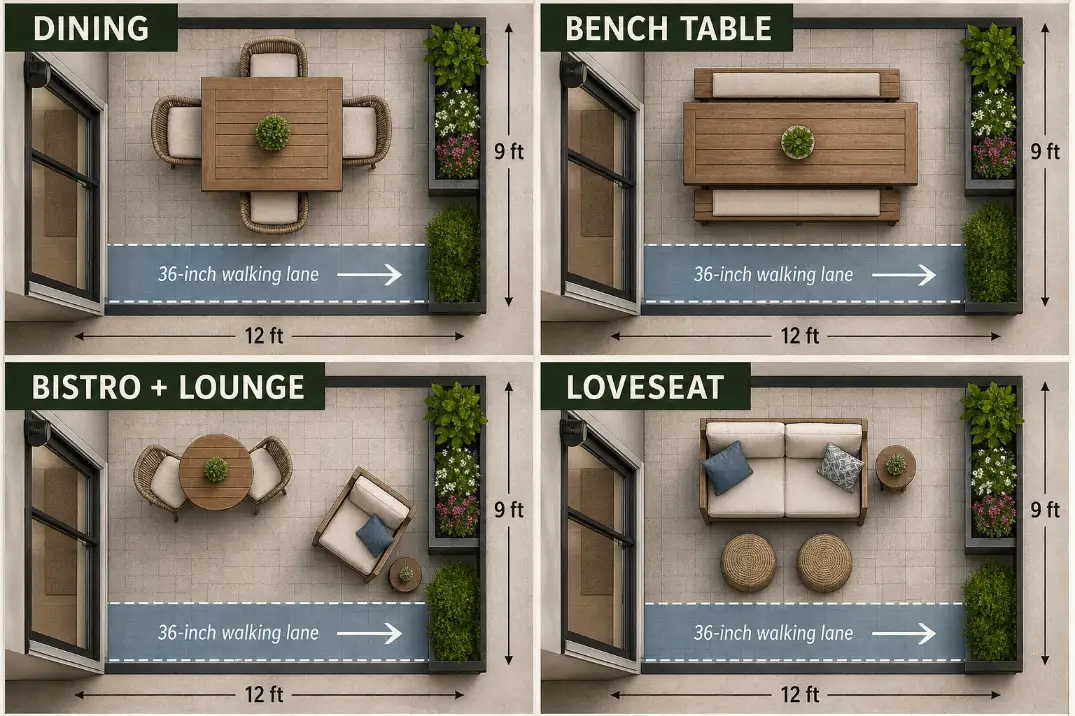
Four 9×12 Patio Furniture Layout Ideas That Actually Work
These layouts are not interchangeable. Each one solves a different version of the 9×12 problem.
1. Lengthwise dining layout
This is the strongest layout if the patio is mainly for meals. Place a narrow rectangular table parallel to the 12-foot side. Do not center it just for symmetry. Shift it enough to protect one clear walking lane.
Exact 9×12 setup: Use a 30×60-inch table for easier four-person dining, or a 30×72-inch table if the door and walkway are not fighting the dining zone. Keep one side open with a 30- to 36-inch path. Avoid chairs on all four sides unless the patio has unusually clear edges.
This layout works best when the door is near one short end. The first 3 feet can stay open as a landing area, while the dining zone sits farther along the 12-foot length.
The fix that often wastes time is buying smaller chairs while keeping a 40-inch-wide table. On a 9×12 patio, table width usually causes more trouble than chair style.
2. Bench-and-table layout along one long side
A bench changes the math because it removes chair pullout on one side. That matters a lot on a 9-foot-wide patio.
Exact 9×12 setup: Use a 16- to 18-inch-deep bench along one 12-foot edge, a 30- to 34-inch-wide table, and chairs only on the open side. If you need extra seating, use two lightweight end chairs that can move away when not in use.
This layout is especially useful for families because the bench gives more seating without filling both long sides with movable chairs. The downside is commitment: once a bench is built in or visually anchored, the patio has a clear direction. In a narrow space, that is usually a strength, not a weakness.
If you are deciding whether to use bench seating or individual chairs, bench seating vs patio chairs is especially relevant for patios where every inch of pullout space matters.
3. Bistro table plus two lounge chairs
This is the best 9×12 layout when the patio is used by one or two people most days. It gives the space a relaxed, flexible feel without pretending it can host a full outdoor dining room.
Exact 9×12 setup: Use a 28- to 32-inch bistro table near one corner or along one end. Pair it with two compact lounge chairs, ideally under about 30 to 34 inches deep. Keep the center of the patio open enough to move from the door to the yard without walking around every piece.
A 36-inch round table can still work, but it starts needing more clearance around all sides. A 42-inch round table usually belongs only if the patio is dining-first and the rest of the furniture stays minimal.
4. Shallow loveseat with two compact chairs
For a lounge-first patio, skip the sectional. A loveseat and two compact chairs usually work better because they leave more flexible gaps.
Exact 9×12 setup: Use a 54- to 60-inch loveseat, an 18- to 24-inch-deep coffee table, and two compact chairs angled toward the loveseat. Keep the opposite long side mostly open or use only a slim planter row.
The failure point is deep seating. A 38- to 42-inch-deep outdoor sofa may look comfortable, but it can consume the movement zone. For a narrow 9×12 patio, shallow seating usually beats plush furniture that belongs on a wider deck. If you are tempted by large cushions, compare the real footprint with the guidance in deep seating for small patios before buying.
Pro Tip: Tape the active footprint, not just the furniture footprint. Mark where chairs sit when pulled out and where people’s feet land when seated.
The Layout Mechanism: Fit vs. Function
A 9×12 patio can look complete from above and still fail in use. The symptom is “this patio feels cramped.” The mechanism is usually one of three things: chair pullout blocks the route, the door landing is crowded, or both long sides are filled with bulky pieces.
This is why adding décor rarely solves the problem. A rug, lantern, or planter may make the patio prettier, but it does not restore circulation. The healthier layout may actually look slightly emptier because it protects movement first.
This visual should make the 9-foot constraint obvious: once the chair zone and walking lane overlap, the layout is already failing.
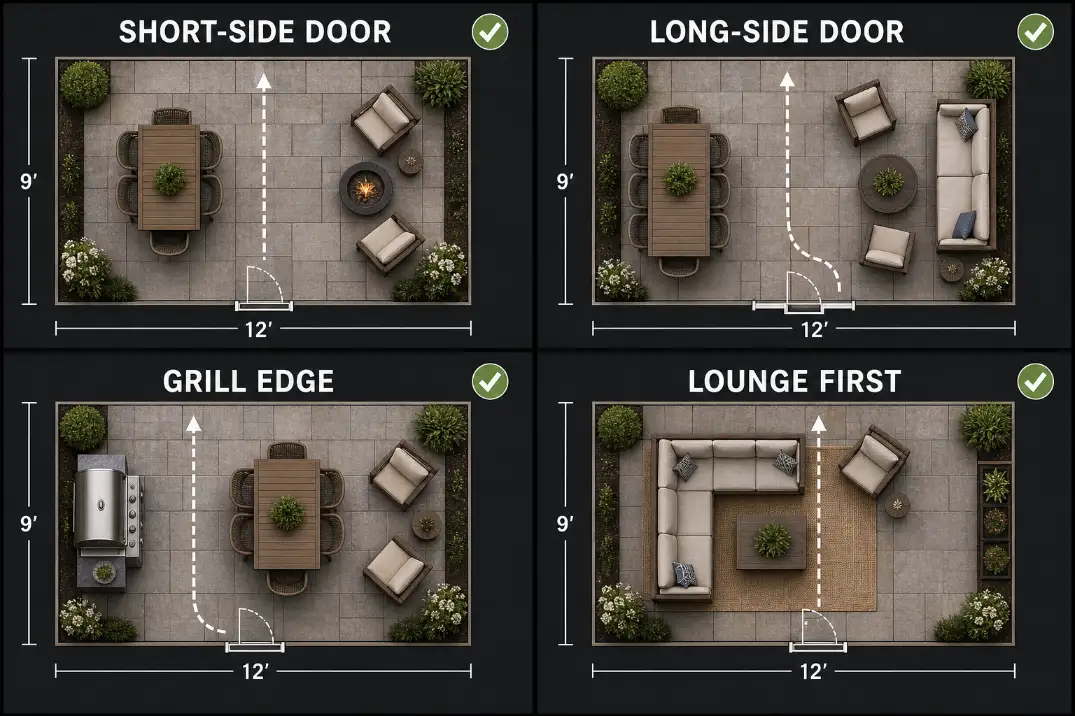
Door Position Changes the Best 9×12 Layout
Door location often matters more than furniture style. A good layout with the wrong door relationship becomes a bad daily-use layout.
If the door is on the short side
This is usually the easiest condition. Use the 12-foot length like a runway. Keep the first 30 to 36 inches outside the door clear, then place the main furniture farther out.
Best options:
- Lengthwise dining table
- Loveseat at the far end
- Bench-and-table layout along one long side
Avoid placing a dining chair directly in the door route. It may fit when tucked in, but it will block the patio as soon as someone sits down.
If the door is on the long side
This is trickier because the door opens into the side of the rectangle. Do not center a table in front of the door unless there is still a clear path around it.
Best options:
- Bench on the opposite long side
- Bistro layout shifted toward one end
- Loveseat placed away from the door landing
The biggest mistake is treating the door as just another edge. On a narrow patio, it is the starting point of the whole circulation plan.
If the patio has a sliding door
A sliding door removes swing clearance, but it does not remove traffic. You still need a clean landing where someone can step out, turn, and move toward seating without dodging chair backs.
If one side has a wall or railing
Use the fixed side to your advantage. A wall, railing, or fence side is usually better for a bench, slim planter row, or narrow console than for deep lounge chairs. What you want to avoid is bulky furniture on both long edges.
Door position changes the winning layout more than most furniture shoppers expect, so the second idea grid should compare layouts by entry and use scenario rather than repeating the same four furniture groupings.
When Dining, Lounging, and Grilling Compete
A 9×12 patio can support one main function and one smaller support function. It rarely supports a full dining set, a deep lounge group, and a grill station comfortably.
Pick the primary function first
If meals matter most, choose the dining layout first. The secondary function might be a slim serving ledge or a small grill at the edge.
If relaxing matters most, do not force a full dining set into the plan. Use a side table, nesting tables, or a bistro table instead.
If the patio is mainly for one or two people, a bistro-and-lounge setup will usually feel better than a four-seat table that is used twice a season.
Keep grill space honest
A grill is not just the grill body. Many grills need about 3 feet of working space in front for the cook to stand, open the lid, and move food safely. On a 9×12 patio, that work area should usually sit near an outer edge, not between the door and the seating.
The less likely problem is that the grill is too small. The more likely problem is that the grill sits in the traffic lane. If cooking has to share the patio with seating, small patio grill placement near a dining area can help you avoid turning the main path into the cook zone.
What Not to Buy for Most 9×12 Patios
Some furniture looks reasonable in a showroom or product photo but behaves badly on a narrow rectangle.
Oversized dining tables
A 38- to 42-inch-wide dining table is usually too wide unless the patio is almost entirely dedicated to dining. The issue is not the tabletop alone. It is the tabletop plus chair pullout plus walking space.
Large round tables
Round tables are friendly for conversation, but they need clearance on every side. A 42-inch round table can feel surprisingly bulky on a 9×12 patio, especially near a door.
Deep sectionals
A sectional often sounds efficient because it combines seating, but many outdoor sectionals are too deep for a 9-foot width. Once you add a coffee table and legroom, the open lane disappears.
Bulky storage boxes
A storage box against the only clear side can ruin an otherwise good layout. If storage is needed, choose a bench that already serves as seating or keep storage outside the main patio route.
Permanent “extra” folding chairs
Folding chairs are useful for guests. They are not useful if they live in the corner every day and narrow the walking path. Store them elsewhere unless they have a wall hook or dedicated storage spot.
Planters on both long sides
One long planter row can make the patio feel intentional. Planters on both long sides can make it feel like a corridor. In a 9×12 layout, one calm edge is usually better than two decorated edges.
9×12 Patio Furniture Size Guardrails
| Furniture piece | Safer size for 9×12 | Risky size | Why it matters |
|---|---|---|---|
| Rectangular dining table width | 30–34 in. | 38–42 in. | Wide tables erase chair and walking clearance |
| Rectangular dining table length | 60–72 in. | 84+ in. | Long tables crowd door and end zones |
| Round bistro table | 28–32 in. | 42+ in. | Larger rounds need clearance all around |
| Loveseat depth | 30–36 in. | 38–42 in. | Deep seating blocks circulation |
| Bench depth | 16–18 in. | 24+ in. | Deep benches start behaving like sofas |
| Console or serving ledge | 12–18 in. | 24+ in. | Support pieces become obstacles |
This table is more useful than brand names because product lines change, but dimensions do not. A “small patio set” can still be too deep, too wide, or too hard to move around on a 9×12 slab.
The key comparison is not cheap versus expensive furniture. It is furniture that only fits versus furniture that still works when people sit, stand, and move.
Final 9×12 Layout Checklist
- Keep one 30- to 36-inch walking lane clear from the door to the yard.
- Use the 12-foot length for the biggest piece: table, bench, or loveseat.
- Keep dining tables around 30 to 34 inches wide when possible.
- Allow at least 24 inches behind dining chairs; 30 inches is better.
- Keep lounge seating under about 36 inches deep unless the layout is lounge-only.
- Do not fill both long sides with bulky furniture, planters, or storage.
- Treat grill carts, rugs, planters, and side tables as part of the layout from the start.
- Choose one main use and one smaller support use, not three equal zones.
The Best Starting Layout for Most Narrow 9×12 Patios
For most narrow 9×12 patios, start with one of two plans: a 30- to 34-inch-wide rectangular table placed lengthwise or a shallow loveseat layout with one open side.
If family dining is the priority, use a bench along one 12-foot edge. If the patio is mainly for one or two people, a bistro table with two compact lounge chairs will often feel more generous than a forced four-seat dining set.
The rule is simple: the layout is not successful because the furniture fits on the slab. It is successful when the door landing, chair pullout, and walking lane still work after people sit down.
For a broader planning principle that also applies to small patios, Penn State Extension notes that outdoor rooms work best when they start with an honest choice about what the space needs to do: Penn State Extension.