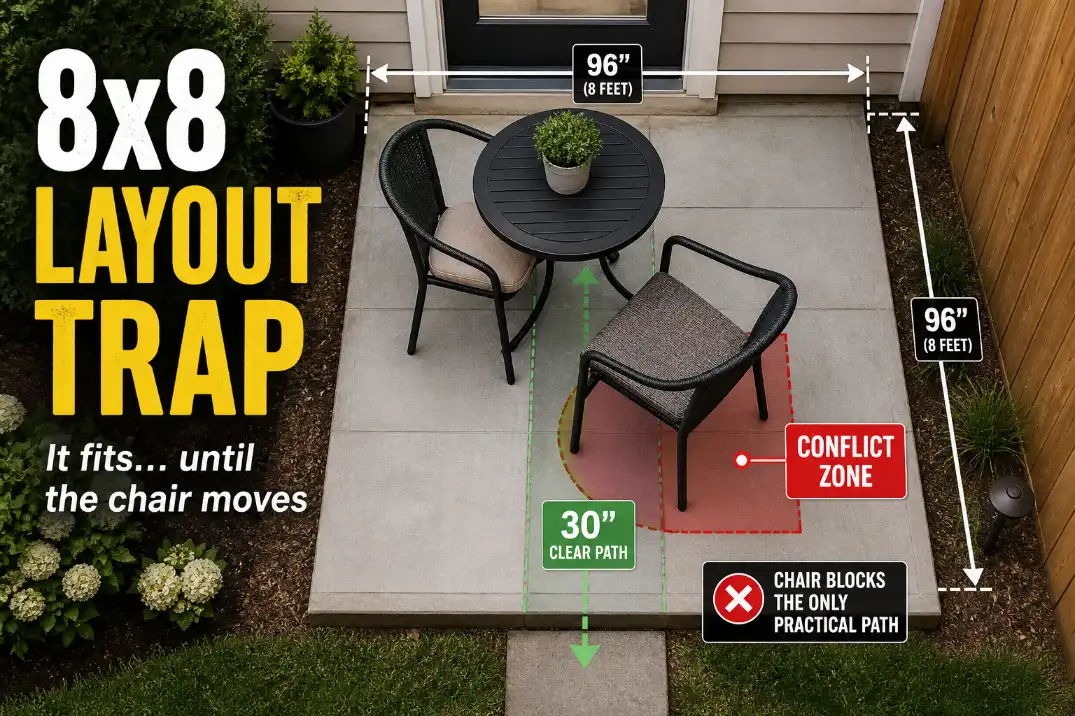
An 8×8 patio usually fails at the moment furniture starts moving. A table may fit when the chairs are tucked in, but the layout can collapse when someone pulls out a chair 18–24 inches, opens the door, or tries to walk through the only clear route.
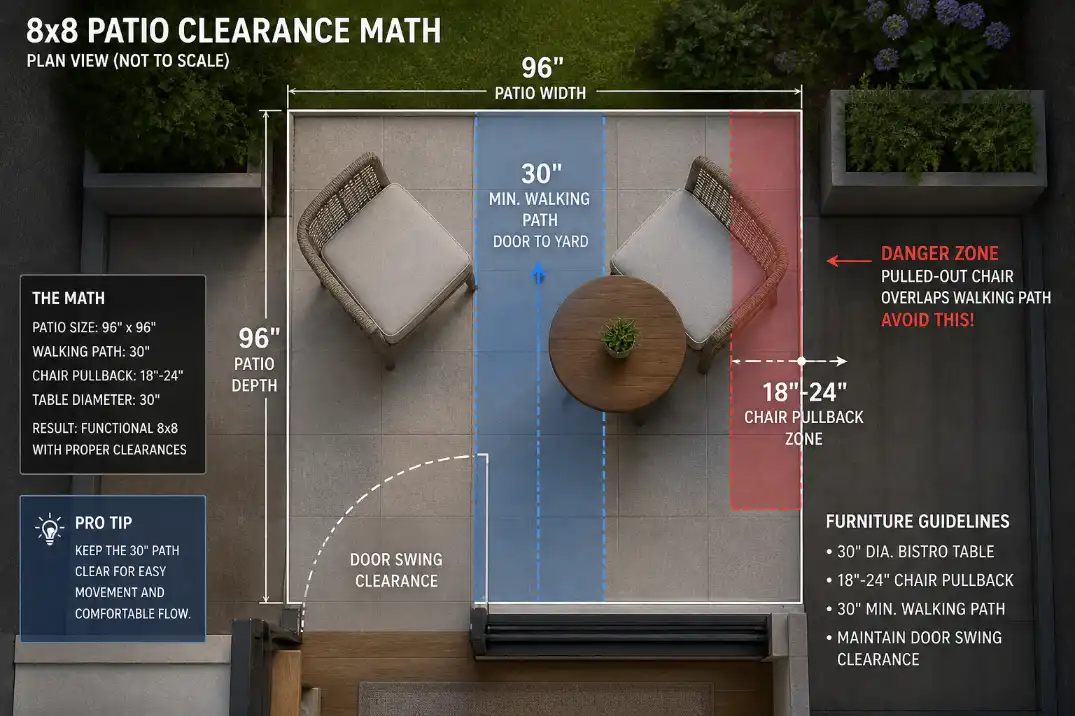
That is the real pressure of a 96-by-96-inch patio: after you protect a 30-inch walking path, the actual furniture zone often drops from 64 square feet to closer to 35–45 usable square feet.
That makes an 8×8 patio different from a general small patio. A 10×10 patio gives you 36 more square feet. A 12×12 patio has more than double the area. On an 8×8 patio, the best layout is rarely the one that fits the most furniture. It is the one that still works after the chair moves.
Why 8×8 Layouts Need Their Own Rules
A tiny patio does not shrink evenly. People still need adult-sized walking room. Chairs still need pullback space. Doors still need clearance. A planter still takes up real floor area.
That is why 8×8 patio planning is less about decorating and more about elimination.
| Space Type | Practical Reality |
|---|---|
| 8×8 patio | One main use, usually two permanent seats, clear path first |
| 10×10 patio | One main use plus a small secondary piece may work |
| 12×12 patio | Dining and lounging can sometimes share the space |
| 8×8 with door swing | Door arc and chair pullback cannot overlap |
| 8×8 with storage | Storage must replace another piece, not add to it |
The key rule is simple: one main furniture group, one small support piece, and one uninterrupted walking path. If a piece does not support the main use, it probably does not belong there permanently.
What people overestimate first
Most people overestimate how many seats an 8×8 patio should hold. Four permanent seats sound useful, but each one needs legroom, turning space, and a place to move when someone stands up.
A better target is two comfortable permanent seats, with one or two folding or stackable guest seats only when needed. A patio that works for two people every week is more valuable than one that barely works for four people twice a season.
If the patio already feels tight before furniture arrives, the problem may be broader than furniture size. The common space-wasting patterns in Small Patio Design Mistakes That Waste Space are worth checking before replacing one bulky set with another.
Seven 8×8 Layout Blueprints That Actually Work
These are not full outdoor-room designs. They are compact blueprints that survive the real limits of 96 inches by 96 inches.
1. Corner bistro blueprint
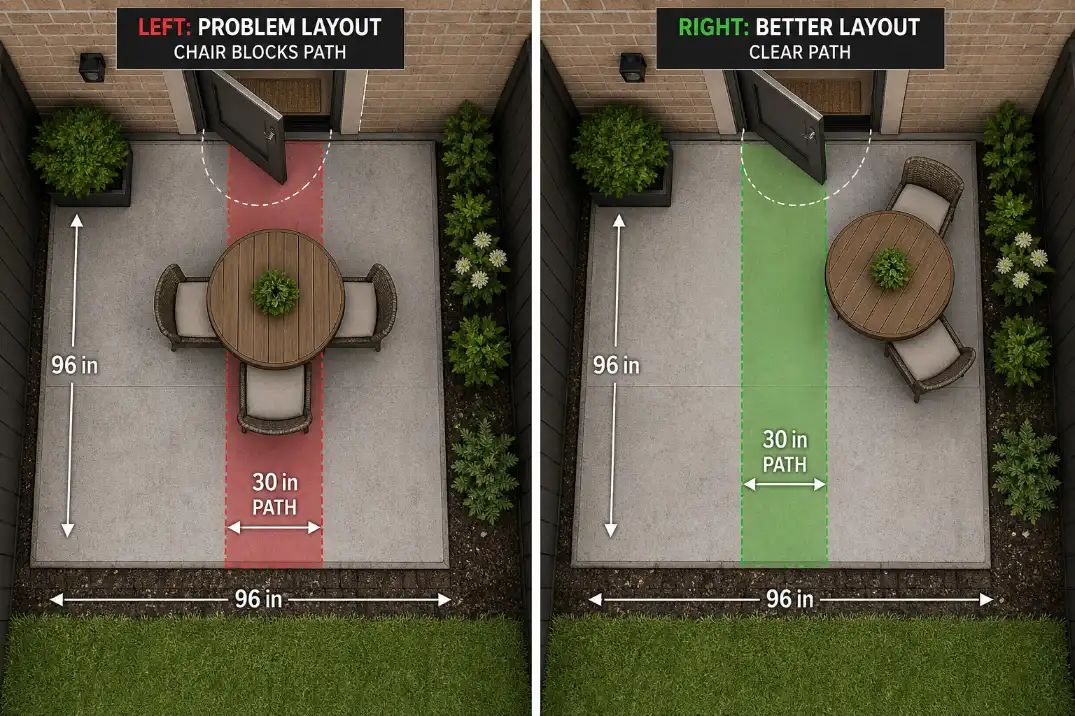
Use a 24–30 inch round bistro table with two slim chairs. Place the table near a corner, not in the center.
This works because the walking path can run past the furniture instead of circling around it. The chair-pullback test matters most: pull each chair out at least 18 inches. If either chair blocks the door, step, or yard exit, the set is too centered or too large.
A 36-inch table may sound only slightly bigger, but on an 8×8 patio it often crosses the line from comfortable to awkward. The extra diameter steals from the same zone where knees and walking clearance need to exist.
2. Fence-side bench blueprint
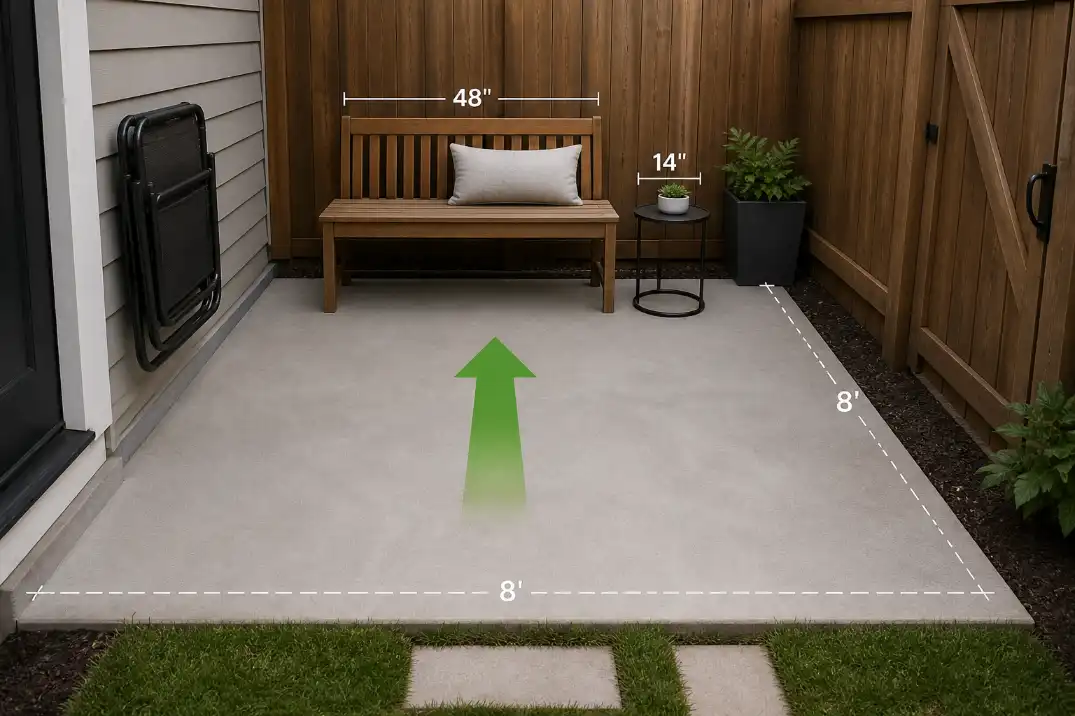
Place a 48–60 inch bench along the least active edge: a fence, railing, wall, or back boundary. Add one small side table instead of a coffee table.
This is one of the strongest 8×8 layouts because a bench does not need to slide backward the way chairs do. It turns the edge into seating and leaves the center calmer.
A 48–54 inch bench is safer if you also want a planter or folding guest chair. A 60-inch bench can work, but it should become the main furniture piece, not one part of a larger seating set.
For this kind of tight-space decision, the tradeoff in Bench Seating vs Patio Chairs becomes especially relevant because movable chairs are not always the flexible option in a very small footprint.
3. Single-chair retreat blueprint
One comfortable chair, one small side table, and one tuck-away footstool can make an 8×8 patio feel more generous than a forced two-chair arrangement.
This layout is best for reading, morning coffee, a shaded side patio, or a bedroom walkout. The mistake is choosing a chair that is too deep. Outdoor lounge chairs can be 34–38 inches from front to back before legroom is added. Inside a 96-inch patio, that can consume nearly half the usable depth.
A single-chair layout works when it leaves a clean path beside the chair, not directly through the foot zone.
4. Two slim chairs, no coffee table
Two chairs can work if they are narrow and the table stays small. Look for chairs under about 28 inches wide and angle them slightly toward each other with a small drink table between or beside them.
Do not add a standard coffee table. Even a modest coffee table creates a second obstacle in the exact space where knees, chair legs, and walking clearance already compete.
This layout is best when the patio has a clear entry and no outward-swinging door. If someone has to step outside and immediately turn sideways around a chair, the layout is too tight.
5. Folding dining setup
If you want to eat outside sometimes but do not need a permanent dining zone, a folding bistro table is often better than a fixed one.
The benefit is not just storage. It gives the patio two modes: open when unused, functional when needed. This matters on an 8×8 patio because a fixed table controls the space every day, even when no one is eating.
This setup works well for apartment patios, townhome slabs, and small backyard pads where the patio doubles as a pass-through.
6. Storage-bench-only layout
If storage is necessary, make the storage part of the seating. A storage bench along one edge is usually better than a separate deck box plus chairs.
A deck box can look harmless in the store, but on an 8×8 patio it behaves like another furniture piece. Once it blocks a corner, the layout loses flexibility. A storage bench combines two jobs and keeps the floor plan simpler.
This is also one of the few ways storage makes sense without turning the patio into an outdoor closet.
7. Planter-backdrop layout
Use one or two planters as a backdrop, not as obstacles. Place them behind a bench, along the back edge, or in a dead corner away from the door.
This works best when the furniture is simple: a bench, one small side table, and one vertical planting moment. It gives the patio atmosphere without scattering containers across the walking route.
Avoid matching planter pairs beside the entry. On an 8×8 patio, an 18-inch planter near the door can steal the same practical clearance as an extra chair.
Pick the Layout by Door Position
Door position often matters more than furniture style. The same bistro set can work beautifully on one 8×8 patio and fail on another because the entry point changes the path.
If the door swings into the patio
This is the least forgiving setup. The door swing and the chair-pullback zone cannot overlap.
Keep furniture outside the door arc first, then test chair movement. If both cannot be protected, reject centered furniture immediately. A wall-side bench or off-corner bistro usually works better than a conversation set.
If the patio has a sliding door
A slider gives more flexibility because there is no door swing. Still, the active side of the slider needs a clear lane. Do not put a chair where someone naturally steps out.
Use the fixed wall side for a bench, planter, or side table. Keep the opening side clear enough that a person can step outside without negotiating around furniture.
If the patio opens directly to the yard
The path should run from the house to the lawn without crossing a chair-pullback zone. This is where centered furniture often fails, even if it looks balanced from above.
Place furniture to one side and leave the transition clean. Planters, folding guest chairs, and storage boxes should not sit at the point where patio becomes yard.
8×8 Furniture Buying Rules
Small patio furniture labels can be misleading. A piece can be marketed as compact and still be wrong for an 8×8 patio.
| Piece | Safer 8×8 Range | Reject or Question When |
|---|---|---|
| Bistro table | 24–30 inches wide | 36 inches or larger with fixed chairs |
| Dining chairs | Under 28 inches wide | Arms are bulky or chairs need wide pullback |
| Loveseat | 48–54 inches wide | Over 60 inches unless it is the only main piece |
| Lounge chair depth | Under 32 inches preferred | 34–38 inches plus footroom blocks the center |
| Side table | 12–16 inches wide | It starts acting like a coffee table |
| Planter | 12–16 inches in active zones | 18 inches or larger near the entry |
| Storage | Built into seating if possible | Separate deck box blocks a usable edge |
Pro Tip: When measuring, tape out the furniture with the chair pulled back, not tucked in. Most bad 8×8 layouts look fine only in their most compact position.
What usually wastes money
The fix that often wastes time is buying a smaller version of the wrong layout. A small four-seat dining set is still a four-seat dining set. It still needs chair pullback, legroom, and access on multiple sides.
The same is true for sectionals. Many outdoor sectionals technically fit inside 96 inches, but that does not mean they leave usable movement. If a sectional consumes one full side and part of another, it must replace nearly everything else: no coffee table, no extra chair, no large planter, no deck box.
If bulky pieces are already making the patio hard to use, the logic in Remove Patio Furniture From a Cramped Space fits this exact kind of layout reset.
What Not to Put Permanently on an 8×8 Patio
A few pieces deserve a harder no because they usually solve one problem while creating a larger one.
Four permanent dining chairs
This is the clearest mismatch. Four chairs may fit around a table when tucked in, but the patio stops working when people sit down. A 36-inch table plus moving chairs can require nearly 7 feet of functional width, leaving almost no usable margin inside an 8-foot square.
Use two permanent chairs instead. Add folding guest chairs only when needed.
A full coffee table
Coffee tables belong in layouts with enough room to circulate around them. On an 8×8 patio, a coffee table often occupies the same zone as feet, chair legs, and the walking path.
Use a side table, nesting table, or C-table instead. The support surface should serve the seating, not become the center of the patio.
Large floor decor near the entry
Floor lanterns, plant stands, wide pots, and decorative baskets can all make sense in larger spaces. On an 8×8 patio, they can become trip points or turning obstacles.
Treat anything wider than 16 inches as furniture. If it sits on the floor, it has to earn its place.
Deep seating in multiples
One deep chair can work. A deep loveseat can work if it stays compact and becomes the main piece. Deep seating plus extra chairs is where the patio usually tips into crowding.
A chair that is 34–38 inches deep may feel comfortable, but it changes the whole layout. For more detail on that specific tradeoff, Deep Seating on Small Patios is a stronger follow-up than a generic small-furniture guide.
Small Details That Make 64 Square Feet Feel Usable
An 8×8 patio does not need much decoration, but it does need clean edges and fewer interruptions.
Use vertical surfaces first
Wall hooks, rail-mounted planters, string lights, and narrow shelves often work better than floor decor. The goal is not to decorate less. It is to decorate without stealing the walking route.
This is especially useful for condo and townhome patios where the floor area is fixed but walls, fences, or railings can carry some of the visual weight.
Keep rugs smaller than the slab
A rug can make a small patio feel finished, but wall-to-wall coverage can make the patio feel packed. Leave a visible border of patio surface around the rug so the floor does not read as one stuffed rectangle.
In humid climates or rainy regions, drying time matters too. If the patio stays damp for more than 24–48 hours after rain, a large rug can hold moisture and make cleaning harder.
Put planters behind the layout, not inside it
Planters should create a backdrop. They should not sit where people step, turn, or pull out chairs.
A single tall planter in a back corner often does more for the space than three smaller pots scattered around the furniture. Fewer, better-placed objects usually make an 8×8 patio look more intentional.
Best 8×8 Layout by Main Use
Choose the layout around the use that happens most often, not the rare situation you hope the patio can handle.
| Main Weekly Use | Best 8×8 Layout | What to Reject |
|---|---|---|
| Coffee for two | Corner bistro set | Centered table with tight chair pullback |
| Reading alone | Single lounge chair and side table | Symmetrical second chair used only for looks |
| Casual conversation | Two slim chairs, no coffee table | Deep club chairs with a center table |
| Low-maintenance seating | Edge bench and small table | Several movable chairs |
| Occasional guests | Two permanent seats plus folding extras | Four permanent seats |
| Storage need | Storage bench only | Separate deck box plus seating |
| Decorative sitting corner | Bench, one planter, open center | Planter clusters near the door |
The strongest choice is usually the one that gives up a fantasy use. If the patio is used for coffee five mornings a week and dinner once a month, design for coffee.
When the Standard Small-Patio Fix Stops Working
The standard advice is to buy smaller furniture. That helps only if the layout itself makes sense.
On an 8×8 patio, the real problem is often furniture count. A 24-inch table, two slim chairs, one planter, one storage box, one stool, one rug, and one lantern may all be individually small. Together, they still crowd the same 96-by-96-inch square.
This is where subtraction beats optimization. Move the grill near the patio instead of on it. Store guest chairs away from the daily layout. Replace the coffee table with a side table. Move planters behind the seating. Remove the deck box if it blocks the only usable edge.
A good 8×8 patio does not pretend to be a 10×10 or 12×12 patio. It chooses one main function and protects the clearance that makes that function easy. The best 8×8 patio is not the one that fits the most furniture. It is the one that still works after the chair moves.
For a more formal reference point on why clear walking routes matter around tight outdoor spaces, see the U.S. Access Board.