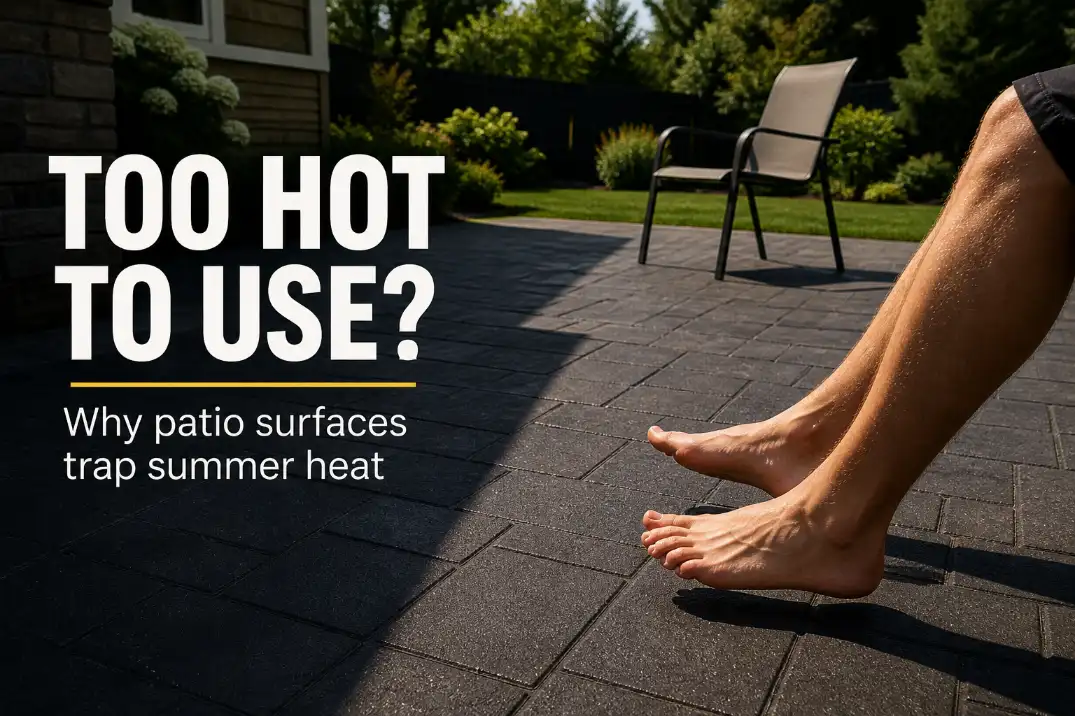
Some patio surfaces get too hot in summer because they absorb, store, and release heat faster than the outdoor space can shed it. The surface name matters, but the bigger clues are darker color, dense material, long afternoon sun, reflected heat, and slow cooling after shade arrives.
If you cannot stand barefoot on the patio for more than 3–5 seconds, the issue is no longer just “a sunny patio.” It is a usability problem.
The most useful test is timing. A patio that feels hot at 2 p.m. may simply need shade. A patio that still feels uncomfortable 1–2 hours after the sun moves has a heat-storage problem.
That distinction changes the fix. Around pools, pet paths, and children’s play areas, this matters more than appearance because the surface people actually touch becomes the design failure.
Umbrellas, rugs, and furniture placement may help a little, but they rarely solve a dark, dense surface that bakes for 4–6 hours in afternoon sun.
The Real Problem Is Surface Behavior, Not Just Surface Type
Most homeowners start by asking whether concrete, pavers, stone, tile, or composite decking gets hottest. That question is useful, but incomplete. Two patios made from the same broad material can feel very different depending on color, texture, thickness, finish, and exposure.
Dark Color Usually Shows Up First
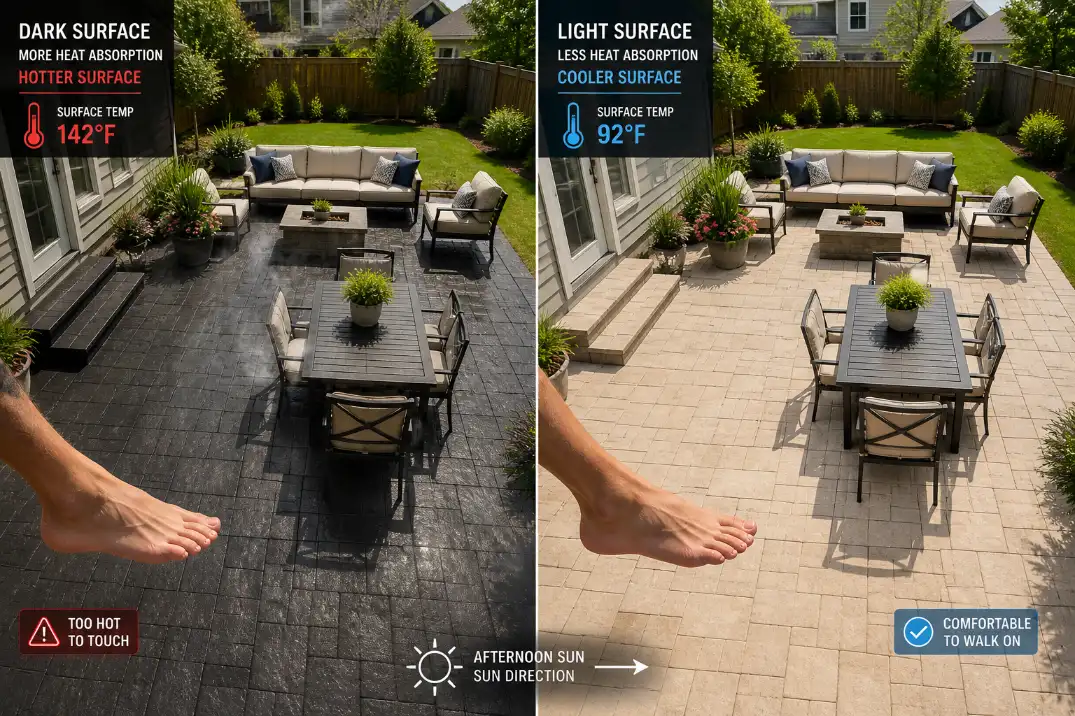
Dark charcoal, black, deep brown, dark red, and slate-colored patio surfaces absorb more solar heat than pale gray, buff, tan, cream, or light beige surfaces. This is why a dark concrete paver patio can feel harsher than a light poured concrete slab, even though both are cement-based surfaces.
Color is especially important on west- and southwest-facing patios. A surface that receives 4 or more hours of sun after 1 p.m. often becomes much less usable than the same material on the east side of the house.
Density Controls How Long the Heat Lasts
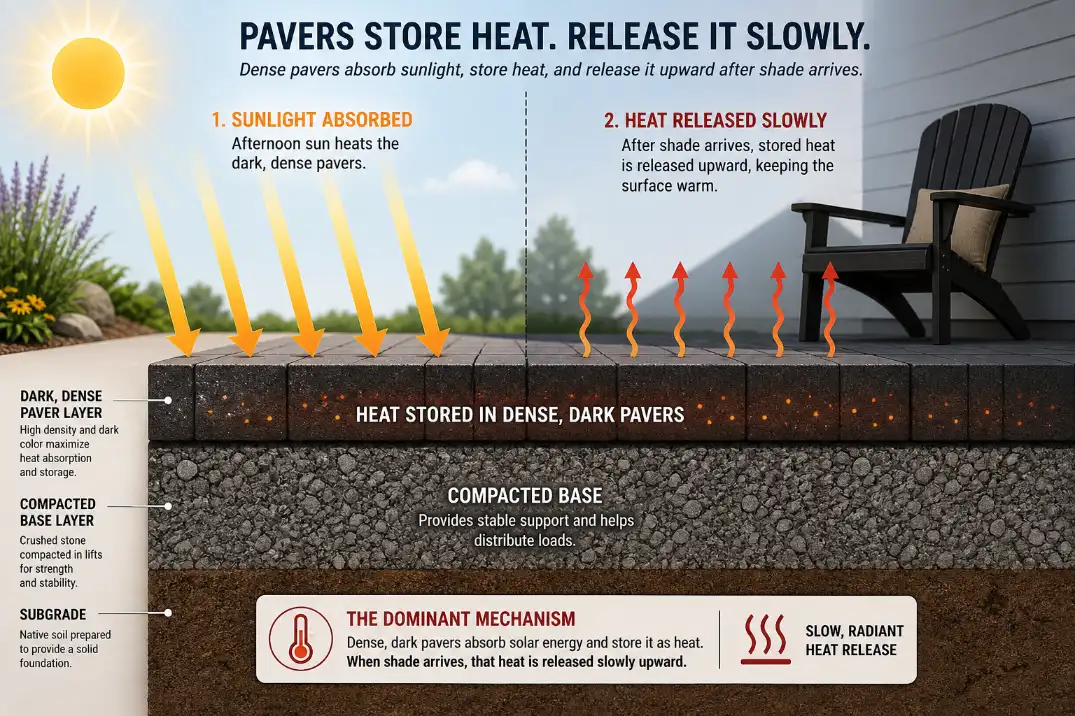
Dense materials store heat. Concrete pavers, poured concrete, porcelain tile, thick stone, and some composite boards can keep releasing warmth into the seating area after direct sun is gone.
That lingering heat is the real giveaway. If the patio still radiates warmth into the evening, the problem is not only sun exposure. The surface is acting like a heat battery.
More open or broken-up surfaces, such as gravel, decomposed granite, and permeable paver systems, may release heat differently because air can move through or around the material.
That does not make them automatically better for every yard, especially if drainage, furniture stability, or maintenance are concerns.
In yards where runoff is already an issue, surface comfort should be weighed alongside the kind of drainage tradeoffs discussed in Pavers vs Gravel for Backyard Drainage.
Quick Patio Heat Diagnostic
Use this before replacing the surface or buying another temporary fix.
| What to Check | What It Reveals | Practical Threshold |
|---|---|---|
| Barefoot comfort | Whether the patio is functionally usable | Pain in 3–5 seconds means it is too hot for casual use |
| Cooling time | Whether the surface stores heat | Still hot 1–2 hours after shade suggests high heat retention |
| Sun timing | Whether shade placement is wrong | 4+ hours after 1 p.m. is usually the harshest exposure |
| Surface color | Whether absorption is working against you | Dark gray, black, brown, and red usually run hotter |
| Nearby reflection | Whether heat is being amplified | Stucco, glass, brick, and fencing can bounce heat back |
| Air movement | Whether heat is trapped | Solid screens on multiple sides can make the patio feel hotter |
The mistake is treating every hot patio as the same problem. A patio that spikes in temperature but cools quickly needs different help than one that stays hot through dinner.
When Patio Heat Becomes a Safety Problem
A hot patio is not only a comfort issue. It can become a safety issue for children, pets, older adults, and anyone walking barefoot from a pool, sprinkler, or hose area.
Pool decks and barefoot transition zones deserve extra attention because wet skin often makes people less aware of heat until the surface already hurts. Dogs are another common blind spot. A surface that feels barely tolerable through shoes can be painful on paws, especially during long afternoon exposure.
The Warning Sign Is Avoidance
A patio is failing when people stop using it during the season it was built for. If chairs get dragged onto the lawn, kids avoid crossing the surface, or the dog refuses a normal path across the patio in July, the issue is not cosmetic.
At that point, buying softer cushions or rearranging furniture will not fix the surface people actually touch.
Hotter Than the Air Temperature
Patio surfaces can become far hotter than the surrounding air. On a 90°F day, a dark hardscape in direct sun may feel punishing even when nearby shaded grass feels manageable. In extreme summer conditions, dark pavement and dense hardscape can climb well past ordinary barefoot comfort levels, so the air temperature alone is a poor guide.
The practical safety cue is simpler than a thermometer: any patio surface that feels painful within 3–5 seconds should be treated as too hot for barefoot use, pets, and poolside walking paths.
The better field test is to check the patio at the time you actually use it, usually between 3 p.m. and 6 p.m. If it fails then, morning comfort does not matter much.
Why Common Patio Materials Feel So Different
Concrete and Concrete Pavers
Concrete is often blamed as if all concrete behaves the same way. It does not. A light broom-finished slab can be far more tolerable than dark sealed concrete or dark pavers in full afternoon sun.
Concrete pavers add another variable: joints. Wider or permeable joints can slightly change drainage and heat behavior, but they do not cancel out dark color or dense material. A dark paver patio can still become a major heat sink.
Pro Tip: Before choosing pavers for a hot yard, place samples in full afternoon sun for 2–3 hours. Touch them with your hand, then check them again after shade arrives. The second check is often more revealing than the first.
Porcelain and Outdoor Tile
Outdoor porcelain can look sharp and modern, but dark or smooth tile often performs poorly in hot exposed patios. It may feel harsh underfoot, and if the finish is slick, the same surface can become a slip concern after rain, pool splash, or cleaning.
This is where heat and safety overlap. A patio finish chosen mainly for appearance can become both hot in July and risky when wet.
If the surface already feels slick or sealed, it is worth thinking through the related issues in Slippery Patio Finish, Cleaning, Sealer, and Drainage Problems before adding another coating.
Natural Stone
Natural stone is not automatically cooler. Light travertine, light limestone, and some pale sandstone can perform well in hot patios, but dark slate or dense dark stone can still get uncomfortable.
The useful distinction is not “natural versus manufactured.” It is color, porosity, finish, and thickness. A thick dense stone may keep releasing heat after a thinner or more textured surface has already cooled.
Composite Decking and Synthetic Turf
Composite decking and synthetic turf are often underestimated because they look softer than stone or concrete. But softness does not mean coolness.
Dark composite boards can get very hot in direct sun. Synthetic turf can also become uncomfortable because plastic fibers and infill absorb heat without the natural cooling behavior of living grass. These surfaces can work in the right setting, but they should not be assumed barefoot-friendly in full summer exposure.
Conditions That Make a Patio Surface Even Hotter
West and Southwest Exposure
West-facing patios are often the hardest to cool because they receive low-angle afternoon sun when the day is already warm. In Arizona, Nevada, inland California, Texas, and parts of the Southeast, this late-day exposure can matter more than the material category.
A patio with 5 hours of morning sun may be comfortable by evening. A patio with 5 hours of afternoon sun may still radiate heat after sunset.
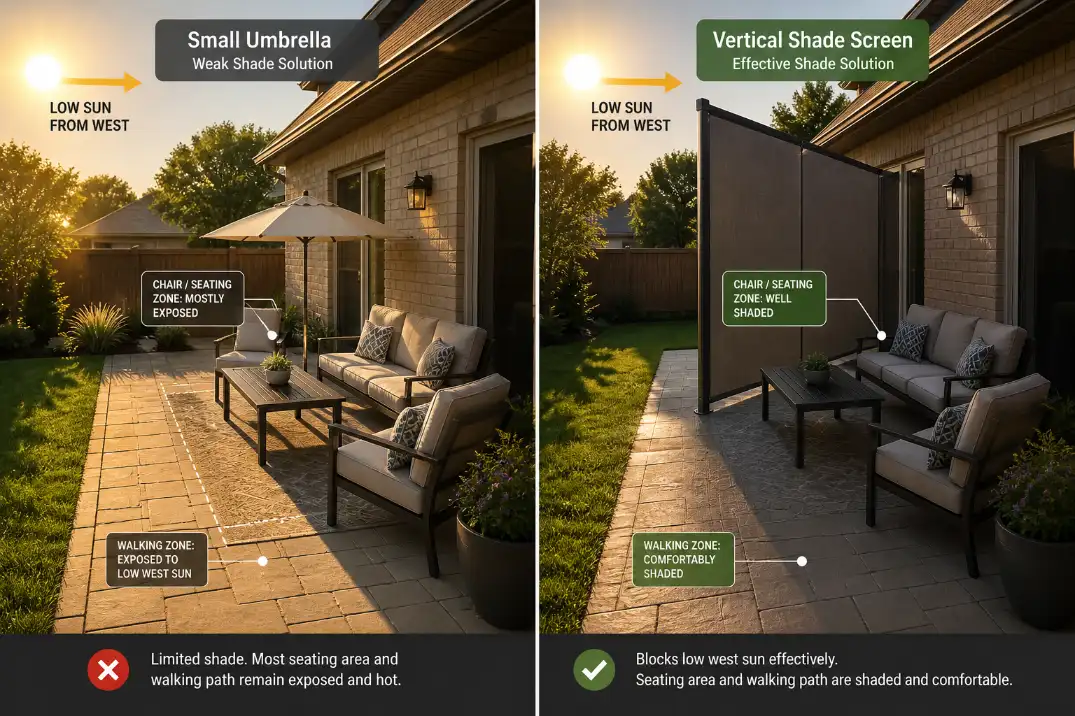
That is why shade placement matters so much. A cover that looks generous at noon may miss the seating area at 5 p.m. If late sun is the real trigger, the fix may need to behave more like the solutions in Patio Shade Problems in Afternoon Sun than a standard overhead umbrella setup.
Reflected Heat From Walls, Glass, and Fences
Heat does not only come from above. Stucco walls, brick walls, large windows, sliding glass doors, pale fences, and nearby hardscape can bounce heat back onto the patio.
This is why the same surface can feel hotter near the house than near the lawn. The patio may be sitting inside a small heat pocket.
Poor Airflow
A hot surface feels worse when warm air cannot move away from it. Solid privacy screens, enclosed patio walls, dense shrubs, and covered structures can trap heat close to the surface.
This does not mean privacy or enclosure is wrong. It means the design needs breathing room. Open slats, lifted plant canopies, gaps under screens, and layered planting can preserve privacy without turning the patio into a still-air box.
Can You Cool an Existing Patio Without Replacing It?
Sometimes, yes. But the fix has to match the failure.
Light Coatings Help Only When the Patio Is Otherwise Sound
A light-colored resurfacing product or coating may reduce heat on a structurally sound concrete patio. It makes the most sense when the slab drains well, is not badly cracked, and the main complaint is surface temperature.
It makes less sense when the patio has drainage problems, loose sections, deep cracks, or a slick finish. In those cases, coating the surface may hide the bigger issue rather than solve it.
Sealers Can Make the Problem Worse
A glossy or darkening sealer may improve appearance while making the patio feel hotter or more slippery. This is especially risky on smooth concrete, tile, or stone around pools and dining areas.
If the patio already feels too hot, avoid choosing a sealer only by how it looks when wet. A richer color often means more heat absorption, not more comfort.
Rugs Are Comfort Patches, Not Heat Fixes
Outdoor rugs can help under a dining table or lounge chair, but they do not cool the patio as a system. They may also trap moisture, create uneven fading, or hide stains.
A rug is reasonable when the hot zone is small and the patio dries quickly after rain. It is usually a weak fix for a large dark patio that bakes all afternoon.
When Shade Is Not Enough
Shade is still the first fix to test, but it has a limit. If the surface becomes usable soon after shade arrives, the problem was mostly exposure. If it keeps radiating heat into the seating area long after direct sun is gone, shade alone is only reducing the next heat cycle. It is not correcting the surface behavior.
That is the point where replacement zones, lighter resurfacing, reduced hardscape area, or a different patio material start to make more sense than another umbrella.
What Changes in Different US Climates
Desert and Inland Western Yards
In desert and inland western regions, the priority is reducing solar gain. Light surfaces, side shade, and lower hardscape coverage usually matter more than decorative planting alone.
Tiny pots will not cool a 300-square-foot heat sink. A shade tree, pergola, side screen, or lighter surface zone will do more.
Humid Southern Patios
In Florida, the Gulf Coast, and other humid regions, heat and moisture often overlap. A surface that stays hot, slick, and slow to dry can become uncomfortable in more than one way.
Here, the best choice is rarely just the coolest-looking material. Texture, drainage, mildew resistance, and drying time all matter.
Freeze-Thaw Regions
In northern states and parts of the Midwest, summer heat is not the only concern. A patio material also has to survive winter movement, deicing exposure, and freeze-thaw cycles.
That does not mean you should ignore heat. It means the best surface has to balance summer comfort with winter durability.
What Actually Helps Most
Aim Shade at the Hottest Use Window
Shade is usually the highest-value improvement, but only when it lands at the right time. For many homes, the critical window is 3 p.m. to 6 p.m.
A west-facing patio may need vertical or angled shade, not just an overhead canopy. A pergola, side screen, vine structure, or retractable shade may outperform a centered umbrella if the sun is coming in low from the side.
Create Cooler Foot Paths and Seating Zones
You may not need to replace the whole patio. If the structure is sound, a cooler walking strip, lighter seating pad, or shaded dining zone can improve daily use.
This works best when the worst heat is concentrated where feet touch: around lounge chairs, pool transitions, grill paths, or the route from the back door.
For cooking areas, comfort also has to work with fire safety, grease, cleaning, and furniture clearance. If the patio heat problem overlaps with grilling, the surface decisions in Best Surfaces Around a Backyard Grill become more relevant than color alone.
Reduce Hardscape When the Patio Is Too Large
A bigger patio is not always better in a hot yard. Extra paving can turn a backyard into a heat sink, especially when the surface is dark and surrounded by walls or fencing.
If the patio is rarely used during summer, replacing part of the hardscape with planting, gravel, shade structure, or a lighter surface may do more than adding another umbrella.
This is the same practical problem behind many Patio Design Problems in Hot Climates: the design may look finished, but the space fails during the season when people most expect to use it.
Best Fix by Patio Situation
| Patio Situation | Better Direction | What to Avoid |
|---|---|---|
| Dark west-facing patio | Add west-side shade and lighter walking zones | Relying only on a center umbrella |
| Pool deck too hot | Use light textured stone, pavers, or resurfacing | Dark tile, dark composite, or slick finishes |
| Small enclosed patio | Improve airflow and reduce hardscape heat | Solid screens on every side |
| Sound concrete slab | Test light resurfacing or coating | Glossy dark sealer |
| Patio still hot after sunset | Treat surface and hardscape area as the issue | Rugs as the main solution |
| Hot grill path | Choose heat-tolerant, cleanable, stable surface | Loose or heat-sensitive materials near cooking |
The strongest fix is usually layered: lighter contact surfaces, targeted shade, and enough airflow for heat to leave. One change may help, but one change rarely rescues a large dark patio in full afternoon sun.
Questions People Usually Ask
What patio surface stays coolest in summer?
Light-colored, textured surfaces usually have the best odds. Light concrete pavers, light broom-finished concrete, travertine, light limestone, and some pale textured stone surfaces can perform well when paired with shade and airflow. No material stays truly cool in full afternoon sun.
Are pavers hotter than concrete?
Not automatically. Dark dense pavers can feel hotter than light poured concrete, but light pavers can be more comfortable than dark sealed concrete. Color, finish, and exposure matter more than the label.
Can shade fix a patio that stays hot after sunset?
Shade can reduce heat buildup, but if the patio stays hot 1–2 hours after shade or sunset, the material is storing heat. In that case, shade helps, but surface color, density, and hardscape area may also need to change.
The Bottom Line
Some patio surfaces get too hot because they behave like heat storage systems. The usual culprits are dark color, dense material, long afternoon sun, reflected heat, and poor airflow. The surface type matters, but it is not the whole story.
Start with the timing test. If the patio cools quickly after shade arrives, fix the shade angle. If it stays hot into the evening, treat the surface itself as the problem.
The most comfortable summer patios are not just shaded; they use lighter contact surfaces, targeted late-day shade, and enough open space for heat to escape.
For broader official guidance on how paved and built surfaces contribute to outdoor heat, see the U.S. Environmental Protection Agency.