Last updated: May 2, 2026
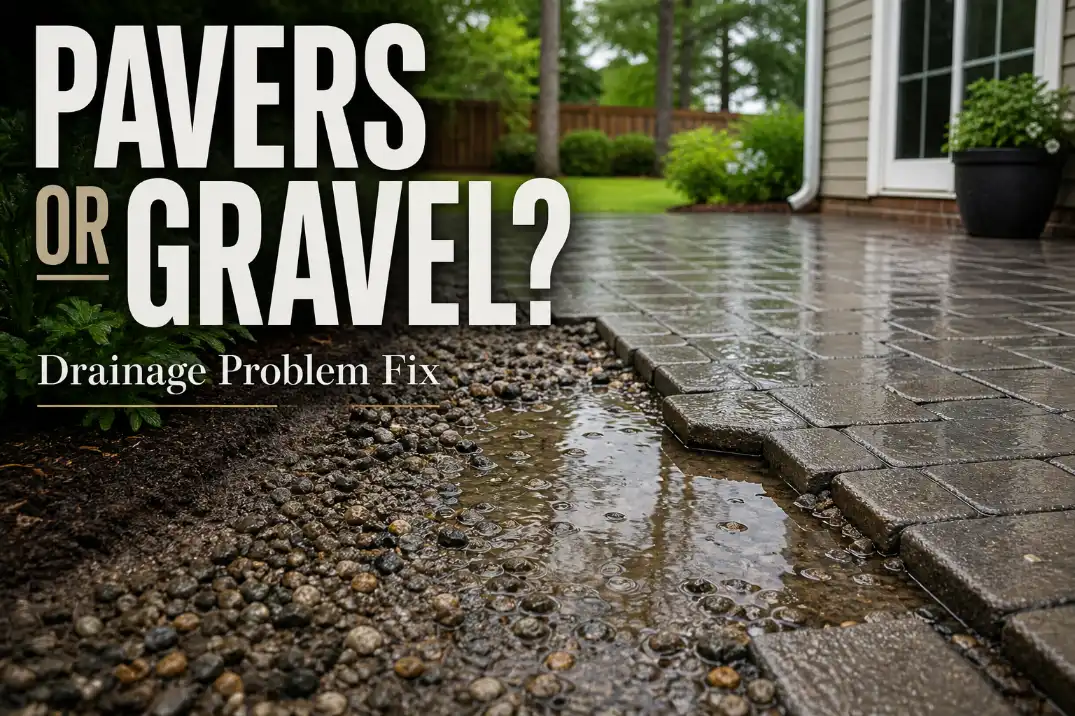
If your backyard stays wet after rain, gravel usually handles light drainage problems better than standard pavers because water can pass through the surface instead of sitting on top. But that does not mean gravel fixes the yard. If water remains for more than 24 hours, flows in from a downspout, or returns to the same low spot after every storm, the surface material is not the main problem.
The better decision is between loose gravel, standard pavers, permeable pavers, or fixing drainage first. Gravel works best for wet margins, informal paths, and areas where water needs release.
Standard pavers work best where people need a stable patio, walkway, or grill zone. Permeable pavers are the middle option when you need a usable surface that can also accept water.
A quick threshold helps: if puddles disappear within 2–4 hours after a normal rain, a surface upgrade may help. If the area is still soft or wet the next day, start with grading, soil compaction, runoff, or downspouts before choosing either material.
Quick Answer: Gravel, Standard Pavers, or Permeable Pavers?
Choose gravel when the area needs release
Gravel is usually the best choice for damp side yards, wet walkway edges, utility paths, narrow backyard passages, and low-use areas that need to dry faster without becoming a formal patio. It opens the surface and lets water move down into the stone instead of sitting directly on compacted soil.
The limit is stability. Gravel is not ideal under dining chairs, grill carts, deep seating, or anything with narrow legs. Even compacted gravel can shift, scatter, or rut when used like a patio floor.
Choose standard pavers when the surface must stay firm
Standard pavers are better when the backyard needs a clean, stable, finished surface. They make more sense for patios, outdoor dining areas, grill zones, and main walkways where furniture needs to sit level.
But standard pavers are not a drainage solution by themselves. They need a compacted base, edge restraint, and a finished slope of about 1/8 to 1/4 inch per foot so water moves away from the house or toward a safe outlet. Without that slope, pavers can make a drainage problem look neater while pushing water into the wrong place.
Choose permeable pavers when drainage and patio use both matter
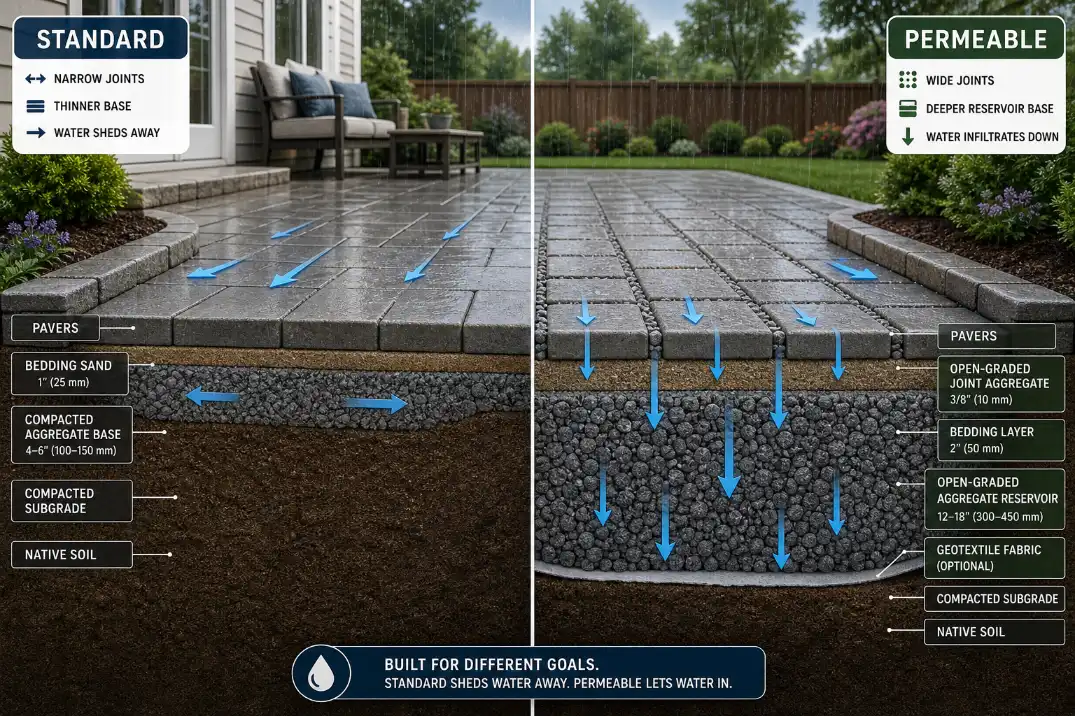
Permeable pavers are different from standard pavers. They use open, stone-filled joints that allow rainwater to move into a clean stone base below. That base acts like a temporary reservoir, giving water somewhere to go instead of forcing it across the surface.
This is often the strongest option when the area must support furniture but also needs better water handling. The catch is installation depth and outlet planning. Permeable pavers only work as a system. In slow-draining clay, the stone reservoir can store water, but it does not magically make clay absorb faster. Some sites still need an underdrain or overflow route.
If pavers are staying damp or slick, the next decision may be whether the surface needs drainage correction, cleaning, or one of the right non-slip patio treatment options.
Choose neither until the water source is fixed
If roof runoff empties into the area, if water runs visibly across the yard during storms, or if the ground stays saturated for a full day, do not expect gravel or pavers to solve it alone. A surface cannot absorb a water source that has not been controlled.
That is the point many homeowners miss: the best-looking material can still fail if the yard is shaped like a bowl.
The Difference Most People Miss
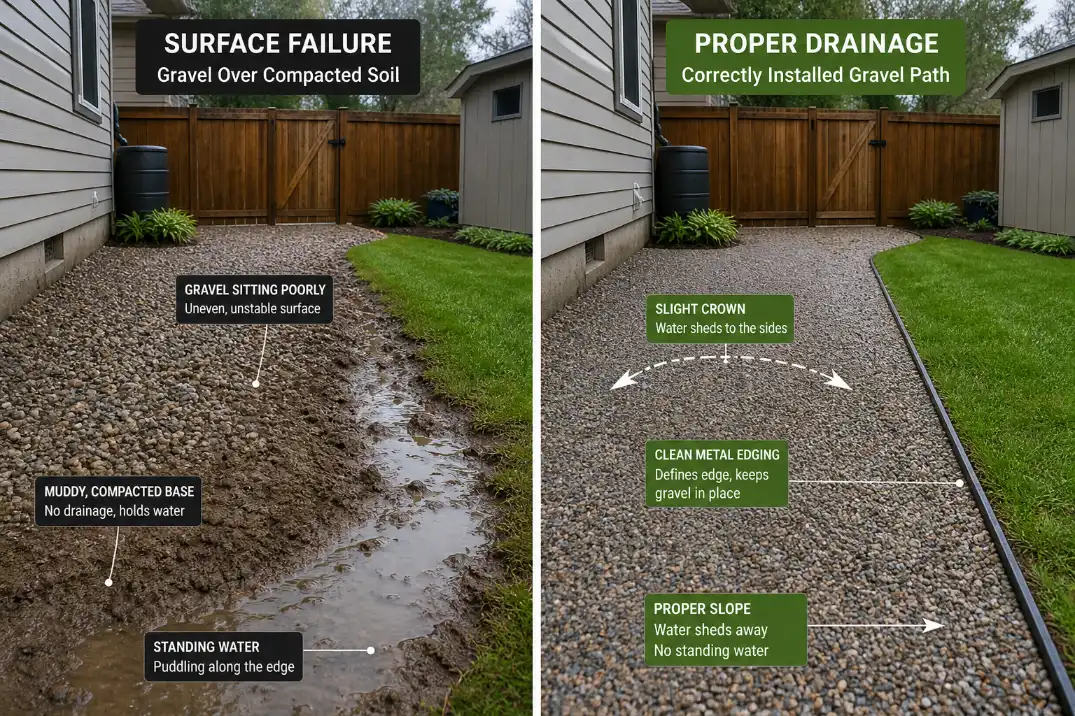
A dry gravel surface can hide wet soil
Gravel can make a wet backyard look improved almost immediately. The top layer dries faster than exposed soil, and shoes may stay cleaner. But the soil underneath may still be saturated.
This is common in clay-heavy yards across parts of the Midwest and Southeast, where water moves slowly downward. A 3-inch layer of decorative gravel can look dry while the ground below remains soft for 12–24 hours. If the area feels spongy underfoot, the gravel has hidden the symptom, not fixed the mechanism.
Gravel improves surface release. It does not automatically improve deep soil drainage.
A flat paver patio can move water into the wrong place
Pavers often fail in the opposite way. They create a clean surface, but if the patio is too flat or pitched incorrectly, water is simply sent somewhere else. That might be toward the lawn, planting beds, fence line, or foundation.
When a patio starts holding water near the house, the surface material is less important than the direction of flow. The same warning signs discussed in patio water pooling against the house apply here: damp foundation edges, staining, algae growth, and puddles that linger after the rest of the patio dries.
Surface material is not the drainage system
Gravel, standard pavers, and permeable pavers all behave differently, but none of them overrides bad grading. If water has no outlet, it will collect. If roof water is dumped into the area, it will overwhelm the surface. If soil is compacted several inches deep, water may perch above it.
The surface helps only after the water path makes sense.
Backyard Drainage Scenarios: Which Surface Wins?
| Backyard condition | Best surface | Why it wins | Do this first |
|---|---|---|---|
| Puddles disappear in 2–4 hours | Gravel or permeable pavers | The issue is likely surface wetness, not major drainage failure | Add slope, edging, and a drainable base |
| Water sits 24+ hours | Neither yet | The yard is holding water below the surface | Fix grading, compaction, or outlet |
| Chairs, grill, or table need support | Standard or permeable pavers | Furniture needs a firm, level surface | Build the base and pitch correctly |
| Downspout empties into the area | Neither yet | Roof runoff can overwhelm both surfaces | Redirect downspouts first |
| Clay soil stays soft | Permeable pavers with outlet planning, or gravel with drainage support | Water needs storage and a controlled release path | Avoid shallow decorative installs |
| Runoff crosses the yard during storms | Pavers only with planned slope; gravel only if contained | Moving water can wash loose stone downhill | Slow or redirect flow first |
| Freeze-thaw climate | Properly based pavers or flexible gravel | Saturated bases heave in winter | Keep water out of the base layer |
Why Gravel Helps — and Where It Fails
It releases light water faster
Gravel is useful because it opens the surface. Instead of rain sitting on compacted soil, water can move through the stone layer and spread out. For wet walking paths, side yards, and low-use corners, that can be enough to make the space cleaner and more usable.
A practical gravel installation usually needs more than a thin decorative layer. In many backyards, 4–6 inches of clean angular stone performs better than 2 inches of rounded pea gravel. Angular stone locks together more firmly, while rounded gravel tends to roll, scatter, and migrate into lawn.
It fails when runoff has speed or volume
Gravel is often overestimated in sloped yards. If water visibly moves across the backyard during a storm, loose stone can shift, wash downhill, or collect at the low edge. The problem is no longer just wet ground; it is moving runoff.
That is why a yard with stormwater cutting across a hardscape should be handled more like a sloped yard where runoff cuts across a patio than a simple surface upgrade.
Gravel can be part of the solution, but only if it is contained, edged, and supported by grading or drainage that slows the water.
It needs separation, edging, and maintenance
Gravel works best when it stays clean and separated from soil. If mud pumps up into the stone, the surface gradually loses drainage capacity. A geotextile fabric layer can help separate gravel from soft soil, but fabric is not magic. If the yard has nowhere to drain, water will still sit above or below it.
Edging matters too. Without it, gravel spreads into lawn, planting beds, and patio edges. Over time, that turns a low-cost idea into a repeated cleanup chore.
Pro Tip: If gravel starts disappearing into mud within the first rainy season, do not just add more stone. The base is mixing with soil, and the drainage layer is failing.
Why Pavers Help — and Where They Fail
They create usable space
Pavers are the better choice when the backyard needs structure. They support furniture, define outdoor rooms, and create a surface that feels intentional near the house. For grill stations, dining sets, and main walkways, pavers usually beat gravel in daily use.
They are also easier to sweep and keep visually clean. That matters in yards with leaves, pets, kids, or frequent foot traffic.
Standard pavers need slope
A standard paver patio should not be perfectly flat. It should feel level while still moving water. A slope of about 1–2% is usually enough for patio drainage, which translates roughly to 1/8 to 1/4 inch of drop per foot.
If that slope is missing, pavers can hold shallow water in joints and low spots. If the slope points the wrong way, the patio may send water toward the house or into a soggy strip of lawn.
A common wasted repair is lifting and re-leveling a few sunken pavers without correcting why they sank. If water is softening the base or washing fines out of the bedding layer, the same pavers may settle again after several storms.
Permeable pavers need a real reservoir base
Permeable pavers are not simply regular pavers with larger gaps. The open joints matter, but the base matters more. Water needs to pass through the joints into bedding stone, then into a deeper clean-stone reservoir where it can slowly infiltrate or move to an underdrain.
If permeable pavers are installed over compacted soil with only a shallow base, they may clog, overflow, or act much like standard pavers. The visible surface is only the top of the system.
The Hidden Base Decides the Outcome
Gravel base versus decorative gravel
Decorative gravel is often used too thinly. A shallow layer may control mud on the surface, but it does not create meaningful storage for water. In wet zones, the stone layer needs enough depth to hold shape and stay separated from the soil.
For a path or wet margin, 4 inches may be enough in a mild case. For chronically wet soil, the area may need deeper excavation, a better outlet, or a different drainage solution entirely.
Standard paver base versus permeable paver base
Standard pavers usually rely on a compacted aggregate base and bedding layer. The goal is stability and surface runoff. Permeable pavers rely on open-graded stone with void space. The goal is infiltration and temporary water storage.
Those are different systems. Swapping the surface without changing the base does not create the same performance.
This is especially important after hardscape changes. A new patio or walkway can alter the way stormwater travels through a yard, which is why backyard drainage after a patio or walkway should be considered before the final material is chosen.
Clay soil and freeze-thaw change the risk
Clay soil drains slowly and compacts easily. In a clay backyard, both gravel and pavers need more caution because water may sit above the soil rather than soaking in quickly. In northern freeze-thaw states, wet base layers can expand, heave, and shift pavers out of alignment.
A patio that drops or heaves by more than 1/4 to 1/2 inch in a season is not just “settling.” It is usually pointing to water movement, base weakness, or freeze-thaw stress.
The Maintenance Difference Most Homeowners Feel Later
Gravel is cheaper upfront but easier to disturb
Gravel usually costs less to install than pavers, especially for informal areas. That lower upfront cost is one reason it is attractive for wet backyard edges and utility paths. But the maintenance is more visible.
Leaves settle into it. Soil and mulch can wash across it. Dogs, kids, wheelbarrows, and lawn equipment can scatter it. In a wet backyard, gravel may need periodic raking and topping up. If it borders lawn, expect cleanup unless the edging is strong.
Pavers cost more upfront but are cleaner day to day
Pavers usually cost more to install because the base, cutting, edging, and leveling matter. The payoff is daily usability. Chairs sit better, carts roll more cleanly, and the surface feels more finished near the house.
The repair cost is the tradeoff. If a gravel path settles, you can often add and rake stone. If a paver patio settles, individual pavers may need to be lifted, the base corrected, and the surface reset. That extra investment makes sense in active spaces. It makes less sense in a wet corner nobody uses.
Permeable joints must stay open
Permeable pavers need maintenance too. Leaves, soil, mulch, and fine sediment can clog the joints over time. If water stops entering the joints and begins running across the surface, the system is losing performance.
In leafy yards, joint cleaning may be needed once or twice a year. In dusty or mulch-heavy areas, it may need attention more often. Permeable pavers are not maintenance-free; they are drainage-capable when kept open.
The Wrong Question: Surface Choice vs Water Source
Do not ask gravel to absorb a roof
A 1,000-square-foot roof can shed more than 600 gallons of water during a 1-inch rain. If a downspout empties into the backyard problem area, gravel is not the first fix. Standard pavers are not the first fix either.
The water source has to be redirected before the surface is chosen. If planting beds or patio edges are being flooded by roof discharge, the issue is closer to downspouts flooding backyard planting beds than a simple pavers-versus-gravel decision.
Do not cover a bowl-shaped yard
If water collects in the same depression after every storm, adding a nicer surface only covers the low spot. Gravel may hide the puddle. Pavers may bridge it temporarily. But the water still has no reason to leave.
That is the point where a routine surface fix stops making sense. The grade needs correction, the water needs a route, or the low area needs to become an intentional drainage feature.
Do not ignore water near the house
Water near the foundation deserves priority over patio appearance. If the wet area is within a few feet of the house, the goal is not just comfort; it is safe drainage away from the structure.
In that case, treat the surface as the final layer, not the repair.
When a Hybrid Layout Works Better Than Choosing One
Use pavers for the living area
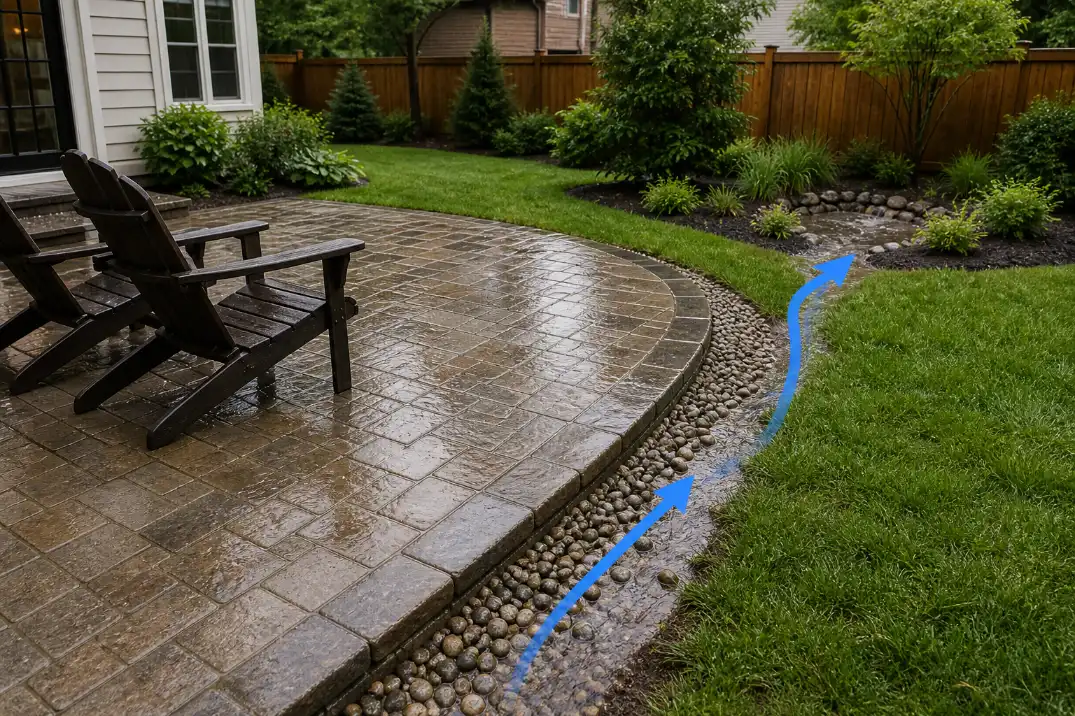
A hybrid design often gives the best result in real backyards. Pavers can form the patio center where chairs, tables, and grill equipment need support. This keeps the usable space clean, level, and easy to maintain.
Use gravel for the release edge
Around that firm surface, gravel can handle splash, overflow, and damp transitions. A gravel strip along the patio edge can prevent soil from washing onto the pavers and give light runoff a place to slow down.
This is much stronger than trying to make the entire backyard gravel or forcing pavers into every damp edge.
Keep the water path intentional
The gravel edge still needs somewhere to send water. That may be a planted swale, rain garden, dry creek bed, or approved drainage outlet depending on the property. Without a planned path, even a hybrid layout can become a prettier version of the same wet yard.
If the backyard has broader drainage issues beyond one patio edge, it is worth thinking through the whole pattern rather than treating each puddle separately. A yard with recurring wet zones often fits the larger warning signs covered in backyard drainage problems homeowners ignore.
Final Decision
Choose gravel for mild wetness, informal paths, side-yard passages, and drainage edges where stability is not the main goal.
Choose standard pavers for patios, dining areas, grill zones, and main walkways where the surface must stay firm, clean, and usable.
Choose permeable pavers when the space needs both furniture stability and better water intake, especially if the base is designed as a full drainage system.
Choose neither yet if water sits for 24 hours, roof runoff enters the area, stormwater moves visibly across the yard, or the wet spot is close to the house. In those cases, the drainage path comes before the surface.
For broader official guidance, see the EPA’s overview of permeable pavement.