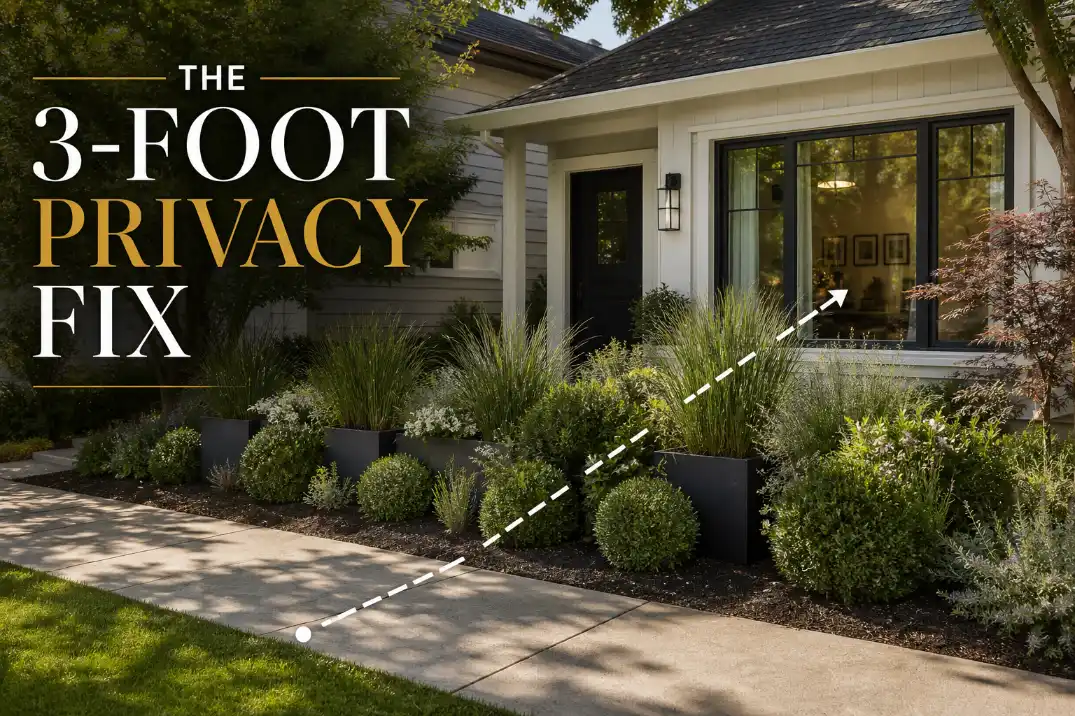
Small front yard privacy usually fails when homeowners screen the property line instead of the actual view line. If your front window sits within 6–12 feet of the sidewalk, the smartest fix is rarely a full hedge. It is usually a targeted 30–60 inch privacy layer placed where people actually look from: the sidewalk, curb, driveway edge, or neighbor’s front walk.
Start with three checks: measure the distance from sidewalk to window, note the available bed depth, and keep at least 36 inches of clear walkway space. A 3-foot-deep bed can create real privacy if it uses layered height, but it becomes a pruning problem if you fill it with shrubs that mature 5 or 6 feet wide.
In small front yards, privacy is not about planting the tallest thing you can find. It is about making the exposed view harder to read without making the whole house harder to find.
The Best Fence-Free Privacy Strategy for Small Front Yards
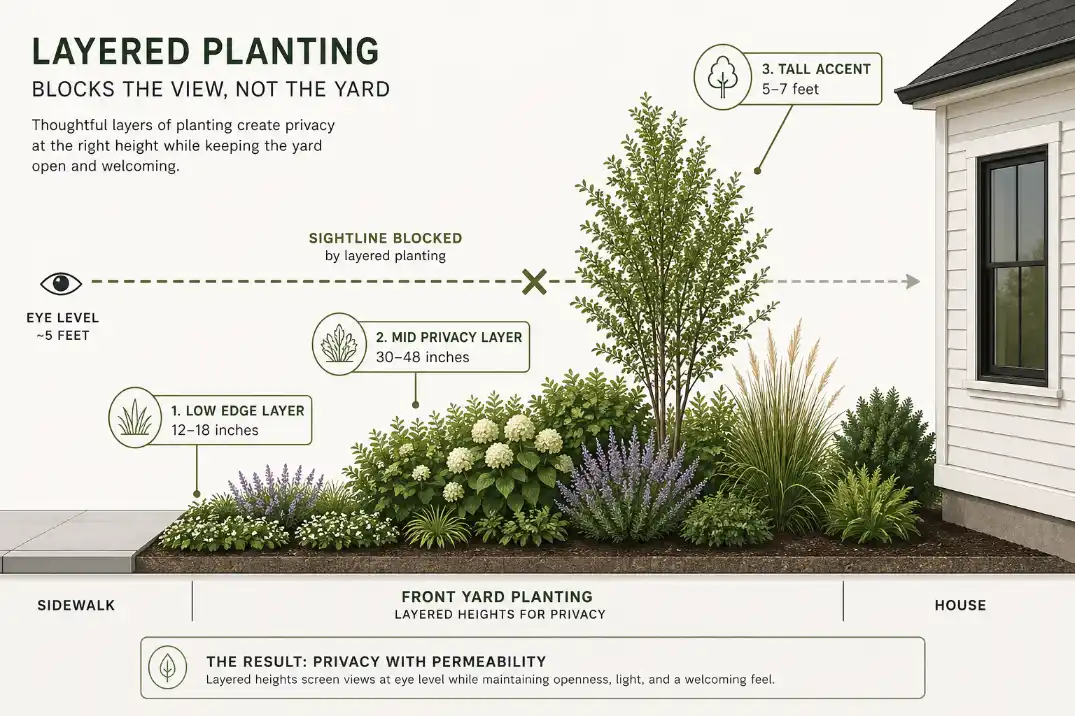
The strongest approach is usually a layered buffer: low plants at the front, medium-height screening where the view needs interruption, and one taller accent only where the sightline is most exposed. This keeps the yard open enough for curb appeal while making the house feel less visible from the street.
Block the View Line, Not the Whole Yard
Stand where the viewer stands first. That might be the sidewalk, the curb, the driveway apron, or a neighbor’s walkway. Look back toward your window, porch, or front door. The point where your eye lands is where the privacy layer should do the most work.
This is where many small-yard privacy projects go wrong. Homeowners plant along the property line because that feels logical, but the real exposure may be closer to the house. A 42-inch shrub placed near the window can block more than a 6-foot plant placed too far forward.
For a small yard, the useful privacy zone is often between 30 and 60 inches tall. Under 24 inches, planting usually softens the yard but does not meaningfully block views. Above 6 feet, the front yard can start to feel closed off, especially when the screen runs in one straight line.
Use Layering Instead of One Solid Hedge
A single hedge can look tidy, but it also creates an all-or-nothing wall. If it is too short, it fails. If it is too tall, it hides the entry. If one plant dies, the gap becomes obvious.
Layering is more forgiving. Low edging plants make the bed look finished, mid-height shrubs interrupt the direct view, and taller accents create privacy only where needed. Use columnar plants for narrow vertical gaps, rounded evergreens for year-round blur, and grasses where softness matters more than winter coverage.
If your small yard is part of a larger no-fence front-yard plan, Front Yard Landscaping for Privacy Without Fences is a useful companion because it explains how front-yard privacy works when a full fence is not part of the design.
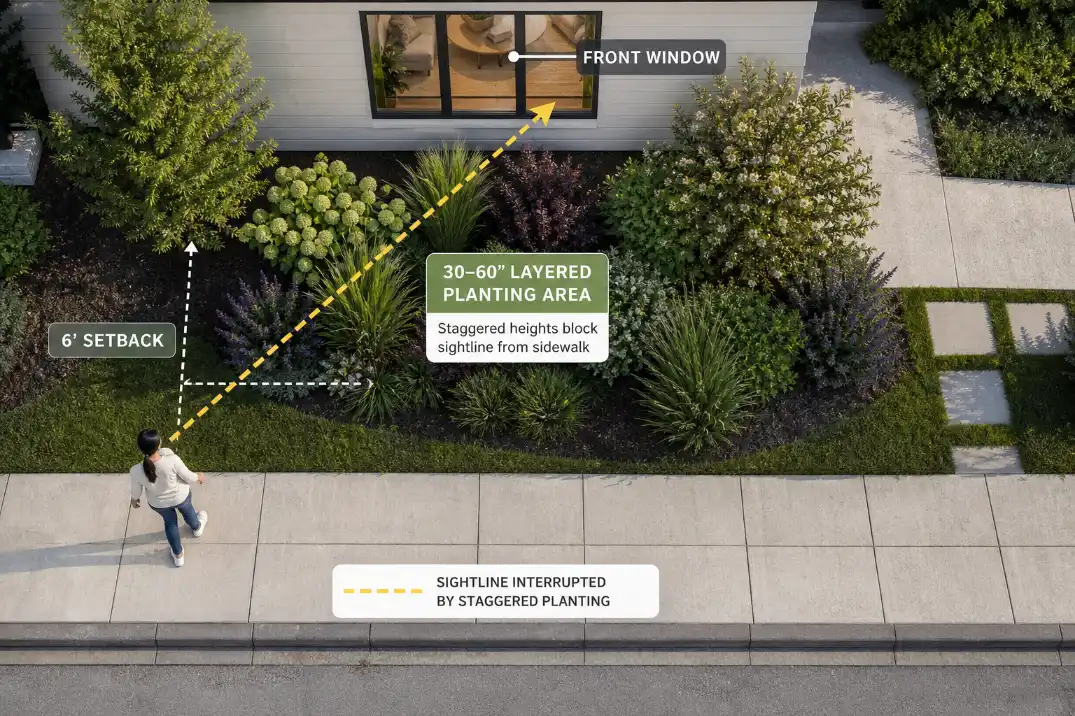
Choose the Privacy Fix by How Much Front Yard Depth You Have
A small front yard is not one condition. A yard with 5 feet between sidewalk and window needs a different fix than a yard with 15 feet of lawn. The available depth should decide the privacy method before you buy plants.
Under 6 Feet Deep: Use Planters and Window-Level Screening
When the sidewalk is very close to the house, do not waste space trying to build a traditional hedge. There often is not enough bed depth for shrubs to mature well.
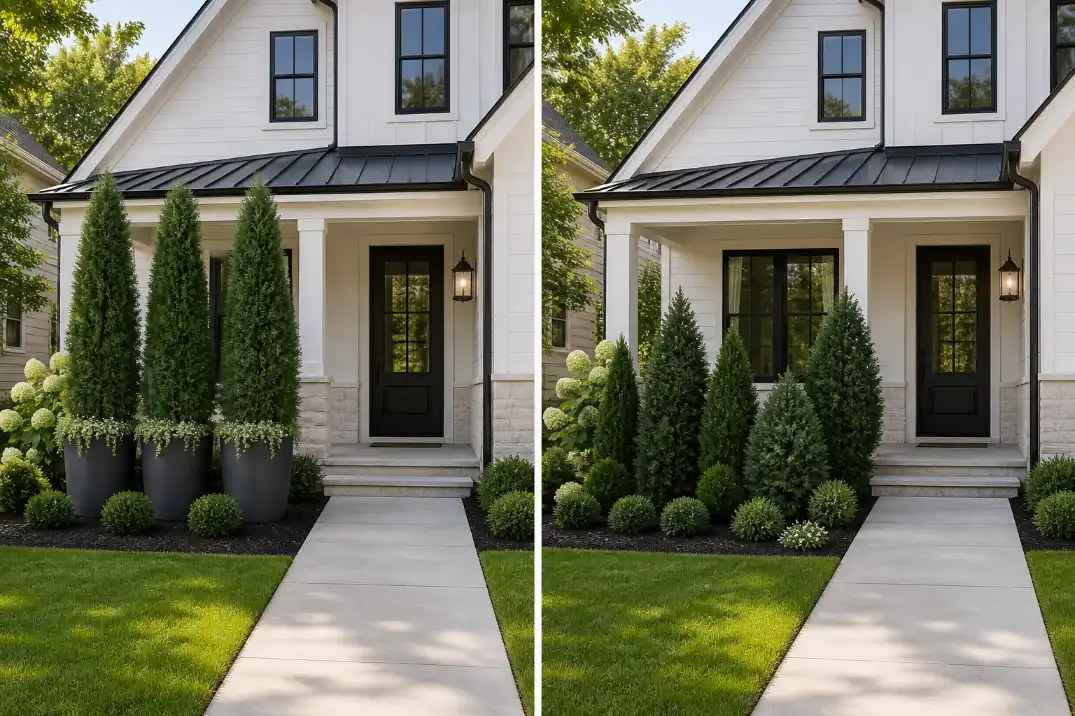
Use tall planters, narrow upright plants, or a window-level planting bed. A 24-inch planter with a 30-inch plant creates about 54 inches of screening immediately. That is enough to blur views into many front rooms without blocking the entire facade.
This is also the better route when roots, utilities, shallow soil, or concrete edges make in-ground planting difficult. A small planter cluster can be moved, adjusted, or replanted faster than a hedge that was placed too close to the walk.
6–12 Feet Deep: Use Staggered Shrubs and Grasses
This is the sweet spot for many small suburban front yards. You have enough room for a layered bed, but not enough room to waste on plants that grow too wide.
Use compact evergreen shrubs for year-round structure, ornamental grasses for soft movement, and low plants near the sidewalk to keep the bed from looking abrupt. Offset plants by 12–18 inches instead of lining them up like a green wall. That small stagger makes the yard feel deeper and screens more naturally.
If your front yard sits on a busy street, plant durability matters as much as height. Road heat, dust, wind, and winter salt can thin out delicate choices quickly, so ideas from How to Choose Front Yard Plants for Busy Streets can help you avoid plants that look good at installation but struggle after one hard season.
12 Feet or More: Use a Layered Bed and One Vertical Anchor
With 12 feet or more, you can create privacy without making the house look hidden. Use a deeper planting bed, one small ornamental tree or columnar evergreen, and a mid-height shrub layer.
The vertical anchor should not sit directly in the center of the front door view. Place it where it interrupts a diagonal view into a window or porch. This keeps the entry readable while giving the yard a more finished, premium structure.
One taller accent is usually enough. Several tall plants in a small front yard can create a crowded, overbuilt look.
Fence-Free Privacy Ideas That Actually Work
The best fence-free ideas are the ones that solve a specific exposure problem. They should not be chosen just because they look private in a photo.
Tall Planters for Instant Height
Tall planters are one of the fastest ways to add privacy in a small front yard. They work especially well near porch edges, beside front steps, or where a narrow bed cannot hold shrubs.
For real screening, choose planters at least 18–24 inches wide. Tiny pots lined along a walkway may look decorative, but they rarely create privacy. A few larger containers look more intentional and give roots enough volume to survive summer heat.
The tradeoff is watering. In hot weather, containers can dry out in 24–48 hours, especially in full sun or windy sites. If you travel often or do not want frequent maintenance, use larger containers, drought-tolerant plants, or drip irrigation.
Pro Tip: Three substantial planters usually look more polished and screen better than a row of small pots.
Staggered Compact Evergreens for Year-Round Privacy
Compact evergreens are the backbone of year-round privacy. The key word is compact. A shrub that matures at 4 feet tall and 3 feet wide is much more useful in a narrow front bed than one that wants to become 8 feet tall and 6 feet wide.
Use them in staggered groups rather than one straight row. The planting looks softer, and the privacy does not depend on every plant forming a perfect wall.
This is where fast-growing shrubs often disappoint. A plant that grows 2–3 feet per year may give quick coverage, but in a small yard it can become a constant pruning job by the third season. If you are trimming more than three or four times during the growing season just to keep the walk open, the plant is too vigorous for the space.
Ornamental Grasses for Soft Seasonal Screening
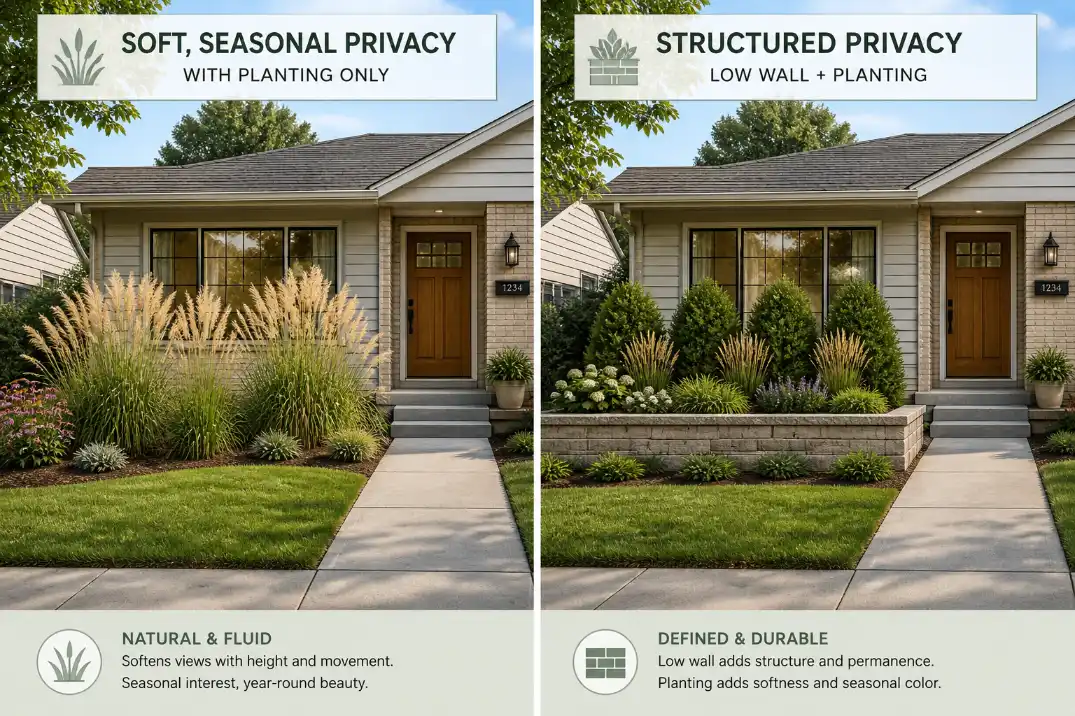
Ornamental grasses are ideal when you want privacy without visual heaviness. Many clumping grasses reach 3–5 feet by late summer, which is the exact range that helps blur views into windows, porches, and seating areas.
They are not perfect year-round screens. After spring cutback, many grasses offer little privacy for several weeks. Use them where seasonal softness is enough, or combine them with evergreen structure so the bed does not look bare in winter.
Clumping behavior matters. In a small front yard, aggressive spreaders can push into lawn, walkway edges, or neighboring plants. A grass that expands gradually is useful; one that runs is a maintenance problem wearing a pretty label.
Low Wall or Raised Bed Plus Planting
A low wall is not a fence, but it can create the base for privacy. This is one of the most underrated fixes for small yards because it gives immediate structure without requiring tall plants.
An 18–24 inch low wall or raised bed paired with 24–36 inch plants can create a 42–60 inch privacy effect. That is often enough to break sidewalk views while still keeping the front yard open.
This combination works especially well where the soil is poor, tree roots limit planting, or the yard slopes slightly toward the street. It also looks more permanent than scattered containers. The wall should read as a planting base, not a substitute fence. Keep it low, soften it with plants, and avoid building a blank barrier across the whole frontage.
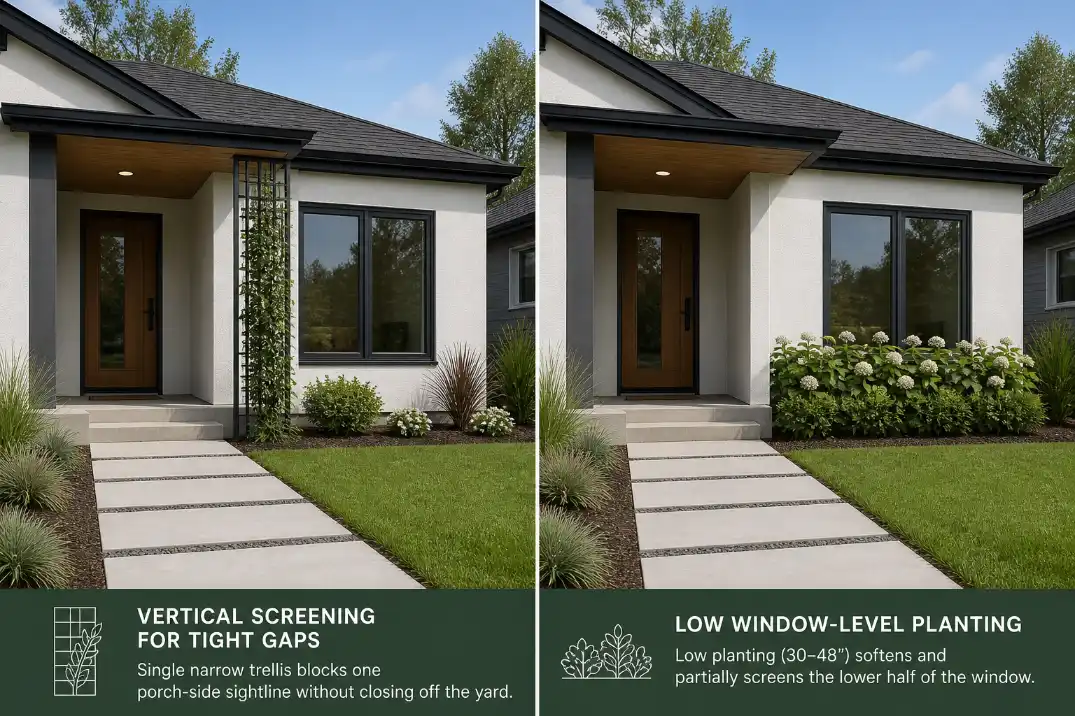
Narrow Trellis or Vertical Screen for Tight Spots
A narrow trellis can solve a very specific problem: one tight sightline where plants do not have enough room to spread. Use it beside a porch, near a window, or at the edge of a small seating area.
The mistake is using a trellis like a mini fence across the front yard. That can look harsh and may attract the same rule concerns as fencing. A single vertical panel with a restrained vine is often enough.
Choose vines carefully. A fast, heavy vine can overwhelm a small trellis, block light, or pull at supports. In front yards, neat growth usually matters more than maximum coverage.
Window-Level Planting Beds
If the main privacy problem is a front window, design around the window instead of the property line. A planting bed below and slightly in front of the window can interrupt views without hiding the whole house.
For many single-story homes, plants in the 30–48 inch range are enough to blur the lower third to half of the glass from the sidewalk. You do not need to cover the full window. In fact, full coverage can reduce natural light and make the house look neglected.
If your house has almost no front setback, every inch counts. The layout advice in Front Yard Privacy With No Setback is especially useful when the sidewalk or street edge sits too close for a normal shrub border.
What Usually Fails in Small Front Yards
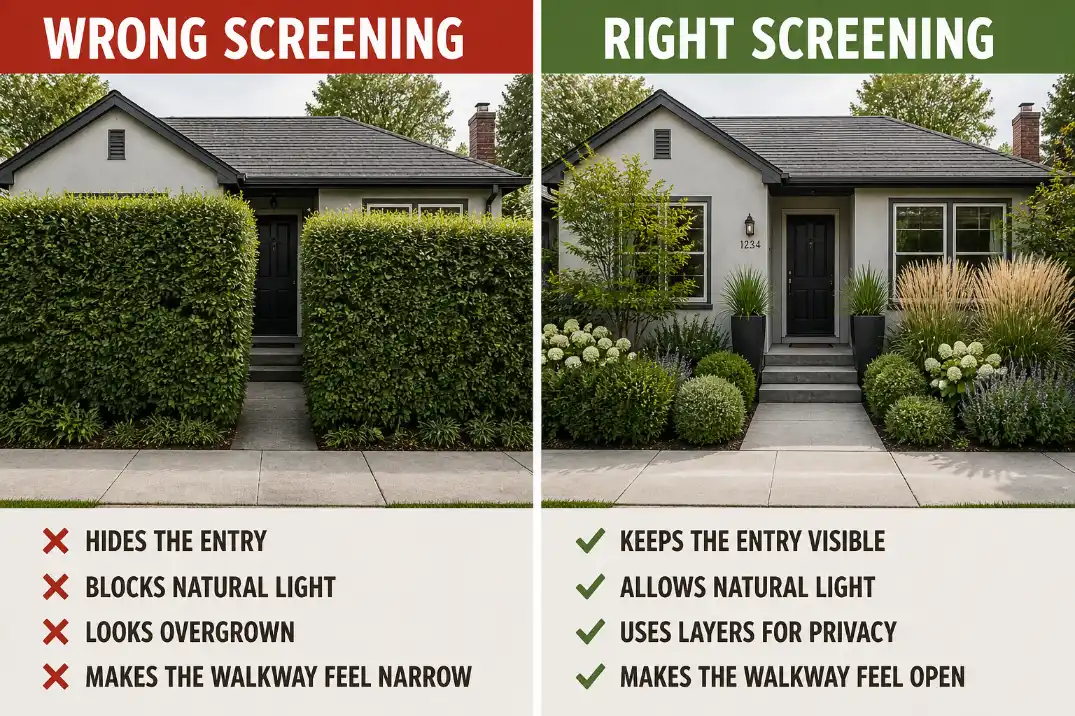
Some privacy fixes look reasonable in isolation but fail once they are placed in a tight front yard. The problem is not always the idea itself. It is the scale.
One Straight Hedge Across the Front
A straight hedge is easy to imagine and easy to overdo. In a small yard, it can make the house feel sealed off, reduce visibility from inside, and turn the front door into a hidden destination.
A hedge also does a poor job when the exposure comes from an angle. If people look diagonally from a driveway, corner sidewalk, or neighbor’s path, a straight curbside hedge may barely interrupt the actual view.
Fast-Growing Shrubs in Narrow Beds
Fast growth is often overestimated. It sounds efficient, but the maintenance can become the real cost.
A shrub that matures 5 feet wide does not belong in a 3-foot-deep bed unless you want constant pruning. Once plants are repeatedly cut back to fit, they often look stiff, woody, or thin in the lower branches. That weak lower growth is exactly where small-yard privacy is usually needed.
Tiny Pots Used as a Privacy Line
Small pots can decorate an entry, but they rarely screen anything. A row of 10-inch containers along a walkway adds clutter without solving the view problem.
If containers are the solution, they need enough size and height to matter. Larger planters with upright or layered planting create privacy; small pots create visual noise.
Blocking the Front Entry
A front yard can be private and still feel welcoming. The front door should remain visible enough for guests, delivery drivers, and emergency access. If the privacy planting makes people pause and wonder where to go, the design has gone too far.
This matters even more when the driveway is open to the street. In that case, the exposed feeling often comes from the driveway’s long sightline, not the entire yard. Front Yard Privacy When the Driveway Is Open to the Street is a better match for that specific layout than simply adding taller plants everywhere.
Small Front Yard Privacy Comparison Guide
| Privacy Fix | Works Best When | Avoid It When | Space Needed |
|---|---|---|---|
| Tall planters | Soil is limited or instant height is needed | You cannot water containers during hot spells | 18–24 inch planter width |
| Compact evergreens | Year-round window or sidewalk privacy matters | The mature width exceeds the bed depth | 3–5 foot planting depth |
| Ornamental grasses | You want soft seasonal screening | You need dense privacy in early spring | 2–4 foot planting depth |
| Low wall plus planting | You need structure and quick height | A wall would make the frontage look harsh | 18–24 inch wall plus planting |
| Narrow trellis | One tight sightline needs vertical blocking | You are trying to screen the whole frontage | 1–2 foot planting strip |
| Window-level bed | The main issue is views into front rooms | Plants would press against siding or windows | 3+ feet preferred |
Design Rules That Keep Privacy From Hurting Curb Appeal
Front yard privacy should not make the home look withdrawn. The strongest designs protect private areas while keeping the entry clear and the house visually connected to the street.
Keep the Door Visible
Do not screen every part of the frontage evenly. Windows, porch seating, and side views can be softened more heavily. The entry should stay legible.
A clear walkway should remain at least 36 inches wide, and plants should not spill into that path at mature size. This is not just about appearance. It affects daily use, deliveries, and how safe the entry feels at night.
For more entry-specific privacy planning, How to Add Privacy Without Making the Front Entry Feel Closed Off explains how to protect the front approach without making the house feel hidden.
Break the Line Instead of Building a Wall
Small yards look better when privacy comes from broken layers. Use staggered shrubs, varied heights, and one or two vertical moments. Avoid equal-height rows that flatten the yard.
The best screen lets the eye pass through some gaps while blocking the direct view into private areas. That partial visibility is what keeps the yard from feeling boxed in.
Repeat Materials and Plant Forms
A privacy design looks more premium when it repeats a few choices instead of collecting too many ideas. Match planter material to the house trim, door color, walkway, or porch finish. Repeat one shrub form or grass texture in more than one spot.
This is especially important in small yards, where every object is noticeable. Too many plant shapes, pot colors, and screen materials can make the yard feel smaller.
Leave Space Around the House
Privacy planting should not be pressed tightly against siding, windows, or vents. Leave at least 12–18 inches between mature foliage and the house where possible. In humid climates, tight planting can hold moisture against surfaces and make maintenance harder.
If a plant has to be cut away from the house every month, it is not a privacy solution. It is the wrong plant in the wrong place.
Practical Layouts for Common Small-Yard Scenarios
The best layout depends on the source of exposure. Do not use the same privacy treatment for every small front yard.
If the Sidewalk Is Close to the Windows
Prioritize window-level planting over perimeter screening. Use plants that interrupt the lower half of the window view from the sidewalk. A compact evergreen, two softer mid-height shrubs, and a low front edge can be enough.
If the sidewalk is only 4–6 feet from the glass, avoid plants with wide mature spread. A 6-foot-wide shrub in a 3-foot bed will either crowd the walkway or need harsh pruning.
If the Driveway Creates a Direct View
Place the privacy element where the driveway view opens toward the entry or window. A pair of tall planters, a compact shrub cluster, or a low raised bed near the driveway edge can interrupt the view without blocking the whole yard.
Keep car-door clearance in mind. Most driveways need about 24–30 inches beside parked cars for comfortable movement. If a privacy planting makes daily parking awkward, it will not last.
If the Front Yard Faces Constant Movement
Homes near walking routes, neighborhood entrances, stop signs, schools, or bus stops often feel more exposed because people pause or pass repeatedly. In this case, soft motion-blurring texture helps.
Use grasses, compact shrubs, and layered foliage to reduce visual attention. The goal is not to disappear from the street. It is to keep the front room, porch, or entry from feeling watched.
If traffic is the main exposure, Front Yard Privacy Problems on Busy Streets goes deeper into how headlights, movement, and road-facing windows change the privacy plan.
If the Yard Is Narrow
Use one strong privacy side and keep the other side lighter. Dense planting on both sides of a narrow walk can create a tunnel effect.
A slim trellis, columnar evergreen, or tall planter can work well, but only where the view needs interruption. In a narrow yard, one vertical accent is usually better than several.
Quick Checklist Before You Buy Anything
- Measure the sidewalk-to-window distance before choosing plants.
- Keep walkways at least 36 inches clear at mature plant size.
- Use 30–60 inch screening for most small front-yard views.
- Avoid shrubs that mature wider than the planting bed can handle.
- Choose planters at least 18–24 inches wide if they need to screen.
- Keep the front door readable from the street.
- Use taller accents only where a specific sightline needs blocking.
Questions People Usually Ask
Can I get real privacy in a small front yard without a fence?
Yes, but it is usually partial privacy. The realistic goal is to block direct views into windows, seating areas, or the entry path. A 30–60 inch layered screen can make a small yard feel much more private without fully enclosing it.
Are planters better than shrubs for small front yards?
Planters are better when space, soil, roots, or utilities limit in-ground planting. Shrubs are better for long-term year-round structure. In many small yards, the best answer is a mix: planters where space is tight and compact shrubs where the bed has enough depth.
What is the biggest mistake with fence-free privacy?
The biggest mistake is copying backyard privacy ideas into the front yard. Tall screens, dense hedges, and full barriers may work behind a house, but they can make a front yard feel closed, dark, or unwelcoming.
How tall should front yard privacy plants be?
For many small front yards, 30–48 inches is enough to blur sidewalk views, while 5–7 foot accents should be used sparingly. Taller is not automatically better. Placement usually matters more than height.
The Best Small-Yard Privacy Looks Intentional, Not Defensive
The best front yard privacy ideas for small yards without a fence do not try to hide the whole property. They solve the specific view that makes the yard feel exposed.
Start with the sightline. Then choose the fix that matches your yard depth: planters for very tight spaces, staggered shrubs and grasses for 6–12 feet of depth, and layered beds with one vertical anchor when there is more room. Add low walls, raised beds, or narrow trellises only where they solve a real constraint.
A small front yard does not need a fence to feel more private. It needs a better privacy layer: measured, placed carefully, and open enough to keep the home looking welcoming. The right solution should make the exposed view harder to read, not make the whole house harder to find.
For broader plant-screening guidance, see the University of Maryland Extension’s guide to Plants for Mixed Privacy Screens.