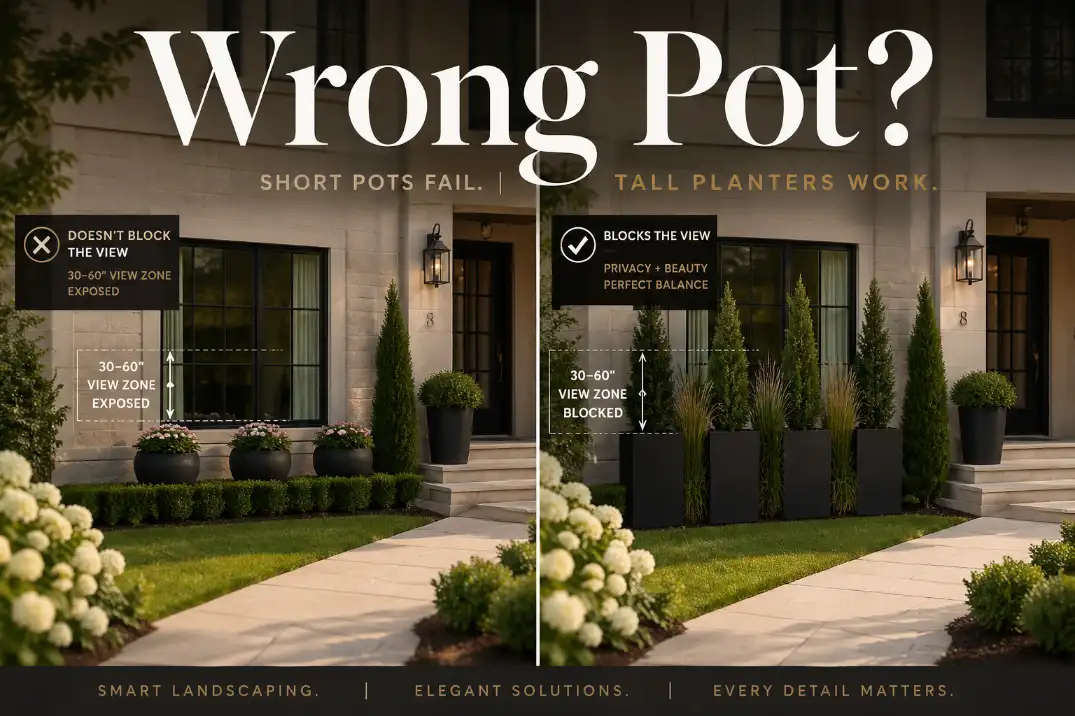
The best plant-and-planter combinations for front yard privacy are not just the tallest plants in the biggest pots. They are matched systems: planter height, soil volume, plant density, and placement all have to solve the same view problem.
In most front yards, the useful privacy zone sits between about 30 and 60 inches above ground, where sidewalk traffic, headlights, and lower window views actually happen.
Start with three checks before buying anything: where the view enters, how much walkway or driveway clearance must stay open, and whether the planter can hold enough soil for the plant you want. A 14-inch decorative pot may look finished on day one, but it rarely supports a lasting privacy shrub.
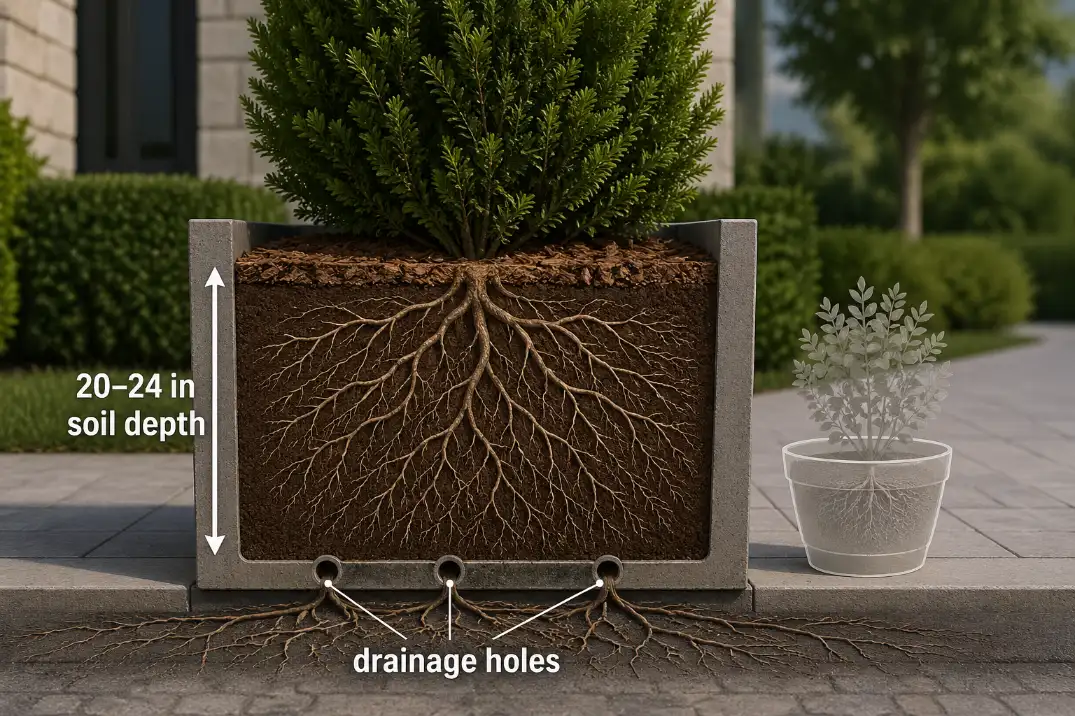
For woody plants, 20–24 inches of usable soil depth is usually the minimum worth considering. For taller evergreens or exposed driveway locations, 24–30 inches is safer.
How to Choose the Right Combination
A front yard planter has to do more than look attractive from the curb. It has to lift the screen into the right sightline, hold enough root volume, and still keep the entry welcoming. That is why the right combination usually begins with the problem, not the plant.
Start With the View Line, Not the Plant
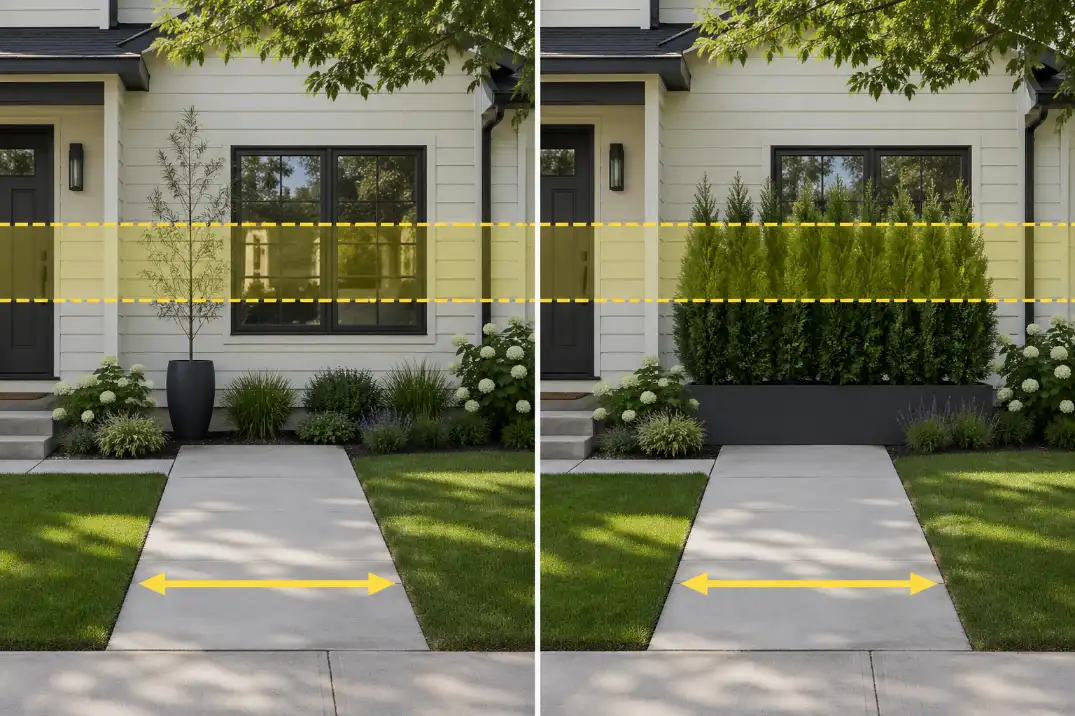
If pedestrians can see into a lower window, the screen needs density from roughly 30 inches upward. If headlights sweep across the yard, the screen may need to start lower and run wider. If the issue is a neighbor’s angled view from across the street, one planter near the porch will probably not be enough.
This is where many projects go wrong. A homeowner buys a beautiful 5-foot shrub, sets it in a narrow pot, and still feels exposed because the foliage is too high, too sparse, or too far from the actual view path.
Privacy is not measured by plant height alone. It is measured by how much of the view line the combination interrupts.
Match Root Volume to Screen Height
A tall plant in a shallow planter is usually a short-term display. The top may look full for a few months, but the root zone dries quickly, overheats near pavement, and becomes unstable in wind.
For compact shrubs, a planter at least 20 inches deep can work if the exposure is moderate. For columnar evergreens, large hollies, podocarpus, or driveway-side containers, start closer to 24–30 inches deep.
Planter width matters too. A narrow planter can force roots into a small column of soil, which dries faster than a wider box. If the soil is dry 3 inches down less than 24 hours after watering in warm weather, the container is probably too small, too exposed, or not mulched well enough.
Decide Between Year-Round Privacy and Soft Screening
Evergreen shrubs and columnar evergreens are best for year-round privacy. Ornamental grasses, flowering shrubs, and seasonal fillers are better for soft screening. They blur the view, add movement, and make the yard feel less exposed, but they may not block much in winter.
That distinction matters in front yards because privacy still has to look intentional from the street. A soft grass screen can be beautiful near a sidewalk, but it will not replace evergreen density in front of a living room window. If you are still deciding whether planters or in-ground planting should carry the main screen, Privacy Plants vs Planters for Front Yards helps clarify where each option works better.
Best Front Yard Privacy Combos by Situation
| Situation | Best planter + plant combination | Best use | Avoid if |
|---|---|---|---|
| Street-facing lower windows | 24-inch-deep rectangular planter + compact holly, inkberry, or Japanese holly + low trailing edge plant | Year-round screening at window height | Walkway clearance is under 36 inches |
| Narrow sidewalk frontage | Long trough planter + feather reed grass, switchgrass, or little bluestem + low perennials | Soft privacy without a wall effect | You need solid winter privacy |
| Driveway edge | Heavy 24–30 inch deep square planter + columnar juniper, podocarpus, or dwarf arborvitae + low evergreen filler | Blocking angled views and headlights | The planter is lightweight or shallow |
| Porch corner | Large cube planter + camellia, compact holly, or aucuba + restrained seasonal color | Framing the entry while softening exposure | The corner already feels tight |
| Hot paved frontage | Light-colored deep planter + dwarf yaupon, rosemary, or heat-tolerant grass + mulch | Reflected heat near concrete or asphalt | The site gets little irrigation |
| Part-shade entry | Deep broad planter + camellia, aucuba, inkberry, or evergreen fern filler | Dense screening near a shaded porch | The area receives harsh afternoon sun |
Street-Facing Lower Windows
For lower windows, the safest default is a 24-inch-deep rectangular planter with a compact evergreen shrub and one low edge plant. The planter lifts the base of the screen, while the shrub provides density where people actually look in.
Compact holly or Japanese holly is often the cleanest year-round pick in suitable climates. Inkberry holly works better where soil stays more acidic and evenly moist. Dwarf yaupon holly is a stronger warm-climate option.
The low filler should soften the planter, not carry the privacy job. Liriope, low evergreen sedges, or a restrained trailing plant can finish the edge without stealing water from the shrub. This is where flowers are often overestimated. They may improve the look, but they rarely create privacy by themselves.
A planter 24–36 inches wide and at least 20–24 inches deep is a better starting point than a narrow decorative pot. If the window is close to the walkway, keep the mature plant width at least 6 inches inside the available clearance.
Narrow Sidewalk Frontage
For a close sidewalk, the best pick is a long trough planter with upright ornamental grasses rather than a row of bulky shrubs. The goal is to blur movement and soften exposure, not build a green wall beside the public walk.
Feather reed grass gives the cleanest vertical look in many cooler and temperate regions. Switchgrass or little bluestem can feel more naturalistic where native-style planting suits the house.
The key is repetition. One grass in one pot reads as decoration. A run of 3–5 plants in a trough creates rhythm and starts to screen the view.
This is not the right choice if you need full winter coverage. Many grasses look thinner after storms, pruning, or freeze damage. But for seasonal sidewalk exposure, they often feel more graceful than a row of clipped shrubs.
The same soft-screening logic applies in tight entry areas where privacy needs to feel open rather than blocked; How to Add Privacy Without Making the Front Entry Feel Closed Off covers that balance in more detail.
Driveway Edge
For driveway exposure, the strongest combination is a heavy 24–30 inch deep planter with a columnar evergreen. A driveway is wider, harder, and more visually open than a porch edge, so low planters disappear. The plant needs vertical structure, and the container needs enough mass to keep the screen stable.
Columnar juniper is often the simplest narrow evergreen where the climate fits. Podocarpus is a better warm-climate pick in mild regions. Dwarf arborvitae can work where winter burn and deer pressure are not major problems. Upright holly is another option when a denser broadleaf look suits the house.
Use paired or staggered containers instead of one isolated tall plant. Two or three planters set 3–5 feet apart usually screen better than one oversized specimen. They also look more intentional from the street.
Porch Corner
For a porch corner, the best pick is a broad cube planter with a dense but restrained shrub. This is not the place for the tallest possible screen. The goal is to soften exposure while keeping the door visible and approachable.
Camellia works well in part-shade, mild-region entries where it has protection from harsh afternoon sun. Compact holly gives a tighter evergreen look. Aucuba can be useful in protected shade where a bolder leaf texture fits the architecture. Seasonal color belongs at the edge, not in the center of the privacy strategy.
This combination works best when the porch already has some structure: columns, steps, railing, or a recessed doorway. The planter fills the exposure gap. It should not become a visual barricade. If visitors have to step around the container to find the door, the combination is too large or poorly placed.
Pro Tip: At entries, leave at least 36 inches of clear walking space, and more if the path is used for packages, strollers, or guests walking side by side.
What People Usually Misread
The most common privacy planter mistake is treating visible height as the same thing as useful screening. It is not. The plant, planter, and placement all have to cover the correct part of the view.
Tall Is Not the Same as Private
A tall, narrow plant can still leave the lower view open. This is especially common with young arborvitae, podocarpus, and columnar junipers. They may add height, but if their lower foliage is thin, they do little for sidewalk-level privacy.
Dense branching is often more valuable than dramatic height. A 4-foot compact evergreen in the right planter can screen a front window better than a 6-foot plant with open stems.
Flowers Are Usually a Privacy Bonus
Flowering plants can make privacy planters look finished, but they should rarely carry the whole job. Hydrangeas, annuals, and seasonal color can look full in spring and summer, then lose structure when the season changes.
Use flowers as the front layer, not the main screen. If the yard needs privacy in January as much as in June, start with evergreen structure and add seasonal plants afterward.
The Wrong Planter Makes Good Plants Look Bad
Replacing the shrub while keeping the same shallow planter is usually the expensive version of doing nothing. If the soil volume is too small, every new plant faces the same heat, water, and root stress.
That is why front yard privacy can get costly fast. The plant failure is visible, but the underlying mechanism is often the container. For more on how small choices compound into repeated replacement costs, see Why Front Yard Plants Get Expensive Fast.
Be Careful With Bamboo and Instant Screens
Bamboo appears often in privacy plant lists because it grows fast and looks dense. In a front yard, that speed can become the problem. Running bamboo should generally be avoided near property lines, sidewalks, and driveways because containment failures can become expensive and neighbor-sensitive.
Clumping bamboo is safer, but it is not maintenance-free. It still needs a large reinforced planter, consistent water, and enough room to look graceful rather than cramped. In hot paved frontages, bamboo in a small container can dry quickly and shed leaves under stress.
Instant privacy is easy to overvalue. A plant that gives you coverage in one season but needs constant watering, thinning, or containment is not always the best long-term screen. For front yards, controlled density usually beats aggressive speed.
What Changes by Climate
The right combination changes with heat, humidity, cold, and wind. A plant that performs beautifully in a mild coastal yard may struggle in a freezing northern container or a dry Arizona frontage.
Hot Southwest and Paved Frontages
For hot paved frontages, the better combo is a light-colored deep planter with a heat-tolerant plant and a mulch-covered soil surface. Rosemary, dwarf yaupon in suitable warm regions, tough ornamental grasses, and podocarpus in mild climates can work better than thirsty flowering shrubs.
The planter should protect roots from heat as much as it displays the plant. Thin black containers near concrete or asphalt are usually a poor match because they can heat up quickly and dry out the root zone. A privacy planter that needs watering twice a day in July is not matched to the site.
Humid Southeast Entries
For humid Southeast entries, choose a broad planter with controlled density rather than an overstuffed container. Dwarf yaupon, compact holly, camellia in part shade, or inkberry in suitable acidic soil can work, but the combination needs air movement around the foliage.
The best combo is not the fullest planter on day one. It is the one that still has enough spacing after 6–10 weeks of warm, humid growth. Overpacking a planter may look lush at first and then invite thinning, leaf spotting, or weak interior growth.
Cold Northern Front Yards
For cold northern front yards, use a frost-resistant planter, larger soil volume, and a hardy evergreen that can handle container exposure. A compact spruce, hardy juniper, or regionally appropriate evergreen may be more reliable than a broadleaf evergreen that looks good in warmer-zone examples.
Container plants experience more freeze-thaw stress than in-ground plants. Roots above ground are more exposed, and small pots can freeze solid. Do not assume a plant is safe in a planter just because it is hardy in the ground.
Mild Coastal Areas
For mild coastal areas, the best combo is a heavy broad planter with wind-tolerant evergreen structure. Podocarpus, pittosporum where appropriate, compact broadleaf evergreens, and sturdy grasses can work well, but lightweight planters are risky in wind corridors.
Use broad bases, heavier materials, and lower center-of-gravity combinations near exposed drives or sidewalks. In coastal moisture, drainage still matters; wet roots in a sealed decorative container can fail even when the climate feels gentle.
When One Planter Is Not Enough
A single planter can solve a porch corner, a lower window, or a small gap beside a driveway. It cannot usually solve a full busy-road exposure. When the view problem stretches across the whole front yard, privacy needs rhythm and layering.
Use planters to interrupt key sightlines, then support them with in-ground shrubs, grasses, low walls, or staggered beds. This approach works better than lining up oversized containers like a portable fence. If the main issue is road movement, glare, or traffic directly facing the house, How to Block a Busy Road View in Your Front Yard Without a Fence is a stronger next step than simply buying larger pots.
Use Planters as Gaps, Not Walls
Planters are strongest where the yard lacks planting space: beside a driveway, on a porch edge, near a hardscape corner, or along a narrow walk. They are weaker when asked to replace an entire landscape buffer.
If privacy needs to span 20–30 feet, planters alone often become expensive, heavy, and high-maintenance. A layered design usually looks better and performs better. For no-fence layouts, Front Yard Privacy Layering Without a Fence explains how to combine plant heights instead of relying on one object to do all the work.
A Practical Buying Checklist
Use this before choosing the final plant-and-planter combination.
- The screen covers the actual view zone, usually 30–60 inches above ground.
- Woody shrubs have at least 20–24 inches of usable soil depth.
- Tall evergreens or driveway planters have closer to 24–30 inches of depth.
- The mature plant width leaves 6–12 inches of clearance from walks, steps, and doors.
- Main privacy plants are evergreen if year-round screening matters.
- Seasonal flowers are treated as accents, not the privacy structure.
- The planter has real drainage holes, not just gravel at the bottom.
- The combination still looks intentional from the curb, not like a blocked entrance.
Final Takeaway
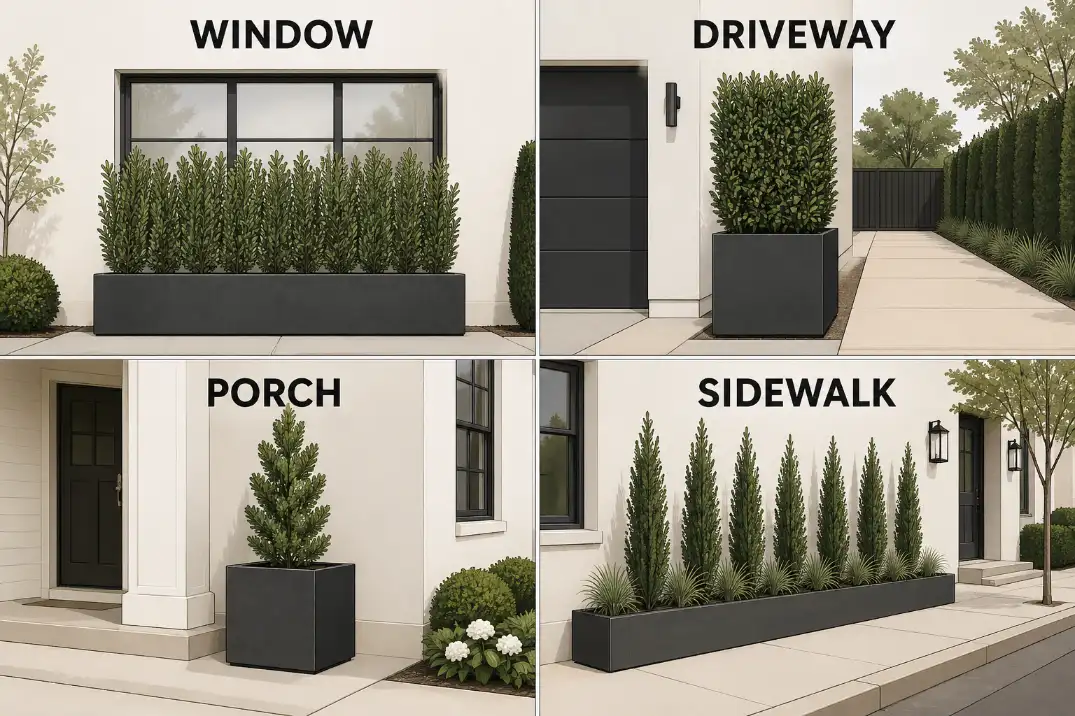
The best plant-and-planter combinations for front yard privacy are specific to the view you are trying to interrupt. For lower windows, use tall rectangular planters with compact evergreens.
For narrow sidewalks, use trough planters with upright grasses. For driveway edges, use heavy planters with columnar evergreens. For porch corners, use broad cube planters with dense but restrained shrubs.
The decision that matters most is not which plant looks tallest at the nursery. It is whether the planter gives that plant enough root volume, whether the foliage fills the useful sightline, and whether the finished screen still lets the front entry feel open.
Once those three pieces match, privacy starts to feel built into the yard instead of added as an afterthought.
For broader planting basics, see the University of Maryland Extension guide to planting a tree or shrub.