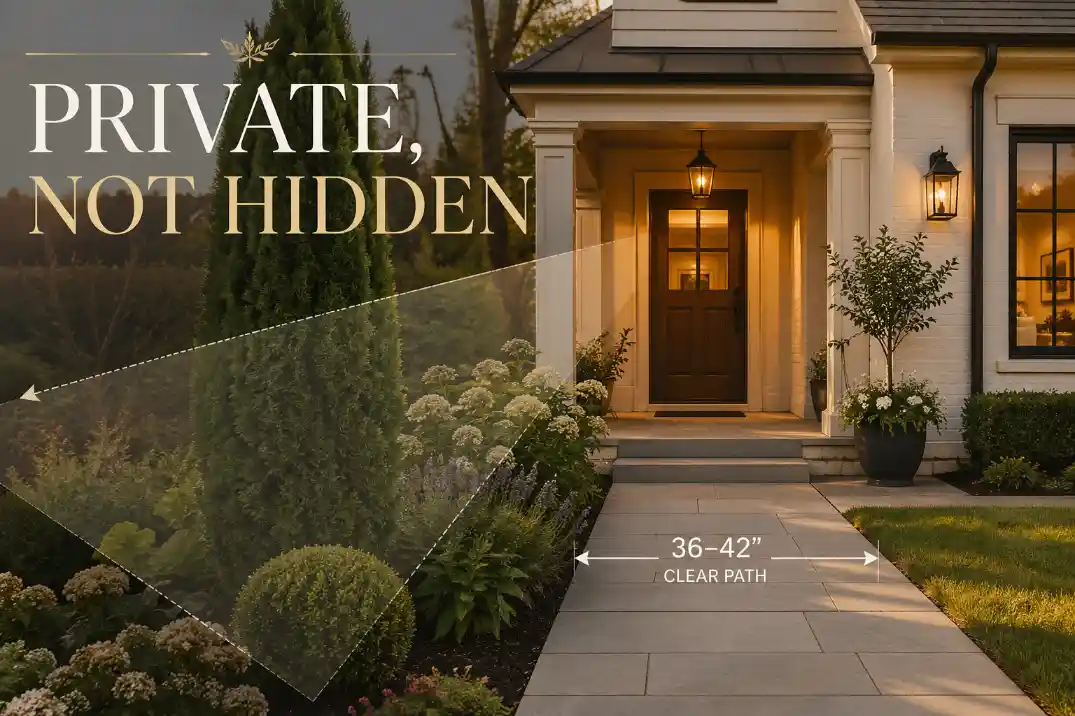
Adding privacy near a front entry is not the same as screening a backyard. The goal is not to hide the door. It is to interrupt the view without interrupting arrival.
Start with three checks: can a visitor identify the front door from 20–30 feet away, does the walkway keep at least 36 inches of clear width after mature plant spread, and does the tallest screen sit beside the entry rather than directly in front of it?
If any of those fail, the problem is probably not a lack of privacy. It is misplaced privacy. A tall hedge, solid panel, or dense row of shrubs may block the view, but it can also make the house feel guarded, dark, or difficult to approach.
The best front-entry privacy usually works as a filter: low structure near the path, medium planting where people look in, and taller screening only at the most exposed angle.
Start With the Arrival Line, Not the Plant List
Before choosing shrubs, panels, or planters, stand where people actually approach the house. That might be the public sidewalk, the driveway, the curb, a neighbor’s porch, or the point where delivery drivers turn toward the door.
The most important question is not “Can someone see the entry?” It is:
Can they see too much without losing the path to the door?
That distinction matters. Front-entry privacy has to do two jobs at once. It needs to reduce direct exposure, but it also has to preserve wayfinding. A backyard screen can be more enclosed because guests do not usually need to read it from the street. A front entry does.
Keep one clear visual corridor
A front door should remain visually readable from the main approach. That does not mean the whole porch has to be exposed. It means the door, steps, house numbers, lighting, or porch opening should still tell people where to go.
A useful rule: keep the central arrival corridor open and push privacy to the sides. If the walkway is the spine of the entry, the screening should shape that spine, not cross it.
This is where many front yards go wrong. A homeowner sees the porch from the sidewalk and plants a hedge across the front. For a few months, it feels better from inside.
After two or three growing seasons, the door starts to disappear, the walkway feels narrower, and the entry begins to look less intentional.
For broader front yard screening, Front Yard Landscaping for Privacy Without Fences is useful because it treats privacy as a layered buffer instead of a single barrier.
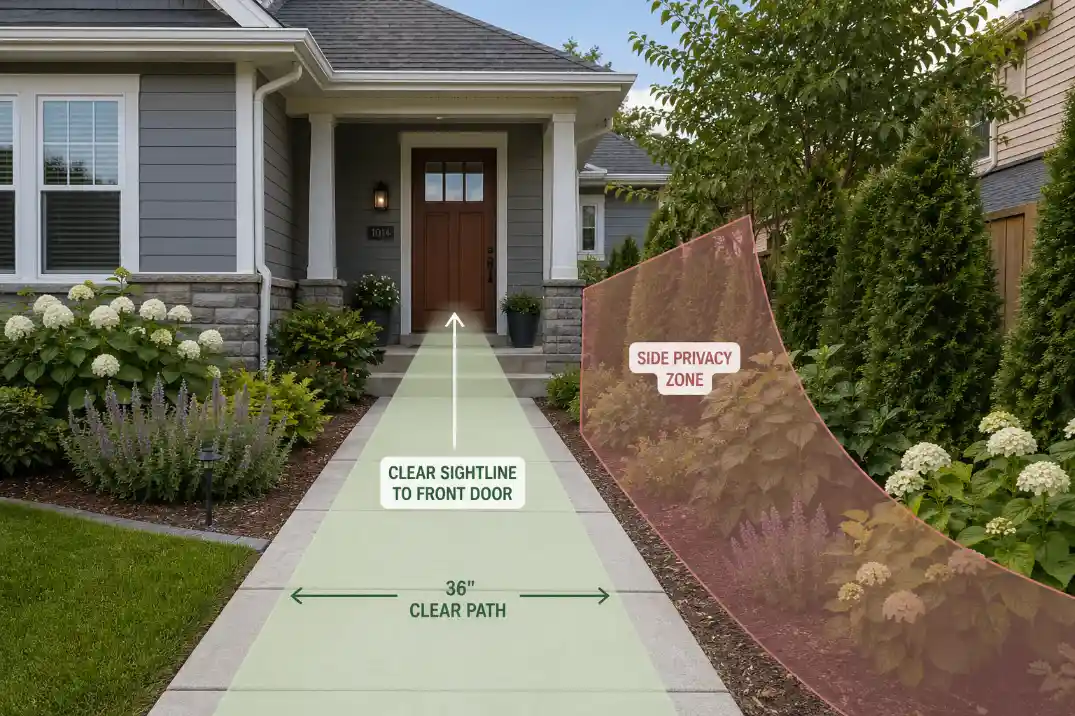
Privacy should not hide the entry
A private entry can still feel welcoming. A hidden entry usually does not.
This is especially important for homes where the garage, driveway, or deep planting already competes with the front door. If privacy makes the door harder to find, the fix is working against the house. Visitors hesitate, delivery people step through planting beds, and the entry can feel less safe at night.
Keep these elements visible from the main approach whenever possible:
- the door or porch opening
- house numbers
- at least one path light or porch light
- the first step or landing edge
- the latch side of the door
If the door is already visually weak, privacy should frame it rather than cover it. A narrow side screen, low wall, or raised planter can make the entry feel more intentional without making it disappear. If the front door already gets lost behind the driveway or garage face, the same visibility problem is covered more directly in Front Yard Landscaping Ideas When the Driveway Makes the Front Door Feel Hidden.
Use Layered Privacy Instead of One Tall Block
The strongest front-entry privacy usually comes from several partial filters, not one full screen. That is because people view the entry while moving. They see it from the curb, then the walkway, then the porch. A single tall hedge tries to solve every angle at once, which is why it often feels heavy.
Low foreground, medium filter, taller side screen
A good entry sequence usually uses three height zones:
| Privacy layer | Useful height range | Best placement | What it should do |
|---|---|---|---|
| Low edge layer | 12–24 inches | Along walkways or bed edges | Define the route without hiding it |
| Soft filter layer | 30–42 inches | Below windows, near porch edges | Reduce direct views while staying open |
| Tall side layer | 5–7 feet | Offset beside the entry or at a corner | Block the worst view angle |
| Overhead layer | 7+ feet canopy | Small tree or limbed-up shrub | Add shelter without face-level enclosure |
The tallest element should rarely sit in the center of the entry view. It usually belongs on the exposed side: near a porch corner, driveway edge, or diagonal sightline from the street.
That offset placement is what keeps privacy from becoming a wall. It lets the house feel protected without making the entrance feel shut.
Block the sharpest view first
Most exposed entries do not need equal screening everywhere. They have one or two bad angles. Maybe the driveway lines up with the porch chair. Maybe the sidewalk cuts close to the sidelight. Maybe a neighbor can see directly into the covered entry.
Fix that angle first. Do not thicken the entire front planting bed just because one view feels uncomfortable.
This matters most when the driveway creates the exposure. Driveway views are often diagonal, not straight-on, so a centered hedge can miss the real problem while making the entry darker. Front Yard Privacy When the Driveway Is Open to the Street explains that exposure pattern in more detail.
Pro Tip: Test the screen location before planting. Use two tall trash bins, stakes, or cardboard panels for a day. If the porch feels better but the door disappears from the sidewalk, the screen is too central.
Choose the Shape Before the Species
Plant choice matters, but plant habit matters more. A 5-foot upright shrub and a 5-foot spreading shrub do very different things near a front door.
Upright forms protect space
For entry privacy, narrow upright plants are often more useful than broad shrubs. They can block a side angle without swallowing the walkway. This is especially helpful near driveways, porch corners, and small stoops.
Look for plants with a mature width that fits the space, not just a height that sounds right. A shrub that matures at 6 feet tall and 2–3 feet wide behaves very differently from one that matures at 6 feet tall and 6 feet wide.
Open branching keeps light moving
Small ornamental trees, limbed-up evergreens, and open-branched shrubs can provide privacy without creating a dark face. They are especially useful where the entry already has a roof, deep eaves, or a shaded north-facing exposure.
Dense evergreen walls are easy to overuse here. They work when year-round privacy is essential, but they can make a covered entry feel dim and airless if placed too close.
Avoid plants that fight the path
Some plants are technically beautiful but wrong beside an entry. Avoid thorny, floppy, suckering, or fast-spreading plants within arm’s reach of the walkway. If a plant has to be pruned every 3–4 weeks during active growth just to keep the path usable, the design is asking too much maintenance from the wrong plant.
This is one of the clearest points where the routine fix stops making sense. More pruning is not the answer when the plant’s natural shape is fighting the entry.
Do Not Let Privacy Steal Walkway Width
Walkway clearance has more impact on the feel of the entry than most people expect. A 36-inch clear walkway is a practical minimum. A 42–48 inch clear path feels noticeably more comfortable, especially if visitors carry bags, children walk beside adults, or the approach has steps.
Mature size is the real measurement
The mistake is measuring the plant on installation day. A young shrub may sit 18 inches from the path and look harmless. If its mature spread is 4 feet, it will eventually lean into the walkway unless it is constantly clipped.
That is why shallow, disciplined planting often feels better than deep, overgrown planting. A 3-foot-deep bed with low edging and one upright screen may feel more open than a 6-foot-deep bed packed with shrubs.
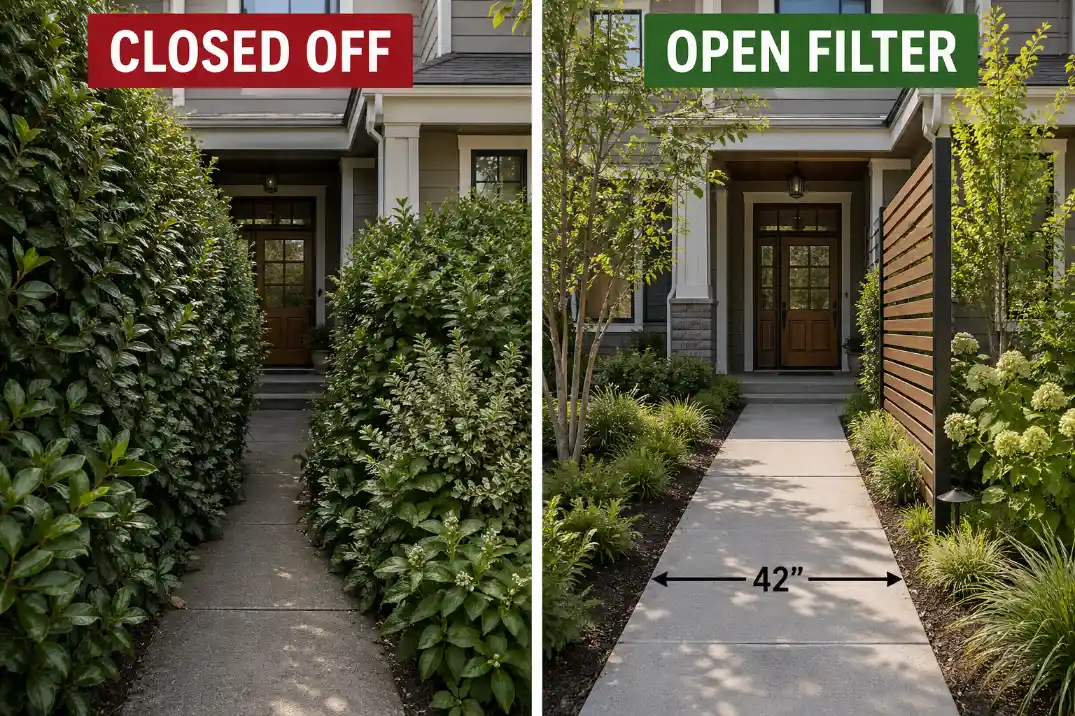
Porch depth changes the answer
A shallow stoop cannot handle the same privacy treatment as a deep porch. If the landing is small or the covered area is less than about 6 feet deep, avoid placing bulky screening right beside the steps. The entry needs room for two people to pause without brushing plants.
On a deeper porch, side filtering can sit closer because the space has enough depth to breathe. On a tight stoop, move taller privacy several feet away and let the walkway remain visually clean.
Plants Are Not the Only Filter
Privacy near the front entry does not always need to come from a hedge. In tight spaces, hardscape can create a cleaner, more controlled filter.
Low walls and raised planters
An 18–30 inch low wall can define the entry and reduce the exposed feeling without blocking the door. It works especially well when paired with planting behind it. Use a low wall when you need to define the approach and block lower-body views from the sidewalk without creating a full-height screen.
A raised planter can do something similar. It gives smaller plants more effective height without requiring a hedge across the front. This is useful when you need immediate structure, but still want the entry to feel open above waist height.
Semi-open screens
A slatted screen, open trellis, or short wing wall can solve a narrow side view in less space than a broad shrub. Use a semi-open screen when the problem is a side angle, not the whole front elevation.
The key is openness. For a front entry, a screen that is 40–60 percent visually open often feels better than a solid panel because it filters movement and light without making the approach feel like a service corridor.
A 6-foot solid panel directly beside a 4-foot-wide walkway is usually too much. It may block the view, but it also makes the entry feel squeezed. If the space is narrow, use a partial-height screen, a raised planter, or a slimmer vertical element instead.
For entries that need to stay private but still friendly from the street, Front Yard Privacy That Still Looks Welcoming fits the same design problem from a broader curb-appeal angle.
Adjust the Strategy for the Local Climate
The same privacy layout does not behave the same way in every US climate. A dense screen that works in a dry climate may trap moisture in a humid one. A deciduous screen that feels perfect in summer may disappear during a northern winter.
| Climate condition | What changes at the entry | Better privacy move |
|---|---|---|
| Humid Southeast | Dense planting near the porch can reduce airflow and make the entry feel damp or dark | Use airier spacing and keep plants off the porch edge |
| Desert Southwest | Privacy planting may also need to reduce glare and heat | Use drought-tolerant vertical accents without hiding the door line |
| Midwest or Northeast winters | Snow piles can narrow the walkway below 36 inches | Keep the key screen evergreen but leave room for snow storage |
| Coastal areas | Wind, salt, and moisture can damage soft dense plants | Use tougher open-branching filters that still allow air movement |
This is where homeowners often underestimate climate. The question is not just whether the screen looks good in May. It has to keep the entry usable during the season that creates the most pressure, whether that is summer heat, winter snow, coastal wind, or humid shade.
Use Lighting to Keep Privacy From Feeling Dark
Night changes the entry more than planting does. A front entry that feels softly private during the day can feel exposed after dark if one bright porch light turns the doorway into a stage. It can also feel closed off if dense planting blocks the light from reaching the walkway.
Use lighting to guide arrival rather than flood the whole porch. Warm light around 2700K–3000K usually feels more residential and less harsh than cooler light. Shielded fixtures help because they light steps, locks, and paths without throwing glare into the yard.
The brightest point should not be a spotlight on the whole porch. It should be useful light where people need it: the step edge, the lockset, the landing, or the walkway turn.
This is especially important on homes with close sidewalks or frequent foot traffic. If the main privacy concern comes from people passing just a few feet from the entry or windows, Front Yard Privacy for Sidewalk, Bike Lane, and Street Traffic gives that public-edge condition more attention.
Quick Checklist Before You Build the Screen
Use this before installing anything permanent:
- Can the front door still be identified from 20–30 feet away?
- Is the walkway still at least 36 inches clear after mature plant spread?
- Is the tallest screen offset to the side rather than centered on the door?
- Are house numbers, steps, lighting, and the latch side of the door still visible?
- Does the densest privacy element block the worst view angle only?
- Will the planting stay out of the path without pruning every few weeks?
- Would the entry still look approachable to someone arriving for the first time?
If two or more answers are no, the privacy plan is probably becoming enclosure.
The Best Front Entry Privacy Feels Filtered, Not Hidden
A front entry does not need to be fully exposed to feel welcoming, but it does need to stay readable. The door should still make visual sense from the approach. The walkway should feel generous. The densest screen should solve a specific view, not cover the whole front of the house.
The strongest design is usually more selective than people expect: one open corridor, one or two filtered side views, low planting to shape the path, and height only where it blocks the most intrusive angle. That balance gives the entry privacy without making it feel closed off, dark, or hard to find.
For broader guidance on plant-based screening and hedgerow structure, see Penn State Extension.