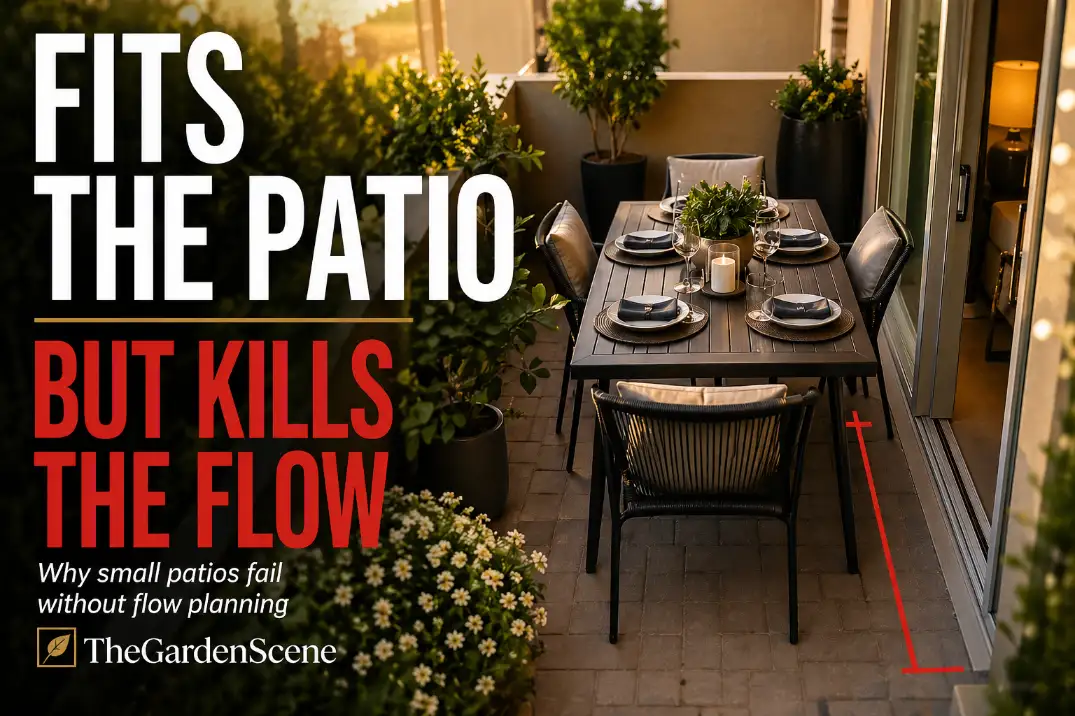
Small patios rarely fail because the table shape is wrong in theory. They fail because the table only works when every chair is pushed in. The real test is the active footprint: the tabletop, the chairs, the pullout space, and the route people use to move through the patio.
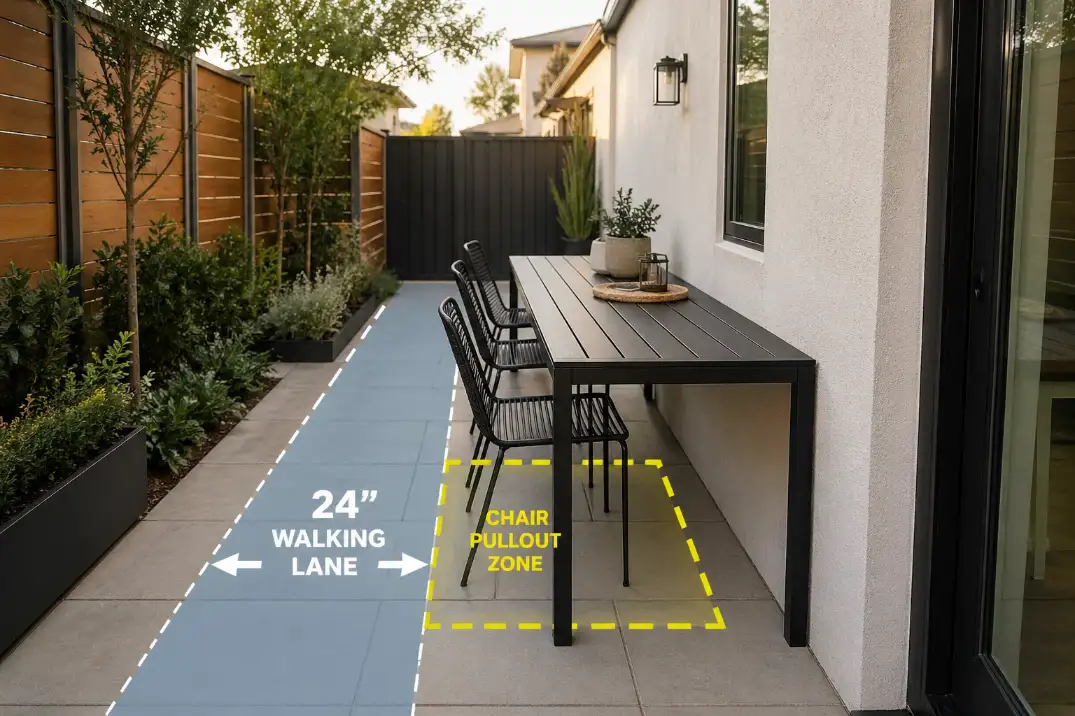
Use this as the first filter: 30–36 inches behind dining chairs is workable, 42–44 inches is more comfortable if people need to pass behind seated guests, and anything under 24 inches of walking lane will feel tight fast.
A 36-inch round table may seat four, but it can still block the only clean path from the sliding door. A 48-inch rectangular table may sound larger, yet work better if one side sits tight to a wall or bench.
The best patio table shape is not the one that looks smallest online. It is the one that still works after people sit down.
Start With the Active Footprint
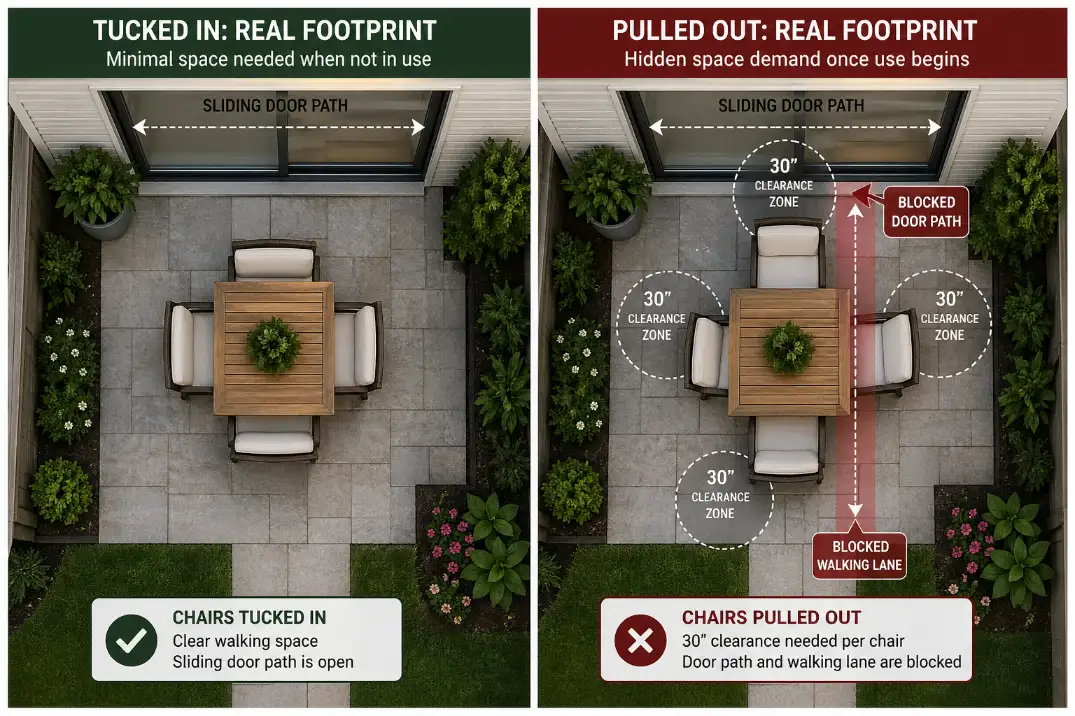
The biggest buying mistake is measuring only the tabletop. A table that looks compact in a product photo can nearly double its working footprint once chairs slide back.
The tucked-in layout is not the real layout
A tucked-in dining set is the least demanding version of the patio. Real use is messier. Someone stands up. A chair angles out. A plate gets carried from the kitchen. A guest walks behind another person.
That is where shape matters. Corners, chair angles, and walking routes decide whether the patio feels planned or crowded.
The no-regrets measurement check
Before choosing round, square, oval, or rectangular, measure the usable dining zone, not the full patio. Exclude the door swing, grill lid zone, planter edge, steps, storage box, and any route that must stay open.
A table is usually too demanding if it needs every chair tucked in to make the patio look usable. A healthier setup has a little slack: one person can slide back while another person passes.
Round Tables Work Best When Movement Comes From Several Directions
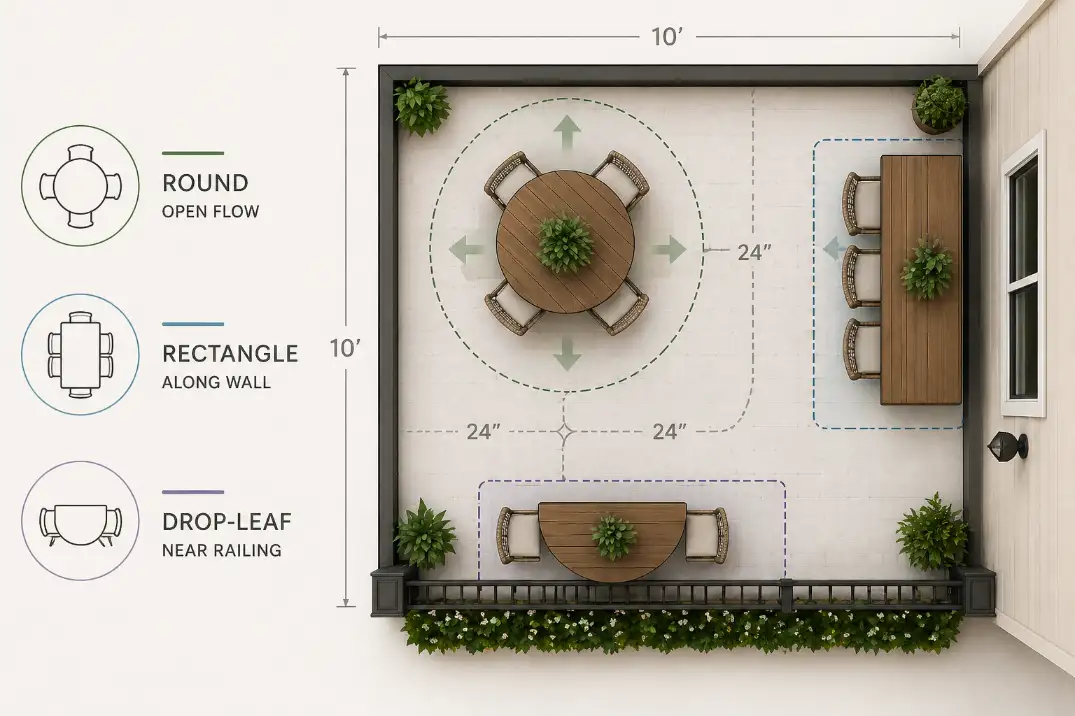
Round tables are usually the safest choice for small square patios, apartment patios, and spaces where people move around the table from more than one side. With no corners, they reduce hip bumps and make tight turns feel less awkward.
A 30–36 inch round table is ideal for two people and workable for casual four-person use. A 42-inch round table can still work, but it needs a more open patio. Past that point, the table often starts taking circulation space rather than improving dining comfort.
Round is strongest when the patio has flexible movement around it. It is weaker on long narrow patios, where the circle leaves awkward leftover strips on both sides and cannot sit flush against a wall.
Rectangular Tables Are Better for Narrow Patios
A rectangular table often beats a round table in a long, narrow outdoor space because it follows the shape of the patio. The best version usually sits parallel to the longest edge instead of floating in the center.
For small patios, look for rectangular tables around 28–32 inches wide and 48–60 inches long. That range gives enough surface for meals without creating a bulky center obstacle.
One side should do less work
Rectangular tables are most efficient when one side is simplified. That may mean a bench, a wall-side placement, or chairs only on the ends and one long side. If every side needs full chair pullout, the rectangle loses much of its advantage.
This is where seating choice changes the whole layout. A bench can reduce visual clutter and keep one side tighter, while four bulky chairs can make even the right table shape feel wrong. The tradeoff in Bench Seating vs Patio Chairs matters most when the patio is already close to its limit.
Square Tables Are Useful, But Less Forgiving
Square tables look compact, and sometimes they are. A small square café table can be excellent for two people, coffee, laptops, or a balcony corner. The problem starts when a square table is treated like a four-person dining solution in a tight traffic zone.
A 30×30 inch square table can work well for two. A 36×36 inch square table with four chairs needs more breathing room than people expect because the corners project into walking routes.
Square tables are best when the patio itself is balanced and the table can sit cleanly without blocking a doorway. They are weakest near sliding doors, steps, grill paths, or diagonal movement routes.
Oval Tables Solve the Corner Problem, Not the Space Problem
Oval tables are useful when you want the seating logic of a rectangle without hard corners. They can make four-person dining feel more graceful in a small outdoor room, especially when people need to move around the ends.
But oval does not magically save space. Many oval outdoor tables are long enough that they still need a generous patio. If the space is under 8 feet wide, check the full chair-pulled-out footprint before assuming the rounded ends will solve the layout.
Half-Round, Drop-Leaf, and Folding Tables Deserve More Attention
For very small outdoor spaces, the best table may not be a classic dining shape at all. Half-round, drop-leaf, folding, and wall-mounted tables often outperform normal patio sets because they respect everyday space.
Best for balconies and apartment patios
A half-round table can sit against a railing or wall while keeping the outer edge soft. A drop-leaf table can stay compact most days and open only when needed. A folding table makes sense when the patio is used for coffee more often than full meals.
This is the option people often underestimate. They shop for a permanent four-person set when the patio really needs a flexible two-person setup with occasional guest capacity.
Pro Tip: If four-person dining happens only occasionally, do not let that rare use control the whole patio. Choose the best daily table and store extra seating separately.
Quick Shape Guide for Small Outdoor Spaces
| Patio situation | Best table shape | Working size range | Why it works | Watch out for |
|---|---|---|---|---|
| Small square patio | Round | 30–42 inches | Softens movement from several sides | Oversized diameter |
| Long narrow patio | Rectangular | 28–32 inches wide | Follows the patio shape | Chairs on all four sides |
| Balcony or apartment patio | Half-round / drop-leaf | 24–36 inches | Saves daily floor space | Too many permanent chairs |
| Two-person dining | Round or square café | 30–36 inches | Compact and simple | Bulky armchairs |
| Four-person meals | Oval or compact round | 36–42 inches round / 48–60 inches long | Adds seating without harsh corners | Tight pullout zones |
| Grill + dining patio | Rectangular or folding | 30 inches deep or less | Keeps zones clearer | Centered table blocking cook path |
Best Shape by How You Use the Patio
For coffee, reading, or laptop use
Choose a small round, square café, or drop-leaf table. You do not need a dining footprint if the patio mostly supports one or two people. A 24–30 inch table can be enough for drinks, a book, and a small plate.
The wasteful fix here is buying a full dining set “just in case.” It usually turns a pleasant small patio into furniture storage.
For two-person dinners
A 30–36 inch round table is usually the most forgiving choice. A narrow rectangle also works if the patio is longer than it is deep.
The better option depends on the walking path. If people move around the table from several sides, choose round. If the patio has one clear long wall, choose rectangular.
For four-person meals
Four-person dining needs more discipline. A 36–42 inch round table works if the patio is open around it. A compact oval or narrow rectangle can work better if the patio has a strong directional layout.
On a 10×10 patio, this becomes a full layout decision, not just a table decision. The usable space disappears quickly once chairs, planters, side tables, and door clearance are included, which is why What Outdoor Furniture Actually Fits on a 10×10 Patio is a helpful reference before choosing a larger set.
For grill and dining together
A centered round table can become a problem if it blocks the cook’s route. In shared grill-and-dining patios, rectangular or folding tables usually perform better because they can stay out of the main work lane.
The table should not sit where the grill lid opens, where hot tools move, or where people carry food. If the patio has to support cooking, prep, and seating, the zone logic in Best Patio Layout for Grill, Prep Space, and Dining matters more than choosing the prettiest table shape.
What People Usually Misread
“Seats four” is not the same as “works for four”
A four-seat table only works if four people can sit, move, and stand up without blocking the patio. If every chair must stay tucked in for the layout to look good, the set is too demanding for the space.
A healthier small-patio dining setup has a little slack: one person can slide back, another can pass, and the door route still works. A failing setup only works when nobody is moving.
Corners matter more outside
Outdoors, people move around furniture less formally. They carry plates, step around planters, open grill lids, pull cushions, and move between house and yard. Table corners catch that movement.
That is why square and rectangular tables need more care near doors and narrow paths. The symptom is a patio that feels cramped. The mechanism is usually a corner sitting inside the natural walking line.
Bigger is not the best upgrade
When a table feels crowded, people often buy a bigger one. On a small patio, that can make the problem worse. The better fix may be a side cart, tray table, wall shelf, or folding prep surface.
If the issue is serving space, solve serving space. Do not sacrifice the whole patio to add 6 inches of tabletop.
What Changes by Patio Size
Under 6 feet wide
Do not force a normal dining set here. Use a bistro table, half-round table, wall-mounted drop-leaf, or folding table. Keep depth near 24–30 inches if chairs face each other.
A four-person set may fit on paper, but it will usually consume the entire patio once chairs move.
Around 8×8 feet
This is a strong range for a 36-inch round table with slim armless chairs. A square table can work, but only if the door path and walking lane do not cross the corners.
If the patio has one fixed route from house to yard, place the table beside that route, not inside it.
Around 10×10 feet
A 10×10 patio can handle a round, oval, or compact rectangular table, but not all layouts are equal. If dining is the main purpose, a 42-inch round table may be comfortable. If the patio also needs a grill or lounge chair, a wall-side rectangle may be smarter.
Around 12×12 feet
At 12×12 feet, table shape becomes more about zoning. A rectangular table can anchor one side, while a round table can create a central dining area. Still, a six-person set needs caution. With chairs pulled out, the active footprint can approach 9 feet across.
For mixed-use patios, 12×12 Patio Furniture Layout gives a clearer sense of how dining, seating, and movement compete.
The Final Decision Rule
If the patio is square and movement comes from several sides, choose round. If the patio is long and narrow, choose rectangular. If the patio is mostly for two people, a small square café table can work.
If the patio needs four seats without sharp corners, consider oval. If the patio is very tight, choose half-round, drop-leaf, or folding before forcing a permanent dining set.
The table shape should follow the bottleneck. On some patios, the bottleneck is width. On others, it is the sliding door, grill path, stair landing, or chair pullout zone.
The Practical Verdict
For most small outdoor spaces, the best patio table shape is the one that protects the clearest path.
Choose round when people move around the table from multiple directions. Choose rectangular when the patio is narrow or the table can sit along one edge. Choose square for two-person café setups or balanced patios with no door conflict.
Choose oval when you want four-person dining with fewer hard corners. Choose half-round, drop-leaf, or folding tables when everyday space matters more than permanent seating.
The table that wins is not the one that technically fits. It is the one that still works after chairs move, people stand up, and the patio is used like a real outdoor room.
For broader patio sizing guidance, see Better Homes & Gardens.