Quick Answer: Start With the Patio Constraint, Not the Cart
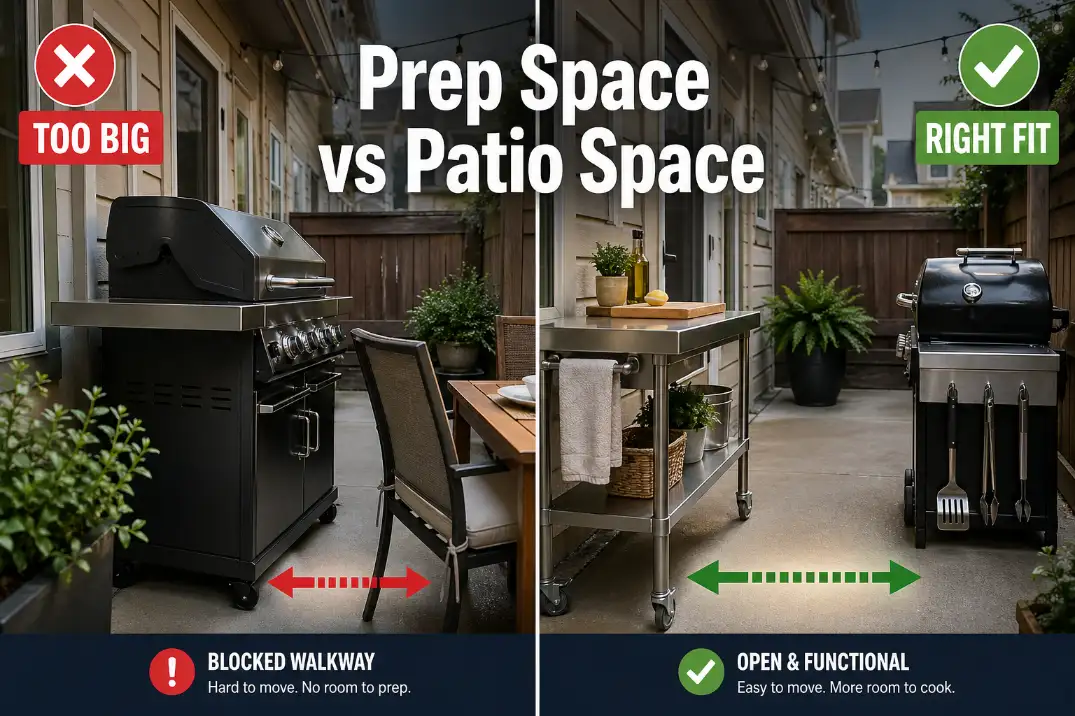
For tight patios, the best compact prep table or grill cart is usually not the biggest one you can fit. It is the one that leaves enough walking space, gives you one reliable prep surface, and keeps hot tools or serving trays from landing on dining chairs, railings, or the grill lid.
Start here:
| Patio situation | Best category to consider first |
|---|---|
| Narrow patio, balcony, or townhouse slab | Slim stainless prep table |
| Patio doubles as dining space | Rolling grill cart with locking casters |
| Grill has little or no side workspace | Grill cart with fold-down shelves |
| Small grill area feels cluttered | Compact utility cart, only if storage is the real issue |
| Uneven pavers or exposed weather | Heavier metal cart with stable legs or larger wheels |
The mistake is buying a cart like it is miniature outdoor kitchen furniture. On a tight patio, it needs to behave more like a controlled work zone: stable, narrow, weather-tolerant, and easy to move out of the way.
What Matters Most in a Tight Patio Layout
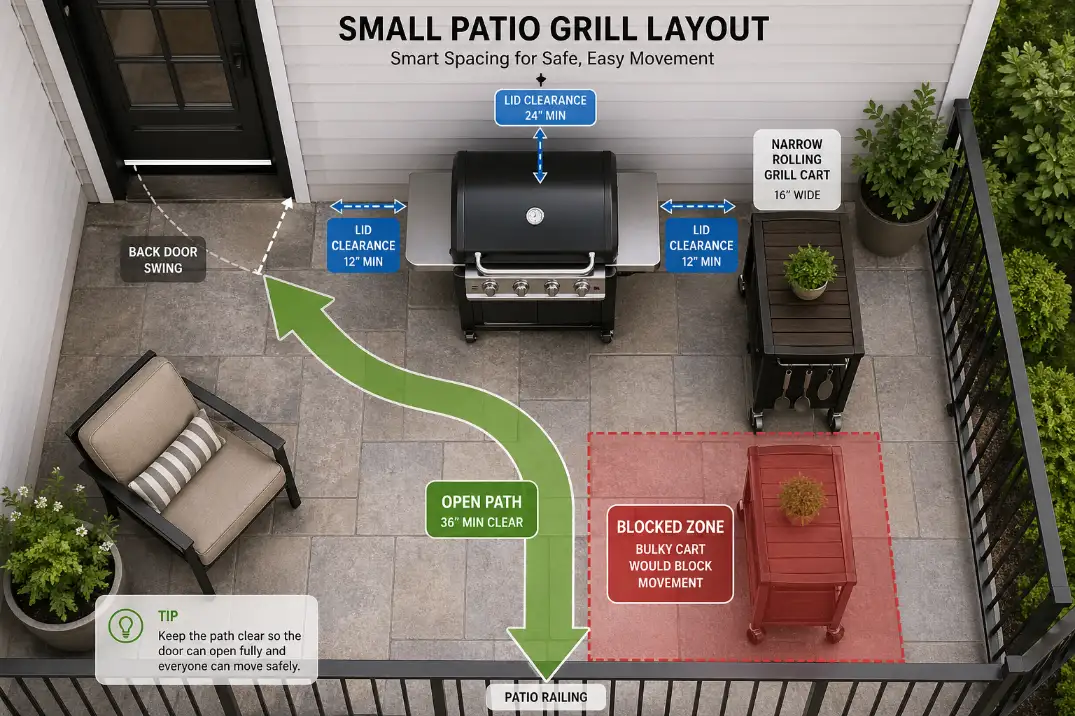
The winning choice depends less on “best overall” and more on the patio’s pinch points. A compact cart can still be too large if it blocks the route between the back door, grill, and table.
Before choosing, measure three things:
- The open walkway after the grill lid is raised
- The distance between the grill and seating area
- The space needed to roll or turn the cart without dragging it sideways
For most small patios, a cart or table around 20 to 36 inches wide is easier to live with than a broad station with oversized shelves. Depth matters just as much. A deep cart can steal more space than its width suggests.
Best Overall Fit: Slim Stainless Prep Tables
A slim stainless prep table is the safest first choice for most tight patios because it gives you a durable, wipeable work surface without pretending to be a full outdoor kitchen. It works especially well when the grill already has storage or when you mostly need a place for trays, seasonings, utensils, and cooked food.
Look for a table with a narrow footprint, a lower shelf, rounded or finished edges, and enough weight to stay steady when loaded. In humid, coastal, or rainy climates, stainless construction is usually more forgiving than painted steel, but finish quality still matters.
Skip this category if you need enclosed storage or if the table will sit uncovered all season in harsh exposure.
For most tight patios, this is the category to browse first because it adds usable prep space without turning the grill area into permanent furniture. If your main problem is having nowhere clean and stable to set trays, tools, or cooked food, a slim stainless prep table is the cleanest starting point.
| BEST FIRST CHOICE FOR TIGHT PATIOS |
|---|
| Slim Stainless Prep Table |
| Best for small patios that need a stable grill-side landing surface without adding bulky storage. |
| It fits tight layouts because it adds prep space while preserving walking clearance around the grill and seating area. |
| Look for a 20–36 inch width, stainless or weather-resistant metal construction, a lower shelf, and leveling feet or stable legs. |
| 🔴 SHOP 24 inch stainless prep table |
Best for Flexible Layouts: Rolling Grill Carts With Locking Casters
A rolling grill cart makes sense when the patio has to change roles. If the same slab is used for grilling, eating, container plants, and occasional entertaining, mobility matters more than maximum storage.
The key is locking casters. A cart that rolls easily but does not lock securely can feel unstable during prep. This matters on pavers, stamped concrete, and slightly sloped patios where a light cart may drift or wobble.
Best for:
- Patios that need to open up after cooking
- Renters or homeowners who rearrange often
- Grills that do not have much side-shelf space
Skip if:
- Your patio surface is very uneven
- The cart will stay outside uncovered year-round
- You need a fixed heavy-duty work surface more than mobility
Choose this category when the patio layout changes between cooking, dining, and everyday use. The cart earns its space only if it moves easily and locks firmly once it is in position.
| BEST FIT FOR FLEXIBLE PATIOS |
|---|
| Rolling Grill Cart With Locking Casters |
| Best for patios where prep space is needed during cooking but open floor space matters afterward. |
| It fits flexible layouts because it can move beside the grill, shift toward the table, then store out of the traffic path. |
| Look for larger wheels, at least two locking casters, a rigid frame, and shelves that can hold loaded trays without flexing. |
| 🔴 SHOP rolling grill cart |
Best for Grills With No Side Shelves: Carts With Fold-Down Shelves
If your grill is small or portable, a cart with fold-down side shelves can be the right upgrade. It gives you temporary workspace when you are cooking, then shrinks back after use.
This category is especially useful on narrow patios where a fixed-width table would always be in the way. The trade-off is that fold-down shelves are not all equal. Thin shelves can flex, hinges can loosen, and lightweight carts may tip if too much weight is placed on one side.
Choose this category if you need workspace only during cooking. Avoid it if you routinely prep heavy platters, use cast iron, or need a permanent serving station.
What to look for:
- Fold-down shelves that lock firmly in place
- A stable center frame
- Heat-resistant or easy-clean shelf surfaces
- Enough closed width to store neatly against a wall
If the grill itself has little or no side workspace, this is the most space-efficient upgrade. It gives you working room only when you need it, then folds back down before the patio starts feeling crowded.
| BEST OPTION FOR NARROW GRILL ZONES |
|---|
| Grill Cart With Side Shelves |
| Best for compact grills that need extra prep space without permanently widening the layout. |
| It fits narrow patios because the side surfaces expand during cooking and don’t dominate the space when not in use. |
| Look for sturdy side shelves, a stable frame, heat-resistant surfaces, and a compact overall width when shelves are down. |
| 🔴 SHOP grill cart with side shelves |
When a Utility Cart Helps — and When It Is Not the Main Answer
A compact utility cart can help if the real problem is clutter: tools on the dining table, towels on chair backs, trays balanced on the grill lid, or fuel accessories sitting on the patio floor.
But this should not be the first category for everyone. A utility cart is more of an organization fix than a true prep-surface solution. It works best when you already have enough grill-side workspace but need better control over tools and accessories.
Choose one only if it has a solid top surface, open lower shelves, weather-resistant construction, and hooks or rails that keep tools accessible. Skip it if you need a sturdy prep surface for heavy trays or if the cart will live fully exposed to rain and humidity.
What to Avoid Buying for a Small Patio
The wrong cart usually fails in one of three ways: it is too deep, too light, or too specialized.
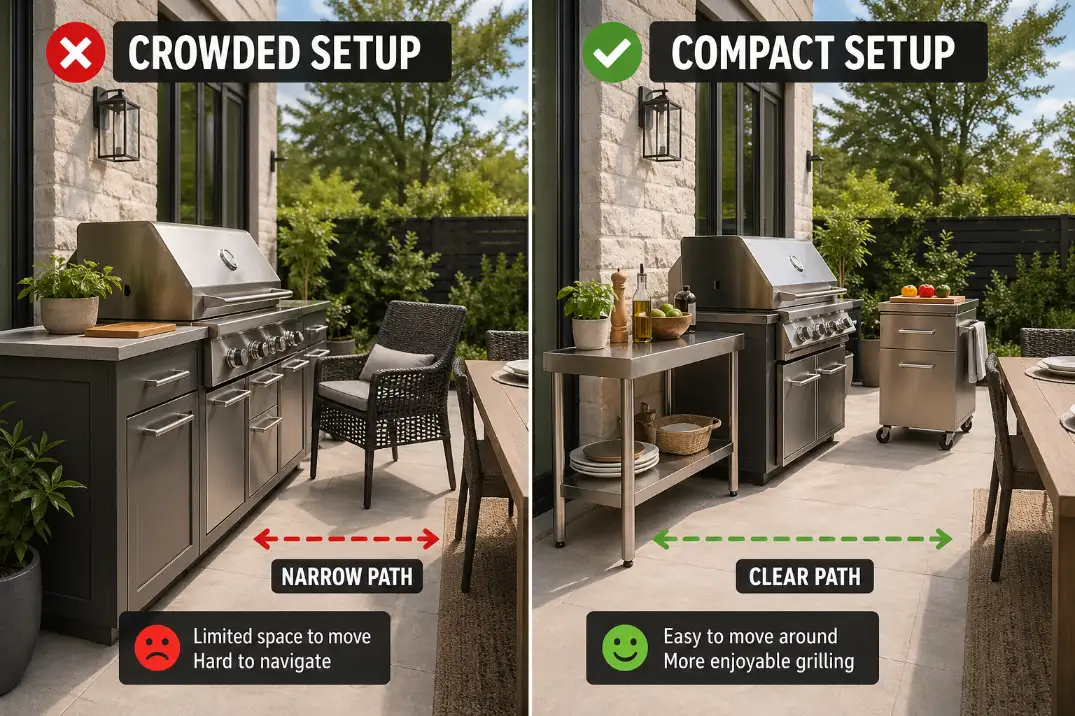
Avoid oversized cabinet-style grill islands unless the patio is large enough to treat the grill area as a fixed outdoor kitchen. They look useful online, but on a tight slab they can block movement, trap heat near seating, and make cleaning around the grill harder.
Be cautious with very lightweight folding tables. They can work for serving, but they are often poor grill-side prep surfaces if they wobble, stain easily, or cannot handle hot tools.
Also avoid carts with tiny wheels if your patio has pavers, expansion joints, gravel borders, or any slope. Small wheels are fine on smooth concrete, but frustrating on textured surfaces.
Compact Prep Table vs Grill Cart: Which Should You Choose?
Choose a compact prep table if you mainly need a sturdy surface. Choose a grill cart if you need storage, mobility, or fold-away function.
| Category | Best for | Main weakness |
|---|---|---|
| Slim stainless prep table | Reliable prep space in narrow layouts | Limited storage |
| Rolling grill cart | Flexible patios and movable serving | Can wobble if too light |
| Fold-down shelf cart | Temporary workspace beside small grills | Hinges and side stability matter |
| Utility cart with shelves | Tool control and vertical storage | Not always ideal for heavy prep |
| Cabinet-style cart | Larger patios with fixed grill zones | Often too bulky for tight layouts |
The best choice is the one that removes friction from cooking without creating a new patio problem.
When Not to Buy Yet
Do not buy a cart yet if the grill itself is poorly placed. If smoke blows into the seating area, the grill blocks the back door, or the lid opens into the walkway, a prep table will not fix the real layout issue.
Also wait if you have not measured the patio with chairs pulled out. Many small patios feel workable when empty and crowded once people are seated.
A cart should support the layout. It should not be used to rescue a layout that already fails.
Final Verdict
For most tight patios, start with a slim stainless prep table if you need a durable landing surface and do not need enclosed storage. Choose a rolling grill cart if the patio layout changes often. Choose a fold-down shelf cart if the grill has little or no built-in workspace.
A compact utility cart can help when clutter is the real issue, but it should not replace a true prep table if what you need is a stable surface beside the grill. Avoid oversized cabinet-style stations unless the patio has enough room to treat the grill area as a fixed outdoor kitchen.
FAQ
What size prep table is best for a small patio?
A 20 to 36 inch wide prep table is usually the most practical range for tight patios. Go narrower if the table sits near a doorway, railing, or dining chair path.
Is stainless steel better than plastic for a grill-side table?
Usually, yes. Stainless steel is easier to clean, more heat-tolerant, and better suited to grill-side use. Plastic can work for light serving, but it is not ideal near hot tools or greasy prep.
Are enclosed grill carts worth it on small patios?
Only if you truly need protected storage. On tight patios, enclosed carts can feel bulky and may trap moisture. Open shelves are often easier to use and maintain.
Should a compact grill cart have wheels?
Wheels are useful if the cart needs to move between cooking and dining zones. For uneven pavers or sloped patios, choose larger wheels and locking casters.
Related Articles
- How to decide whether a small patio should prioritize dining space or a grill zone
- Best surfaces to use around a backyard grill
- How wind can ruin backyard cooking setups
- How to plan a patio layout around grilling, prep, and dining
- How much space a grill area really needs
- Why a grill station may be too big for your patio
For placement and clearance decisions, it is also worth checking the NFPA’s basic outdoor grilling safety guidance, especially if your compact cart will sit near deck railings, siding, eaves, or a tight walkway.