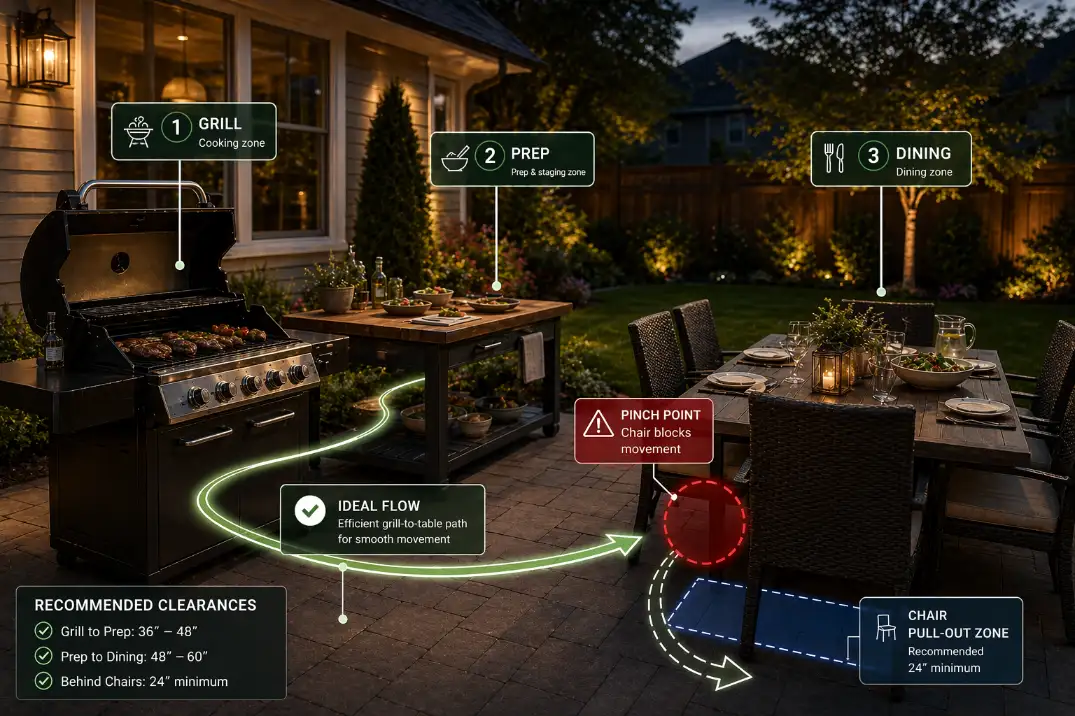
The best patio layout for grill, prep space, and dining is usually a three-zone setup: grill on the most open edge, prep within 1 to 3 steps, and dining outside the direct heat and smoke path.
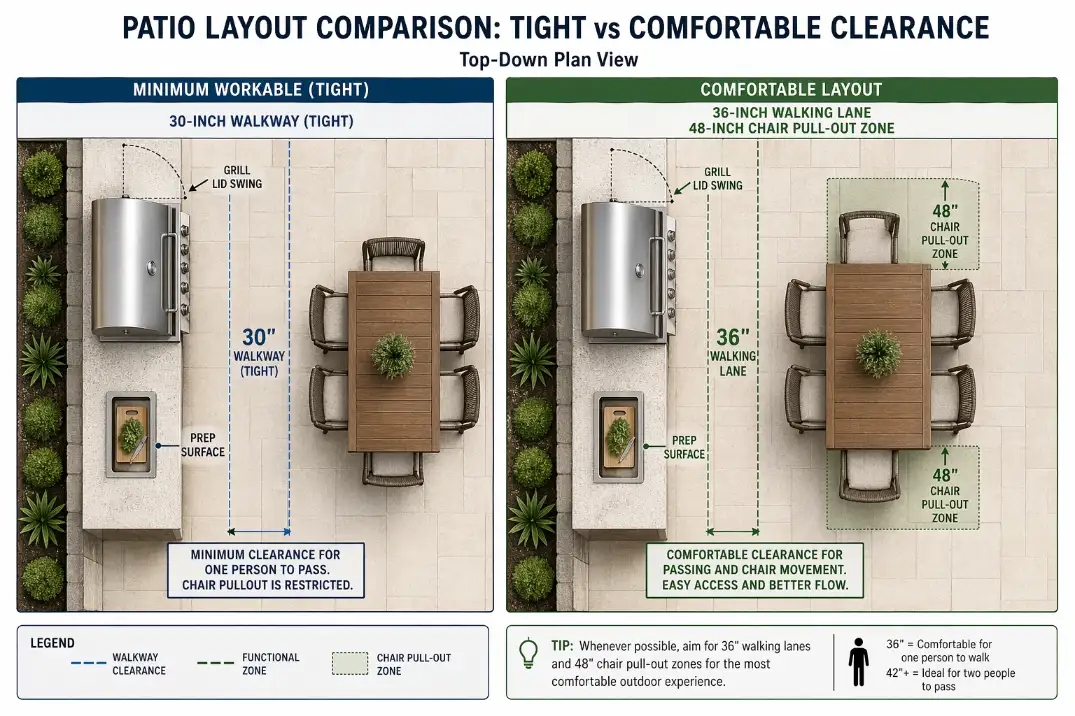
A workable layout needs more than object spacing. It needs movement spacing: about 36 inches for a clear walking lane, 48 inches where chairs pull out, and at least 24 inches of landing space beside or near the grill.
The mistake is treating this like a furniture-fit problem. A dining set can feel a little tight and still work. A grill layout fails faster because the cook needs lid clearance, heat clearance, tool access, food landing space, and a route that does not cut through seated guests.
Even a 12-by-12-foot patio can feel cramped if the grill, prep cart, and table all fight for the same path.
The Layout That Usually Works Best
For most back patios, the strongest arrangement is not a full outdoor kitchen. It is a simple working sequence: house access → prep surface → grill → dining table. Those zones should feel connected, but not stacked in one corner.
Put the grill on an open edge
The grill should usually sit along an outside patio edge, near open air, or beside the clearest ventilation path. Centering the grill can look balanced in a plan view, but it often wastes the main circulation lane and pushes heat toward guests.
A grill placed too close to the dining table creates two problems at once: the cook loses a landing zone, and guests sit inside the heat zone. If the patio is small, this is where compact placement matters more than symmetry.
For tighter patios, the same placement logic applies in Small Patio Grill Placement Near a Dining Area: the grill should serve the dining area, not invade it.
Keep prep close, but not in the chair path
Prep space works best within 1 to 3 steps of the grill. Farther than that, people stop using it and start balancing trays on the dining table, grill side shelves, or chair arms. That is when the layout technically has prep space but does not function like one.
The weak version is placing a prep cart directly between the grill and table. That creates a bottleneck. The better move is to place the prep surface beside the grill or at a slight angle, leaving the serving route open.
Pro Tip: If the prep table blocks the only walking route, it is not prep space. It is an obstacle with a cutting board on top.
Minimum Patio Size by Use
The usable patio size is not just the slab size. It is the space left after chairs pull out, the grill opens, and someone walks through with a tray. This is why a slightly smaller table can improve the patio more than a larger prep cart.
| Patio Size | What Usually Works | What Usually Fails | Best Layout Choice |
|---|---|---|---|
| Under 8×8 ft | Grill plus small landing surface | Full dining and prep setup | Two-zone grill + compact seating |
| 8×10 ft | Grill, narrow prep, 2-person dining | Four chairs plus cart | Edge grill with folding prep |
| 10×10 ft | Grill, prep, small 4-person dining | Oversized table or island | L-shaped or corner layout |
| 10×12 ft | Grill, prep, 4-person dining with better flow | Bulky grill station | Edge grill with separate prep |
| 12×12 ft and larger | Clear grill, prep, and dining zones | Center-loaded furniture | Three-zone layout |
Minimum is not the same as comfortable
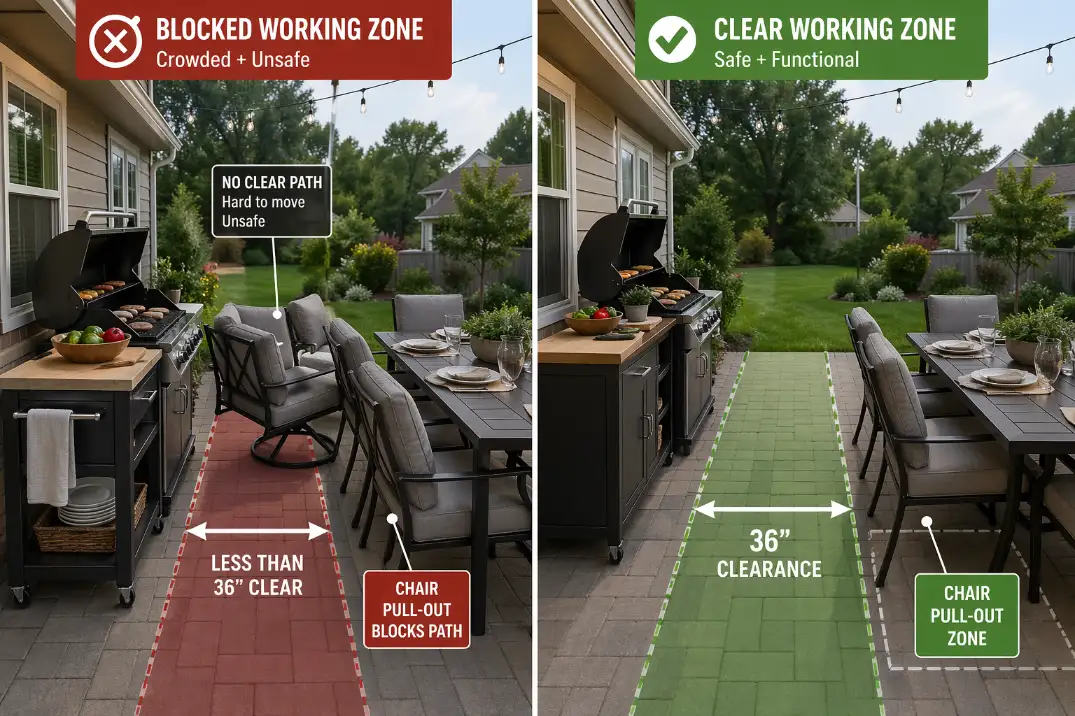
A 30-inch path may be passable, but 36 inches feels much better when people are carrying food. Around dining chairs, 48 inches is the safer target because chair movement and walking movement overlap.
This is where many layouts go wrong. The patio may have enough square footage on paper, but the traffic lane disappears once people sit down. A healthier layout has fewer objects and cleaner movement. A failing layout has every feature present but no usable route.
If the grill station itself is eating the circulation zone, the issue is more about scale than furniture arrangement, as covered in When a Grill Station Is Too Big for the Patio.
Clearance Rules That Matter Most
The clearest layout rule is simple: protect movement first, then improve storage and surface protection. Storage can be added later. Lost clearance is harder to fix.
Keep the hot zone out of normal traffic
The cook should not have to step backward into a dining chair every time the lid opens. Guests should not have to pass between the grill and prep surface to reach the table. If either happens, the symptom is crowding, but the underlying mechanism is a broken work zone.
The grill also needs reasonable separation from siding, fences, pergola posts, outdoor curtains, and covered roof edges. Exact clearance depends on the grill model and manufacturer instructions, but a grill pressed tight against a wall or combustible surface is not just inconvenient; it is a safety problem.
Protect the surface after the layout is solved
Surface protection matters, but it should come after the grill position is settled. A mat can reduce heat marks, grease stains, and surface wear under the cooking zone, but it will not make a blocked route safe or fix chairs that pull into the grill path.
For tight slabs where heat, grease, and chair clearance overlap, Best Grill Mats and Protective Pads for Small Patios is the right follow-up after the grill zone is already placed well.
The Best Layouts by Patio Shape
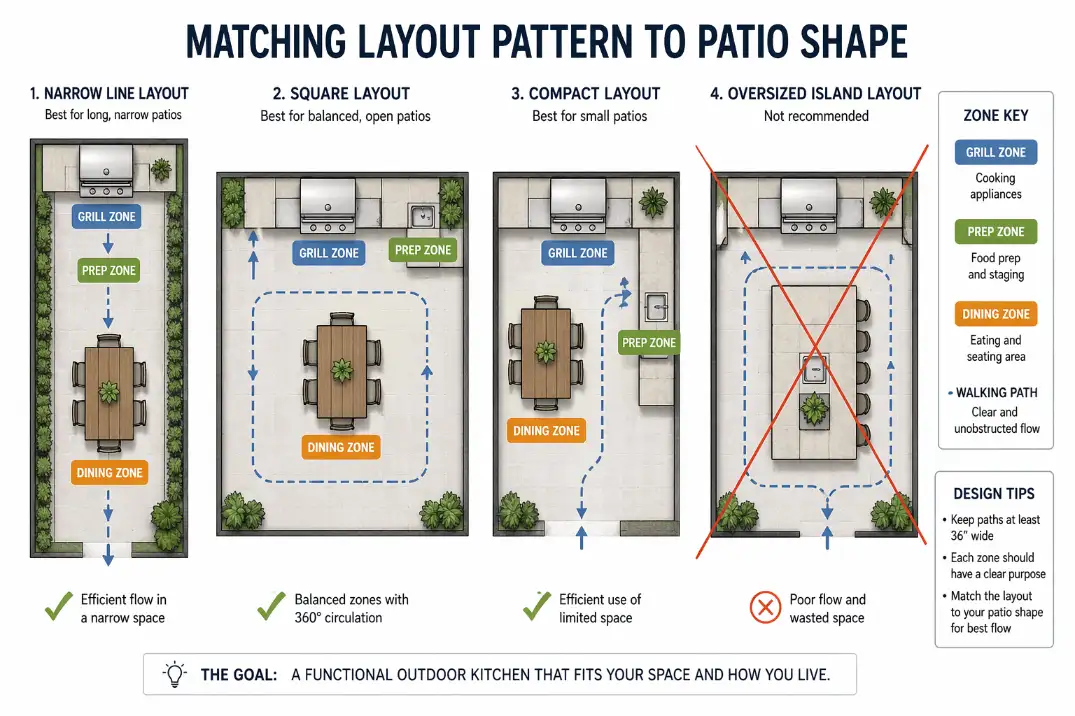
The right layout depends more on patio shape than on the grill model. A layout that works on a square patio can feel awkward on a narrow slab.
Long narrow patio: use a line layout
On a narrow patio, place the grill and prep along one long edge, then put dining at the wider or more open end. This keeps the walkway from zigzagging.
The weak version is a straight line where the cook stands between the grill and the table. The better version leaves a clear lane along one side. Even 6 inches of unnecessary cart depth can matter on a narrow slab.
Square patio: use an L-shaped layout
A square patio usually works best with the grill on one side and prep turning the corner. Dining sits diagonally across from the heat zone. This creates a loose L-shape instead of a crowded center.
The table should not be the center of every movement path. If every trip from the house, grill, and yard cuts behind the same chair, the layout will feel worse during use than it looks from above.
Small patio: choose two strong zones
On a very small patio, the honest choice is usually between a strong grill-prep setup with compact dining or a stronger dining setup with minimal prep. Trying to force a full grill, prep cart, storage, and four-person dining area into a tight slab often creates a patio nobody enjoys using.
This is why How Much Space a Grill Area Really Needs to Work Well matters before buying another cart or table. The missing piece is often clearance, not equipment.
When a U-shaped or island layout is too much
U-shaped and island layouts look appealing because they promise a real outdoor kitchen. On a normal patio, they often create too much fixed mass. Once an island is installed, the walking path has to bend around it every time someone cooks, serves, or sits down.
A U-shaped layout usually makes sense only when the cooking area is separated from dining or the patio has enough room for two clear lanes: one for the cook and one for guests. If the island leaves less than about 36 inches around key sides, it is probably too much patio structure for the space.
What People Usually Misread First
They blame the table before the grill zone
The dining table gets blamed because it is the largest object, but the grill zone is often the real problem. A grill needs standing room, lid clearance, side access, heat clearance, and landing space. A table mostly needs chair movement.
If the cook has to step backward into a chair every time the lid opens, the table is not the underlying problem. The grill was placed without a working zone.
They add prep space too late
A prep cart added after the patio is already crowded usually becomes clutter. Prep should be planned before storage, décor, side tables, or extra chairs.
The best prep surface is not huge. Even a 24-by-36-inch surface can change the layout if it sits in the right place. A larger cart in the wrong location just narrows the route.
They underestimate smoke direction
Smoke does not need to fill the whole patio to be a problem. If the grill sits under a covered edge, near a wall, or inside a still corner, the dining area can become uncomfortable in 10 to 15 minutes of cooking.
If smoke is the recurring issue, moving the grill a few feet may help more than changing the table layout. Covered patios especially need more care because trapped smoke behaves differently from open-air smoke, as explained in Why Grill Smoke Gets Trapped on a Covered Patio.
A Simple Patio Layout Decision Check
Use this before buying another table, cart, mat, or grill island:
- Can someone walk from the house to the table without passing through the grill work zone?
- Can the grill lid open fully without forcing the cook backward?
- Is there at least 24 inches of landing space for hot trays?
- Can chairs pull out without blocking the only route?
- Does smoke move away from the dining area within the first 5 minutes of cooking?
- Is the prep surface close enough to use without crossing behind seated guests?
- Is the grill clear of siding, fencing, posts, curtains, or roof edges according to the grill manual?
If two or more answers are no, rearranging or downsizing furniture is usually smarter than adding accessories.
When the Standard Fix Stops Working
The standard fix is to push everything against the edges. That works until the patio becomes a ring of objects with no useful center. Once every edge is occupied, the center turns into the only walking route, serving route, and chair pull-out zone.
At that point, the fix is not another slim cart. It is removal or downsizing. A four-seat table may need to become a two-seat bistro setup. A bulky grill station may need to become a smaller grill with a separate folding prep surface. A permanent island may not belong on that patio at all.
The routine fix stops making sense when clearances fall below about 30 inches in the main traffic lane or when dining chairs cannot pull out without colliding with the grill zone. Below that, the patio may look furnished but function like storage.
The Best Final Arrangement
For most U.S. back patios, the best final arrangement is simple: grill on the most open edge, prep within arm’s reach or one step away, dining outside the heat path, and a clear route from the house to the table.
The grill should be important without becoming the patio’s traffic circle. Prep should support cooking without blocking serving. Dining should feel close enough for conversation but far enough from heat, smoke, lid movement, and raw-food handling.
If the patio feels crowded after that, remove the least-used piece first. In real use, one clear path is worth more than one extra chair.
For broader official outdoor cooking safety guidance, see the National Fire Protection Association.