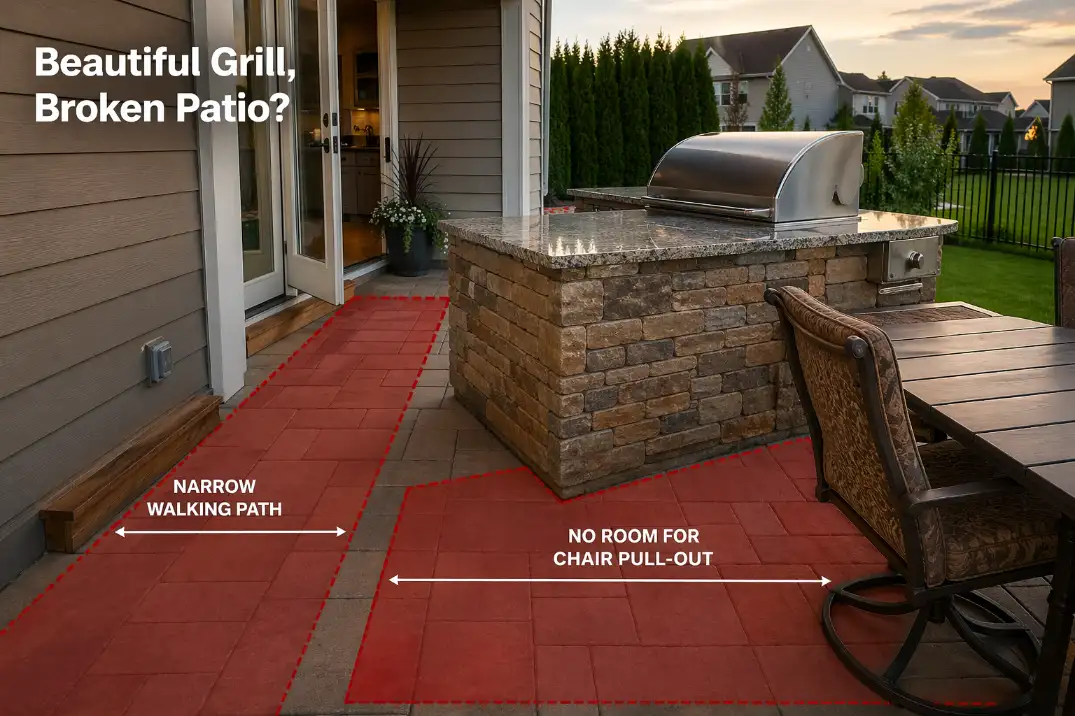
A grill station is too big for the patio when it cancels the patio’s other jobs. The problem is not just the width of the grill or the length of the island. It is whether the setup leaves enough room to cook, walk, open doors, pull out chairs, and stay clear of heat.
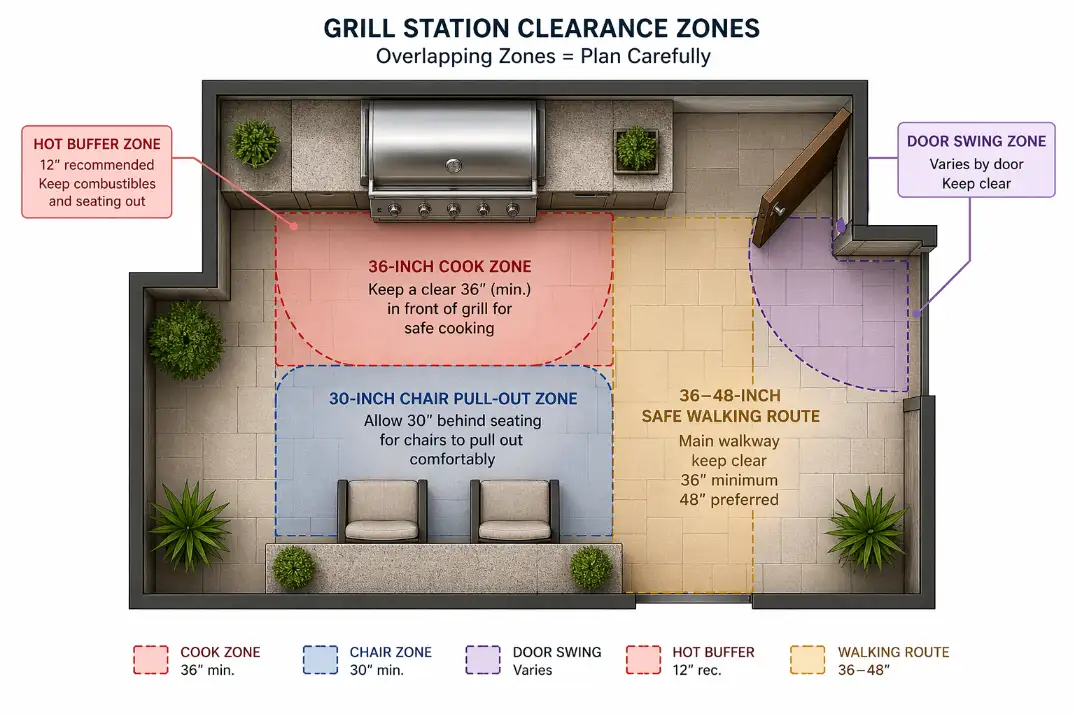
Start with four checks: the cook needs about 36 inches of standing room in front of the grill, dining chairs need about 30 inches to pull out, active walkways usually need 36–48 inches, and the hot cooking face should not sit directly inside the main traffic route.
If the grill is under a cover, near siding, or close to a railing, manufacturer clearance and ventilation matter even more.
A large grill station may look high-end, but if it turns a patio into a narrow obstacle course, it is oversized for the space.
Too Big or Just Badly Placed?
Not every crowded grill station needs to be demolished. The first decision is whether the station is truly too large or simply sitting in the wrong zone.
It is too big when shrinking everything else still does not work
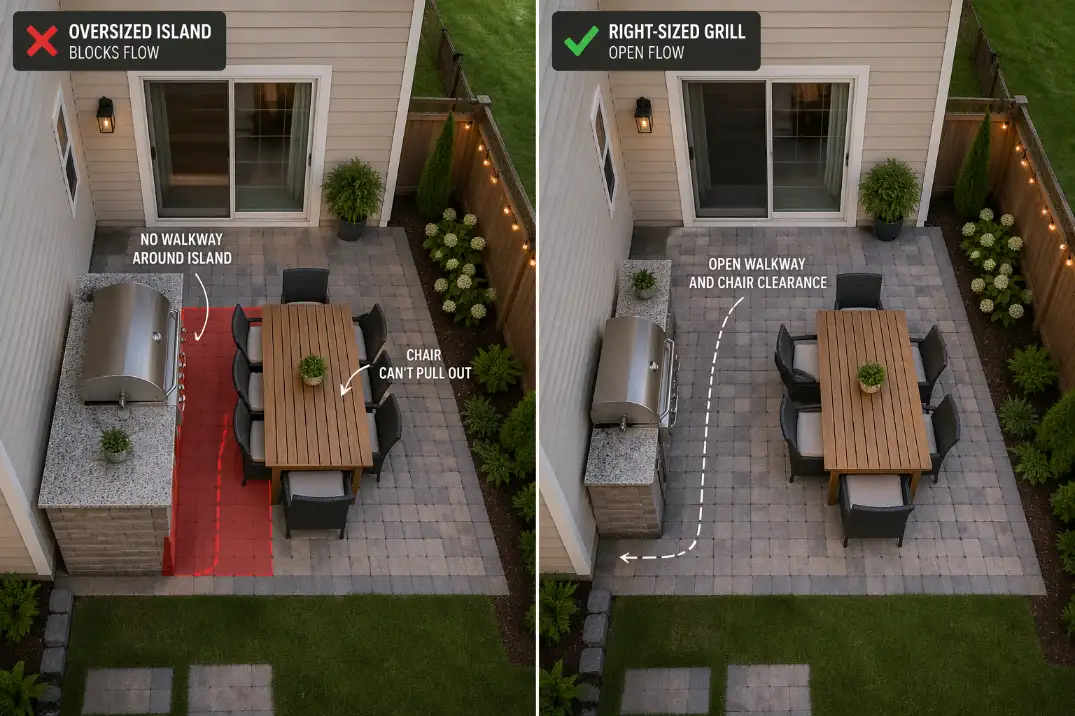
If you push in chairs, remove a side table, angle furniture, and still cannot keep a clear 36-inch cooking zone, the grill station is probably too large. This is especially common with L-shaped islands, bar overhangs, and long stone counters on patios under about 150 square feet.
A compact patio can handle a grill. It usually cannot handle a grill, bar, prep counter, storage run, dining table, and main walkway all fighting for the same 10-by-12-foot slab.
It is badly placed when the same station could work on the edge
Sometimes the grill is not too large; it is simply in the path between the back door and the dining area. That location makes every task collide. Someone carrying food crosses the cook zone. A guest pulling out a chair blocks the grill. A dog or child moves through the hottest part of the patio.
If the same grill could sit along a side edge with a clear route behind it, relocation may solve more than downsizing.
For a deeper spacing breakdown, how much space a grill area really needs to work well explains why the working zone around the grill matters more than the grill’s listed width.
Quick Fit Test for a Patio Grill Station
| Patio condition | What it usually means | Best move |
|---|---|---|
| Under 120 sq ft | A built-in island will often dominate | Use a compact cart or edge placement |
| 120–180 sq ft | Grill can work, but only with discipline | Avoid L-shapes and bar overhangs |
| Dining and grill share one zone | Chair movement will fight the cook zone | Separate the table path from the grill face |
| Door opens toward the grill | The station interrupts daily movement | Relocate before adding more counter |
| Covered patio traps heat or smoke | Size is partly a ventilation issue | Check clearance, airflow, and grill direction |
| Less than 36 inches in front | The cook zone is compromised | Shrink, move, or replace the station |
The strongest warning sign is not visual bulk. It is when one normal patio action blocks another.
What People Usually Misread First
More counter space can make the patio worse
A large counter feels practical because grilling creates clutter fast. Trays, tongs, foil, plates, spices, and drinks all need somewhere to land. But on a tight patio, more counter often solves prep while making circulation worse.
A single 18- to 24-inch landing surface beside the grill usually helps more than another 4 feet of stone counter. The goal is not maximum counter. It is enough landing space without stealing the center of the patio.
Pro Tip: If you grill for 30 minutes but sit outside for 3 hours, protect the seating and walkway first.
The table is not always the real problem
Dining chairs often get blamed because they visibly block the path. But chairs are supposed to move. A chair pushed back 24–30 inches is normal use, not clutter.
If that normal chair movement blocks the grill, the grill station is too close to the dining zone. This is why small patio grill placement near a dining area becomes such a common failure point on compact patios.
Why Oversized Grill Stations Fail
A grill station does not only occupy its own footprint. It controls the space around it.
A 6-foot island may take up about 18–24 square feet physically, but its working zone can dominate 60 square feet or more once you include the cook, open lid, heat buffer, side access, and guest movement.
Fixed islands remove flexibility
A freestanding grill cart can shift a foot, rotate slightly, or move closer to the patio edge when guests come over. A built-in island cannot. That permanence is why a small sizing mistake becomes a long-term layout problem.
Built-ins also create dead corners. These corners look intentional in photos, but in real use they often become places where no one can comfortably stand, sit, or pass.
Heat makes tight spacing feel even tighter
People often underestimate heat more than footprint. A chair may technically fit near the grill, but it may not feel usable when the grill is running at 450–600°F. In hot climates, pavers and walls can hold that heat long after cooking ends.
That is why the best grill location is usually near the edge of activity, not in the center of it. The cook should stay connected to the patio without turning the entire seating zone into the hot zone.
Covered patios raise the stakes
Under a roof, pergola, or low overhang, a grill station can be too large vertically as well as horizontally. Smoke, heat, lid clearance, and combustible surfaces all matter more.
If smoke gathers under the cover or drifts directly into seating, the issue may not be the grill’s size alone. It may be the wrong grill direction, weak airflow, or a station that belongs outside the covered zone. The related guide on grill smoke trapped under a covered patio covers that specific failure pattern.
What to Remove Before Replacing the Grill
The smartest fix is usually not “buy a smaller grill” first. Remove the parts that waste space without changing how you cook.
Remove decorative side counter first
Long counters look useful, but many become display surfaces, not work surfaces. If a side counter narrows the only walkway, it is the first thing to question.
Remove the bar overhang next
Bar seating at the grill island often sounds convenient, but it can be the worst use of space on a small patio. Stools need room behind them, and guests sitting at the grill face are often too close to heat, smoke, and splatter.
Remove the L-return before reducing cooking power
L-shaped grill islands are one of the most common ways small patios lose usable space. The return leg often blocks the center of the patio while adding storage or counter that could be handled with a movable prep table.
This is where many outdoor kitchens go wrong: they combine cooking, prep, storage, bar seating, and serving into one fixed block. Outdoor kitchen mistakes that waste backyard space goes deeper into that pattern.
When Downsizing Is the Better Move
Downsizing makes sense when the station cannot pass the fit test even after furniture and layout changes.
A smaller grill setup is usually better when:
- the cook has less than 36 inches of clear standing room
- the main walkway passes directly in front of the grill
- chairs cannot pull out without hitting the island
- the grill lid conflicts with a wall, post, railing, or roofline
- grease tray or propane access requires moving furniture
- the patio only works when everything is staged perfectly
The last point matters. A patio that works only when chairs are pushed in and nobody is cooking does not really work.
For small patios, a straight grill run along one edge usually beats an island in the middle. A 30- to 36-inch grill with one useful side shelf often performs better than a large built-in that forces every other activity into leftover space.
The Better Patio Grill Setup
The best grill station for a small patio has three traits: it sits near the edge, it has one reliable landing surface, and it leaves the center open.
A compact cart, narrow built-in run, or grill plus movable prep table often gives better daily function than a permanent island. The patio feels larger because people can still move naturally. The cook has a defined spot. The dining area keeps its chair space. The door remains useful.
If the patio also struggles with table placement, small patio grill and table seating problems can help separate a furniture-scale issue from a grill-scale issue.
The final rule is simple: keep the grill station only if it supports outdoor cooking without weakening the patio’s everyday use. Once it makes the door awkward, the seating cramped, the walkway unsafe, or the covered area smoky, the station is too big for the patio.
For broader official safety guidance, see the U.S. Fire Administration outdoor fire safety guide.