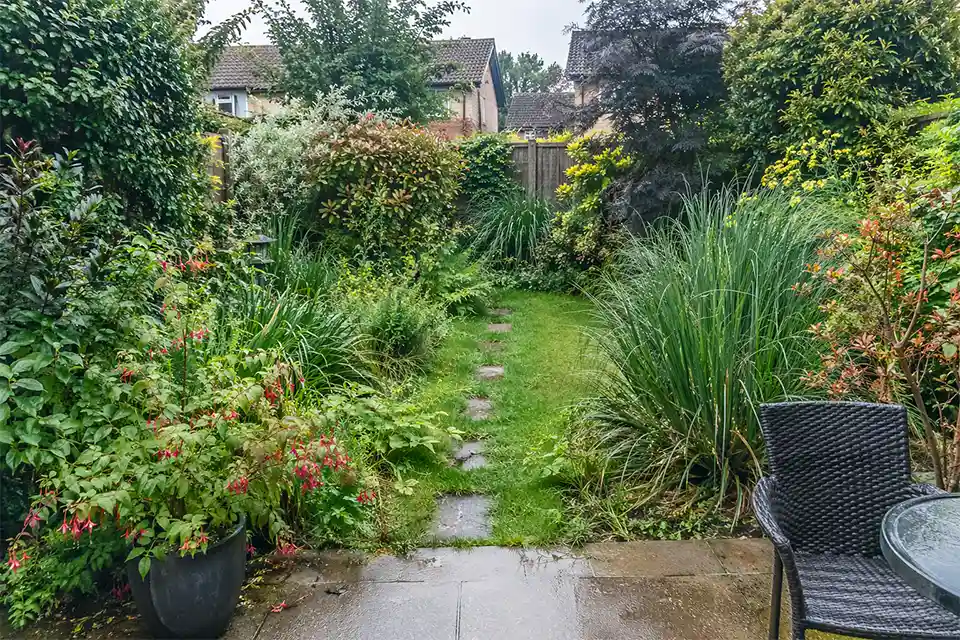
An overplanted backyard usually feels smaller for a simple reason: the planting has started taking space from movement, sightlines, and daily use. In most yards, the first warning signs show up before the space looks wildly overgrown.
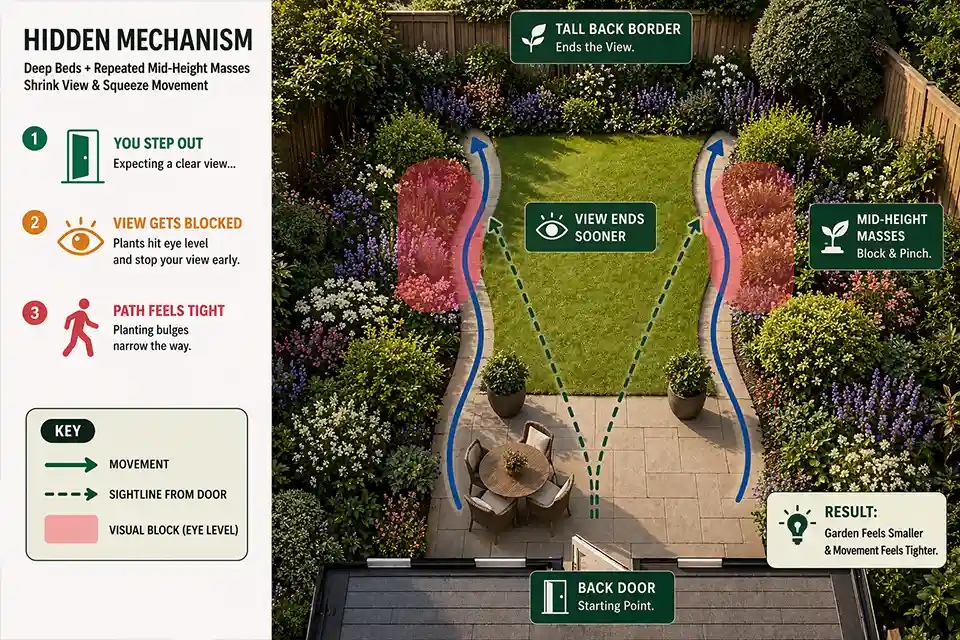
Main paths drop below about 3 feet wide. Shrubs or grasses push 18 to 24 inches into patio edges. The view from the back door hits foliage within 8 to 12 feet instead of traveling across the yard.
If you are cutting the same plants back two or three times in one growing season just to keep the yard usable, the issue is no longer just maintenance. It is a layout problem.
That is the key distinction people miss. A small backyard can still feel open. An overplanted backyard feels tight because too much plant mass is sitting where the eye travels and where people move.
What looks “lush” in a photo often feels crowded in real life once the center of the yard stops reading as one clean space.
Why this happens faster than people expect
Planting density rarely becomes a problem all at once. It usually builds in layers.
Plants go in small, then the yard gets “finished” too many times
Most overplanted yards start with a reasonable plan. Then the gaps look empty in year one, so more gets added. A filler shrub goes near the patio.
Another grass goes by the corner. A few extra perennials soften the edge. A container gets dropped at the path entrance.
None of those choices seem dramatic on their own, but together they turn the center of the yard into leftover space.
This is especially common around the patio edge, where planting feels like an easy way to soften hardscape. In practice, that edge is often the first place where the yard starts shrinking.
If that sounds familiar, Shrubs Taking Over the Patio? What Went Wrong covers the same crowding pattern from the patio side of the problem.
Medium-height plants usually do more damage than tall ones
People often blame the tallest plant first. That is not usually the one making the yard feel smaller.
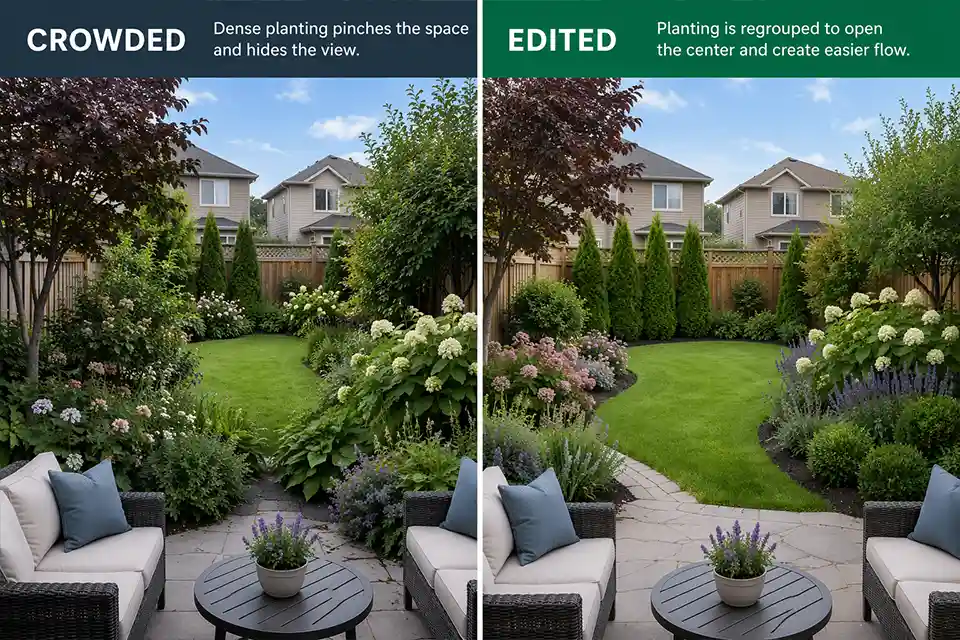
In compact backyards, the bigger offenders are often repeated plants in the 24- to 54-inch range. They occupy the exact layer where people look across the yard and move through it.
A taller tree with open trunk clearance may actually preserve space better than a row of broad shrubs or floppy grasses planted at eye level.
That is why an overplanted yard is not really about height alone. It is about how much visual and physical bulk exists between knee height and chest height.
What people usually misread first
More planting does not automatically make the yard feel richer
In a modest backyard, open space is not wasted space. It is the visual relief that makes the planted areas feel deliberate.
Once every border is layered at the same intensity, the eye loses that relief. The yard starts feeling padded instead of designed.
That is why five small plant groupings often make a backyard feel smaller than two stronger planted zones. Every new bed edge, pot, accent shrub, and texture change creates another interruption.
The center of the yard no longer reads clearly.
This visual compression shows up in other small-space situations too.
Why a Small House Can Make the Yard Look Tiny gets at the same issue from a different angle: the space often feels smaller because too many elements are competing at once.
Trimming is often a cosmetic fix, not a real one
A lot of homeowners try to solve the problem with constant cutting back. Sometimes that buys a few weeks. It does not change the structure of the yard.
If a shrub matures at 6 feet wide and is being forced into a 3-foot slot, trimming is not really control. It is evidence that the plant and the space are mismatched.
The same is true of grasses or perennials that spill over edges every few weeks in summer. When the same correction keeps repeating, the problem is not technique. It is plant choice or placement.
“Go vertical” only works when the base stays calm
This is one of the more useful distinctions for small yards. Vertical emphasis can help a backyard feel bigger, but only when it saves horizontal space.
A slim trellis, trained vine, or airy upright form can pull the eye upward without clogging the ground plane. A broad shrub mass, stacked planters, or repeated bulky containers usually do the opposite.
So vertical planting is not a blanket solution. It helps when the footprint stays light below. It fails when the base becomes dense and visually heavy.
How to tell whether the yard is actually overplanted
Start with circulation, not plant count
The fastest check is functional. Can you move from the back door to seating, lawn, gate, grill, or storage without brushing plants or making little detours? If not, the yard already feels smaller than it should.
Quick Diagnostic Checklist
- Main walking routes are under about 3 feet wide
- Patio-edge plants push 18 inches or more into usable seating space
- The far fence or focal point disappears behind near foliage
- The center reads as several fragments instead of one open shape
- Shrubs or grasses need repeated cutbacks during the same growing season
- Accent pots and small bed islands create too many visual stops
Check spread, not just height
This is where people often make the wrong call. Low-growing does not always mean space-efficient. Plenty of plants stay under 12 inches tall but spread 18 to 24 inches sideways, flop into paths, or blur bed edges.
In compact yards, width often matters more than height because width is what steals circulation and compresses the center.
Pay attention to what is happening after rain and during peak growth
Crowded planting does not only affect space. It can also hold moisture and reduce air movement in already tight zones.
If the dense sections around the patio or fence line still look heavy and damp 24 to 36 hours after rain while the open parts of the yard recover faster, that is another clue that the planting mass has become excessive for the space.
What actually makes the yard feel bigger again
The best fix is usually subtraction with purpose, not a total reset.
Keep one strong planted moment, not five competing ones
Most overplanted backyards improve quickly when one border or one focal planting stays expressive and the rest of the yard quiets down.
That may mean removing duplicate shrubs, merging scattered beds, or cutting a mixed palette down to fewer repeating forms.
You do not need every corner to perform equally hard. A backyard feels larger when one or two zones carry the visual weight and the rest stay calmer.
That same logic shows up in Backyard Layout Problems That Make Spaces Hard to Use, where too many competing zones make a space feel awkward long before it looks obviously crowded.
Protect one open shape the eye can read immediately
That open shape might be a lawn panel, widened patio apron, gravel surface, or simple stretch of unbroken ground plane. What matters is continuity.
Once the center gets interrupted every few feet by a specimen shrub, little planting island, or decorative container cluster, the yard loses scale.
People usually overestimate how much variety a small backyard can carry. They underestimate how much larger the yard feels when the center stays legible.
Replace repeat offenders instead of editing them forever
Some plants are not wrong in themselves. They are wrong for the slot. If a plant needs hard correction every few weeks just to keep the yard functioning, that is where the standard fix stops making sense.
| Signal | Healthier condition | Failing condition | Better response |
|---|---|---|---|
| Main circulation | 3 feet or more clear | Under 3 feet and pinched | Remove or relocate edge mass |
| Patio edge | Plants stay outside furniture zone | Foliage leans into chairs and traffic | Pull back or replace bulky growers |
| Sightline | View reaches the fence or focal point | View stops in near planting | Thin or simplify mid-height mass |
| Maintenance | Light seasonal shaping | Repeated correction all season | Replace chronic spreaders |
| Spatial reading | One clear center | Many small interruptions | Merge beds or delete extras |
Pro Tip: Remove the plant that interrupts movement or the main view first, not the one that merely looks biggest.
When trimming is no longer enough
The yard has crossed the line when plants control the layout
Once planting dictates where furniture fits, how people move, how much light reaches the center, and how much of the yard can be seen at once, the issue is no longer cosmetic. The planting has overtaken the structure of the space.
That is also why some yards keep getting harder to live with over time.
Backyard Landscaping Problems That Get Worse Over Time connects to this same pattern: what starts as fullness can turn into functional crowding by year two or three.
Remove first, then wait before replanting
This is where a lot of homeowners rush. They cut back or remove a crowded section, the yard suddenly looks bare for a few days, and they refill the gap too quickly. That is how the same mistake repeats.
A better move is to reopen the space, live with it for 2 to 4 weeks, and then decide what still feels unresolved.
Mark the furniture zone, walking path, and the longest sightline before adding anything new. In many yards, that pause reveals that far fewer replacement plants are needed than expected.
Pro Tip: In a compact backyard, every plant should either screen, anchor, soften, or frame. If it is not doing one of those jobs clearly, it may not be earning its footprint.
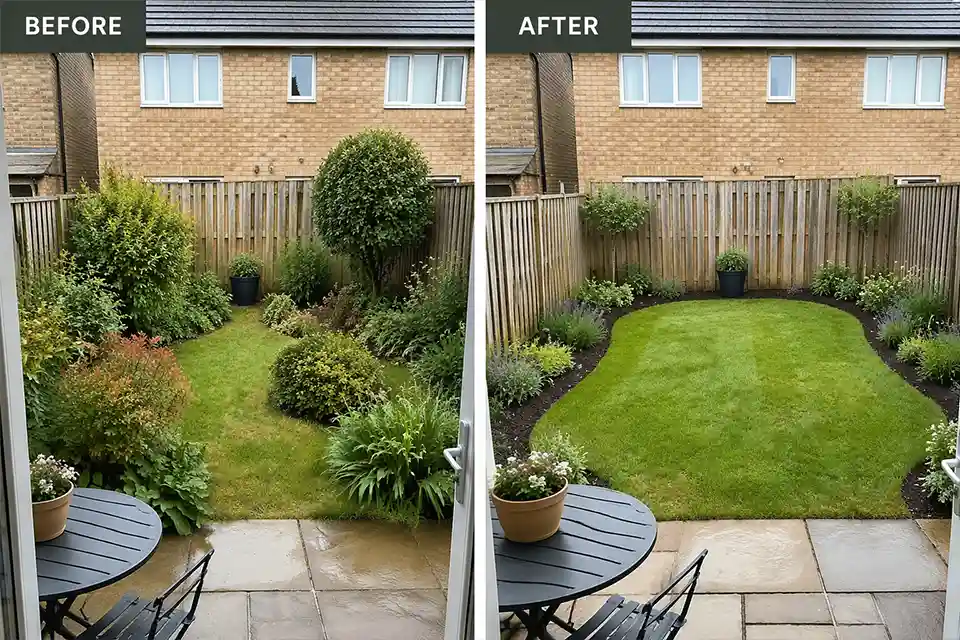
An overplanted backyard does not feel smaller because it has too much garden. It feels smaller because too much of the yard has been turned into edge, interruption, and maintenance pressure instead of open, usable space.
The yards that feel best usually are not the emptiest ones. They are the ones that know where to stay open.
For broader plant placement guidance, see University of Florida Gardening Solutions.