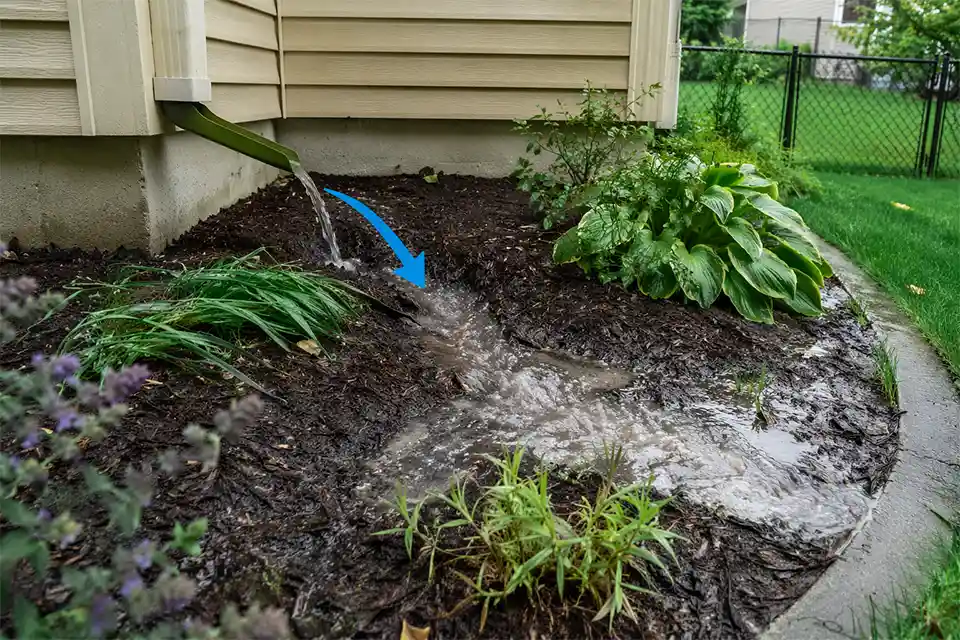
If a backyard planting bed keeps flooding where the downspout lands, the problem is usually not the plants first. It is usually concentrated roof runoff hitting a bed that is too small, too compacted, or too poorly graded to absorb that water fast enough.
Start with three checks: does water sit longer than 24 hours after a normal rain, has mulch shifted more than 2–3 inches from the outlet point, and is the wet zone spreading more than about 2 feet beyond the downspout?
Those clues matter more than yellow leaves alone. This also looks different from simple overwatering. Overwatering usually stresses the bed more evenly.
Downspout flooding usually creates one obvious failure zone: splash damage, a muddy channel, buried crowns, exposed roots, or a recurring soft spot that shows up after every storm.
What is usually causing it
Most of the time, one narrow planting bed is being asked to do the job of a drainage area.
The most likely cause: too much water in one small spot
A single downspout may be carrying runoff from a large section of roof, then releasing it into a bed only 2–4 feet wide. Even if that bed looks fine in dry weather, it can fail during storms because the water arrives as a pulse, not a slow soak. That is the first pattern to prioritize before blaming the soil, the mulch, or the plant palette.
What people misread first
People often assume the bed is simply “too wet,” then start replacing plants or switching to more moisture-tolerant varieties. That usually wastes time. The real issue is often impact and flow concentration. Water hits one point hard enough to shift mulch, compact the surface, and train the next storm to follow the same path.
What is less likely than it looks
Clay soil can make the problem worse, but it is often overestimated as the starting cause. Plenty of decent loam beds still flood when runoff is concentrated badly. The bigger mistake is treating a discharge problem like a planting problem.
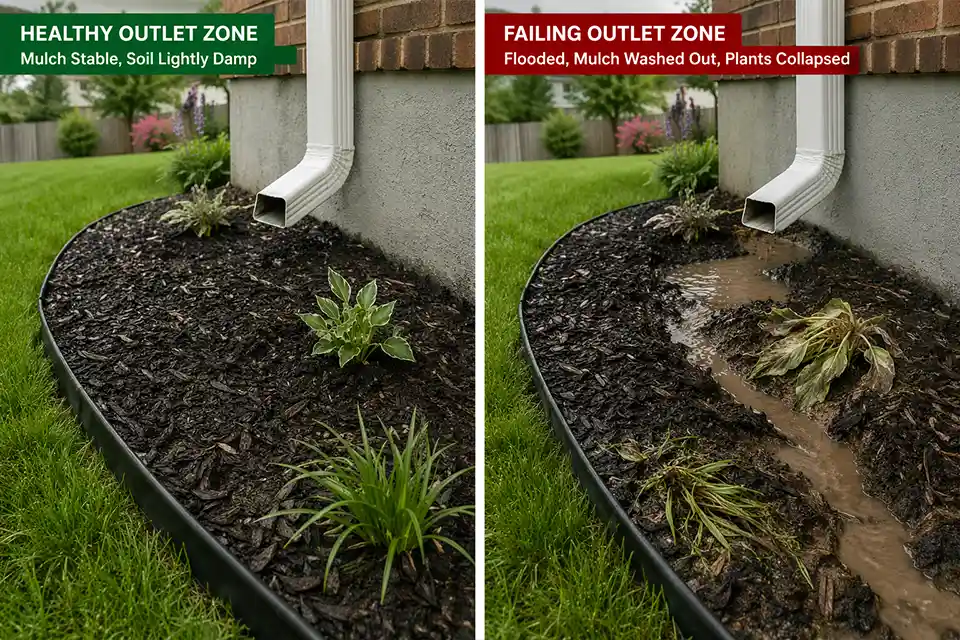
Quick diagnostic checklist
- Water remains in the outlet area longer than 24–48 hours after a routine storm
- Mulch keeps washing aside or piling against edging after rains around 0.5–1 inch
- The bed surface crusts over or sinks slightly near the downspout
- Damage is concentrated in one impact zone instead of affecting the whole bed evenly
- Replanting helps briefly, then the same area fails again within one season
If that list sounds familiar, the bed is probably not the real problem. The outlet is.
Why the obvious fix often fails
More mulch is usually not the fix
Fresh mulch makes the area look repaired, but loose mulch is often the first thing to move. It can hide the problem for a week and then wash again in the next storm. That is cosmetic recovery, not drainage correction.
Replanting too early usually fails
This is one of the most common time-wasters. People replace perennials or shrubs before changing the water path. The new plants then sit in saturated soil, get splashed repeatedly, or end up with buried crowns and exposed roots. The bed looks like it has a plant problem when it really has an outlet problem.
Splash blocks help, but only within limits
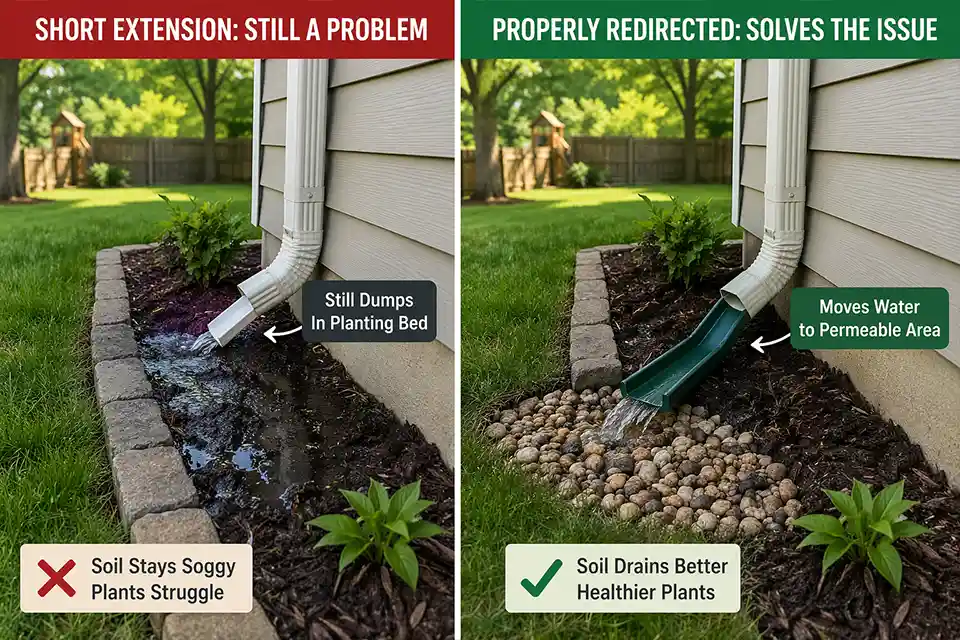
A splash block can reduce direct scouring in the first 1–2 feet, and sometimes that is enough for a minor problem. But if the bed stays soft for a day or two after normal rain, or the wet zone keeps extending downhill, a splash block is not solving the real volume issue.
Pro Tip: A splash block is a stabilizer, not a strategy. If the bed is narrow or the runoff is forceful, use it as a temporary measure while you change where the water actually goes.
Some yards show the same broader runoff pattern after hardscape changes, which is why a bed-level fix can disappoint when the whole site is already moving water badly, as in Backyard Drainage Problems After Adding a Patio or Walkway.
When an extension is enough — and when it isn’t
An extension is often enough when
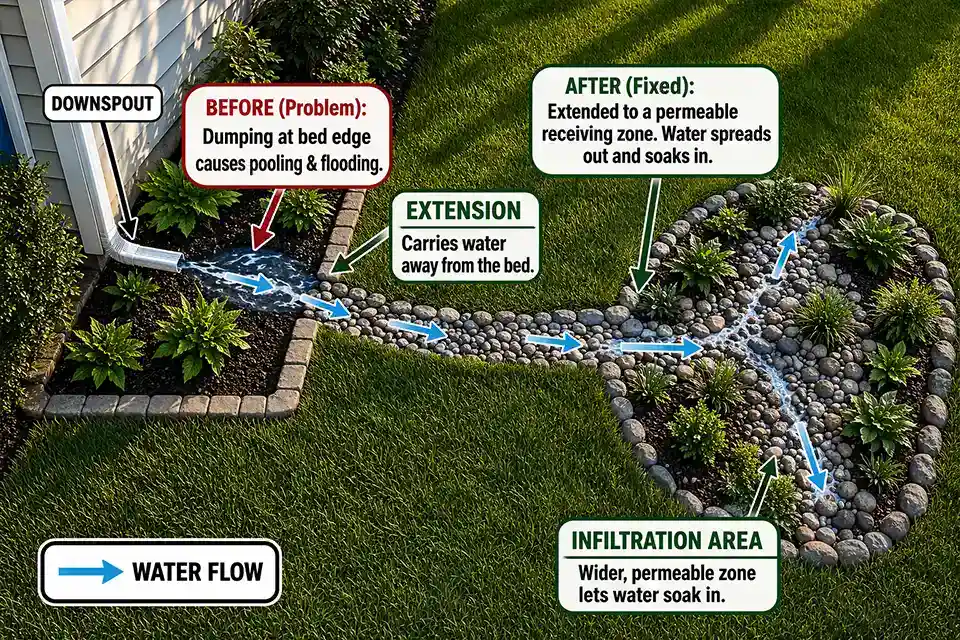
The simplest good outcome is this: the downspout outlet gets moved far enough away from the bed that the discharge lands in a broader, more permeable area and drains within about 24 hours. If the damage is limited to the first couple of feet and the rest of the yard handles water normally, an extension may solve the issue without bigger drainage work.
An extension is not enough when
If the new outlet still dumps into another tight bed, into compacted ground, or into a low zone that stays soggy for 24–48 hours, you have only moved the failure. The same is true if runoff starts traveling toward a fence line, patio, or neighboring yard. At that point, the question is no longer “How do I protect this bed?” but “Where should this water actually go?”
The decision point that matters
A narrow planting bed should not be your permanent receiving area for heavy roof runoff. Once the bed is acting like drainage infrastructure, standard planting fixes stop making sense.
That larger pattern can overlap with the same drainage failures seen in Backyard Drainage Problems You Shouldn’t Ignore.
Can a downspout safely drain into a planting bed?
Yes, sometimes. But only under narrower conditions than people think.
When it can work
It can work when the bed is large enough, the soil infiltrates well, the outlet is softened so it does not scour the surface, and the bed drains fast enough that water does not linger past the 24–48 hour range. A purpose-built rain garden is different from a standard ornamental bed for exactly this reason.
When it usually does not work
It usually fails when the bed is small, flat, compacted, or installed at the bottom of another runoff path. It also fails when the bed sits beside hard surfaces that accelerate water toward it. In that setup, the downspout is only part of the load.
The mistake people underestimate
They underestimate how often the surface seals over. After repeated impact, the top layer can stop taking water as well as it did when the bed was first planted. So even if the setup seemed acceptable in year one, it may start failing later.
What changes under different site conditions
On sloped ground
Even a mild grade around 3–5% can turn a downspout outlet into a washout path. Water does not just soak in; it starts traveling. In those yards, the outlet point matters even more than the plant choice.
Near patios or walkways
Hard surfaces increase flow speed and reduce forgiveness. A bed that might have handled roof water alone may start flooding once runoff from a patio edge or walkway is also entering the same zone.
In heavier clay soils
Clay is not always the root cause, but it narrows your margin for error. If the bed already drains slowly, concentrated discharge will overwhelm it faster and stay visible longer.
These stacked failures often resemble what happens in Bare Soil Washout on a Sloped Backyard or Why Mulch Keeps Sliding Off a Sloped Planting Bed.
Practical fix ladder
Step 1: Check for the cheap failure first
Make sure the gutter and elbow are not clogged, overflowing, or shooting water sideways. A blocked upper section can make the bed look like it is the problem when the real issue starts above it.
Step 2: Move the discharge before rebuilding the bed
If possible, redirect the outlet to a broader permeable area rather than a decorative bed. This is the step that changes outcomes most often.
Step 3: Stabilize the impact zone
If water still exits near planting, reduce splash and scour with a proper surface transition. This is where a splash block, stone apron, or controlled spread area can help.
Step 4: Rebuild only after the flow is controlled
Once runoff is no longer hammering the same point, then it makes sense to regrade the bed, improve soil structure, reset mulch depth to roughly 2–3 inches, and replant only if needed.
| Field condition | What it usually means | Best next move | What often wastes time |
|---|---|---|---|
| Minor splash, no standing water next day | Localized outlet damage | Add impact protection and minor redirection | Rebuilding whole bed |
| Muddy zone lasts 24+ hours | Bed too small or too slow-draining | Move outlet to larger receiving area | More mulch |
| Damage repeats after every storm | Concentrated runoff not solved | Extend, reroute, or redesign discharge | Replanting first |
| Water leaves the bed and keeps traveling | Site drainage problem, not just bed failure | Address grading or conveyance | Bed-only patching |
| New outlet creates another wet pocket | Failure has been relocated | Reassess destination area | Assuming any extension is enough |
If runoff is already escaping the bed and moving downhill, the problem may be crossing into the same decision territory as Sloped Backyard Water Running Into a Neighbor’s Yard.
Questions people usually ask
Is this just a plant selection problem?
Usually no. Plant choice matters after the outlet issue is controlled, not before.
Should I use a French drain here?
Not automatically. If the main problem is roof runoff being dumped in the wrong place, conveying or redirecting that water is often the first priority. A French drain is not a universal answer for a bad discharge point.
When should I stop trying small fixes?
When water still stands longer than about 24–48 hours, the same area fails after each storm, or runoff starts leaving the bed and affecting other parts of the yard.
For broader official guidance, see Oklahoma State University’s downspout disconnection guidance.