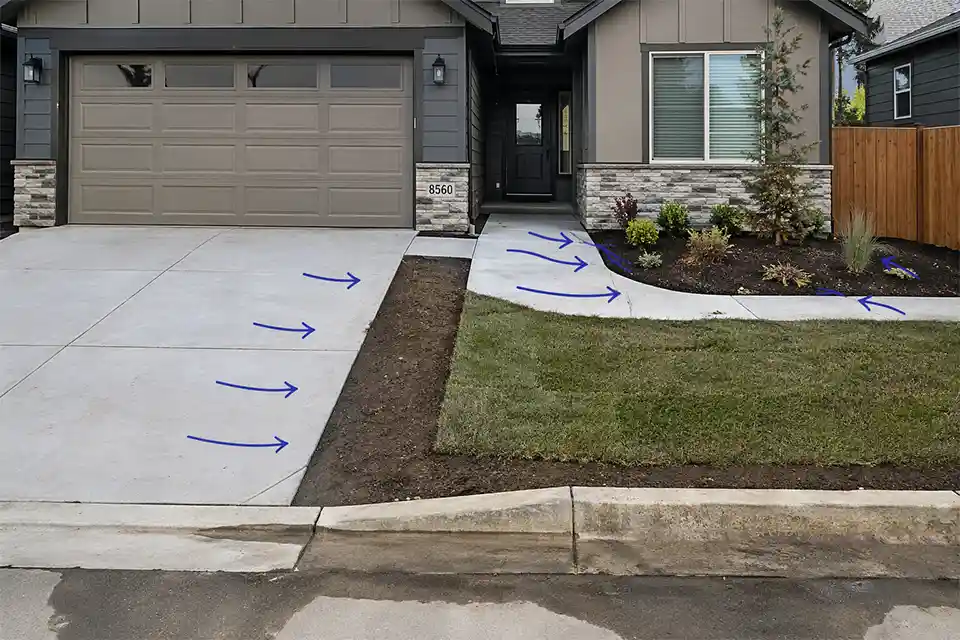
If your front yard started failing only after regrading, a new walkway, fresh pavers, or a wider driveway, the problem is usually not the yard in general. It is what the project changed.
In most cases, that means one of three things: the new surface pitch now sends water the wrong way, the soil or subgrade was compacted during construction, or the finished grade ended too flat, too high, or too low at a key transition.
That is the first distinction that matters. This is not the same as an older yard that has always drained poorly.
It is a post-project failure pattern. A practical first check is whether runoff now reaches the house-side zone within 5–10 minutes of a normal rain, whether the same low area stays wet for more than 24 hours, or whether mulch, gravel, or loose soil moves 2–6 feet after the first few storms.
If that is happening, stop treating it like a planting or mulch problem. Treat it like a water-path problem.
The most common failure is wrong water direction
A front yard can look sharper and function worse.
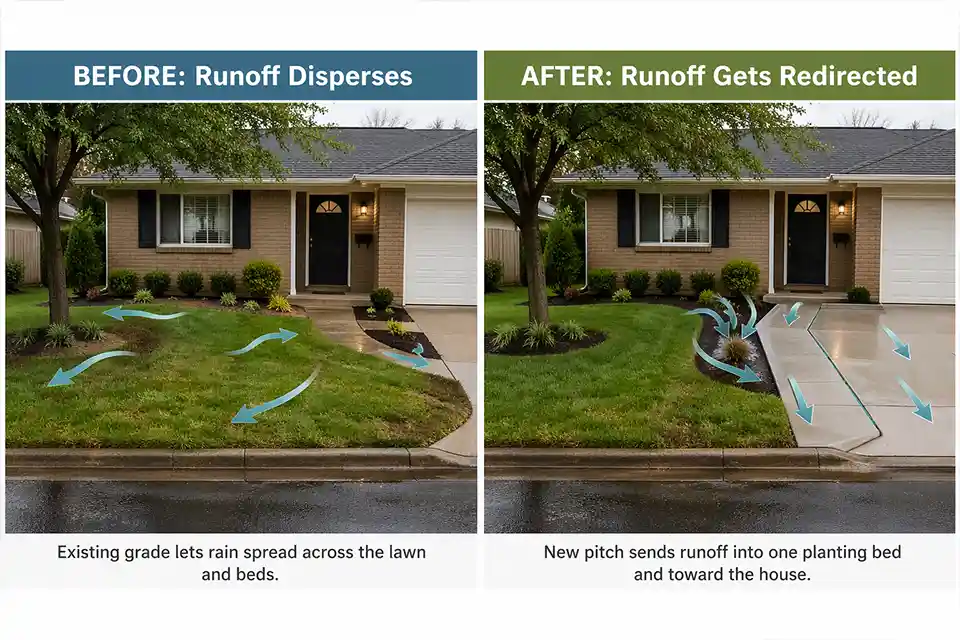
That usually happens when the project adds hard surface, compacts the site, and slightly changes slope at the same time. Before the work, rainfall may have spread loosely across lawn and planting beds. After the work, a driveway edge, walkway pitch, border, or tight transition can collect that same water and send it to one weak point.
Most front yard problems after hardscaping are not “too much water” problems first. They are direction problems.
That is why the visible puddle can mislead people. The puddle is only the receiver. The more useful question is what new surface, edge, or elevation change is feeding it.
If the strongest symptom is house-side pooling, Front Yard Water Pooling Near the House: What’s Usually Causing It goes deeper into that more foundation-focused version of the same issue.
Quick diagnostic checklist
- Water still sits in the same spot after 24 hours
- Runoff now crosses the main walkway or entry path
- A narrow bed is suddenly handling water from multiple hard surfaces
- Soil feels hard 2–4 inches below the top layer near the project area
- One corner, edge, or transition settles more than about 1/2 inch
- Mulch or gravel keeps moving even after being reset once
What people usually misread first
They blame the plants too early
When new plants struggle 2–8 weeks after the job, people naturally assume the plant selection was wrong. Sometimes it was. More often, the plants are just reporting a site change faster than the hardscape does. Plants do not create new runoff tracks, repeat washout, or slick entry paths. They react to them.
If the lowest bed now stays wet but the upper bed dries fast, that is usually not a simple planting mistake. It is a water-distribution mistake.
They underestimate compaction below the finish layer
Fresh topsoil can hide a bad root zone. A yard may look newly built and still be functionally sealed underneath. That happens when equipment traffic compacts the receiving layer, the subgrade, or the bed area beside new paving. Water then skates across the surface or lingers in shallow soil instead of moving down and away.
If a shovel or probe hits firm resistance just a few inches down even when the soil is moist, do not assume the decorative finish tells the truth.
That is also why some “new plant failure” complaints are really shallow-root-zone complaints. Front Yard Plants in Shallow Topsoil: What Usually Goes Wrong fits naturally here when the bed looks fresh but the soil profile underneath was never truly rebuilt.
They miss the role of sub-base and transition failure
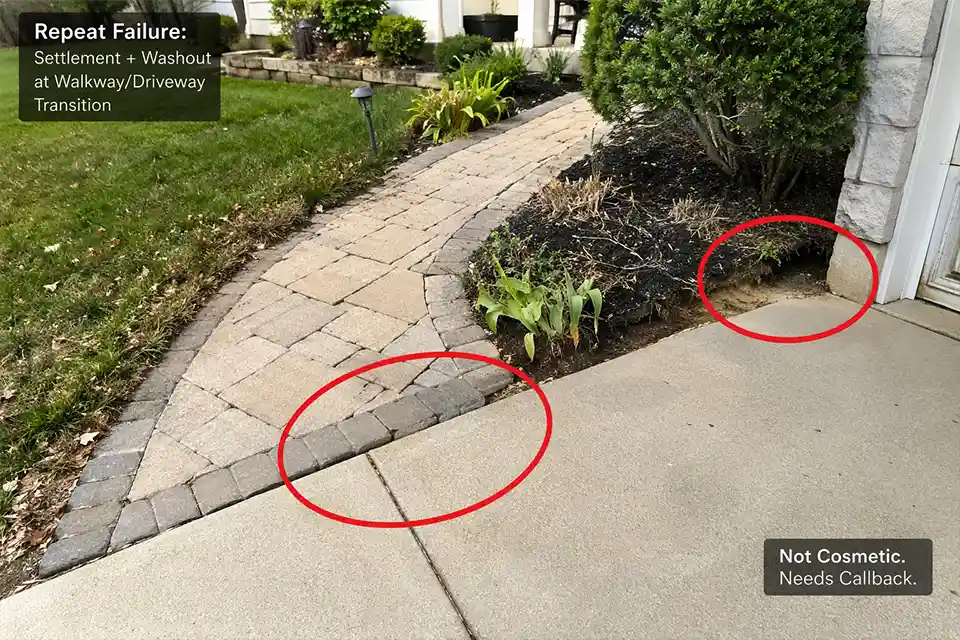
With new hardscaping, the weak point is not always the bed soil. Sometimes the real issue sits under the pavers, beside the walk, or at the place where hardscape meets planting area. A transition that keeps settling, reopening, or channeling water often points to sub-base failure, poor support at the edge, or a finish height that never made sense in the first place.
That matters because a surface patch can make a base problem look fixed for a few weeks.
Normal settling or bad grading?
A little early movement does happen after site work. But normal settling and bad grading do not behave the same way, and confusing them wastes time.
What is usually still within reason
Small localized settlement of roughly 1/4–1/2 inch during the first season can happen, especially after repeated rain or irrigation. On its own, that does not prove the whole installation is wrong.
What is no longer routine settling
If water now runs toward the house, crosses the front walk, repeatedly returns to the same basin, or keeps reopening the same washout after 2–3 ordinary storms, that is no longer a harmless adjustment period. That is the site showing you that pitch, finish grade, or runoff concentration was not solved properly.
| What you see | More likely mechanism | What it usually means | Best next move |
|---|---|---|---|
| Water moving toward foundation | Reverse pitch or wrong finish grade | Direction error near the house | Regrade first |
| Bed washout after ordinary rain | Hardscape concentrating runoff | Water is arriving too fast | Redirect or spread flow |
| Plants declining in wet soil | Compacted soil or subgrade | Roots lack air, not just water | Rebuild soil structure |
| Edge keeps shifting | Water velocity plus weak support | Border failure is secondary | Fix runoff path first |
| Walkway stays slick or muddy | Cross-flow over access route | Circulation and drainage now conflict | Re-pitch or intercept flow |
| Same corner settles again | Base or transition failure | Cosmetic patch will not last | Rebuild that section |
A good rule here: once the same point fails twice, stop treating it like a surface-refresh problem.
If one of the repeat symptoms is a moving border or collapsing bed line, Why Front Yard Edging Keeps Shifting is the right supporting read because it frames shifting edges as a water-and-base problem, not just a product problem.
Drain, regrade, or leave it alone?
This is where the article has to choose.
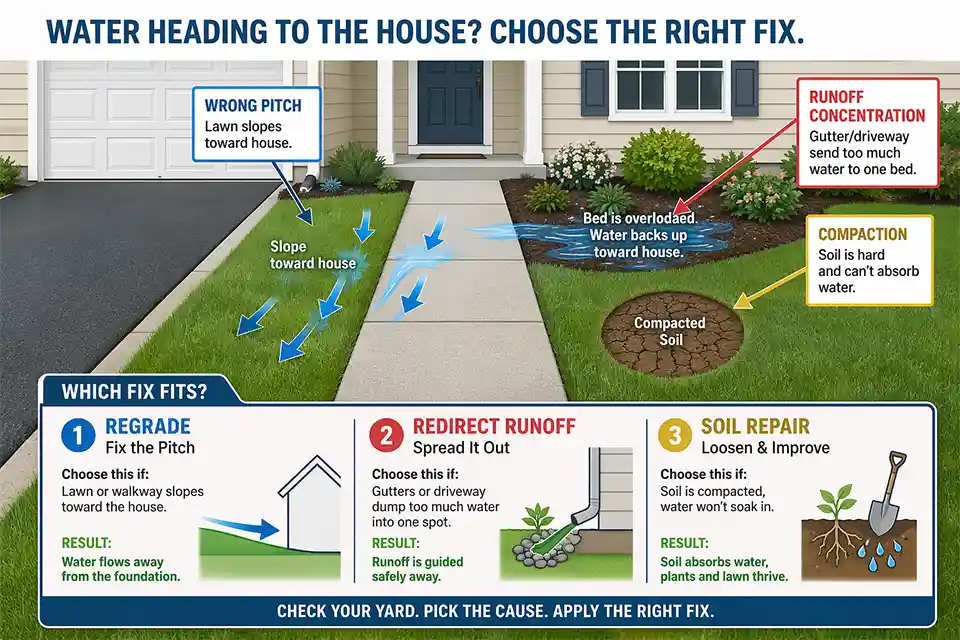
Regrade when the water is aimed wrong
If the project now sends water toward the house, into the same narrow bed, or across the main entry route, the first fix is usually regrading or correcting pitch. A drain may catch some water, but it does not correct a surface that is fundamentally sending water to the wrong place.
As a practical benchmark, hard surfaces near a house should still shed water away from it. When the finished pitch no longer does that, the layout has crossed from inconvenient to faulty.
Redirect or spread flow when volume is concentrated
Sometimes the overall slope is acceptable, but one bed or transition point is receiving too much runoff from adjacent hardscape. In that case, the smarter move is not always a full regrade. It may be a controlled interception or redirection before water hits that weak point at full speed.
Rebuild soil when infiltration is the real limiter
If the direction mostly makes sense but the site still holds water too long, the deeper problem may be compaction or a badly restored soil profile. This is where more mulch usually wastes time, and more topsoil can quietly make finished heights worse.
Leave it alone only when the pattern is fading
If the area drains fully in less than 24 hours, settlement is minor, and the symptom is becoming less visible after early storms, watchful patience can be reasonable. But this is the condition people overestimate. They give a clearly failing grade too much grace because the project still looks new.
Pro Tip: If the same symptom appears after each of the first 2–3 real storms, treat that as a pattern, not bad luck.
Why the obvious fixes usually waste time
More mulch is the classic delay move. It can make the bed look better for a week or two, but it does not change pitch, runoff speed, or absorption.
More topsoil is not automatically smarter. If the finished grade is already too high against paving, too flat near the house, or too tight at a transition, adding 1–2 more inches can push the yard farther in the wrong direction.
Even decorative resets can briefly hide real failure. New stone, stronger edging, or replacement plants may make the space look corrected, but if the hardscape still concentrates water or the base still settles, the same area usually fails again.
This is also where front-entry layout matters more than people expect. When runoff and foot traffic now share the same corridor, the redesign is part of the problem. Front Yard Design Problems With Driveway and Front Door Access is especially relevant when the yard became visually cleaner but functionally more awkward after the project.
When this stops being a DIY issue
The job changed the site, so the job has to be questioned
If the yard functioned acceptably before the work and the trouble started clearly after it, the project deserves scrutiny first. That does not automatically mean the entire install was poor. It does mean you should stop treating the timing as coincidence.
These are strong callback thresholds
Water now runs toward the house.
The same puddle returns after 2–3 ordinary storms.
A corrected paver edge or transition settles again.
Runoff crosses the main walkway.
One narrow bed keeps receiving water from multiple hard surfaces and repeatedly fails.
At that point, you are no longer looking at a simple maintenance problem. You are much closer to a pitch, grading, base, or installation defect problem.
What usually deserves a harder reset
Repeated settlement at the same transition.
A walkway or driveway that clearly pitches runoff into a bed or toward the foundation.
A “fixed” low spot that comes back after the next ordinary rain.
A front yard where the surface looks finished but the soil beside the hardscape behaves like compacted fill.
Those are the moments where patching stops making economic sense.
A front yard that fails after regrading or new hardscaping usually does not need more decorating.
It needs the water path judged honestly, the pitch corrected where direction is wrong, the soil rebuilt where compaction changed infiltration, and the repeat-failure zones treated like construction problems rather than seasonal quirks.
For broader official guidance, see the U.S. Department of Energy guide on final grade slopes away from foundations.