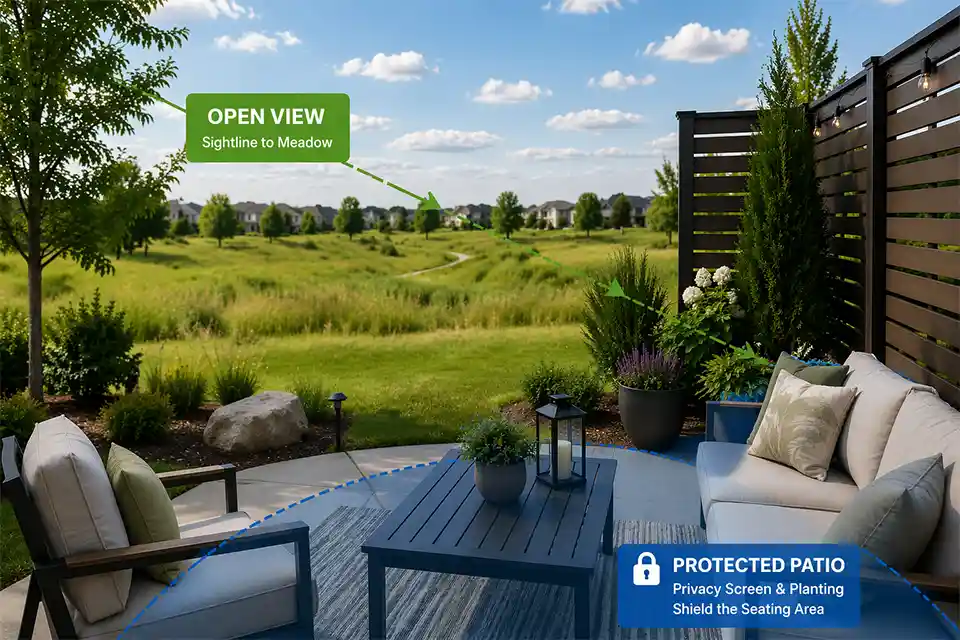
If your backyard backs to open space, the mistake is usually not “too little privacy.” It is solving the wrong kind of exposure. Most of these yards do not need a closed rear boundary. They need one or two sightlines interrupted at the height and location that actually affect comfort.
Start with three checks. First, note where the discomfort happens: patio seating, dining area, hot tub, or the whole yard. Second, check the angle: straight across, diagonal from a path, or slightly elevated from behind.
Third, measure the depth you can really plant or build into. If the rear edge gives you only 2 to 3 feet, a layered privacy screen is limited before it starts.
That is the key difference between an open-space lot and a standard fence-line privacy problem. In this scenario, the best fix is usually view editing, not full enclosure.
What people usually get wrong first
The biggest misread is treating open space like a shared property line.
Exposure is not the same as intrusion
A rear view can feel open without being meaningfully intrusive. Homeowners often respond to that open feeling by trying to block everything. But a yard that looks outward across 60 to 100 feet of meadow or common land is not the same as a yard where a close neighbor looks straight into the patio. Technical visibility and lived discomfort are not the same thing.
What matters more is whether the main use zone feels watched. If the seating area feels exposed at 36 to 42 inches above grade, that is the problem to solve. The horizon is usually not.
One diagonal sightline can cause most of the discomfort
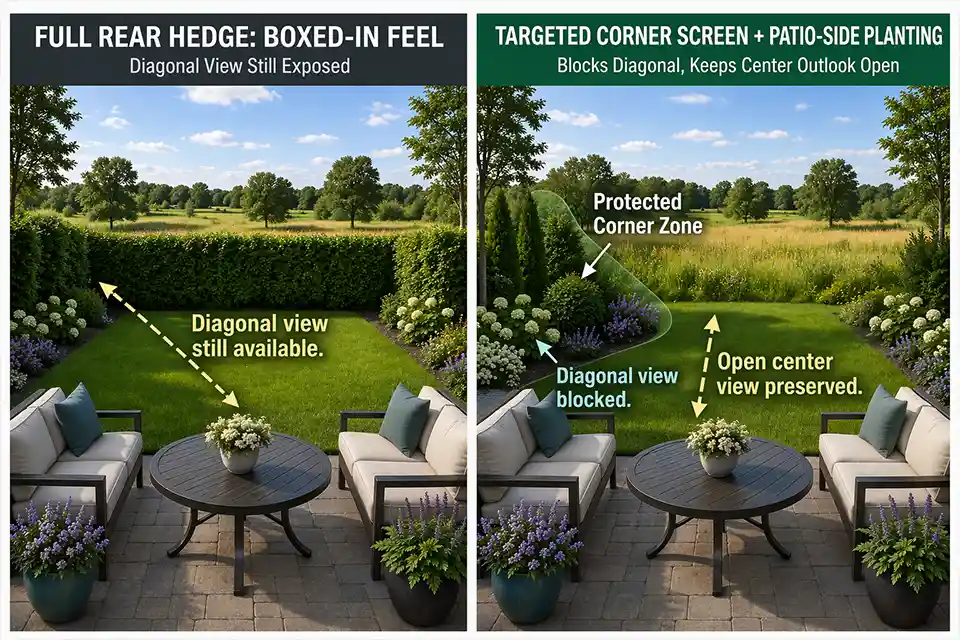
This is the part people underestimate. A broad rear opening often matters less than one diagonal angle from a trail, side path, or bend in the open space. If that diagonal line crosses the lounge or dining area, the yard feels exposed even when the rest of the rear edge is fine.
That is why a long straight hedge often disappoints. It blocks the big backdrop but leaves the pressure point open.
The yard’s best feature is easy to erase
A backyard that backs to open land often feels larger because it borrows depth from the landscape beyond it. A solid rear wall can remove that in one move. The yard becomes shorter, darker, and more boxed in without becoming meaningfully more comfortable.
That is the central judgment call in this kind of project: do not solve a view asset like a privacy emergency.
Not all open-space lots create the same privacy problem
“Open space” sounds like one condition, but it is not. The better your diagnosis here, the less likely you are to overbuild.
Open meadow, reserve, or common green
This is often the easiest version. The lot feels exposed because it opens out, not because people are constantly looking in. In this setting, a 5- to 7-foot screen near the use area often works better than a full rear barrier because it protects comfort at eye level while leaving the long view intact.
Path, trail, or movement corridor
This is a different problem because movement catches attention. A trail 30 to 50 feet behind the yard can feel more intrusive than a larger open area with no foot traffic. Here, the goal is usually to break repeated diagonal sightlines rather than wall off the whole rear edge.
That same “smaller failure zone than it first appears” pattern shows up in Pool or Hot Tub Too Exposed? Backyard Privacy Fixes That Work, where the right screen often protects one use area instead of the entire yard.
Slightly raised land behind the lot
A grade increase of even 2 to 4 feet changes the privacy math. A low shrub mass that works on flat ground can fail quickly when the viewer is slightly above you. In that case, the problem is no longer just openness. It is height and angle.
If the rear exposure is really being created by elevation, the logic starts to overlap with Uphill Neighbor Privacy on a Sloped Lot. A low screen at the wrong elevation still fails, no matter how dense it looks from your side.
Protect the use zone before the property line
This is the priority that saves most open-space yards from over-screening.
Start with where people actually sit
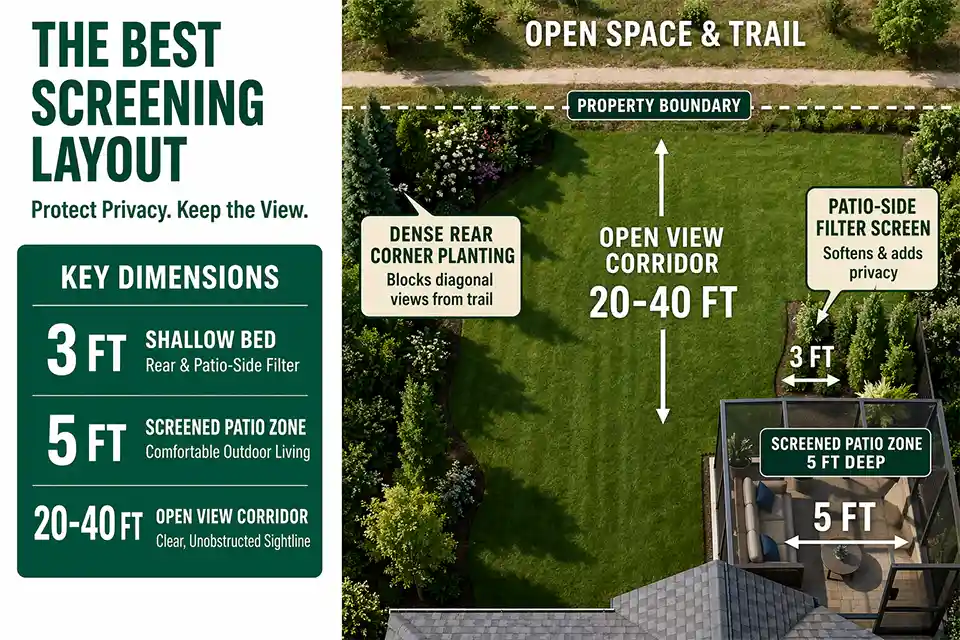
If the discomfort happens on the sofa, dining chair, or spa bench, protect that zone first. A screen that reaches 5 to 7 feet can make a patio feel private even when the broader rear yard stays visually open. That is often enough when the open landscape begins another 20 to 40 feet beyond the use zone.
Homeowners often reverse this logic. They place the tallest element at the far rear edge and leave the patio shoulder or corner view untouched. That usually spends the budget in the wrong place.
Treat one bad corner like one bad corner
If only one rear corner lines up with a path, overlook, or side-grade angle, handle that corner directly. A dense corner composition, offset screen, or patio-side interruption can do more than a full-width rear hedge.
This is also why broad “privacy hedge” advice often misses the point. In many of these yards, coverage across 25% to 40% of the rear visual field changes comfort more than closing off 100% of the back line.
Keep the center view if the center view is the asset
In an open-space yard, the middle view is often the reason the lot feels good. Preserve it unless it is the actual source of exposure. A good layout often leaves the center more open and puts denser screening at one rear corner, one side-rear junction, or the patio edge.
That selective approach is usually stronger than the flat first-pass screening problem seen in Backyard Privacy Problems in New Construction Yards With No Screening Yet, where homeowners fill the boundary before they understand the sightline.
Privacy fixes that work without boxing the yard in
The best solutions here are usually layered, partial, and slightly off-axis. They do not try to hide everything.
Offset planting beats a flat line
A single linear hedge is easy to picture, but it is usually the least nuanced answer. In most open-space yards, offset layers perform better because they interrupt sightlines without reading like a hard rear wall. If you have 4 to 6 feet of planting depth, staggered planting almost always gives you a better privacy-to-openness balance than one clipped row.
The practical threshold is simple: under 3 feet of bed depth, do not expect a lush layered screen to become convincing. That is where homeowners waste time forcing the wrong solution into the wrong strip.
Canopy plus understory preserves depth
Where space allows, a small tree grouping over a shrub layer often feels more natural than a single opaque mass. The canopy interrupts upper and diagonal views. The understory handles lower sightlines. Together, they screen without making the rear edge read like a boundary wall.
This is one of the most underused moves in view-sensitive backyards. People often overestimate the need for complete opacity and underestimate how effective partial interruption can be.
Filtered screens often perform better than solid ones
A screen does not need to be fully opaque to change comfort. In this setting, something that remains roughly 30% to 50% visually open can still break the direct line of sight while preserving air, light, and borrowed spaciousness. That is often a better fit than a solid wall, especially when the rear openness is one of the lot’s main strengths.
| Fix type | Best use | Keeps the view open? | Where it usually fails |
|---|---|---|---|
| Solid rear fence or wall hedge | Fast separation at boundary | Low | Boxes in the yard and may miss diagonal exposure |
| Single shrub row | Mild edge softening | Medium | Often too thin for real privacy |
| Corner screen planting | One strong diagonal sightline | High | Too narrow if exposure is broad and elevated |
| Patio-side screen | One main use zone | High | Does not solve the whole rear edge |
| Layered canopy plus understory | Balanced comfort and openness | High | Needs more room and better placement |
Pro Tip: Mock up the screen first with stakes and temporary fabric for 7 to 10 days. Morning and late-afternoon sightlines often reveal more than a quick midday test.
When the standard fix stops making sense
A few conditions should change the recommendation early.
The bed is too shallow for the screen you want
If the rear strip is under 3 feet deep, stop pretending it can support a layered privacy wall that stays healthy and full. This is the point where a patio-adjacent screen, partial built element, or hybrid approach makes more sense than more plants.
The real problem is elevation, not openness
If exposure is coming from above rather than across, a standard rear-edge privacy fix may stop making sense. The issue has shifted from broad openness to sightline height. That is when a lower, denser rear planting can look substantial from your yard and still fail from the viewing angle that matters.
Fast growth is not the same as useful screening
This is another point people misjudge. A fast privacy planting that reaches height quickly but thins out near the base by year 2 or 3 is a weak answer in an open-space yard because the seated zone stays exposed. Height alone is not success. Coverage where people actually sit is success.
The same “looks like privacy, functions like exposure” problem is part of what makes Small Backyard Privacy Fences Fall Short useful reading here too. Apparent separation and actual comfort are not always the same thing.
A better decision rule
If the yard feels exposed only where you sit, protect the use zone first. If the rear openness is broad but not intrusive, keep the center view and screen selectively. If one diagonal line keeps crossing the patio, interrupt the diagonal rather than screening the whole boundary. And if the view is really coming from above, stop treating the problem like a flat rear edge.
That is the clearest way to think about this lot type. An open-space backyard usually needs view control, not full closure. The best version of the yard still looks outward, but it no longer feels exposed when you use it.
For broader design guidance on visual screens and preserving views, see Colorado State University Extension.