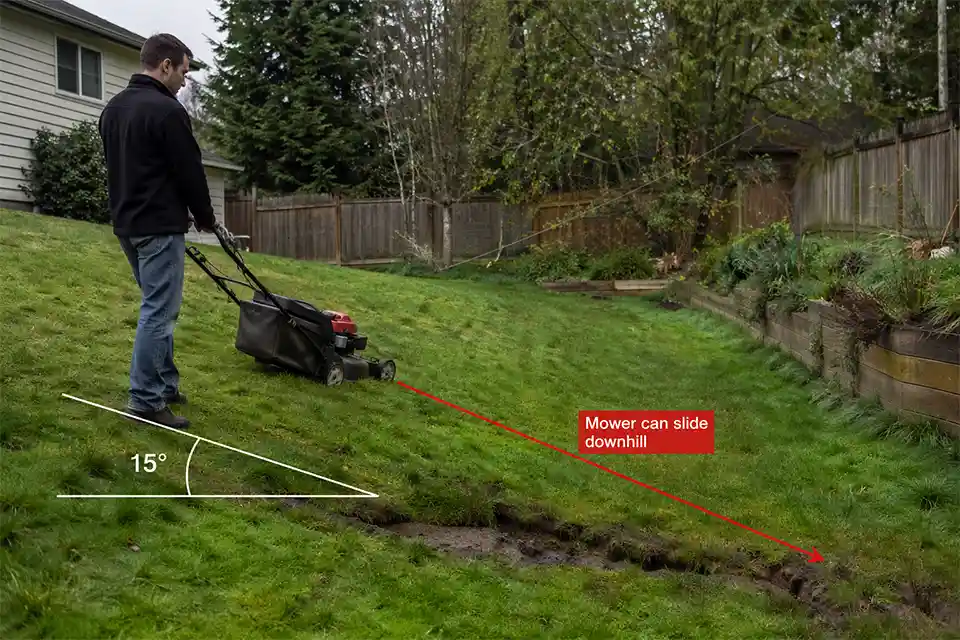
A sloped backyard usually becomes hard to mow safely before it looks extreme. The real shift is not always that the hill got steeper. It is that the surface stopped acting like stable lawn.
Once slope angle, lingering moisture, uneven ground, and mower type stop lining up, mowing turns from routine upkeep into a traction and control problem.
Around a 15-degree slope, many standard riding mowers are already near or beyond the point where ordinary “just go slower” advice stops being useful. A rise of roughly 2.7 feet over a 10-foot run is about a 27% slope, which is already a serious threshold for ride-on mowing.
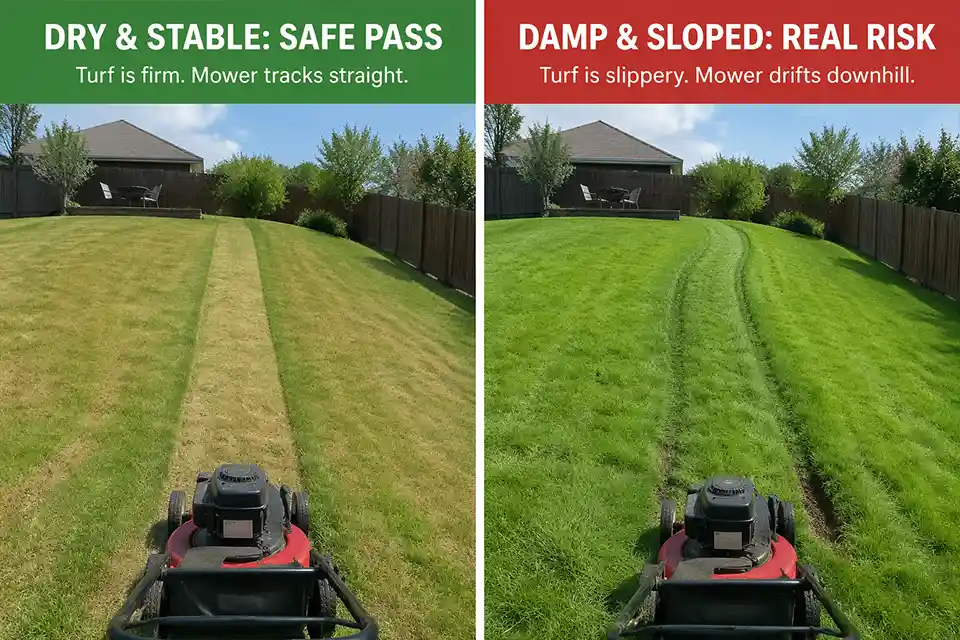
The first checks that matter are practical. Does the mower drift downhill even when the grass looks fine? Do you need to correct your line mid-pass? Does the lower half of the slope stay slick into the next day after rain or irrigation?
Those signs matter more than whether the hill looks dramatic from the patio. This is also where people confuse a mowing problem with a lawn problem. Uneven cutting or scalp marks are nuisance issues. A hill that pulls the machine sideways, hides a rut, or forces awkward turns is a safety issue.
Quick diagnostic checklist
- The mower will not hold a straight line without correction.
- Grass on the slope still feels slick 24 hours after rain or watering.
- You hesitate before turns because there is no flat reset point.
- The hill has ruts, exposed roots, washout marks, or soft spots.
- The lower edge ends near a fence line, ditch, wall, bed edge, or drop.
- The steepest section only still exists as lawn because it has not been redesigned yet.
The real problem is usually traction before steepness
A lot of homeowners think the yard became hard to mow because the hill is simply too steep. That is often only part of it. The more useful diagnosis is that the surface has become less predictable.
Wet grass changes the category fast
This is the condition people underestimate most. A slope does not need to be muddy to become a poor mowing surface. It only needs enough surface moisture to reduce tire grip or footing.
That is why a backyard that felt manageable in dry weather can feel completely different the morning after irrigation, or in a shaded stretch that dries slowly.
This usually shows up first in the lower third of the slope, where water lingers longest and turf roots are often weaker. If that part of the yard already struggles to hold plants or keep grass dense, the mowing issue is rarely isolated.
It often overlaps with the same slope instability behind Plants Keep Dying on a Sloped Backyard Bank.
Irregular ground matters more than people expect
A sloped yard is not experienced by the mower as one clean angle. It is experienced as a sequence of small changes. A shallow rut, exposed root, washout seam, or hidden depression can suddenly shift weight downhill and shrink your control margin.
That is why cosmetic fixes often waste time. Reseeding a bare strip or filling one visible dip may improve appearance, but it does not solve the mowing problem if the slope is still moving water poorly or eroding unevenly.
When the hill already shows those patterns, the more relevant issue may be the broader slope condition, not the grass cover alone. That is the same logic behind Bare Soil Washout on a Sloped Backyard.
What people usually misread first
The most common mistake is treating this as a confidence issue. It is usually an equipment-and-surface mismatch issue first.
The mowing direction depends on the mower type
This is one of the easiest places to get bad advice mixed together. Riding mowers and push mowers do not belong to the same slope logic. If a riding mower is being used within its safe operating limits, the mowing pattern is typically up and down the slope.
A walk-behind mower is usually handled across the slope instead. Mixing those patterns can make a manageable hill feel less stable than it is.
That distinction matters because many homeowners are not really struggling with the whole yard. They are struggling with one hill while using the wrong machine pattern for that hill.
Zero-turn agility gets overestimated
Zero-turns look more capable than they often are on slopes. Quick turning can feel like control, but on a slick or irregular hillside it can turn into side-loading and sudden correction. If the yard already forces awkward turns near the bottom edge or beside a fence line, agility stops being an advantage.
One useful rule: when the machine feels capable but the surface does not feel trustworthy, believe the surface.
Why the yard became harder to mow now
Most sloped backyards do not become difficult all at once. They become difficult by losing margin.
The surface changed before the mowing changed
Usually the hill did not suddenly become a problem because the angle changed. It became a problem because the surface changed first. The grass may now dry more slowly because shade has increased.
The lower half may stay softer because runoff patterns changed. Small washouts may have deepened enough to interrupt wheel travel. The edge may have weakened near a bed, fence, or drainage line.
That is why people often say, “I used to mow this just fine.” They probably did. But the current hill is not quite the same hill anymore.
Edge conditions are often riskier than the middle
The most dangerous part of a sloped yard is not always the steepest-looking middle section. It is often the lower edge, the side margin, or the transition where the slope meets something unforgiving.
A ditch, retaining edge, bed border, fence line, or drainage swale reduces your recovery space. The pass may feel fine until the moment it needs a correction.
If that sounds familiar, the mowing problem may be tied to bigger slope layout issues rather than mowing technique alone. In some backyards, that same pattern connects to runoff, grade transitions, or structural pressure lower on the hill, which is why When Water From a Sloped Backyard Runs Into a Neighbor’s Yard and Retaining Wall Failure Signs on a Sloped Backyard often belong in the same cluster.
| Condition | What is actually making it hard | Better decision |
|---|---|---|
| Dry, even, moderate slope | Normal mowing challenge | Keep mowing with the right machine and pattern |
| Slope stays slick into the next day | Traction loss | Delay mowing and reassess moisture conditions |
| Ruts, roots, washout, settling | Sudden angle changes | Repair the surface or reduce mowable area |
| Tight edge near ditch, wall, or fence | Recovery space is too small | Create a buffer and finish by hand |
| Frequent mid-pass corrections | Control problem | Stop treating it like routine lawn mowing |
When the standard fix stops making sense
This is the decision point that matters most. Some slopes should stop being lawn.
Going slower is not a real fix
Once the surface is slick, irregular, or edge-sensitive, slowing down does not solve the actual problem. It does not change slope geometry. It does not remove the rut. It does not make the lower edge safer. It just stretches out the same bad setup.
People often overestimate how much careful driving can compensate for a weak mowing surface. They underestimate how quickly repeated corrections signal that the setup no longer makes sense.
The steepest section may need a different maintenance model
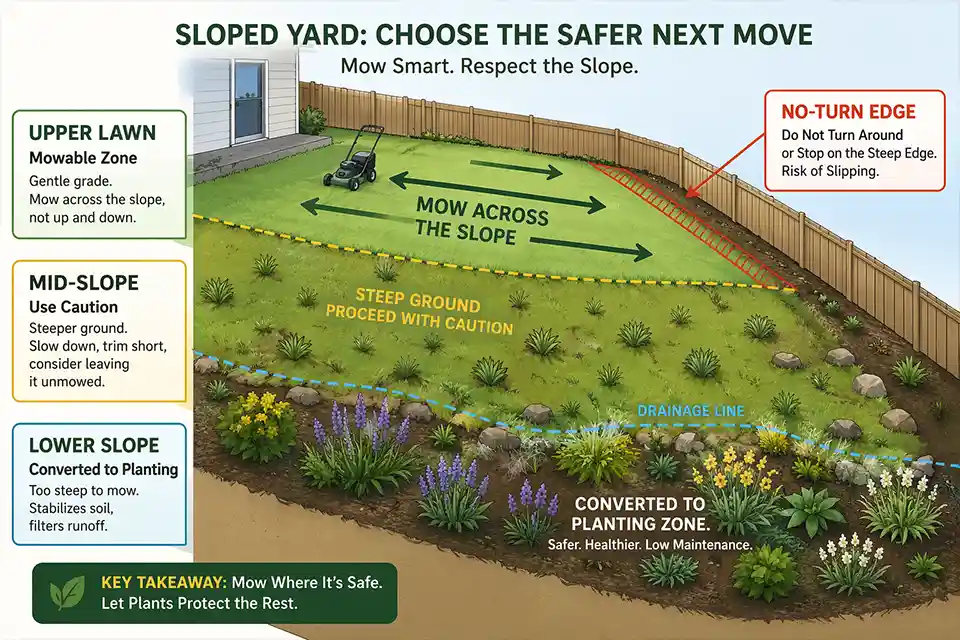
If the worst 10 to 20 feet of the yard is what keeps turning mowing into a safety decision, that strip may no longer belong in a conventional lawn plan. This is where shrinking the mowable area can be smarter than endlessly trying to optimize the machine choice.
That does not mean the whole backyard needs a redesign. It often means the steepest bank should become a planted slope, a groundcover section, or another low-cut-maintenance zone while the flatter upper or lower yard stays lawn.
The same logic often applies where steep grade changes have already pushed the yard toward more complex fixes, as in Tiered Backyard Problems on a Steep Slope or Why a Sloped Backyard Flat Space Feels Too Small.
Pro Tip: If mowing the steepest part depends mostly on caution rather than surface stability, the problem is no longer mowing technique. It is landscape design.
The clearest decision rule
If the slope is within the mower’s limits, the turf is dry, the ground is even, and you can mow in the correct direction without correcting mid-pass, it is still a mowing problem.
If the hill stays slick, hides ruts, forces awkward turns, or ends at a risky edge, it is no longer mainly a mowing problem. It is a slope-management problem.
And once a slope becomes a slope-management problem, trying to preserve every inch of lawn usually creates more risk than value. The better outcome often comes from reducing the mowable area, stabilizing the steepest section, and treating the hill like a site condition instead of a lawn that just needs more care.
For broader official guidance, see OSHA’s riding mower slope safety page.