Last updated: April 19, 2026
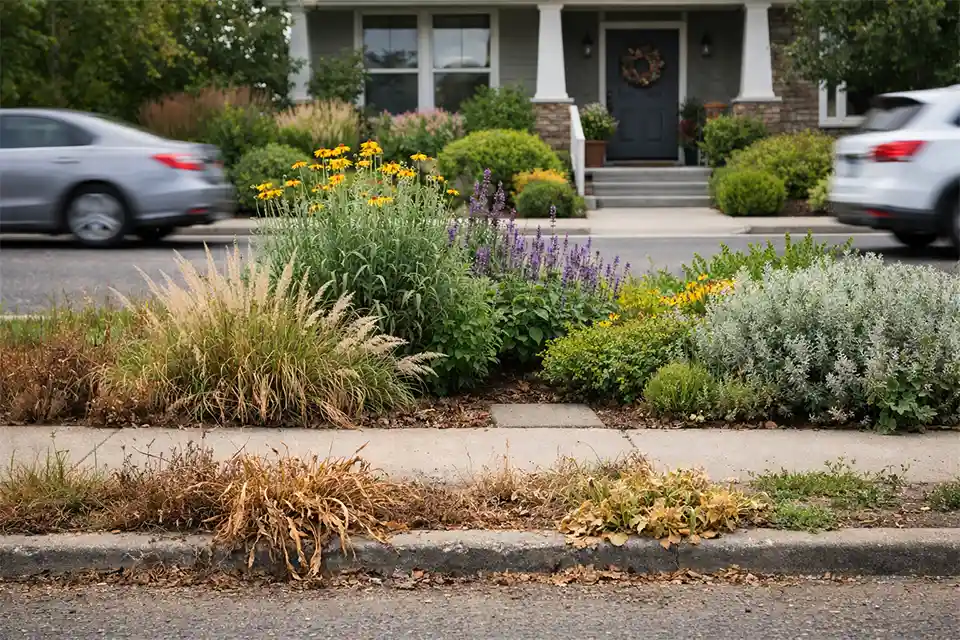
On busy streets, the curbside edge should function as a buffer first and a garden second. That is the decision most plant lists miss. The first failures are usually not random, and they are not always about watering.
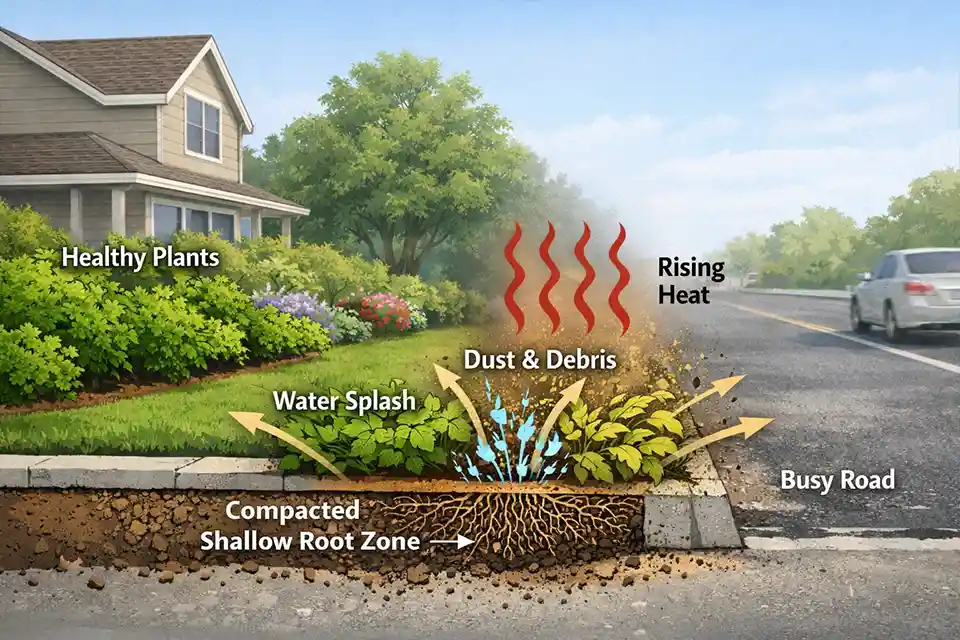
They come from mismatch: a shallow outer bed gets road dust, reflected heat, splash, turbulence, compacted soil, and occasional foot traffic, then gets planted like a soft decorative border.
Start with three checks. Measure how many feet of bed depth you actually have. Look at whether damage is worse on the street-facing side. Then see how quickly the top 2 to 3 inches of soil dry after watering.
If the bed sits within about 3 to 5 feet of the curb, roadside exposure usually matters more than homeowners expect. If burn is concentrated below roughly 18 to 30 inches high, or appears after late winter on the curb-facing side, that points more to splash and road stress than ordinary drought.
That distinction matters because the most common fix here, more watering, often solves the wrong problem.
Read the site in layers before you choose a single plant
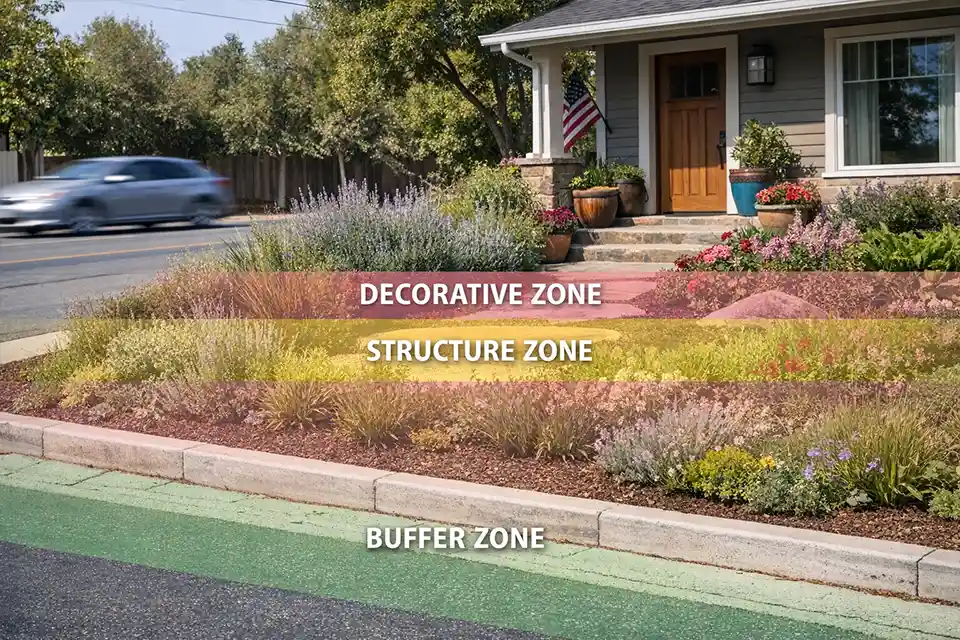
A busy-street front yard rarely behaves like one planting area. It acts like several small zones compressed into one visible space, and each zone should do a different job.
The curbside strip is the stress buffer
This outer band, often the first 3 to 6 feet from the curb or sidewalk edge, takes the hardest hit from grit, heat, splash, and edge disturbance. It should carry the toughest textures and the least fragile visual expectations. If a plant only looks good when it is clean, unbothered, and perfectly hydrated, it is already a weak candidate here.
The middle zone should carry the structure
A little farther back, conditions often improve enough for denser shrubs, stronger foliage mass, and more reliable screening. This is usually where the planting should do most of its visual work. Many busy-street yards go wrong by putting decorative fillers in the outer strip and forcing oversized screening shrubs into the wrong place.
The inner zone is where decoration belongs
Closer to the walk, porch, and windows, plants are more protected from direct spray and curbside wear. This is where softer detail, finer texture, or more seasonal bloom makes sense. The prettiest plants should not be asked to absorb the hardest roadside stress.
That same edge-versus-interior logic is why Best Plants for Narrow Front Yard Strips Between Sidewalk and Street overlaps so naturally with this topic: once the outer band becomes shallow, hot, and exposed, delicate choices stop being good choices.
What to look for in plants on busy streets
The better question is not which plant can survive. It is which plant still makes sense after dust, splash, trimming pressure, and uneven care are factored in.
Favor durable foliage over fragile bloom
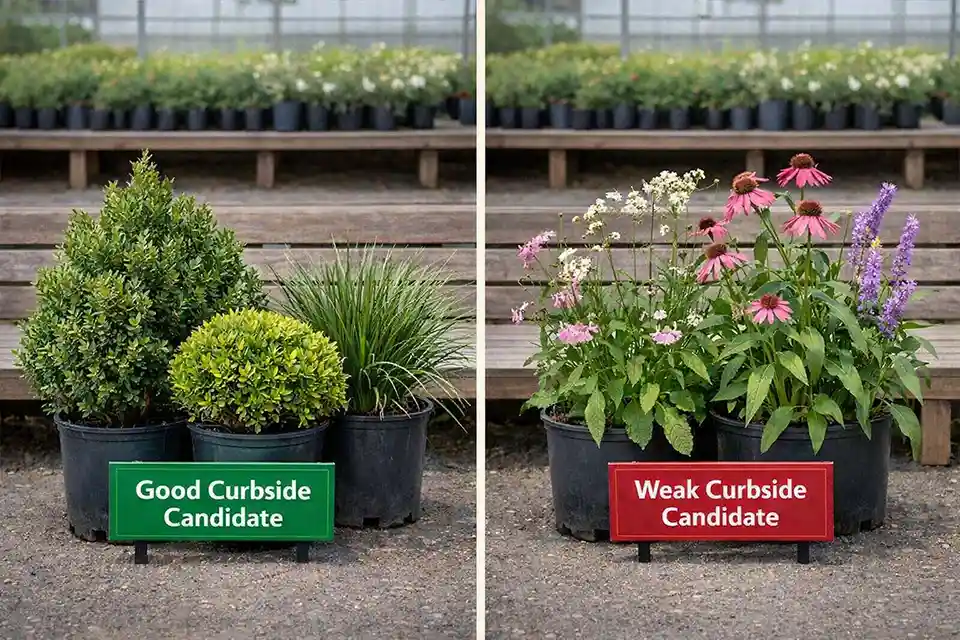
The closer a plant is to traffic, the less it should rely on delicate petals or pristine foliage to earn its place. Thicker leaves, denser branching, and shapes that still read clearly when not spotless usually outperform plants whose appeal depends on looking freshly groomed at all times.
Choose forms that hold their boundary
A plant that leans into the sidewalk, sprawls toward the curb, or needs repeated correction every few weeks turns a busy-street bed into a maintenance trap. Compact, mounded, clumping, or upright habits usually perform better than brittle stems and loose spreaders.
Prioritize visual tolerance, not just biological tolerance
This gets missed all the time. Some plants can handle a little road grime and still look intentional. Others may technically survive but look tired almost immediately. On a busy street, appearance durability matters nearly as much as hardiness.
When you are choosing at the nursery, reject these first
Skip plants with floppy growth in a small pot, stems that already snap or crease too easily, or forms already sprawling wider than their container proportion suggests. Be cautious with plants whose entire selling point is delicate bloom performance, especially if the outer bed is under about 4 feet deep. Also reject shrubs that already look too broad for the bed depth you actually have. On busy streets, oversizing starts early.
A useful rule is simple: the harsher the edge, the less the plant should rely on softness to look good.
What people usually misread first
Dust is a clue, not always the main problem
Dusty leaves are obvious, so they get blamed first. But a sturdy plant can remain healthy even if it looks grimy for a while. The bigger issue is that dust often arrives with heat, compaction, and repeated drying. Cosmetic stress is easy to see. Root-zone stress is usually more important.
Full sun gets too much blame
Many homeowners describe the bed as “just sunny.” That misses the real pattern. A planting strip beside dark pavement with exposure from about noon to 5 p.m. can run materially hotter than the rest of the yard because direct sun, reflected heat, and drying airflow stack together. The plant is not simply in sun. It is in a rougher microclimate.
Foot traffic gets underestimated
A shortcut taken once or twice a day can do more damage than a small irrigation mistake. Repeated pressure at the same edge line breaks stems, compacts soil, and ruins otherwise durable plants. Where that happens, the same practical logic behind Front Yard Plants for Areas with Sidewalk Shortcut Traffic becomes relevant: sturdier form beats prettier filler.
What usually fails first on busy streets
This is one of the fastest ways to tell whether the layout is wrong before the whole bed starts declining.
The lowest outer foliage
The first visible damage often shows up low, where splash, grit, and heat collect most consistently.
The curb-facing side
When one side of the plant repeatedly declines faster than the other, the issue is usually exposure pattern, not random weakness.
Anything that flops into pedestrian space
Plants that lean into the walk or spill into a shortcut line rarely improve with time. They usually become more corrective work.
Bloom-dependent plants that need to stay pristine
If a planting depends on delicate flowers or clean foliage to look successful, the roadside edge is often the wrong stage for it.
Oversized shrubs forced into shallow beds
These may look like instant structure, but they often become pruning problems within 2 to 4 growing seasons.
That is also why the upkeep burden in Front Yard Maintenance Problems from Busy Road Dust and Debris is not separate from plant choice. On busy streets, maintenance pressure is part of the selection process.
If privacy is part of the goal, change the plant mix
A busy street often creates a privacy problem, but that does not mean the right answer is a large hedge planted at the curb.
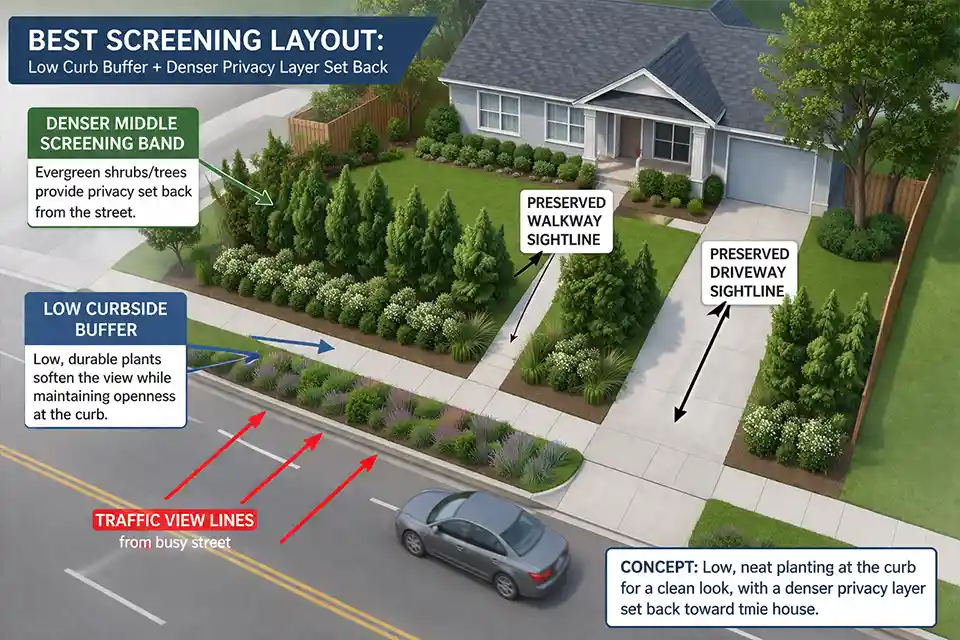
Put the privacy layer in the middle, not at the harshest edge
For many homes, the best screening comes from dense shrubs set back from the road rather than pressed into the most exposed strip. Even 4 to 8 feet of setback can make the difference between a screening plant that stabilizes and one that stays stressed.
Filter views instead of forcing a wall
Most front yards on busy streets look better when plants soften and filter passing views rather than try to block everything completely. Dense branching in the 3- to 5-foot range often improves comfort more than a hedge trying to behave like a barrier. The goal is usually visual buffering, not fortress landscaping.
That same tension shows up in Front Yard Privacy Problems on Busy Streets, where the problem is not only visibility. It is how privacy, exposure, and curb appeal start competing with one another.
Do not expect a shallow front bed to solve road noise
Plants can soften views and reduce the feeling of exposure, but a front bed that is only 6 to 10 feet deep is rarely a meaningful traffic-noise solution. Use planting for visual calm, layered screening, and a better edge between the house and the street. Do not treat it like acoustic engineering.
Keep sightlines where they still matter
A dense planting can improve privacy and still create problems if it blocks the walk, narrows the driveway view, or makes the front door feel hidden. On busy streets, good screening is controlled screening. It should soften the house from the road without making the yard feel closed off from the people actually using it.
Pro Tip: Keep the curbside layer lower and tougher, then let the middle layer do most of the privacy work.
Choose the main job of the planting first
One reason busy-street plantings disappoint is that homeowners expect the same outer strip to do everything at once: bloom, screen, stay low-maintenance, absorb road stress, and still look refined. That is usually too much to ask from the hardest part of the site.
If the main job is durability
Simplify the curb edge, reduce species count, and favor plants that hold form without constant correction.
If the main job is privacy
Move density inward and let the middle layer do the filtering instead of forcing the harshest edge to become a wall.
If the main job is curb appeal
Protect the decorative layer from the road so the plants people actually notice are not also the ones taking the worst abuse.
If the main job is low maintenance
Use fewer plant types at the front edge and avoid anything that needs frequent deadheading, shearing, or cleanup to stay acceptable.
This is where a lot of front yards become easier: once the outer strip is treated as a buffer zone, plant choices get clearer and the rest of the yard stops fighting the street.
Why the obvious fixes often fail
More watering is the classic time-waster
During the first 6 to 8 weeks after planting, irrigation helps roots establish. After that, repeating the same watering fix on a plant that keeps burning on one side usually misses the mechanism. If splash, heat, compaction, or roadside exposure are the real issue, more water does not make the site gentler.
Replanting the same shrub in the same spot is not a strategy
If the road-facing side keeps showing lower-leaf burn after winter, stop calling it bad luck. Summer scorch and late-winter salt or splash injury do not behave the same way. Summer stress usually builds after hot spells. Winter roadside damage often appears as delayed browning or dieback on the curb-facing side as spring growth starts.
Bigger shrubs usually create the next problem
Instant screening is tempting, especially when windows face traffic. But large shrubs planted too close to the road often become pruning problems within 2 to 4 growing seasons. They get forced off paths, block sightlines, or are sheared into shapes they were never meant to hold.
That same overcorrection appears in homes where the discomfort starts at the window line, not just at the curb, which is why How to Fix Front Yard Privacy for Windows Facing a Busy Road reinforces the same point from a house-facing angle.
A quick decision guide for the real bed
| If the site condition is… | Prioritize… | Avoid… |
|---|---|---|
| Bed sits within 3 to 5 feet of the curb | tough low buffer planting | delicate mixed bloomers |
| Damage shows after late winter on the curb-facing side | setback and exposure-tolerant structure | replanting the same broadleaf shrub |
| Bed is shallow and pavement runs hot in afternoon | fewer species and simpler massing | fussy curbside detail |
| People cut through the same outer edge repeatedly | sturdier upright or clumping forms | soft spreaders and brittle stems |
| Privacy matters from the street or sidewalk | dense mid-layer branching | oversized hedge at the curb |
| Front walk or driveway visibility is already tight | lower outer layer and controlled middle height | broad screening mass at the front edge |
The smartest layout is usually simpler than people expect
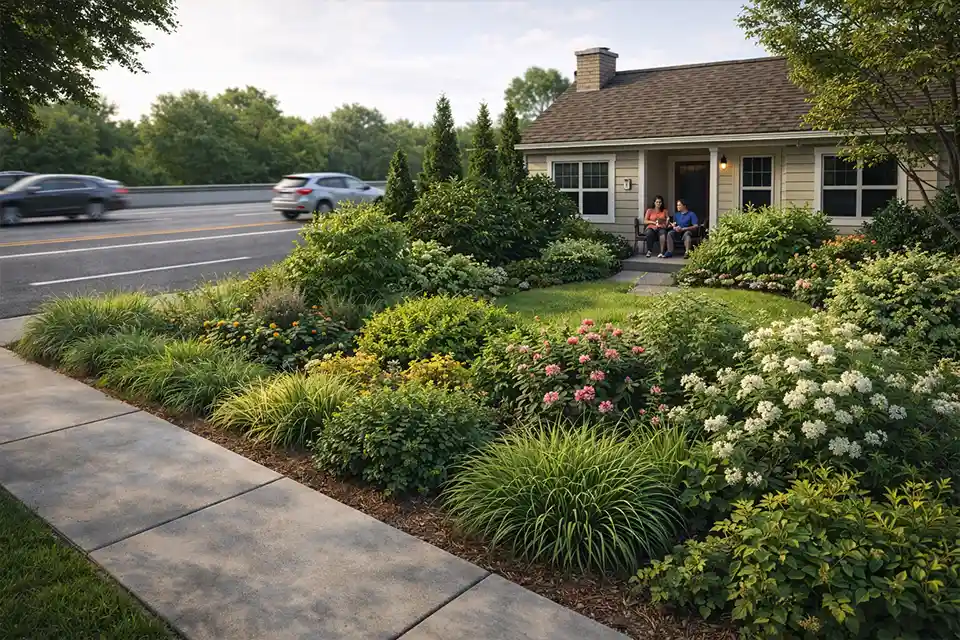
Most busy-street front yards improve when the planting gets less ambitious at the outer edge and more intentional closer to the house.
Use fewer species at the street edge
A limited front-row palette is easier to maintain, easier to replace, and easier to read from the road. It also avoids adding visual clutter to a setting that already has enough motion.
Let massing do more of the visual work
A busy-street planting has to survive biologically and read clearly visually. From a moving car or from across the street, tiny plant distinctions usually disappear. Simple, readable groups outperform fussy mixtures more often than people expect.
Move your decorative plants inward
If a finer-textured or more ornamental plant matters to the look of the house, give it distance. Even 4 to 6 feet of extra setback can improve appearance and reduce maintenance more than many homeowners expect. In very hot outer beds, the same harsh-edge logic also overlaps with How to Choose Front Yard Plants in Blazing Afternoon Sun.
The mistake is usually not choosing weak plants. It is expecting the road edge to behave like the rest of the yard. Once the outer strip is treated as a buffer zone, plant choices get easier, maintenance drops, and the whole front yard starts looking more intentional.
If winter road splash is part of your planting risk, University of Minnesota Extension has a clear guide to salt damage in landscapes.