The first sign that a modern front yard is aging badly usually is not damage. It is loss of intent. The yard stops looking crisp and starts looking underplanted, overcorrected, or oddly cheap.
The fastest checks are simple: does the layout still look balanced after two full growing seasons, are open surface areas still clean after ordinary leaf drop and one rainy week, and has any single plant expanded by 12 to 24 inches in a season and started carrying too much of the composition?
That matters because a front yard can be healthy and still look wrong. A traditional planting scheme often absorbs uneven growth without much drama. A minimalist one usually cannot.
Once gravel drifts 2 inches past the edge, a thin bed still looks empty after 18 to 24 months, or dark edging starts telegraphing every seam, the problem is no longer just maintenance. The design idea itself is starting to fail.
The first sign is usually not damage
The yard starts looking unfinished, not mature
This is the misread that causes the most delay. People think the yard just needs more time. Sometimes it does. But a modern front yard that is maturing well still looks deliberate while it fills in. A poorly aging one starts exposing its weak spots instead.
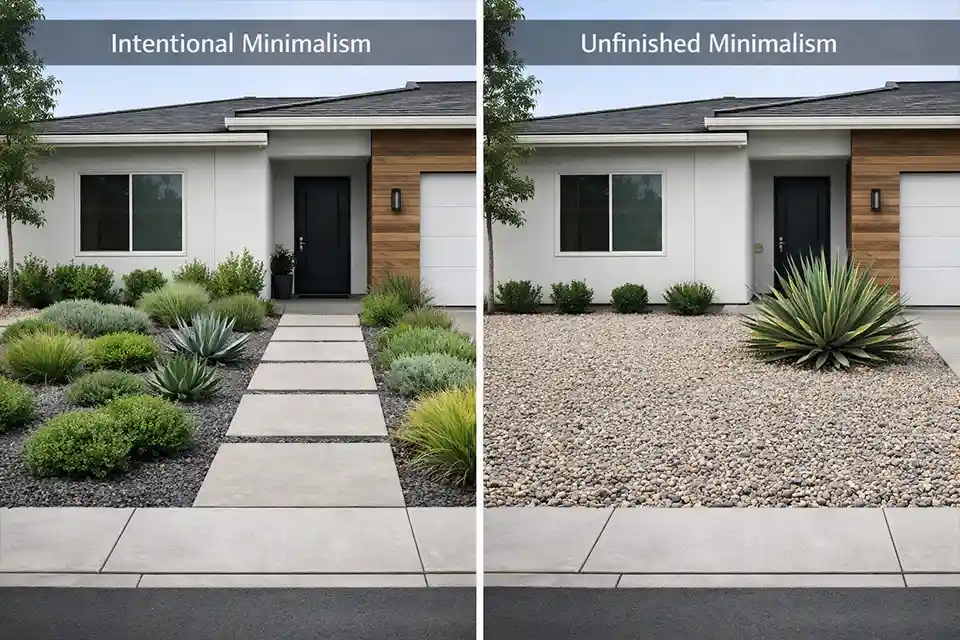
Bare gravel reads like filler. Thin beds read like leftover strips. One accent plant starts carrying the whole scene.
That is why some of the same frustrations show up in Why Low-Maintenance Front Yards Often Become High-Maintenance.
The issue is not always more work. It is that every missed cleanup cycle becomes more visible.
Clean lines stop reading as deliberate
Modern front yards often depend on sharp edges and visual restraint. That works only when the details stay controlled. A 1-inch edging shift, a narrow runoff stain, or a bit of irrigation overspray can read much louder in a strict design than it would in a fuller planting scheme.
People often overestimate how much clean lines can carry on their own. The cleaner the design, the more every flaw gets promoted.
The modern choices that photograph better than they live
Large open gravel zones
This is the most common failure pattern. Open gravel looks premium in photos because it removes visual clutter. In real front yards, it often becomes a magnet for visible clutter. Leaves sit on top of it. Weeds puncture it.
Rain moves it. If decorative rock is drifting 2 to 3 inches into adjoining edges after a wet stretch, the design is asking too much from a finish material that should have been doing less work.
Front Yard Gravel and Rock Spreading Into Lawn shows the same pattern: once containment starts failing, the whole controlled-modern look weakens fast.
One heroic plant doing all the design work
This is another common modern move that photographs well early and disappoints later. A single sculptural shrub, grass, or small tree looks strong at installation because the rest of the space is so stripped back. But that also gives one plant far too much visual responsibility. If it grows 30% faster than expected, leans, or simply gets wider by year two or three, the whole yard starts looking off.
Razor-thin beds against stark hardscape
Beds that are only 18 to 24 inches deep can look crisp on a plan. On site, they often feel mean. They leave little room for roots, little room for layered planting, and almost no room for error. Against pale concrete, dark steel edging, or large gravel fields, every proportion matters.
A narrow bed is not automatically elegant. Sometimes it is just underbuilt.
What makes a modern front yard start looking cheap
Decorative rock starts reading as filler
At installation, decorative rock can read as intentional minimalism. After a season or two, if the composition is weak, the same rock starts reading as empty coverage. The yard no longer looks restrained. It looks like planting was skipped. Cheap Front Yard Ideas That Cost More Later runs into the same logic: some shortcuts do not fail because they break, but because they stop looking convincing.
Hard surfaces age louder than people expect
People tend to blame plants first. Often the harder surfaces age worse. Black edging starts showing every bump. Weed barrier peeks through gravel after 12 to 18 months. Pale concrete reveals runoff marks and irrigation overspray. None of those are major structural failures, but together they can make a front yard look tired fast.
Empty space stays empty too long
A front yard that still feels visually bare after two growing seasons is usually sending a real signal. People keep waiting because the layout looked expensive on day one. But if empty areas are still carrying most of the scene after 18 to 24 months, the composition is probably too thin to age well.
| Design choice | Why it looks good at install | How it starts failing | Better long-term direction |
|---|---|---|---|
| Large open gravel fields | Clean, graphic, low clutter | Debris, drift, visible weeds | Reduce exposed surface with planted mass |
| One oversized focal plant | Dramatic and sculptural | Layout feels lopsided by year 2–3 | Use slower forms with supporting structure |
| Thin linear beds | Crisp and architectural | Empty, stressed, or crowded edges | Make beds deeper and less brittle |
| High-contrast hardscape | Sharp modern finish | Stains and seams show quickly | Use materials with more forgiveness |
| Ultra-sparse planting | Minimal and calm | Yard starts reading unfinished | Add controlled density, not clutter |
Decision thresholds that actually matter
When a refresh is enough
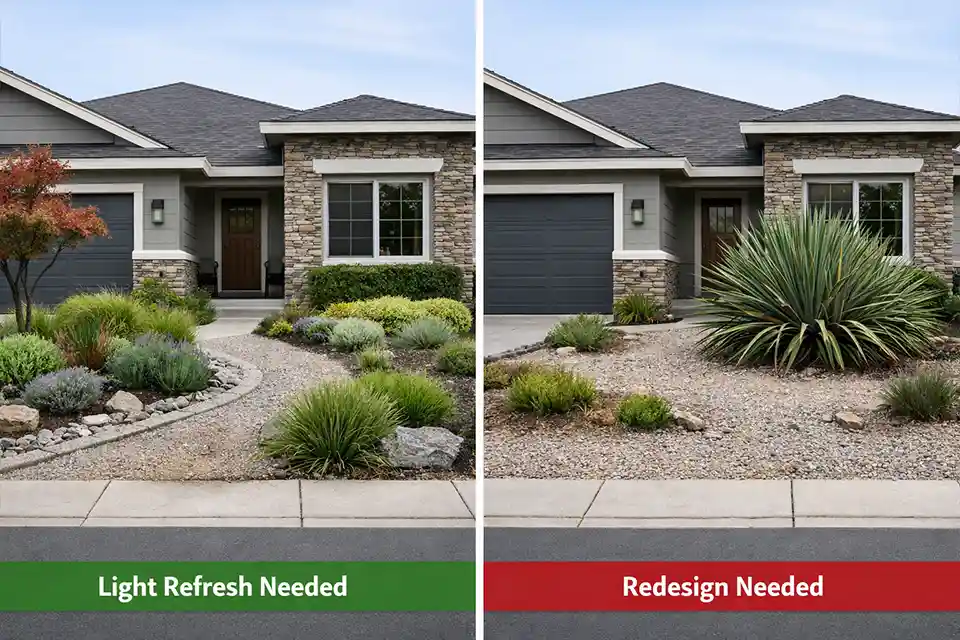
A light refresh is still reasonable when the structure is basically sound and the problem is mostly visible wear. That usually means the yard still reads as intentional from the curb, plant spacing is broadly working, and no single material is doing all the visual heavy lifting.
A refresh usually makes sense when gravel drift is minor and confined to edges, stains are visible but the geometry still looks balanced, one plant is slightly oversized rather than dominating the whole composition, and the yard still looks better after cleanup for more than a few weeks.
When the layout is too weak for cosmetic fixes
This is the line many homeowners wait too long to admit. A stronger intervention is usually warranted when exposed surface makes up more of the visual scene than planted structure, the composition still feels bare after 18 to 24 months, one feature plant controls the whole front yard by year two or three, or each “fix” only resets the same disappointment for 4 to 8 weeks.
At that point, the issue is no longer maintenance quality. The layout is asking too much from too little.
What is cosmetic and what is structural
Mostly cosmetic: surface staining, minor gravel migration, one visible seam, one plant needing cleanup, a short-term seasonal imbalance.
Mostly structural: underplanted layout, beds too thin to support the composition, exposed rock fields carrying the design, one oversized focal plant doing most of the visual work, or hardscape contrast so severe that every flaw gets amplified.
The fixes people keep wasting time on
More pruning
This is the classic rescue move. Once the yard starts looking swollen or uneven, people prune harder to preserve the original picture. That can buy a few weeks. It rarely solves the deeper mismatch.
If a plant needs trimming every 4 to 6 weeks through the growing season just to stay inside the composition, the design is depending on correction, not compatibility. Front Yard Ornamental Grass Maintenance Problems becomes relevant for exactly that reason.
Surface refreshes
New mulch, darker gravel, larger rock, replacement edging: these can make the yard look refreshed for a month or two, but they do not solve weak structure. If too much of the scene depends on exposed ground and hard lines, new finish materials usually just restart the same decline.
Replacing one plant at a time
People do this because it feels manageable. But if the layout is underplanted or visually brittle, replacing one plant rarely changes the outcome.
Front Yard Flower Beds That Keep Needing Replanting points to the same problem from a different angle: repeated replacement often means the planting layer is being asked to rescue a weak design.
Pro Tip: If the yard only looks convincing for a week after cleanup, stop upgrading finishes first. The more important question is which part of the design keeps needing visual rescue.
What to change first
Reduce exposed surface before changing materials
This is usually the highest-value move. When too much of the front yard depends on gravel, mulch, or bare hardscape to look finished, the scene becomes fragile. Reducing exposed surface with more planted structure usually improves the yard faster than swapping one finish for another.
Give thin beds real depth
If the existing bed is only 18 to 24 inches deep and still looks visually starved, adding 8 to 18 more inches of usable depth often does more than replacing plants within the same weak strip.
Replace hero plants with support structure
A single dramatic plant is rarely the most stable long-term answer. If one focal element already dominates the whole yard, the better move is often to reduce its visual burden by adding quieter support around it or replacing it with a slower, tighter form.
What ages well instead
More planted structure, less exposed surface
The modern front yards that hold up best have enough planted structure to absorb small imperfections. A missed cleanup cycle, a bit of leaf drop, or one plant growing slightly wider should not collapse the whole composition.
Slower-growing forms with realistic spacing
Plants that stay close to their intended size are easier to keep aligned with the geometry. That matters more than dramatic install-day impact.
Simpler geometry with more tolerance
The problem is not modern style. It is fragile modern style. A restrained layout can still look sharp without relying on exposed filler, razor-thin beds, and one hero plant doing all the work.
The front yards that age best are the ones that still look intentional after ordinary weather, ordinary growth, and ordinary human delay.
For broader official guidance, see University of Minnesota Extension landscape design guidance.