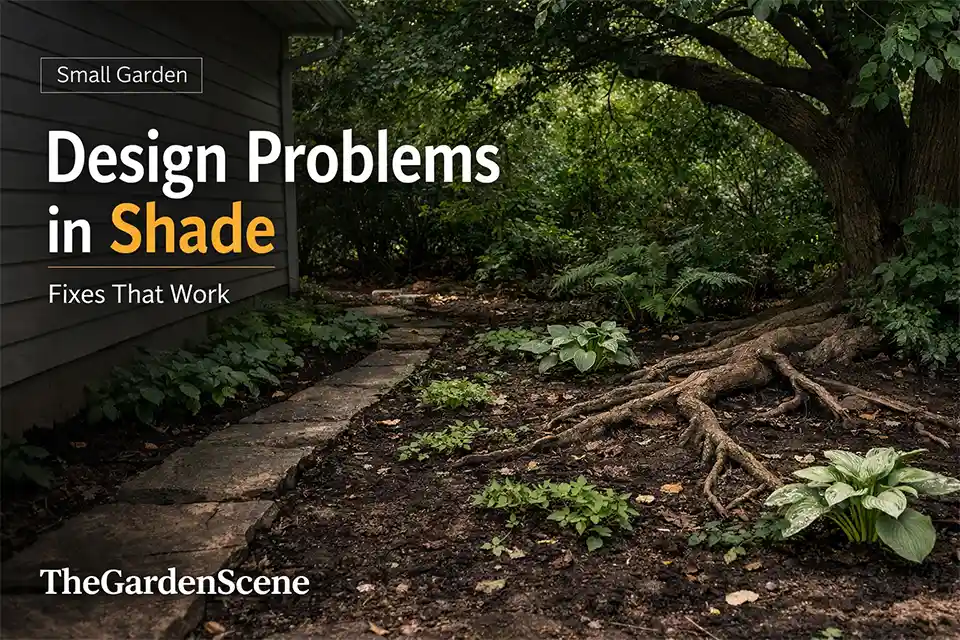
Small garden design problems in shaded areas usually get blamed on the plants, but the planting often only reveals what the layout got wrong first.
In a compact space, three checks matter more than any plant list: whether the bed gets less than 2 hours of direct sun or closer to 3 to 4 hours of morning light, whether the soil is still damp 48 hours after rain, and whether tree roots dominate the top 6 to 8 inches of soil.
Those signals separate deep shade, wet shade, and root-heavy dry shade, and each one pushes the design in a different direction.
A bed that looks thin under tree roots does not need the same fix as a dark side yard that stays wet for days. And a bed that survives but still feels cramped is often not a growing failure at all. It is a small-space planning failure.
The four failure patterns behind most small shaded gardens
Most small shaded gardens break down in one of four ways. Until that is clear, almost every fix is guesswork.
Root-heavy dry shade
This is the most underestimated condition. Under mature trees, the bed may look cool and sheltered but still dry within 12 to 24 hours in summer because roots take moisture before new plants can settle. People see empty space and add more plants. That usually creates more maintenance without creating a stronger garden.
If roots show up every few inches when you dig, the bed does not need more variety first. It needs less competition. In practice, that often means shrinking the planted area, improving a smaller zone properly, or lifting part of the design into raised sections 10 to 14 inches high.
Wet, stagnant shade
Wet shade declines more quietly. Plants do not burn. They lean, stretch, mildew, and stay weak. If the soil still feels tacky after 48 hours, or a 6-inch test hole still holds water after 1 hour, the issue is drainage and airflow before it is planting.
This is where people waste time on cosmetic fixes. More mulch, more compost, and more plants can make the bed look worked on while leaving the real problem untouched.
Moderate shade with a muddy composition
This is often the most fixable version, but it gets handled badly because people assume the answer is more color or more plant types. A small garden with 3 to 4 hours of morning sun can still look rich. What usually drags it down is too many medium-size plants, too many disconnected textures, and no clear hierarchy from the main viewing point.
Deep shade pretending to be a flower border
Once direct sun drops below 2 hours, it usually stops making sense to design the bed as if bloom will carry it. In deep shade, flowers can still play a role, but they cannot carry the whole composition. The garden needs structure to do more of the work.
That larger site pattern also shows up in Backyard Landscaping Problems in Shaded Areas, but small gardens feel the penalty faster because every weak decision is compressed into a tighter footprint and a shorter view.
The layout mistakes that make shade feel worse
A shaded garden can be healthy and still look disappointing because the layout makes the shade feel heavier than it really is.
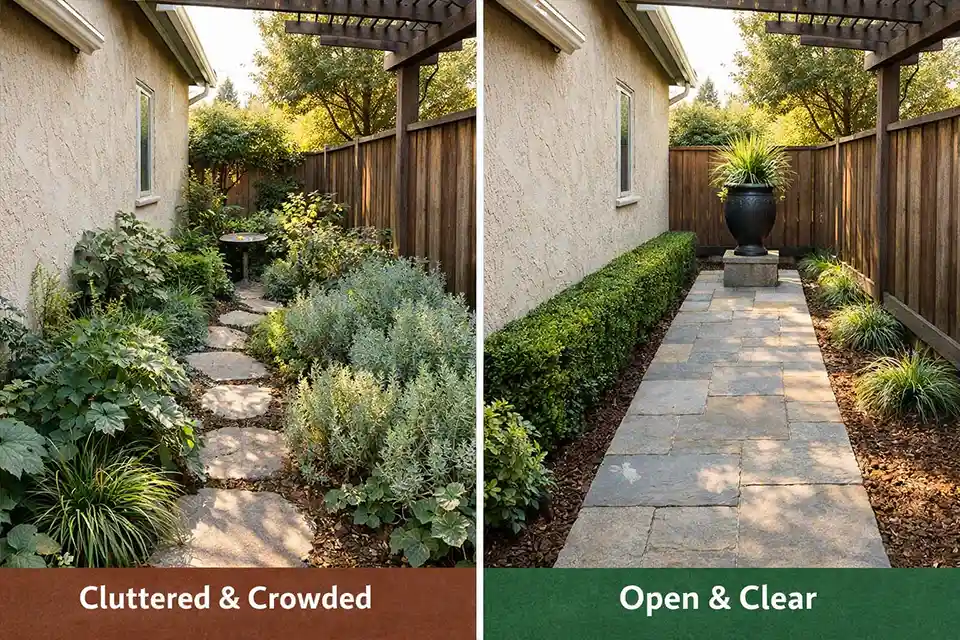
The walkway is too narrow for the planting
In small shaded gardens, access matters more than people think. When the walkable edge is less than about 24 inches clear, soft growth spills into it quickly, especially in damp shade. That makes the garden feel tighter, darker, and less intentional. A bed should not be designed as if every plant will stay inside its nursery outline.
The bed is too deep for the space to read clearly
This is common along fences and side yards. A planted depth of about 4 feet can work well. Once a bed pushes past 6 feet in a small shady space, it often starts to read as a dark planted mass unless the layout is extremely simple.
Every plant sits in the same middle band
When everything lands around the same height, the bed goes flat. Shade makes this worse because bloom is doing less visual work. One upright form, one lower mass, and one broader-leaved plant usually create more shape than six medium fillers at roughly 18 to 24 inches.
The edge is weak
A ragged edge makes a shaded garden look dimmer. A clean mowing strip, a defined border, or one straight or gently curved line of paving can sharpen the layout before a single plant is replaced.
If the garden already feels crowded to maintain, the same pattern often shows up in Small Garden Design Mistakes That Increase Maintenance. Shade just makes that crowding look heavier and recover more slowly.
The layout decisions that actually improve the garden
A better shaded garden is usually not one that contains more. It is one that directs the eye better and asks less from the planting.
Decide where the garden is meant to be seen from
Most small shaded spaces have one main viewing angle: from the patio door, from a kitchen window, or while walking down a side path. That is the angle the layout should serve first. If the best view is from 8 to 12 feet away, the bed needs a stronger silhouette and fewer tiny details. If the space is only seen at close range, finer texture can work.
People often plant as if the bed will be admired from every side when it really has one dominant viewpoint.
Protect one clear movement line
A small shaded garden feels better when it has one obvious movement line, even if that is only a short stepping-stone path or a narrow run beside the bed. Once planting collapses into circulation space, the whole garden reads as tighter and darker. The layout should protect that line first and decorate around it second.
Give the eye one place to land
A focal point in shade does not have to be dramatic. It can be a bench, a pot grouping, a clipped shrub, a slim trellis, or one cleaner vertical accent. What matters is that the eye does not have to search through an even layer of similar material.
Let one surface stay quiet
In shade, one quiet surface often makes the rest of the garden read better. That might be a simple gravel section where drainage allows it, a plain stretch of paving, or a controlled mulch area that is not chopped up by small accents. Without that pause, the layout often feels nervous.
That is also why Small Garden Design Principles That Work translate so well here. Strong small-space design is usually about restraint, not fullness.
Pro Tip: If a shaded bed feels cramped, remove one-third of the small accents before adding anything new. The layout usually improves faster by subtraction.
What people fix too early
The wrong first move is usually driven by anxiety, not diagnosis.
More plants
This creates instant fullness and delayed frustration. Planting at 8-inch centers when mature spread is 16 to 18 inches turns a small shady bed into a permanent editing job.
More bright flowers
White or pale flowers can help, but they do not fix a layout with no height change, no focal point, and no clean edge. The design is asking flowers to do structural work.
More mulch
In root-heavy dry shade, 2 to 3 inches of mulch may help slow moisture loss. In wet shade, the same layer can slow drying and keep the bed stale. The visible symptom may be the same. The underlying mechanism is not.
When planting should stop being the main answer
A strong shade design has to know when planting is no longer the best tool.
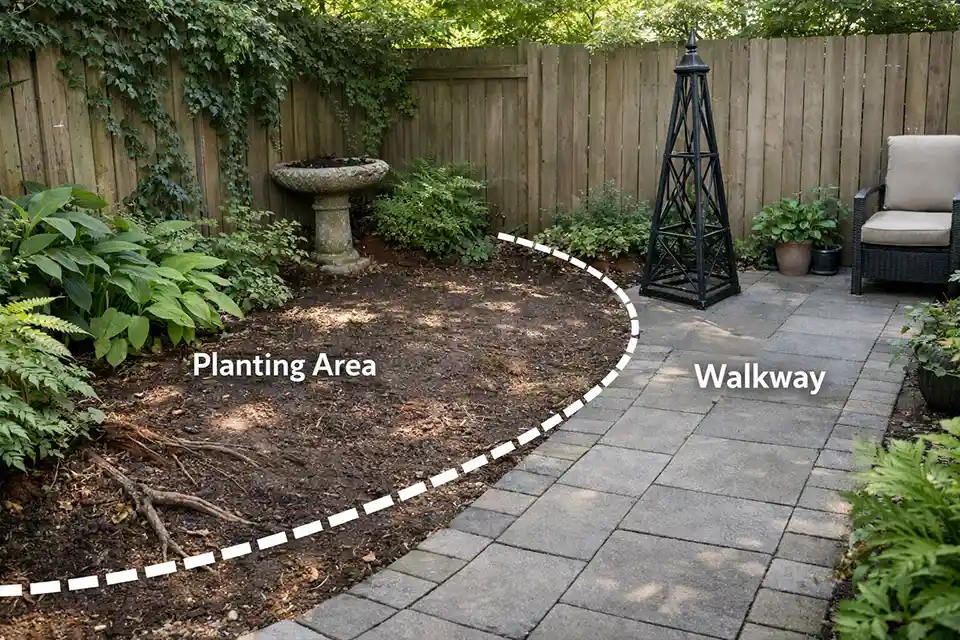
Shrink the bed when roots dominate
If roots fill the top 6 to 8 inches and new plants struggle through the first growing season, the bed is probably too large for the site. A smaller planted zone with 8 to 10 inches of improved soil usually works better than fighting to keep the entire footprint planted.
Shift to structure in deep shade
Under less than 2 hours of direct sun, it often makes more sense to let containers, paving, one focal object, and restrained foliage carry the garden than to keep forcing a flower-led scheme.
Correct water movement before replanting wet shade
If runoff, trapped grade, or hardscape drainage is feeding the bed, that comes first. Even a 2% to 3% slope away from the house can change whether a small garden dries within a day or stays dark and sealed for several. In that case, Backyard Drainage Problems Homeowners Ignore is more useful than another planting article.
Quick comparison guide
| Condition | What it usually looks like | What actually helps | What usually wastes time |
|---|---|---|---|
| Root-heavy dry shade | Thin plants, exposed roots, dry topsoil by the next day | Smaller improved bed, raised sections, repeated tough planting | Replanting the whole area |
| Wet stagnant shade | Floppy growth, mildew, dark damp soil after 48 hours | Better airflow, grade correction, less mulch | More compost without drainage fixes |
| Moderate shade with some morning sun | Plants survive but the space feels cramped or muddy | Repetition, focal point, clearer path and edge | Adding more small varieties |
| Deep shade under 2 hours | Sparse flowering, slow recovery, dull layout | Structure, containers, simplified planting | Forcing a colorful border |
The best small shaded gardens are not the fullest ones. They are the ones where the layout makes the shade feel deliberate instead of accidental.
For broader official guidance, see University of Minnesota Extension’s Gardening in the Shade.
Snippet: Small garden shade problems usually come from roots, wet soil, or weak layout. Fix the real issue first and the whole space works better.