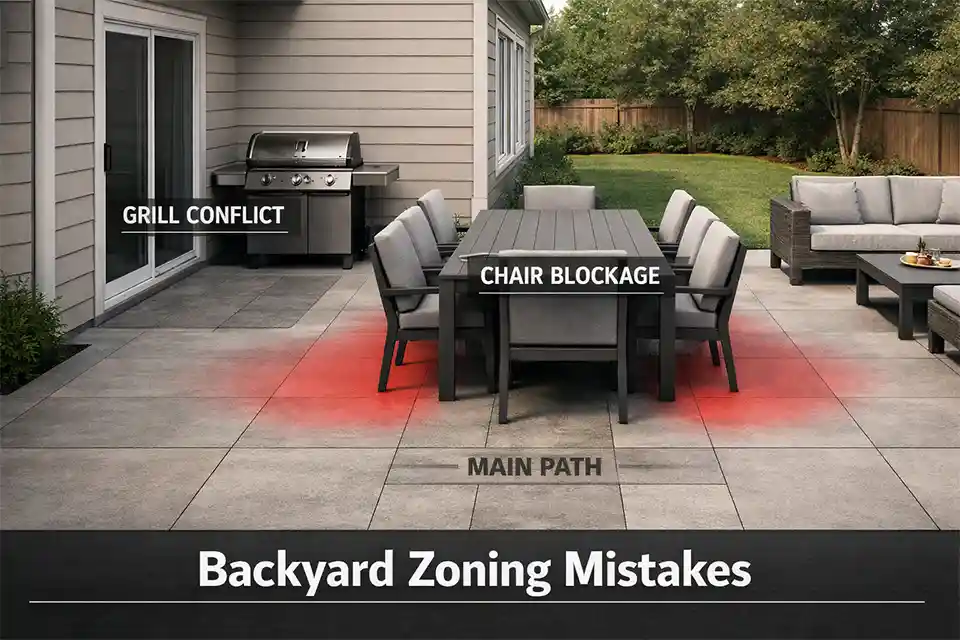
Most backyard flow problems are not caused by yard size. They are caused by bad zoning. The pattern is usually easy to spot once you stop looking at the furniture and start looking at movement.
If your main route shrinks below 36 inches, if people have to angle around chair backs, or if the first 6 to 8 feet outside the back door is already occupied by a table or sectional, the yard is not underfurnished. It is mis-zoned.
The first checks should be practical: measure the narrowest path in real use, watch where people cut across the lawn, and see whether the grill, dining area, and lounge are borrowing the same clearance.
That is the difference between a backyard that is merely small and one that is zoned badly. A small yard can still flow if the main route is protected and each zone has one job. A larger yard with overlap, bad adjacency, and dead-end destinations can feel harder to use because the extra space is wasted on conflict instead of function.
Quick Diagnostic Checklist
Your backyard likely has a zoning problem, not just a furniture problem, if at least three of these are true:
- The main walking route drops below 36 inches at any pinch point
- A seated person blocks a path the moment a chair is pulled out
- The grill and dining set compete for the same 3-foot working zone
- The area right outside the back door feels crowded within the first 6 to 8 feet
- A fire pit, bench, or pergola sits 25 to 30 feet away but gets used less than once a week
- The lawn shows repeated shortcut lines where people ignore the intended route
These are not cosmetic signals. They are structural signals. If people keep inventing a better path than the one your layout provides, your zones are in the wrong places.
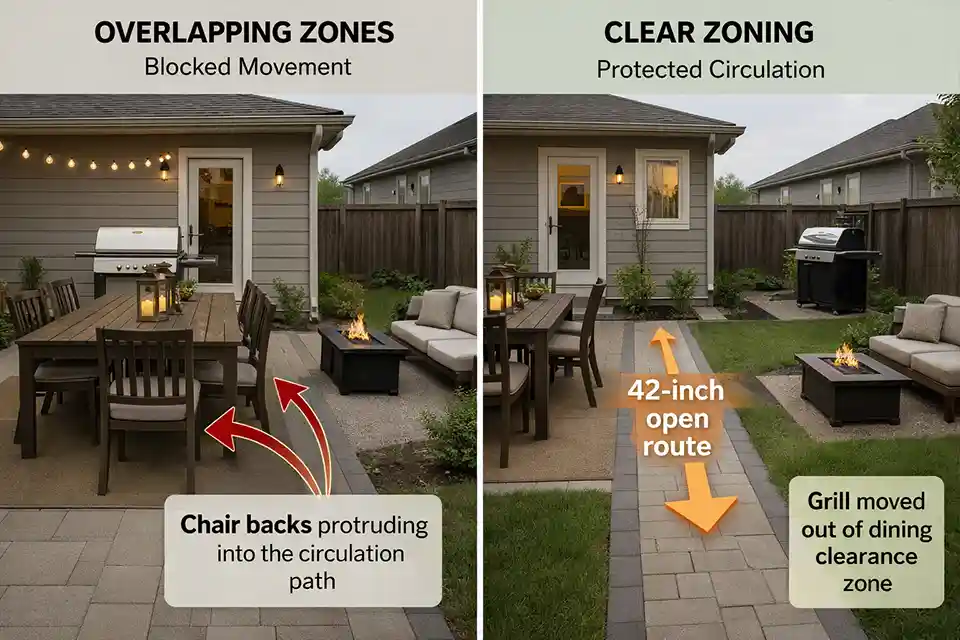
What People Usually Misread First
The first misread is blaming the yard for being too small. In most cases, the stronger diagnosis is simpler: too many functions were pushed into the best part of the yard. The area closest to the back door becomes circulation space, serving space, cooking space, dining space, and visual entry space all at once. That is not flexibility. That is zone conflict.
The second misread is thinking symmetry equals order. A centered table, matching chairs, and evenly spaced planters may look resolved from the patio door, but outdoor flow is not judged from one viewpoint. It is judged by whether someone can carry food, pass behind a chair, reach the grill, and keep moving without stopping the whole yard.
The third misread is overvaluing features. More features do not create better zoning. A yard with a dining zone, a lounge zone, a grill zone, a fire pit zone, and a decorative bench zone often performs worse than a yard with two strong zones and one support area. That tradeoff gets missed constantly in Backyard Layout Problems That Make Spaces Hard to Use, where the issue is usually not missing square footage but too many competing intentions.
The Zoning Mistakes That Cause the Most Damage
No transition zone at the back door
This is the most common failure because it damages the yard immediately. The first few feet outside the back door function as a distribution point whether you design them that way or not. If that space is already occupied by a table, sectional, storage bench, or clustered planters, the yard starts with friction. People step out and hit furniture before they have even entered the space.
This is where many homeowners waste time. They try to fix the problem with smaller furniture. That usually underperforms because the real mistake is not furniture scale alone. The mistake is assigning permanent activity to space that should stay partly open.
A good rule is simple: preserve the first 6 to 8 feet outside the main door as transition space, or at least keep the central movement line through it clear. If that area has to serve as dining space too, the zone count is already too ambitious.
Double-duty zones that ask one space to do four jobs
This is the classic patio mistake. One slab becomes dining room, grill station, lounge, serving lane, and pass-through route all at once. The result is a backyard that looks full but works badly. A grill needs working clearance. Dining chairs need pull-out space.
A walkway needs protected width. Once those all overlap, the patio stops acting like a zone and starts acting like a collision point.
The key distinction here is between related zones and shared clearance. Grill and dining should usually be near each other. They should not occupy the same movement pocket. Lounge seating can sit near the main patio. It should not sit inside the main path from the door to the yard.
That adjacency logic matters more than many readers expect. “Near” is often correct. “Inside the same clearance zone” is often wrong.
Destination zones without a connector
A tucked-away pergola, fire pit, or seating nook can look like smart zoning. Sometimes it is just isolated zoning. If the destination is 25 to 30 feet away, separated by lawn, wet ground, or an awkward diagonal route, it becomes a low-use zone fast. It may photograph well and still fail in daily life.
One useful threshold: if a zone is attractive but routinely skipped for seven days or more, it is probably not a behavior problem. It is a connector problem. People are not refusing the feature. They are refusing the route.
This is especially common when a backyard tries to feel “layered” without giving each layer a practical connection. That same issue tends to show up in How to Design a Backyard for Everyday Use because the yard may contain destinations but still lack a comfortable sequence.
Fragmented micro-zoning in medium-size yards
This is where design ambition starts hurting usability. In many backyards, especially those with roughly 800 to 1,200 square feet of usable open area, four or five tiny zones perform worse than two or three larger ones. Each mini-zone creates another edge, another routing decision, and another opportunity for conflict.
A sharp decision threshold helps here. In a typical medium backyard, two main zones and one support zone are often enough. For example: dining plus lounge, with grilling treated as a support function rather than a full standalone zone. Not every feature deserves zone status. Storage is not a zone. Serving space is not usually a zone. A decorative bench is not automatically a zone either.
This is where many plans become visually busy and behaviorally thin. Every corner has something in it, but no area is generous enough to use comfortably for more than 20 minutes.
The Better Zoning Logic
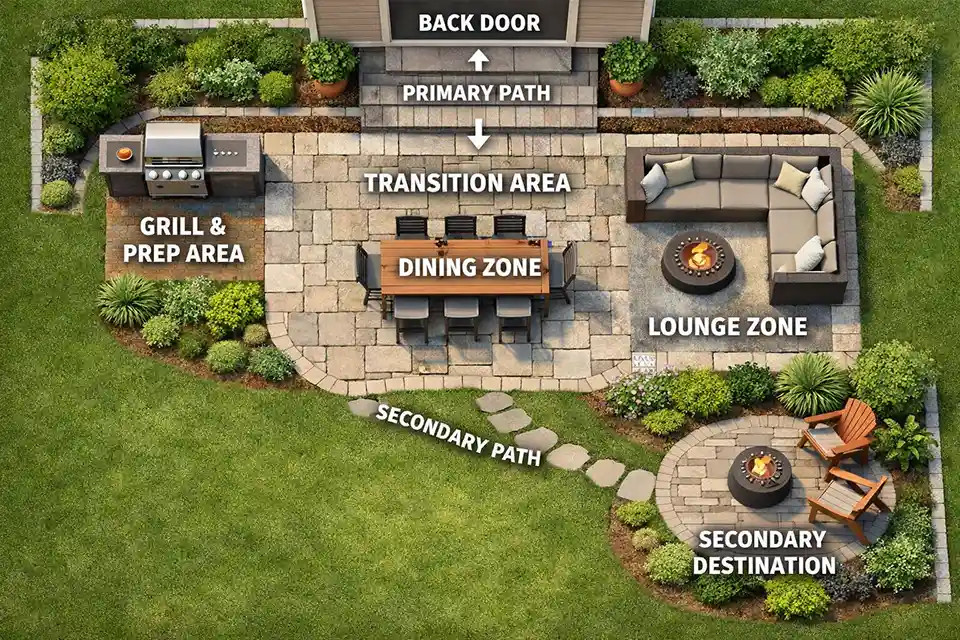
The cleanest way to fix outdoor flow is to choose the route first, the zones second, and the objects last. That order matters. Most failed backyards were designed in reverse.
Start by marking the two or three routes that matter most. In most homes, those are door to dining, door to grill, and door to gate, steps, or lawn. The main route should stay at least 36 inches clear, while 42 to 48 inches feels substantially better anywhere traffic overlaps with dining or frequent carrying. If your best path currently runs through chairs, the layout is already telling you the zones are in the wrong order.
Then decide which zones deserve adjacency and which deserve separation. Dining and grilling should usually sit near each other, but not in the same operating footprint. Lounging should stay close enough to feel connected, but offset from the main traffic line. Open play or open lawn needs uninterrupted shape, not leftover strips around furniture.
That is why some long narrow backyards feel worse than their square footage suggests. The shape encourages corridor behavior unless the zone sequence is deliberate, a problem that often appears in Backyard Design Problems in Long Narrow Yards.
| Zoning mistake | What people assume | What it really means | Better decision |
|---|---|---|---|
| Furniture blocks the first steps outside the door | The patio is just compact | The transition zone has been occupied | Keep the first 6–8 feet more open |
| Grill sits beside the table and feels crowded | The patio needs smaller pieces | Dining and cooking share one clearance zone | Keep them adjacent but not overlapping |
| Fire pit corner gets ignored | People prefer the patio | The destination lacks a connector | Add a direct route or merge the zone |
| Several small features fill the yard | More zones create more function | The yard is fragmented into micro-zones | Reduce to 2 main zones + 1 support zone |
| Lawn keeps getting cut through | People are taking shortcuts | The natural circulation line was ignored | Formalize the route instead of fighting it |
Pro Tip: When a backyard keeps producing the same shortcut, treat that line as design evidence, not bad behavior.
When the Standard Fix Stops Making Sense
Some fixes are worth trying. Some are delay tactics.
Moving a chair, rotating a table, or pulling a planter away from a route can improve a mild conflict. But if the yard still forces your main circulation through the dining area, the problem is no longer styling. It is a zoning failure. Matching cushions, new edging, or “better patio decor” will not change that.
This is also where readers often overestimate what separation can do. Adding more planters, borders, or little dividers may make the zones look more defined, but it can make flow worse by hardening too many boundaries. A backyard needs some flexible spill space so zones can expand temporarily when chairs are occupied or several people are moving at once.
The point where the standard fix stops making sense is when the yard is trying to support too many primary zones for its usable depth. If the patio cannot comfortably hold dining and lounging without the main route dropping below roughly 36 inches, one of those functions needs to move, shrink, or stop being a primary zone. That is a planning decision, not a décor decision.
This same pattern often gets mislabeled as a general furniture issue in Patio Layout Problems That Make Spaces Hard to Use, but the failure usually happened earlier, when the zones were assigned badly.
What Changes Under Real Conditions
Drainage can expose a zoning mistake that stays hidden in dry weather. A route across lawn may feel acceptable until the yard takes 0.5 to 1 inch of rain and the soil stays soft for 24 to 48 hours. At that point, the connector between zones is functionally broken.
This is why some “secondary” paths deserve hardscape or stabilization if they connect a high-use zone. A route that only works in perfect conditions is not a reliable route. Backyard Drainage Problems Homeowners Ignore often become flow problems before homeowners recognize them as drainage problems.
Climate also changes how a zone performs. In hot parts of Arizona, inland California, or similarly exposed summer climates, a seating zone with direct late-afternoon sun can become unusable between about 3 p.m. and 6 p.m. for much of the season. In that case, the zone may be correctly placed spatially but still fail functionally.
That is why thermal comfort belongs in zoning decisions, not just furniture selection. Backyard Design Problems in Hot Summer Climates matter here because a technically accessible zone can still be a dead zone if people avoid it for months.
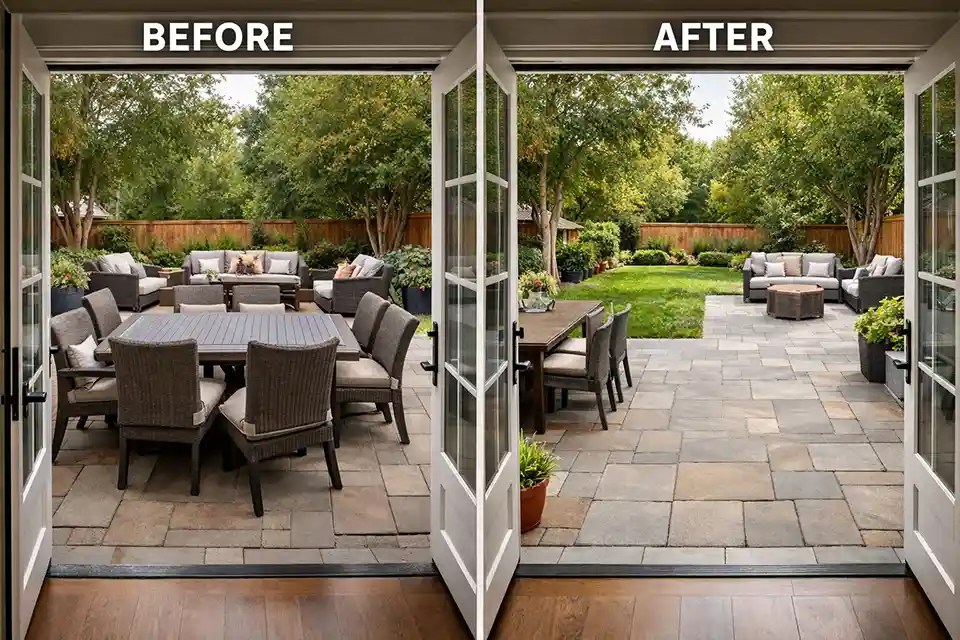
A backyard with good flow is not the one with the most features. It is the one with the fewest zone conflicts. That is the standard to use. Protect the main route, keep related zones close without stacking them into the same clearance, and stop giving every feature its own territory.
If a zone cannot be reached comfortably, cannot operate without blocking something else, or only works when no one is seated, it does not need better styling. It needs a different place in the yard.
See the University of Minnesota Extension landscape design guidance for a broader planning reference.