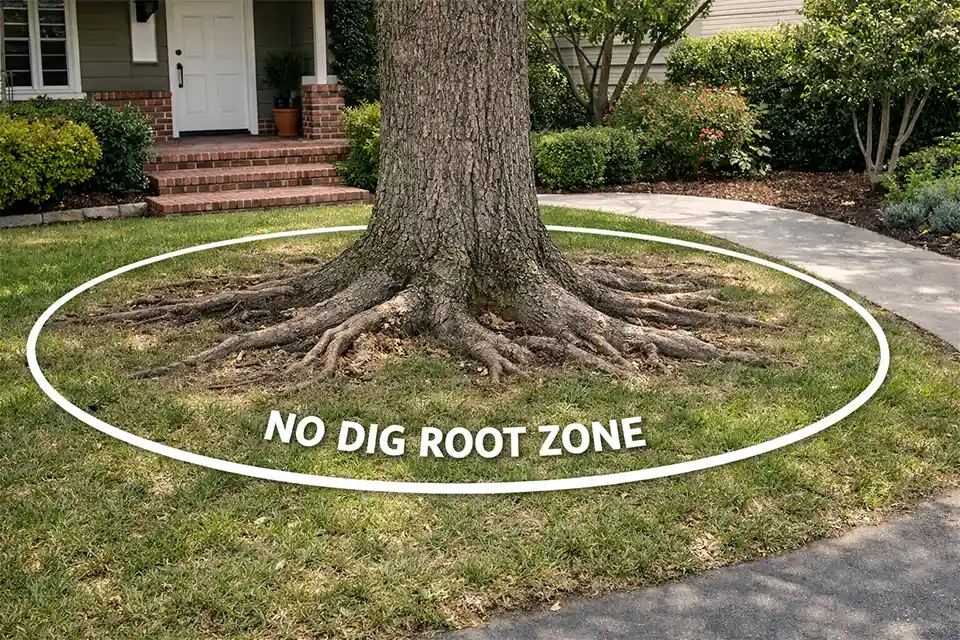
When tree roots control the front yard, the design problem is not how to decorate the space. It is how to stop the yard from fighting the tree. Start with three checks. Measure how close the work will be to the trunk.
If the redesign touches ground within about 10 to 15 feet of a mature shade tree, caution should rise fast. Check whether roots thicker than 1 to 2 inches are already visible at the surface. Then check how the soil behaves after rain or irrigation. If water lingers longer than 24 hours, added fill and compaction become even riskier.
This problem is often misread as a lawn issue, a shade issue, or an uneven-ground issue. Those can be symptoms, but the underlying mechanism is usually root dominance in the top 6 to 12 inches of soil. Once that is true, the site stops behaving like open planting ground.
In practice, the best front-yard design is usually the one that cuts the fewest roots, adds the least weight, and accepts a simpler finish in the heaviest root zone.
Quick Diagnostic Checklist
Pause the redesign and treat the tree as the main constraint if three or more of these are true:
- Surface roots are visible within 8 to 12 feet of the trunk
- The planned work needs trenching deeper than 4 to 6 inches
- You want to add more than 2 inches of soil, gravel, or base material
- Grass under the canopy stays thin even with irrigation
- Materials or equipment will sit under the tree for more than a few days
- The canopy already shows thinning, dead twig tips, or weak leaf-out over the last 2 to 3 seasons
If that list fits the site, the yard does not need a fuller planting plan first. It needs a lower-disturbance one.
What People Usually Misread First
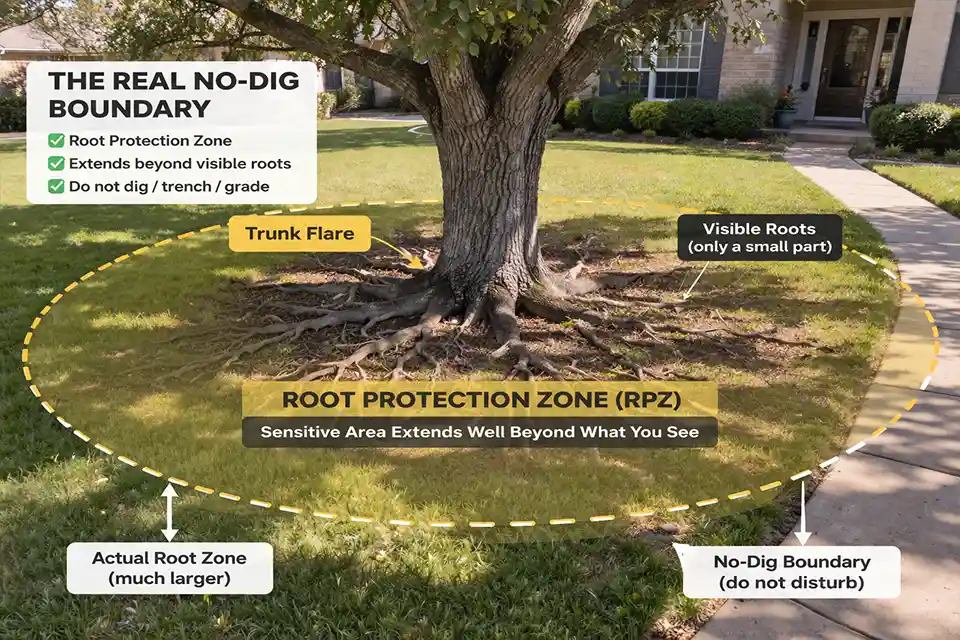
The first mistake is assuming the visible roots define the problem area. They do not. The roots you can see are only the warning sign. The feeder roots that do most of the work often spread far wider than homeowners expect, sometimes well past the drip line. Designing only around the exposed roots is how people end up damaging the more important root zone without realizing it.
The second mistake is thinking shallow work is automatically safe. It often is not. Repeated small disturbances stack up: resetting edging, running low-voltage wire, scraping out a planting strip, adding a little leveling soil, then revisiting the area the next month because it still looks unfinished. None of that sounds major in isolation. Together, it often creates the same outcome as one obviously bad job.
The third mistake is overrating neatness. A perfectly edged bed around a stressed tree is usually worse than a broader, softer mulch zone that leaves the soil alone. Once roots are close to the surface, tidy geometry starts costing more than it gives back. That same pattern shows up when tree roots lift sidewalks and damage front yard lawn: the visible mess is not the real issue. The real issue is that the site is already under pressure.
What Usually Works Better
Once the yard is root-dominated, design needs to shift from improvement by installation to improvement by restraint. The highest-value moves are usually these: widen mulch, reduce excavation, concentrate planting in real pockets rather than forcing continuous beds, and move visual interest toward edges, entries, or containers outside the densest root zone.
A practical threshold helps here. If you cannot install a plant without cutting multiple woody roots or scraping out a uniform hole 6 to 8 inches deep, that location has already failed the test. It is not a planting zone. It is a protection zone.
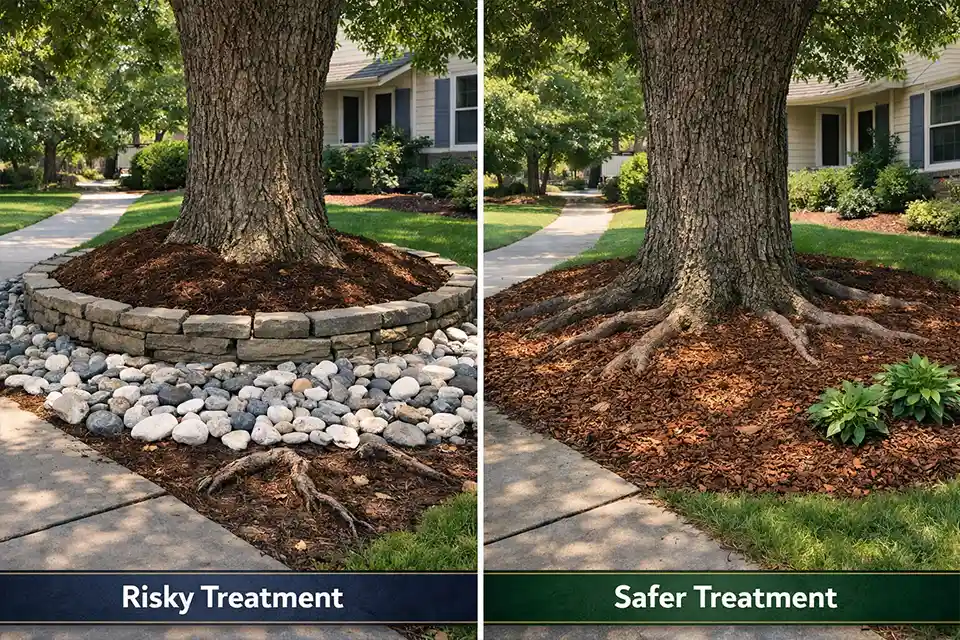
This is where people often waste time trying to “correct” the space into looking like the rest of the yard. A mature tree area usually works better as a quiet visual anchor than as a high-performance planting bed. Broad arborist mulch at about 2 to 3 inches deep, kept a few inches back from the trunk flare, generally ages better than decorative rock, dense shrub packing, or elaborate edging.
Plant selection still matters, but not as much as disturbance level. Small-rooted, shade-tolerant plants placed only where true pockets exist can work. Overplanting usually cannot. The same site logic often explains why front yard shade trees and grass not growing keeps showing up as a separate complaint when it is really part of the same root-zone constraint.
Pro Tip: If the area under the canopy still looks sparse after you simplify it, resist the urge to fill every gap. In root-heavy yards, visual breathing room often looks more intentional after one full growing season than forced fullness does after installation day.
The Fixes That Usually Waste Time
Three fixes disappoint more than homeowners expect.
Adding several inches of fresh soil feels productive because the yard looks smoother immediately. But once fill gets past about 2 inches over a broad active root area, the tradeoff usually turns bad. You may gain short-term visual control and lose long-term root health.
Deep continuous edging is another common miss. Steel, brick, and concrete borders can look like the clean answer, but they often require trenching right where the tree is most sensitive. That is especially wasteful when the edging exists mainly to force a sharp line around a site that is already telling you it wants softer boundaries.
Rock over landscape fabric is the third big one. It gets sold as low maintenance, but in root-heavy front yards it often becomes a hotter, harsher surface that still shifts over time and usually makes later adjustments harder, not easier. If the design goal is longevity, breathable mulch usually beats decorative rock here.
| Common move | Why it looks appealing | Why it usually fails | Better choice |
|---|---|---|---|
| Add 3–4 inches of soil | Hides roots and smooths grade | Can reduce air exchange and alter drainage | Limit fill and accept natural grade |
| Deep edging install | Creates crisp bed lines | Requires trenching through feeder roots | Use shallow or looser bed edges |
| Rock over fabric | Looks permanent and tidy | Traps heat, shifts, and is hard to correct later | Use mulch with minimal soil disturbance |
| Dense shrub planting | Makes the bed look finished fast | Increases competition and irrigation stress | Plant fewer specimens in true pockets |
| New path through root area | Improves circulation | Combines excavation with compaction | Reroute outside the densest roots |
When the Smart Decision Is to Stop Forcing It
Homeowners usually underestimate compaction and overestimate planting flexibility. In real front yards, the line where redesign stops making sense comes sooner than most people think. If the work requires repeated root cutting, frequent settling corrections, extra irrigation just to keep new plants alive, or ongoing patch repairs within 12 to 24 months, the design is not succeeding. It is being propped up.
That is the point to stop treating the area under the tree as unfinished. It may already be finished in the only way that makes sense for the site. A wide mulch ring, fewer materials, and cleaner transitions are not a compromise at that stage. They are the correct response.
Conditions can tighten further when the tree pressure is not even fully yours. Front yards influenced by neighbor trees causing front yard maintenance problems often feel strangely restrictive because roots are entering from off-site, reducing the workable soil volume even farther.
A Better Layout Strategy
The strongest layout in these yards usually shifts visual weight outward. Put more design energy near the sidewalk edge, entry sequence, foundation areas farther from the trunk, or containers that do not require excavation. Let the tree zone read as deliberate open structure, not as a failed bed waiting for more material.
This matters because “do less here” is not the same as “give up on the yard.” It is often the move that makes the rest of the front yard easier to design well. Once the high-conflict area stops consuming budget and labor, the rest of the plan gets clearer. That is also why so many supposedly inexpensive upgrades end up disappointing. They spend money where the site gives the lowest return, which is exactly the pattern behind cheap front yard ideas that cost more later.
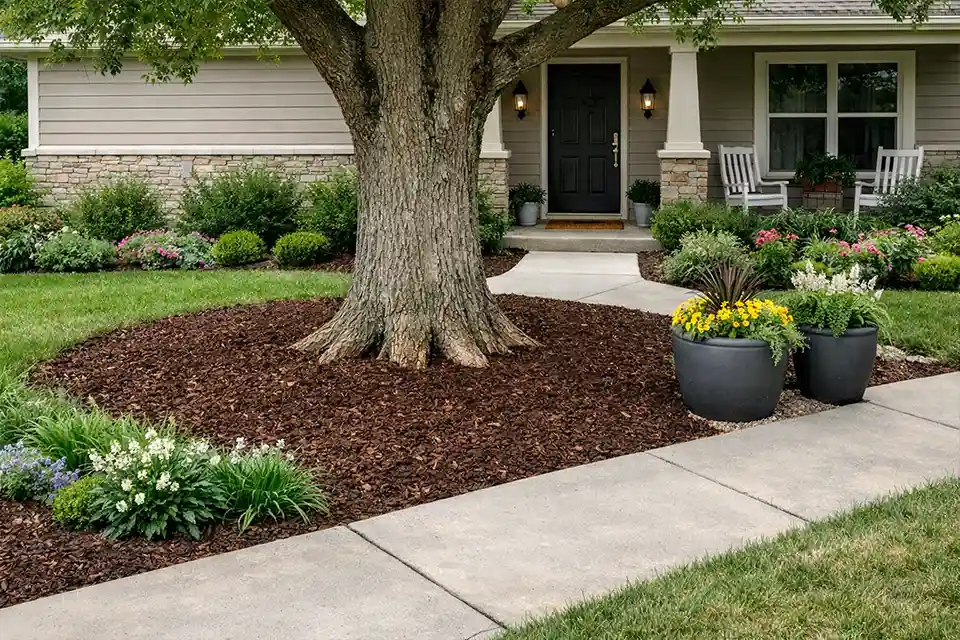
In these front yards, the winning design is rarely the fullest one. It is the one that recognizes when the tree has already decided what the yard can tolerate. Once roots dominate the upper soil, the best move is usually to disturb less, simplify sooner, and stop spending money trying to make a protected root zone behave like ordinary planting ground.
For broader official guidance, see the University of Florida IFAS Extension tree root management resources.