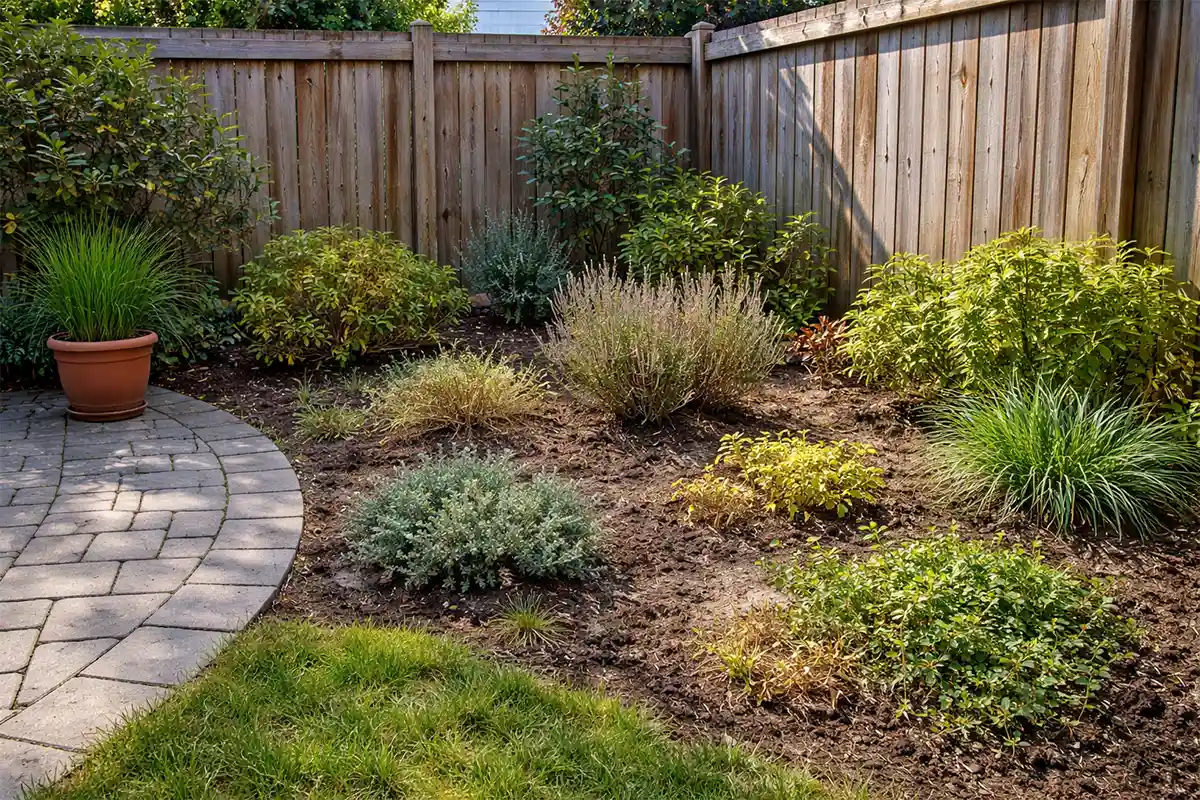
Small garden plants fail most often because tight spaces amplify stress that would be minor in a larger yard. When a planting bed is only 2 feet deep and slopes slightly—sometimes just 1/4 inch per foot—toward a fence or patio edge, water, heat, and root pressure concentrate along that narrow strip. What looks like random decline is usually a predictable response to confined soil depth, uneven runoff direction, and restricted airflow.
The issue typically begins where the plant’s root ball meets compacted soil near a hard boundary, such as a driveway edge or raised border. In that contact zone, even a small height difference between the center of the bed and the outer 12-inch perimeter changes how moisture drains and how roots spread. A one-time wilt during a heatwave is normal. A repeating yellowing line along the same fence alignment every summer is structural.
Early-stage behavior appears subtle. Leaves thin slightly along the outer edge closest to the siding line. Soil feels softer in one 2-foot section after rain while the rest of the bed drains evenly. The plant is not “weak”; it is reacting to concentrated environmental pressure in a confined footprint.
Many homeowners believe that if a plant is labeled “low-maintenance,” it should thrive anywhere in a small yard. That belief is incorrect. Low-maintenance assumes balanced light, consistent soil depth, and proper drainage. In compact gardens where walls, walkways, and borders redirect runoff and reflect heat, those conditions rarely exist naturally.
Why “Low-Maintenance” Plants Struggle in Small Yards
In a small yard where the bed runs parallel to a 6-foot fence and sits 18 inches from a concrete patio, heat and airflow shift dramatically within a short distance. The section closest to the hard surface warms faster in summer afternoons, while shaded corners near the fence retain moisture longer after rain. These micro-differences create uneven root behavior across just a few feet.
As explained in Why “Low-Maintenance” Gardens Never Stay That Way, maintenance increases when environmental stress accumulates in confined spaces rather than dispersing naturally. In small gardens, that accumulation happens quickly along defined lines—often the lowest slope or the narrowest section of soil.
You might notice that plants nearest the patio edge dry out faster than those planted 2 feet farther back. That difference is not random; it reflects how heat and runoff direction interact with shallow soil depth.
Limited Root Space and Hidden Competition
When two shrubs are planted 20 inches apart in a bed only 8 to 10 inches deep, their root systems collide beneath the surface long before the canopy fills in. The competition begins along the contact plane where roots meet compacted soil near a border or walkway.
From above, everything may look balanced. At ground level, however, one side may thin while the opposite side remains dense. This uneven growth pattern often follows the same alignment as a driveway edge or retaining wall. The constraint is physical, not nutritional.
Early fatigue appears as slower growth along the outer 1-foot strip. It does not yet look like failure, but the pattern is forming.
Drainage Imbalance in Tight Layouts
A subtle slope—barely visible when looking across a 10-foot span—can direct water repeatedly toward one corner of a bed. If that low corner sits just 1/2 inch below the opposite side, runoff will concentrate there during heavy storms. Soil in that 2-foot radius remains saturated longer, stressing roots differently than soil near the higher edge.
This recurring moisture line is often mistaken for plant sensitivity. In reality, it is a predictable effect of grade direction and boundary placement. When decline returns to the same zone season after season, it signals a repeating structural pattern rather than isolated plant weakness.
Microclimates Created by Structure
Small gardens bordered by siding, fencing, or stone walls experience intensified temperature swings. A dark fence panel can radiate stored heat into the nearest 12-inch planting strip for hours after sunset. Conversely, areas near shaded corners may stay damp and cool well into the morning.
You may stand at eye level and notice that foliage along one fence line appears lighter or thinner than plants just 2 feet inward. That visual cue reflects how microclimate shifts within confined dimensions.
Expert insight: Small garden plant failure begins when limited soil depth and boundary-driven microclimates concentrate stress along a consistent contact plane beneath the surface.
In compact landscapes, decline rarely starts dramatically. It begins with slight imbalance—height differences, slope direction, restricted root space—and becomes a pattern only when those physical conditions repeat across seasons.
When Small Garden Layout Magnifies Plant Weakness
In a compact yard, correction begins where measurable imbalance appears. If a planting bed drops 1/2 inch over 4 feet toward a fence line, water will consistently settle within that lower 2-foot strip. If the outer edge near a driveway sits 1 inch lower than the center of the bed, runoff direction favors that boundary every time it rains. Identifying that specific height difference or slope direction tells you exactly where to adjust.
Will a small slope change really matter?
Yes. A correction as small as 1/4 to 1/2 inch per foot can redirect runoff away from a root zone that has been repeatedly saturated.
If plants are failing along one fence line, is spacing the issue?
Often. Increasing the gap from 12 inches to 18 inches from a solid boundary improves airflow and reduces trapped heat.
Does adding fertilizer fix uneven growth along one strip?
No. If soil depth near the border is only 8 inches compared to 12 inches in the center, nutrients won’t solve restricted root volume.
Can shifting a plant just a foot inward change outcomes?
Yes. Moving a shrub 18 to 24 inches away from a reflective patio edge reduces heat concentration and root stress.
Correction happens where physical conditions repeat, not where symptoms appear first.
Rebalancing Slope and Runoff Direction
If runoff collects within the same 2- to 3-foot zone after heavy rain, the slope is guiding water there. Adjusting grade—even by adding soil to raise a low corner by 1 inch—changes the direction moisture travels. When water no longer settles along that outer strip, soil density stabilizes and roots regain consistent oxygen exposure.
In small gardens, slight adjustments carry visible results. A bed that once stayed damp near the siding line for 48 hours after rain may now dry at the same pace as the center. That visible timing shift is proof the slope correction altered behavior.
A common belief is that installing drainage fabric alone solves pooling. Fabric does not change grade. If the surface still tilts toward the same boundary, water will continue following that path.
Expanding Functional Root Space
Limited soil depth near borders often compresses roots into an 8-inch band. Increasing soil depth by even 2 inches across the outer 12-inch perimeter changes how moisture distributes. When the root zone expands from 8 inches to 10 or 12 inches deep, plants experience less fluctuation during temperature swings.
In beds that narrow from 3 feet to 18 inches, redistributing plant spacing reduces underground competition. Moving one shrub 20 inches away from its neighbor creates measurable separation. As root overlap decreases, foliage growth becomes more uniform along that previously stressed strip.
The physical change is simple: more soil volume, less compression. The visible result is steadier canopy density along the border rather than thinning near the edge.
Adjusting Boundary Exposure
Plants placed within 12 inches of a dark fence or stone wall absorb concentrated heat during summer afternoons. Relocating sensitive species 18 inches inward reduces that temperature spike. You may notice leaf edges no longer curling along that same fence alignment.
Similarly, trimming back overhanging structures that cast heavy shade on one 2-foot section improves light balance. If the shaded corner previously stayed damp two days longer than the center, improved airflow can reduce that gap to a single day.
As discussed in Small Garden Landscaping Without Lawn: Hidden Problems, removing turf without adjusting drainage often concentrates moisture along borders. When you correct spacing and slope together, the stress line weakens rather than relocating.
Correcting Design Imbalances Instead of Replacing Plants
Replacing a struggling plant without addressing layout rarely changes long-term behavior. If a 10-foot bed slopes subtly toward the patio edge, shifting the pitch by 1 inch over that span alters runoff entirely. Once water moves away from the outer 12-inch strip, repeated decline slows.
Small Garden Design Principles That Work emphasize alignment and proportion. When beds maintain consistent depth and avoid abrupt elevation shifts near borders, stress distribution becomes more even across the entire footprint.
The goal is not dramatic redesign. It is targeted physical correction where imbalance is measurable.
When a bed drops 1 inch toward a siding line over 4 feet and that grade is raised to level, runoff no longer settles in the same 2-foot band and foliage there remains upright after storms. When two shrubs planted 18 inches apart are spaced to 30 inches within a 3-foot bed, root competition decreases and the outer leaves regain density. When soil depth along a driveway edge increases from 8 inches to 12 inches, moisture stabilizes and the previous yellowing line fades. When a plant is shifted 24 inches inward from a heat-reflecting wall, leaf scorch along that boundary reduces noticeably.
Each adjustment changes a measurable physical condition. Each visible outcome confirms the pattern is weakening.
In compact gardens, the sequence is clear. Adjust the height difference, slope direction, spacing, or soil depth, and behavior shifts. When behavior shifts, repeat failure along that same narrow strip begins to fade.
What Stability Actually Looks Like in a Small Garden
Stability in a small garden is visible, not theoretical. After a heavy rain, water should no longer collect within the same 2- to 3-foot strip near the fence line or patio edge. If the bed slopes slightly—about 1/4 inch per foot—it should direct runoff away from the siding line rather than toward it. Soil along the outer 12-inch perimeter should feel as firm underfoot as the center of the bed.
Foliage should appear consistent across the full 10-foot span, not thinner along one driveway edge. The plant nearest the border should not wilt hours before the one planted 2 feet inward. When you stand at eye level and look across the bed, the canopy height should look even rather than dipping along a narrow strip.
Stability means repeated stress no longer returns to the same measurable zone.
What Should Stop Happening
Once corrections take hold, certain patterns should disappear. Water should not settle in the same corner after two consecutive storms. Leaves should not repeatedly yellow along the same 18-inch section beside a fence. Soil near a boundary should not remain damp 24 hours longer than the rest of the bed.
If decline once followed a visible alignment—like a line parallel to a walkway—that alignment should no longer mark weaker growth. You should not see a recurring 1-inch gap between soil and border after seasonal temperature shifts. The same 2-foot section should not struggle year after year.
When repetition stops, the structure is working differently.
Recognizing Incomplete Correction
A common belief is, “If it looks healthy this week, it’s fixed.” That belief is misleading. One dry stretch does not confirm long-term stability if the slope still tilts 1/2 inch toward the patio edge. Visible dryness after a single rainfall cycle proves nothing if runoff direction has not changed.
Incomplete correction shows up as delayed return. The bed may appear level at first, but after a few months, moisture once again settles along the same siding line. Leaves near that 12-inch perimeter begin thinning subtly. If the measurable height difference or soil firmness was only partially addressed, the pattern slowly rebuilds.
True stability holds across multiple weather cycles, not just one.
If the Pattern Is Ignored
When small imbalances are left alone, the sequence is predictable. Water collects near a border. Soil softens over several months. Root systems in that 2-foot zone weaken. The visible decline expands from a narrow strip to a wider 3-foot band.
What begins as minor uneven growth becomes a broader area of stress. The slope may shift further as soil settles, increasing the height difference by another 1/4 inch. Repetition reinforces the imbalance until the entire bed behaves unevenly.
Small patterns widen when ignored.
When to Monitor, Adjust, or Intervene
Monitoring Stage
A slight difference in growth appears along a 12-inch strip but does not expand after one or two rainfall cycles.
Adjustment Stage
The same 2- to 3-foot area shows repeated moisture imbalance or foliage thinning across a full season.
Structural Intervention Stage
The visible impact zone widens beyond its original alignment, or measurable slope shifts by more than 1/2 inch toward one side.
These stages are based on observable repetition, not guesswork.
Field Check: Is It Actually Stable?
Driveway edge or border line remains level within 1/2 inch across a 4-foot span.
Runoff consistently flows away from the siding line after two heavy storms.
No recurring pooling within the same 2- to 3-foot zone.
Soil firmness feels consistent across the entire bed.
Foliage density remains even along fence and center sections.
No repeating leaf scorch along a heat-reflective boundary.
No gradual widening of thin growth along a straight alignment.
According to the United States Department of Agriculture, long-term plant performance depends on consistent soil drainage, root space, and climate alignment rather than short-term appearance.