After a heavy rain, the lawn feels different under your feet. The top of the slope looks normal, but near the sidewalk the soil is darker, softer, even slightly sunken. That subtle shift is often the first sign the slope isn’t handling water properly.
At first it seems harmless. Water runs downhill. But over time the yard behaves differently than a flat lot: grass thins in one strip, mulch collects in another, and puddles appear where the ground used to stay dry. From the street it still looks fine, yet the way water moves across it slowly reshapes the soil year after year.
Why Slopes Amplify Drainage Problems
After a storm, you can often trace thin lines in the soil where water rushed down. On a flat yard, rain soaks in slowly. On a slope, it picks up speed. That extra speed is what turns normal rainfall into a drainage problem.
As water moves faster, two things happen:
-
It has less time to soak into the soil.
-
It begins to carry fine soil particles downhill.
Soil Erosion and Nutrient Loss
You might notice mulch collecting at the bottom of the slope after every storm. Or a patch of lawn that refuses to thicken no matter how much seed you spread. Those are surface clues of erosion at work.
When topsoil moves downhill, it takes nutrients with it. That upper layer is where most roots feed. Once it thins out, plants struggle even if rainfall is consistent.
Over time, erosion creates repeating patterns:
-
The top of the slope becomes slightly exposed and compacted.
-
The middle develops shallow channels.
-
The bottom collects loose soil and organic debris.
This uneven distribution changes how water behaves during the next storm. The exposed upper area sheds water even faster, and the lower section stays damp longer than intended.
Another common misunderstanding is assuming erosion only happens on very steep hills. Even modest suburban slopes can lose soil gradually. Because the change is slow, many homeowners only notice it when grass begins to fail or edges near the walkway start to sink.
Foundation and Hardscape Vulnerabilities
You may see water pooling near the porch steps or along one edge of the walkway. It might disappear within a few hours, so it seems harmless. But repeated pooling in the same spot is rarely random.
When runoff flows toward the house instead of away from it, pressure builds against foundation walls. In colder regions, freeze-thaw cycles expand small cracks, making them larger over time. What begins as minor dampness can become structural stress.
Hardscape elements show warning signs too:
-
Pavers shift slightly out of line.
-
Concrete edges develop hairline cracks.
-
Steps settle unevenly.
These shifts often follow seasons of heavy rain rather than a single dramatic event. The slope directs water consistently, and consistency is what slowly weakens support beneath these surfaces.
It is easy to blame age or installation quality. In many cases, the real trigger is the way water is being guided across the yard.
The Hidden Cost of Poor Grading
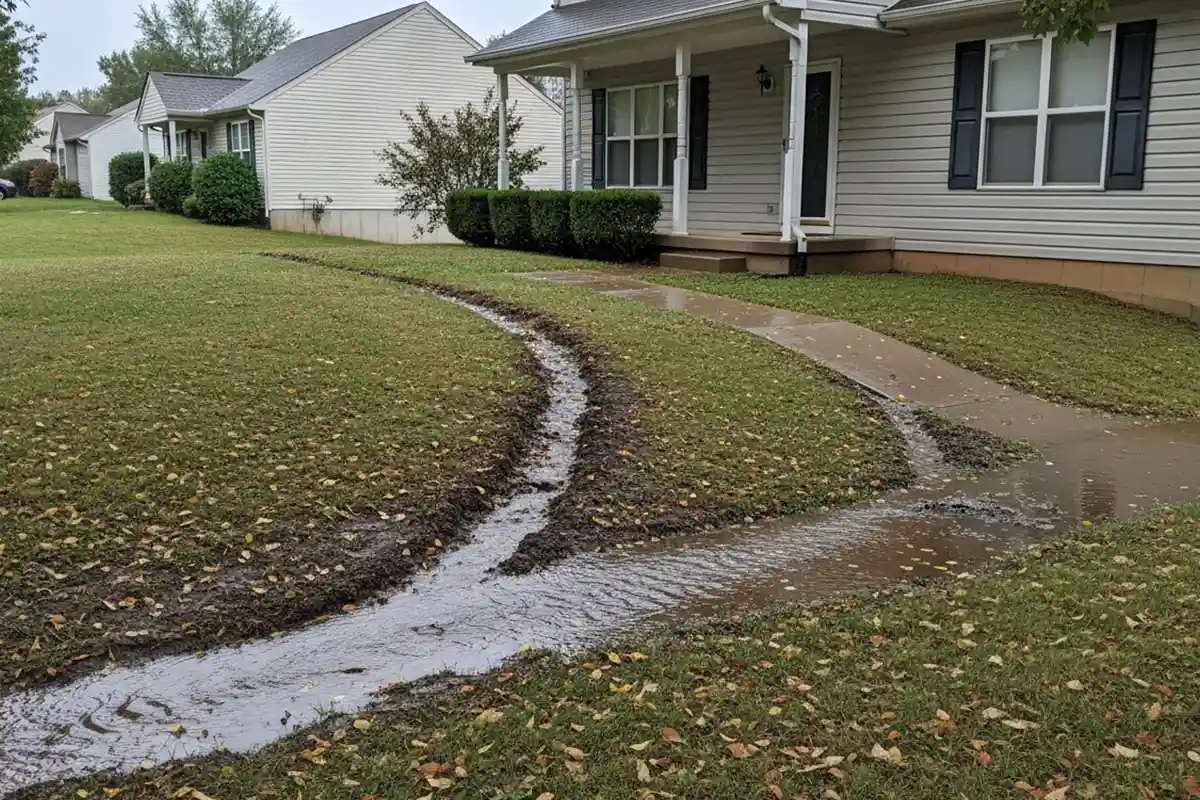
After a renovation or driveway repair, the yard may look smooth and freshly shaped. Yet during the next heavy rain, water seems to drift toward the house instead of the street. That subtle shift often points to grading changes.
Poor grading rarely looks dramatic. Instead, it creates small elevation differences that redirect flow in unintended ways. Even a difference of one or two inches can determine whether water spreads out or concentrates near the foundation.
Here is how grading issues usually show up in daily use:
-
Water lingers longer near the front door area.
-
Soil feels firmer and more compact near the base of the slope.
-
Grass struggles in narrow strips where runoff accelerates.
Homeowners sometimes assume that as long as water eventually drains away, there is no issue. The problem is not only standing water. It is repeated directional flow that slowly shifts soil and increases pressure near structural edges.
Drainage Misreadings at a Glance
| What You Notice | What You Assume | What Is Actually Happening |
|---|---|---|
| A muddy patch at the bottom of the slope | The soil just holds more water there | Runoff is carrying fine particles downhill and concentrating moisture in one zone |
| Small cracks in the walkway | Normal settling over time | Water is eroding support beneath the hardscape |
| Grass thinning in narrow streaks | Poor seed quality | Fast-moving surface water is preventing roots from stabilizing soil |
Pet Traffic and Compacted Runoff Paths
If you have a dog, you probably recognize the diagonal track they prefer when running downhill. That path may look harmless in dry weather. After rain, it often turns into the first muddy strip on the lawn.
Repeated paw traffic compacts soil. Compacted soil does not absorb water easily. So when it rains, water follows the hardened route instead of spreading out.
Over time, this pattern creates a chain reaction:
-
Soil along the path becomes denser.
-
Water speeds up along that line.
-
The lower end of the path stays muddy longer.
In colder climates, that compacted strip can freeze more quickly, making it slick. The slope itself has not changed, but daily use reshapes how water behaves.
Many homeowners focus only on plant choice when managing sloped yards. In reality, daily movement, soil structure, and gravity work together. Once you start noticing where water travels and how the ground feels after rain, the broader drainage story becomes much clearer.
Regrading and Contour Correction Strategies
After a heavy storm, you may notice that water no longer spreads evenly across the slope. Instead, it favors one side, hugging a shallow dip you barely see when the ground is dry. That subtle redirection usually begins with grading shifts that happened months or even years earlier.
Soil does not stay perfectly shaped. Seasonal settling, small construction changes, or added soil near the foundation can alter the pitch just enough to change runoff behavior. On a sloped front yard, even minor contour differences influence how quickly water accelerates and where it concentrates.
Over time, misaligned grading creates layered effects:
-
Upper sections dry faster and compact.
-
Mid-slope areas develop shallow, repeating runoff lines.
-
Lower zones receive excess sediment and moisture.
These patterns reinforce themselves with every storm. The slope gradually becomes less uniform, and water begins to carve predictable paths rather than dispersing naturally.
Retaining Walls and Terracing for Water Control
Standing halfway up the yard, you can often feel the change in footing where one level meets another. A retaining edge interrupts the flow in a way open soil never does. That interruption is not only visual; it changes how force moves downhill.
When a long slope is divided into shorter segments, water loses momentum at each break point. Instead of building speed across the entire yard, it pauses, spreads, and then continues at a reduced intensity. This staged descent lowers erosion pressure across the surface.
Terracing influences structural behavior in several ways:
-
It reduces the uninterrupted length of runoff.
-
It redistributes soil weight more evenly.
-
It alters how moisture accumulates behind structural edges.
Without internal drainage, however, water can build up behind retaining elements. That hidden pressure may not show immediately, but over time it affects wall stability and surrounding soil density.
Why does my sloped yard feel slippery even when it looks dry?
You step onto the lawn in late afternoon and it looks normal. The surface appears dry, yet your shoes slide slightly on the incline. That mismatch between appearance and traction often raises concern because it suggests something is happening below the surface.
Slipperiness on a slope does not always mean visible mud. It can signal subtle moisture retention, compacted soil layers, or material interactions that are not obvious at a glance.
Is the grass wet even if I cannot see water?
Moisture can sit just below the surface after earlier rainfall. On a slope, subsurface water moves slowly, leaving the top layer looking dry while roots and soil beneath remain damp.
Does compacted soil make slipping worse?
Yes. Compacted areas reduce grip because roots cannot anchor deeply. The surface becomes smoother and less textured, especially along repeated foot paths.
Can certain shoes increase the slipping sensation?
Footwear with flat soles or worn tread has less traction on inclined grass. Even mild dampness becomes noticeable when grip is limited.
Does temperature change how the slope feels?
Cool evenings can bring condensation that lightly coats grass blades. On an incline, that thin layer reduces friction more than on flat ground.
Can lighting make the yard seem drier than it is?
Bright sunlight can mask subtle sheen on grass. Shadows later in the day often reveal uneven moisture patterns that were not obvious earlier.
Is the material near walkways part of the issue?
Yes. Fine sediment washing onto hard surfaces can create a thin, slick layer. When it transfers back onto the lawn, traction decreases.
These variations show that a slope interacts with moisture, temperature, and daily use in ways that are easy to misread.
French Drains and Subsurface Diversion Systems
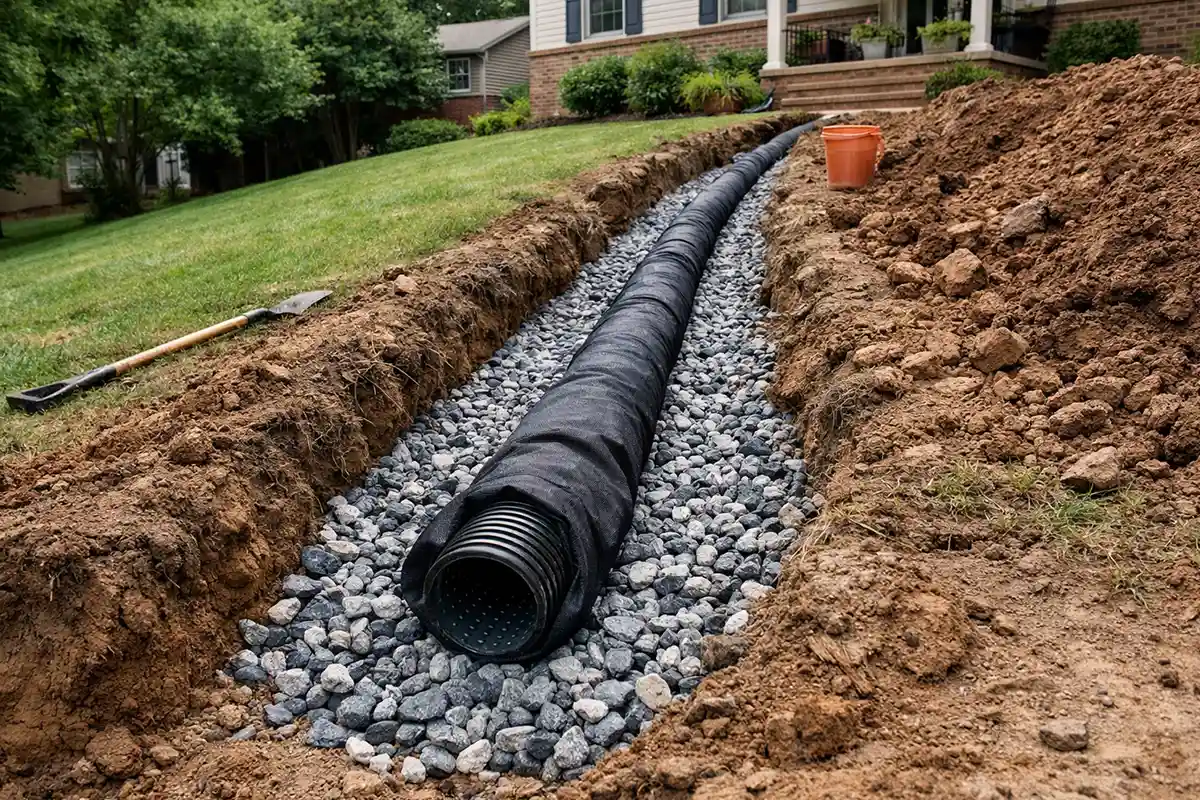
Digging into the slope often reveals damp soil layers that never fully dry between storms. Surface runoff is only part of the picture. Water also travels laterally beneath the visible ground, especially in clay-heavy regions.
A subsurface drain intercepts that hidden movement. Instead of allowing moisture to build near the base of the slope or along the foundation, the system collects and redirects it. Placement matters because underground flow does not always match visible surface lines.
Subsurface systems influence:
-
Long-term soil density near structural edges.
-
Root oxygen availability.
-
Seasonal freeze-thaw expansion in saturated zones.
If the pipe slope is too shallow, water lingers inside the system. If too steep, it may bypass sections of saturated soil. Balance determines whether the system manages gradual accumulation or merely channels peak flow.
Runoff Path Interaction Matrix
| Surface Condition | Subsurface Behavior | Long-Term Impact | Visible Sign |
|---|---|---|---|
| Compacted upper slope | Reduced infiltration | Faster surface runoff | Thin grass strips |
| Mid-slope clay layer | Lateral water movement | Prolonged damp zones | Slight soil sheen |
| Poorly pitched drain line | Partial water retention | Localized saturation | Soft ground near trench |
| Uneven grading | Concentrated flow lines | Soil displacement | Shallow grooves |
| Repeated pet traffic | Compressed soil channels | Accelerated runoff path | Muddy diagonal strip |
This matrix highlights how surface and subsurface dynamics reinforce each other over time.
Permeable Surfaces and Runoff Reduction
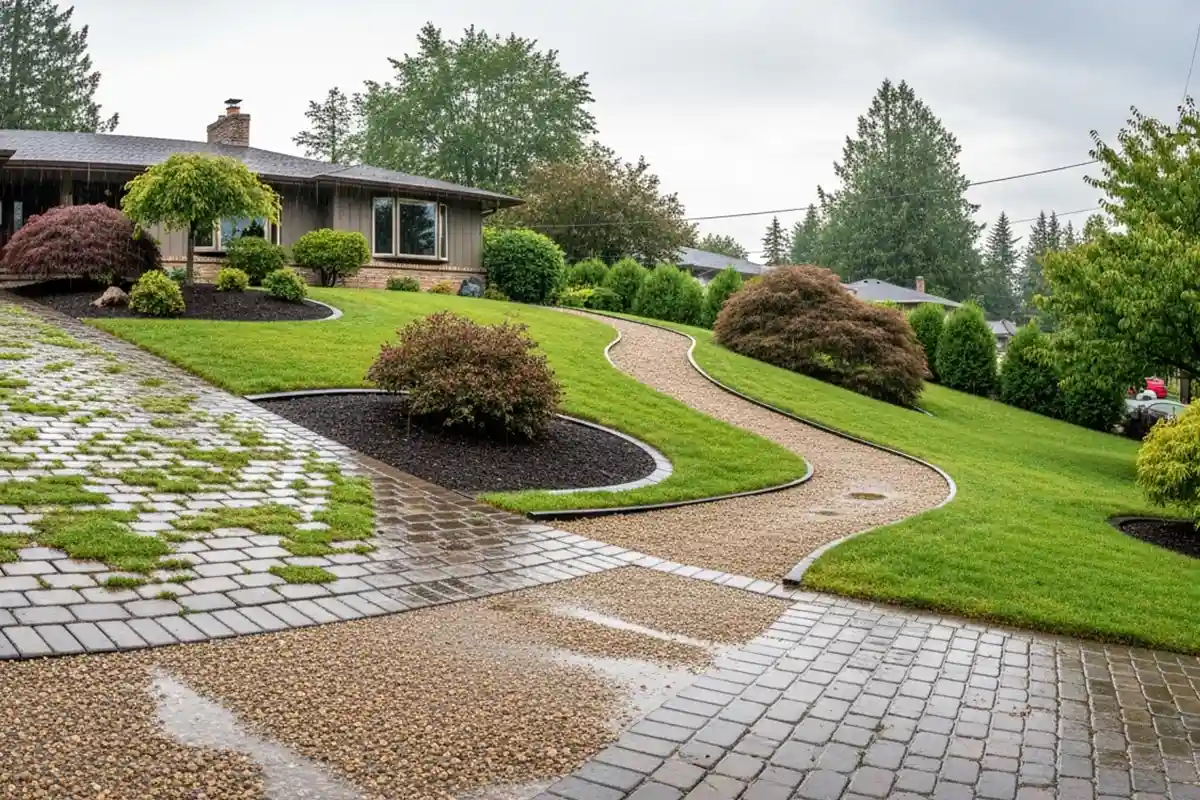
After rain, you may notice that water races off concrete but slows over gravel. Hard surfaces do not absorb moisture, so they accelerate runoff on a slope. That added volume increases pressure on lower sections of the yard.
Permeable materials change the timing of water movement. Instead of shedding everything at once, they allow partial infiltration into a prepared base layer. This reduces peak flow intensity during storms.
However, performance varies by condition:
-
Steeper grades require stronger edge stabilization.
-
Debris-filled joints reduce permeability over time.
-
Heavy rainfall can exceed infiltration capacity temporarily.
Permeable surfaces do not eliminate runoff. They redistribute its timing and reduce concentration, which alters how the entire slope responds during repeated storms.
Behavior Under Changing Conditions
Seasonal rainfall intensity
Heavier storms amplify small grading flaws and expose weak runoff paths more quickly.
Soil composition shifts
Clay retains subsurface moisture longer, while sandy soil drains faster but erodes more easily.
Temperature variation
Freeze-thaw cycles expand saturated soil, subtly altering surface pitch over time.
Daily traffic patterns
Repeated movement compresses specific zones, redirecting water into narrow channels.
Each condition interacts with the slope differently, reshaping drainage behavior gradually rather than all at once.
The combined influence of grading, subsurface flow, material choice, and daily use determines how drainage issues evolve rather than remain static.
Deep-Rooted Planting for Soil Stabilization
A slope that once shed soil after every storm can begin to hold its shape when root systems thicken beneath the surface. Instead of seeing faint runoff lines after rainfall, you notice that water slows down and spreads more evenly across planted areas. That shift often comes from choosing vegetation that anchors the soil rather than simply covering it.
Deep-rooted grasses and structural shrubs change how the ground behaves. Their roots extend vertically and laterally, forming a dense network that resists movement when water accelerates downhill. On moderate slopes, this biological reinforcement can reduce surface displacement without altering the overall layout.
The impact becomes visible in daily use:
-
Bare streaks gradually fill in as roots stabilize loose soil.
-
Mulch remains in place longer after storms.
-
The lower edge of the slope collects less sediment.
In minor erosion scenarios, planting adjustments alone may be sufficient. In moderate cases, root systems support other drainage elements by improving infiltration and reducing runoff speed. On severe slopes with heavy clay and repeated channeling, planting alone may not counteract underlying grading flaws.
This approach can fail when soil remains compacted or when runoff volume exceeds what roots can manage. If deep-rooted plants are installed without improving soil structure, water may continue to skim across the surface rather than penetrate it. In those cases, visible greenery masks persistent instability.
Mulch and Surface Layer Corrections
Improper application creates its own issues:
-
Excess depth traps moisture against plant stems.
-
Uneven layering forms ridges that redirect water unpredictably.
-
Lightweight material on steep grades accelerates displacement.
When surface layers are corrected thoughtfully, the yard feels more stable underfoot and less reactive after storms.
Strategic Rock Placement and Dry Creek Beds
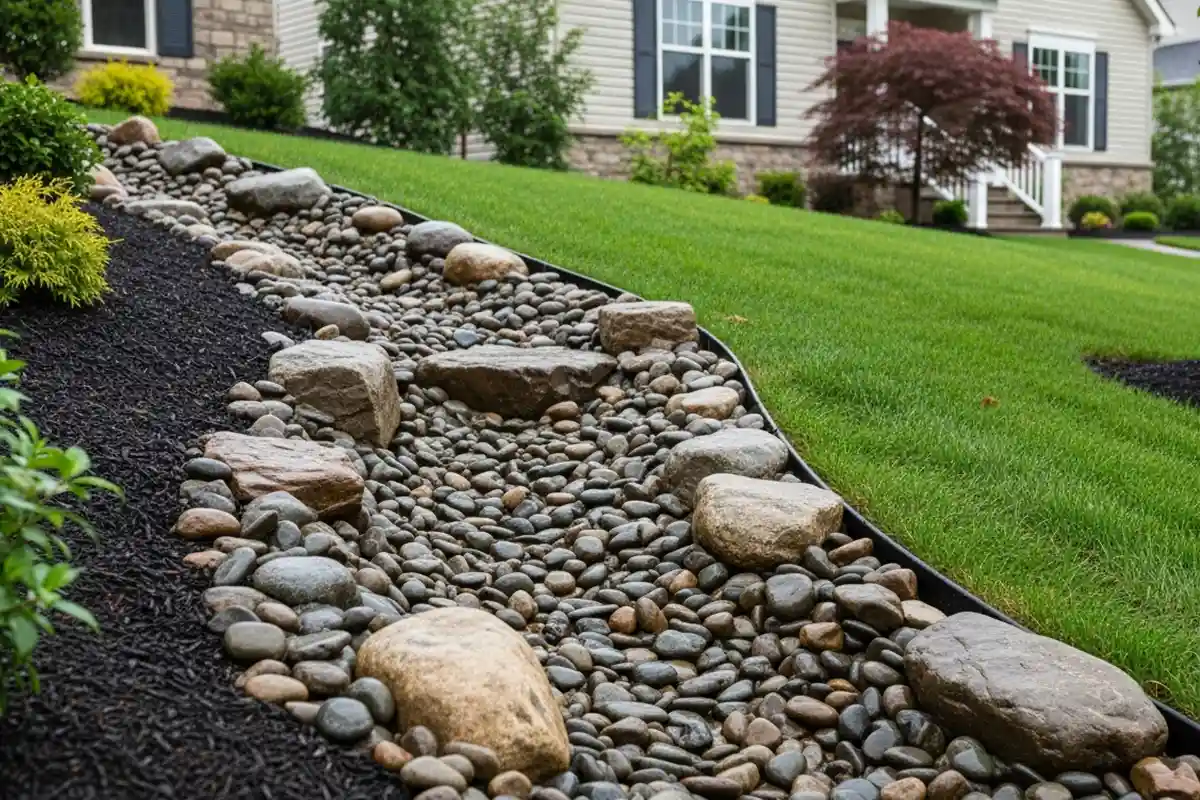
When runoff follows the same path during every storm, shaping that path intentionally can change the entire feel of the yard. Instead of random channels forming, a defined rock-lined corridor guides water where it is expected to travel. After installation, storms tend to look more controlled rather than chaotic.
Dry creek beds function as surface-level energy reducers. Larger stones slow water speed, while smaller aggregate distributes flow across the channel base. On moderate slopes, this redirection prevents adjacent planting beds from being stripped of soil.
Their performance varies by severity:
-
Minor scenarios benefit from narrow decorative channels.
-
Moderate slopes require layered stone sizes for stability.
-
Severe grades demand deeper excavation and reinforced edging.
Failure occurs when rock placement ignores natural flow lines. If installed where water does not typically move, runoff simply bypasses the channel and continues eroding vulnerable areas. Incorrect stone sizing may also allow sediment buildup, reducing capacity over time.
Managing Downspouts and Roof Runoff
During heavy rain, you may notice concentrated streams pouring from downspouts onto the upper section of the slope. Redirecting that discharge often changes how the entire yard behaves in subsequent storms. Water that once carved grooves may begin dispersing more evenly.
Extensions or buried lines that carry roof runoff away from the immediate slope reduce peak flow concentration. In minor cases, modest extension length can decrease erosion significantly. In moderate to severe scenarios, discharge may need to be guided toward designated exit points or infiltration zones.
Observable improvements include:
-
Reduced soil displacement directly below downspouts.
-
Fewer muddy streaks forming after storms.
-
Less pooling near walkway edges.
This strategy fails when extensions discharge water onto another vulnerable section of the slope. Misaligned piping can unintentionally transfer the problem rather than resolve it. Clogged lines also reverse flow direction, pushing water back toward foundations.
Integrated Slope Stabilization Framework
When grading, planting, and runoff control work together, the yard handles storms more calmly. Instead of sudden washouts, changes become smaller and more predictable, especially during back-to-back rain.
Minor issues improve with small adjustments. Moderate slopes need both surface and subsurface coordination, while severe grades require structural correction first. If grading remains flawed, surface fixes only hide the problem, and drainage without flow correction leaves weak spots behind.
Self-Assessment Checklist for Ongoing Stability
-
Runoff lines reappear in the same location after each storm.
-
Soil feels noticeably softer at the base of the slope.
-
Pavers or walkway edges show slight seasonal movement.
-
Grass density varies sharply between upper and lower sections.
-
Mulch shifts downhill more than two inches after rainfall.
-
Downspout discharge creates visible splash zones.
-
Rock channels collect sediment instead of guiding water.
-
Pet paths remain muddy longer than surrounding turf.
If several of these indicators persist despite adjustments, deeper structural intervention may be necessary.
Even with corrections in place, slopes continue to respond to weather patterns, soil shifts, and daily use. Watching how the yard behaves after each season often reveals whether changes are stabilizing the system or simply masking underlying movement.