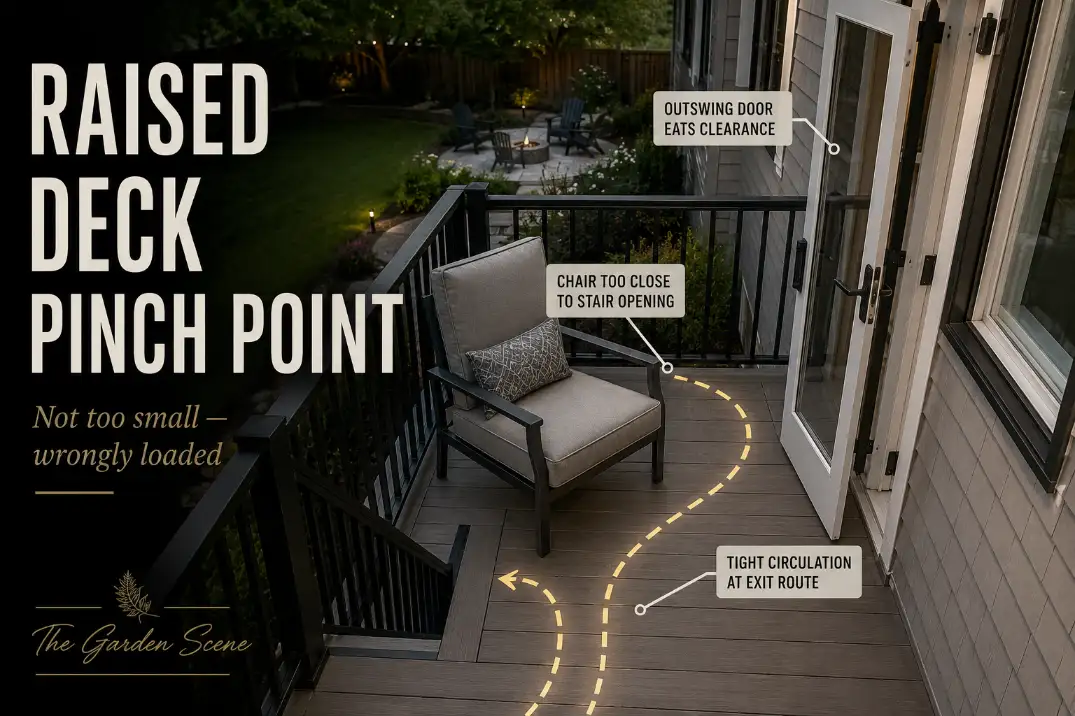
A raised deck usually fails near the back door before it fails anywhere else. The deck may not be too small; the first movement zone may simply be overloaded.
Check three things first: whether the door has at least a 36-inch clear landing area, whether the stair approach stays open without a sideways step, and whether chairs or a grill expand into the route during use.
A layout that looks fine empty can fail within 10 minutes of dinner because a 30-inch-deep chair, an open grill lid, or a screen door swing enters the same space. This is different from a general small-deck problem.
The issue is not total square footage first. It is whether the first 4 to 6 feet outside the door are being forced to work as landing, hallway, dining edge, stair approach, and cooking access all at once.
The Back Door Pressure Point
The landing is a decision zone, not leftover space
The most important part of a raised deck is often the plainest part: the first few feet outside the back door. That area decides whether the deck feels safe, smooth, and easy to use. A 180-square-foot deck can still feel awkward if the landing zone is pinched, while a smaller deck can work well if the route is protected.
Treat the back door area like an exterior hallway. A 36-inch clear path is the practical minimum; 42 inches feels noticeably better when someone is carrying food, opening a screen door, or stepping around another person.
If the landing is less than 36 inches deep in the direction of travel, the deck starts forcing small corrections every time someone exits.
This is where many layouts get misread. Homeowners often blame the stairs because they are the visible interruption. More often, the real mechanism is that the door landing has been turned into a furniture edge.
The symptom is “the stairs feel too close.” The mechanism is “the route has no protected pause point.”
A good first move is to compare the deck empty against the deck in use. Open the door fully, pull one dining chair back 24 to 30 inches, and imagine someone carrying a tray toward the stairs. If those actions overlap, the layout is not just tight; it is asking one zone to perform too many jobs.
For tighter decks, the route logic in Small Deck Layouts That Keep a Clear Route applies especially well because the goal is not to fill the deck evenly. It is to keep the movement line obvious.
Door type changes the real clearance
A sliding glass door creates fewer swing conflicts, but it still needs a landing where someone can pause before turning toward the stairs. An outswing door, storm door, or screen door is less forgiving because it can steal working depth exactly where the deck already needs breathing room.
If the door forces a person to step backward, turn sideways, or shift around furniture within the first 3 feet, the landing is failing. That is true even if the deck technically has enough square footage elsewhere.
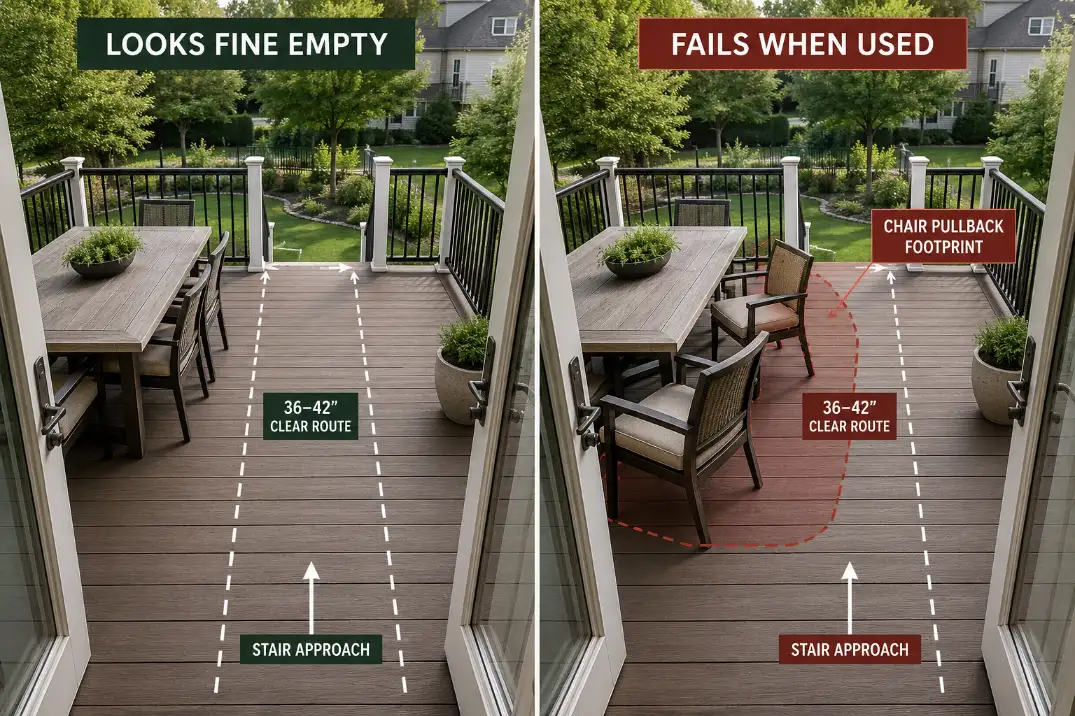
Quick diagnostic checklist
- The door opens toward furniture, the stair edge, or a grill zone.
- A chair pullback overlaps the main route by more than 6 inches.
- Guests step sideways within the first 3 feet outside the door.
- The stair opening is visible, but the approach path is interrupted.
- The deck feels fine empty and crowded within the first 10 minutes of use.
- Wet leaves, snow melt, or water collect where people pause before using the stairs.
Pro Tip: Test the layout with furniture pulled out, not tucked in. Decks are used in their expanded state, not their staged state.
When Stairs Steal Space
Stairs do not just remove square footage
Stairs steal more than the rectangle they occupy. They also claim an approach lane, a turning zone, a visual safety buffer, and a no-clutter edge. On a raised deck, that invisible footprint often matters more than the stair opening itself.
A 36-inch-wide stair may need a 36-inch landing and a clean approach that feels closer to 42 inches in daily use. If the stairs turn immediately beside the back door, the deck can develop a funnel effect: people exit the house, hesitate, then choose between stepping toward the stairs or cutting around a chair.
That hesitation is a stronger warning sign than the actual deck size.
The common waste-of-time fix is pushing furniture tighter against the rail. It may open a strip of deck on paper, but it often makes the seating less usable and leaves the stair approach psychologically exposed.
People do not like sitting with their chair backs inches from a stair opening, especially on decks elevated more than a few feet above grade.
The guidance in Keep Patio Entry Clear fits this raised deck problem because the entry area must stay readable before any styling decision matters.
Where the stair opening hurts most
| Stair position | Usual problem | Best first move |
|---|---|---|
| Beside the back door | Fastest landing pinch | Keep furniture off the door-side lane |
| Centered across the deck | Symmetry looks good but blocks flow | Shift dining or seating to one side |
| One far corner | Usually easiest to protect | Preserve a clear diagonal route |
| Turned stair with landing | Better pause point, larger footprint | Keep the turn landing free of storage |
A corner stair is usually easier to live with than a centered stair because it lets one side of the deck own circulation. A centered stair can look balanced in a plan, but it often slices the deck into two shallow furniture zones.
A turned stair with a landing can feel safer and more natural, but only if the landing is not treated as storage or a grill parking spot.
The bottom landing can undo the top layout
Do not stop the diagnosis at the upper deck. If the stair lands on wet grass, loose gravel, or a narrow strip beside a planting bed, people slow down at the bottom and the whole route feels less secure.
This is especially noticeable in Midwest rain patterns, northern freeze-thaw conditions, and shaded backyards where surfaces may stay damp for 24 to 48 hours.
A stable bottom landing should feel like a destination, not an afterthought. If the top route is clean but the last step drops onto mud, slope, or an uneven paver, the stair still feels wrong.
Protect the Landing
Keep the pause point clean
The landing should let someone exit, pause, turn, and choose a direction without stepping into a furniture zone. That is its job. On raised decks, this matters because the first step outside the door often happens while someone is looking down, holding something, or dealing with a pet, child, or screen door.
A practical landing should remain clear for at least 36 inches in the direction of travel. If the deck allows it, 42 to 48 inches is more forgiving, especially near sliding doors or outswing doors.
This does not mean every deck needs a huge empty square. It means the landing cannot double as the back half of a dining chair zone.
This article is about layout usability, not a substitute for local deck code. If stair width, rise and run, guardrails, landing support, or ledger connection details are already questionable, solve those before adjusting furniture.
A better chair cannot compensate for a stair or landing that is structurally wrong.
When the routine fix stops making sense
Adding a small rug, planter, or console table near the door often looks logical because it “defines” the entrance. On a raised deck with back-door and stair pressure, that routine decorating move stops making sense once the landing is already below 42 inches of working depth. Anything placed there becomes another obstacle in the highest-use area.
The better move is often subtractive. Remove the object closest to the door, then see whether the stair approach becomes natural. If one removal changes the whole deck, the problem was not lack of design. It was a blocked pressure point.
If the deck connects awkwardly to the house, Back Door Patio Transition Feels Awkward is useful because the same transition logic applies whether the surface is raised deck or ground-level patio.
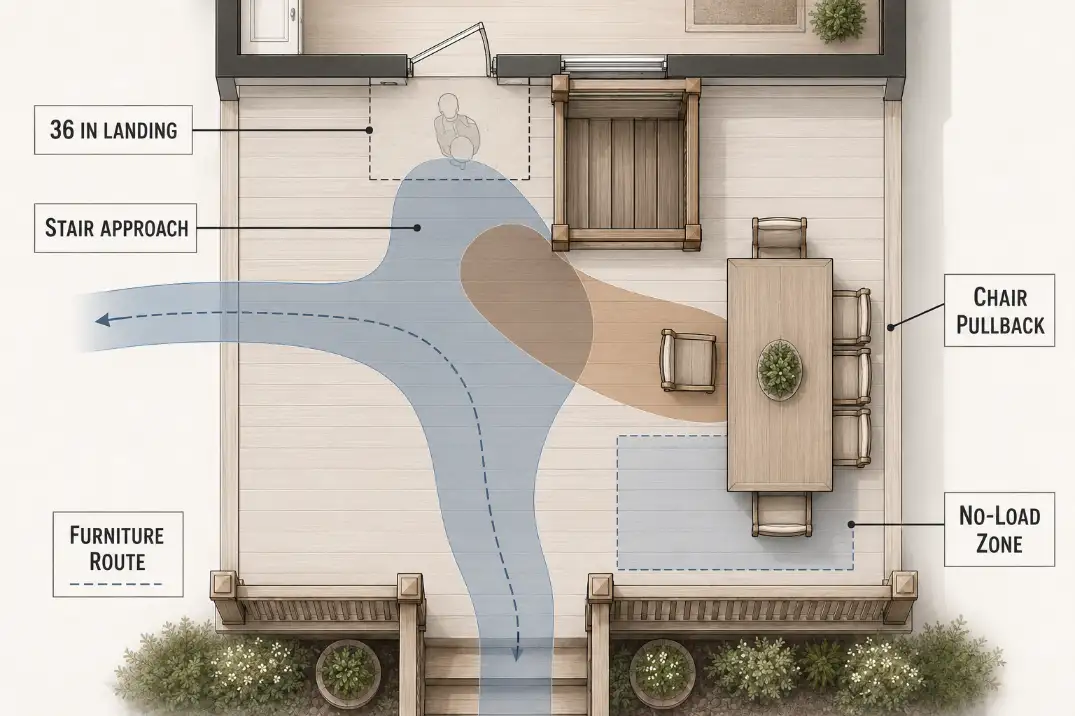
Dining Near the Stairs
Dining needs pullback space, not just table space
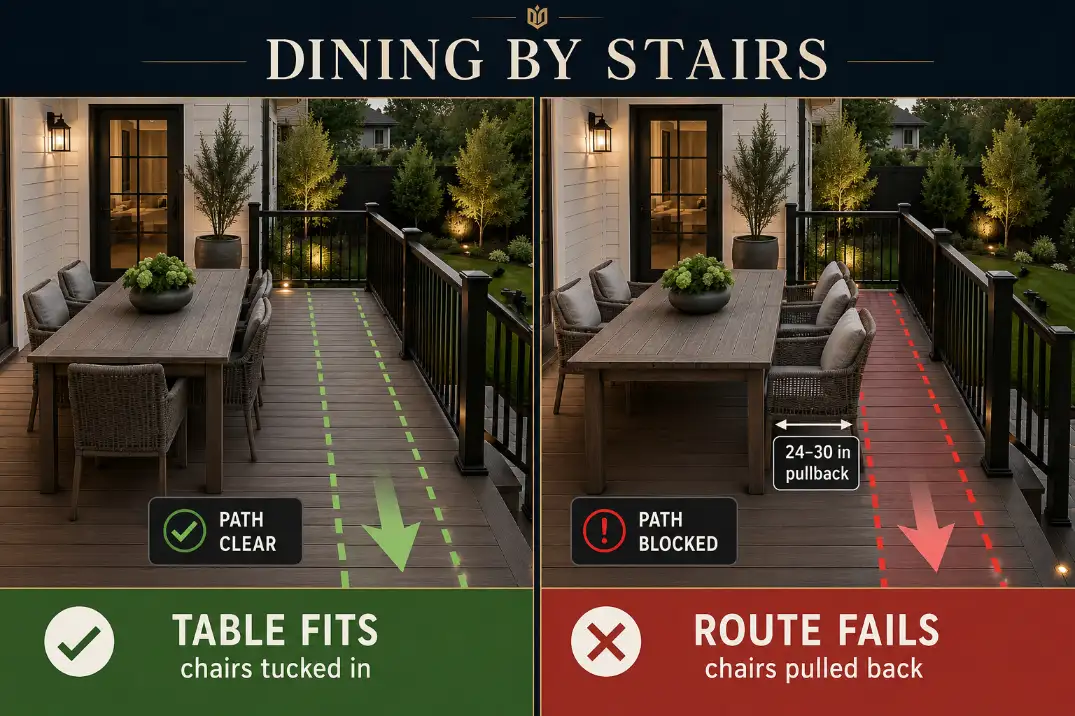
Dining is the easiest zone to place badly near stairs because a table looks compact when the chairs are tucked in. In use, each chair usually needs 24 to 30 inches of pullback, and people need another 12 to 18 inches to pass behind comfortably. That means a 36-inch table can create a working footprint closer to 8 feet once people sit down.
If stairs are close to the dining zone, the key question is not “does the table fit?” It is “can someone leave the table while another person uses the stairs?” If the answer is no, the deck will feel crowded even with only four people outside.
A round table can help when the deck needs softer circulation, but it is not magic. A 48-inch round table still needs chair movement around it. A narrow rectangular table against the quiet side may work better if it protects the route from door to stairs.
For related seating decisions, Patio Layouts for Back Door Seating helps clarify when seating should support the entry instead of competing with it.
The table test that matters
Set the table where you want it, then pull out the two chairs closest to the stairs. If the remaining clear path drops below 30 inches, the layout will feel tight during meals.
If it drops below 24 inches, people will start turning their bodies sideways, and that is usually the point where the deck stops feeling relaxed.
This is also where cosmetic fixes disappoint. A slimmer chair helps only if the path is nearly working already. If the table sits directly between the back door and stairs, changing chair style rarely solves the real conflict.
Grill Without Blocking Exit
The grill needs a working edge
A grill placed near the back door feels convenient until the lid opens, smoke drifts toward the entrance, or someone has to pass behind the cook to reach the stairs. The grill is not just an object; it creates a hot zone, a lid-swing zone, and a cook stance.
Keep at least 3 feet of working space in front of the grill where possible, and avoid placing that space directly across the door landing. If the cook’s stance blocks the only clean route to the stairs, the grill is in the wrong zone even if it technically fits.
The better position is usually a secondary edge: close enough to dining to serve food, but not inside the first movement path from the door. A compact prep surface can help, but only if it does not create another pinch point.
Pro Tip: Open the grill lid during layout testing. A closed grill underestimates the working footprint by a surprising amount.
A deck that combines cooking and dining should borrow from Patio Layout for Grill, Prep, and Dining rather than treating the grill as leftover equipment to park near the rail.
What is more likely than “the grill is too big”
The grill may be oversized, but placement is usually the earlier problem. A 4-burner grill on a clear edge can work better than a smaller grill parked beside the back door. Size matters after the route, landing, and heat zone are sorted.
The condition people underestimate is the exit path during active cooking. If guests must pass between the grill and the stair opening, the layout will feel tense even if no one says it is unsafe.
Keep One Side Quiet
A raised deck needs one low-conflict edge
The best raised deck layouts near back doors and stairs usually keep one side quiet. That does not mean empty. It means low-conflict: no grill lid, no chair pullback into the route, no stair opening, no door swing, no storage bin that has to be opened during use.
This quiet side can hold a bench, a narrow console, a pair of lounge chairs, or planters if they do not interrupt circulation. The point is to give the eye and body one area that is not asking for constant negotiation.
If both sides of the deck are active, the middle becomes a squeeze lane. If one side stays calm, the deck feels more intentional even when it is modest in size.
The best fix is usually a hierarchy
Do not try to make the deck equally good at everything. Rank the zones in this order: door landing first, stair route second, dining or seating third, grill fourth, decor last. That order may feel strict, but it prevents the most expensive mistake: buying smaller furniture to preserve a layout that was wrongly organized from the start.
Lighting can support the hierarchy, especially where stairs are close to the door. A top landing light, low-glare step lighting, and a visible edge help at night, but lighting should confirm a clear route, not rescue a blocked one.
If the deck route already works by day, Path Lighting for Steps, Slopes, and Walkways can help make the same movement line readable after dark.
The strongest layouts are rarely the fullest ones. They protect the first few feet outside the back door, give stairs a real approach, keep the lower landing stable, and leave one side of the deck quiet enough that people are not negotiating every step.
Once that hierarchy is right, the deck stops feeling like a collection of objects and starts behaving like an outdoor room with a clear entrance, safer movement, and fewer small daily annoyances.
For structural deck, stair, landing, guard, and footing guidance, review the American Wood Council Prescriptive Residential Wood Deck Construction Guide.