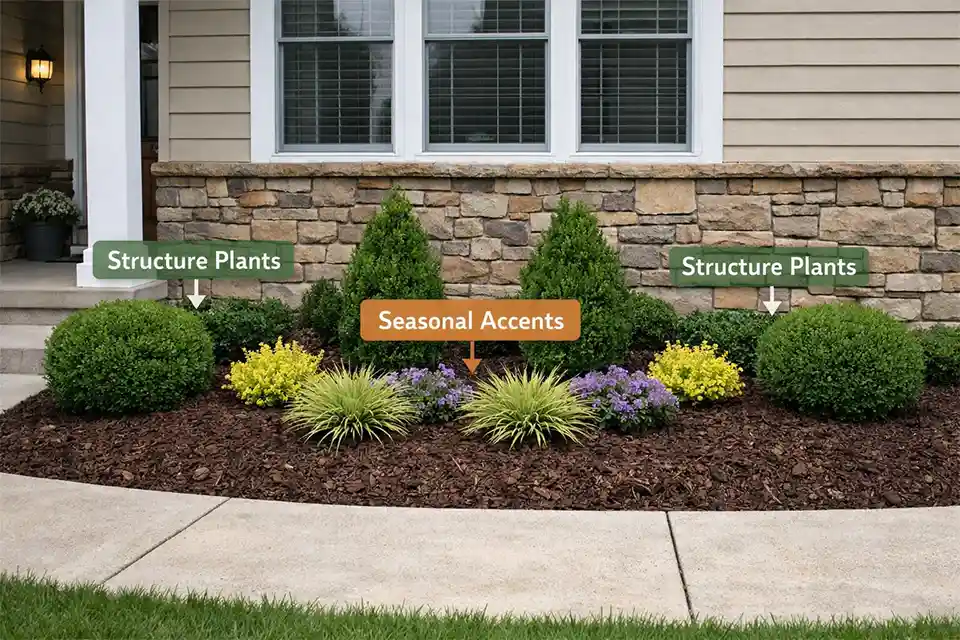
The best low-maintenance front yard plants for people who travel often are not the ones that merely survive neglect. They are the ones that still look orderly after 7 to 10 days away and can often stay presentable for 10 to 14 days in summer once established. That is the real threshold.
If a plant needs deadheading every week, starts sagging when the top 1 to 2 inches of soil dry out, or looks unfinished the moment flowering slows, it is a poor fit for a front yard that may sit unattended.
A lot of homeowners misread this point. Drought tolerance helps, but survival is not the same as curb appeal. In a visible front bed, the real test is whether the planting still looks composed when nobody has touched it for more than a week.
That is also why the obvious fix often wastes time. More irrigation can keep a needy plant alive, but it does not stop flopping stems, petal litter, or shrubs that outgrow a narrow bed. In front yards, the bigger failure is often visual instability, not outright plant death.
What matters most in a travel-friendly front yard
Structure matters more than flower count
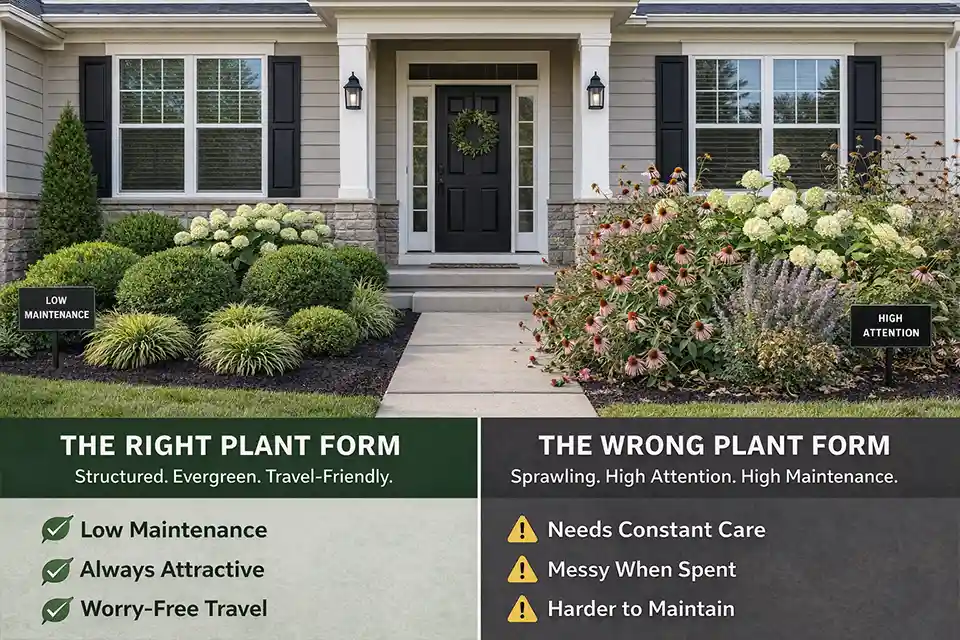
For frequent travelers, structure should carry the yard. Evergreen shrubs, upright grasses, durable mounding perennials, and restrained groundcovers keep a bed looking intentional even when bloom is off.
This is where many “easy plant” lists go soft. They treat every low-water plant like an equal answer, even though some still look rough between maintenance cycles. The same trap shows up in Why Low-Maintenance Front Yards Often Become High-Maintenance, where the real problem is often a plant mix that depends on constant correction.
Mature size is a maintenance decision
A shrub that wants to finish 5 feet wide in a 3-foot bed is not low-maintenance. It is a pruning schedule. The same goes for groundcovers that can gain 12 to 18 inches into edging or walkways in a season.
People usually overestimate watering and underestimate growth habit. In many front beds, overgrowth creates more repeated work than drought does. A plant that fits at maturity usually stays cleaner, healthier, and less demanding than one that is always being cut back.
Establishment still counts
New plants are not travel-proof yet. For the first 8 to 12 weeks, and often through the first growing season, even strong low-maintenance choices need closer watering and better observation.
That means a newly planted front bed can still struggle during a 9-day summer trip even if the same plant mix would be easy next year.
The best plant groups for people who are away often
Evergreen shrubs that hold the design together
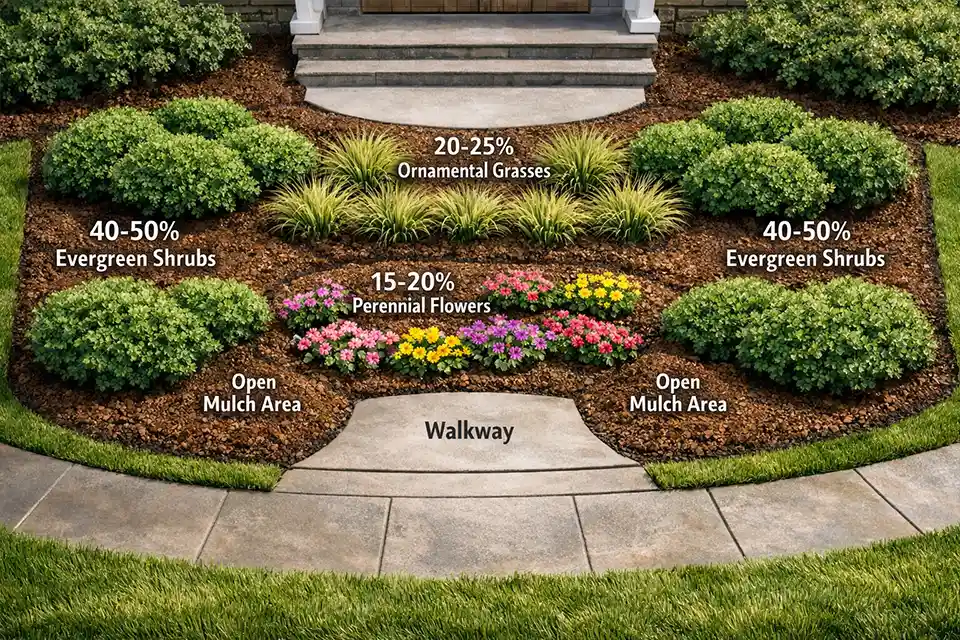
If the goal is to come home to a front yard that still looks finished, evergreen anchors should do more of the work than most people expect. In many front beds, they should make up about 40% to 50% of the planting.
The safest starting points for most U.S. front yards are compact, slow-to-moderate growers with neat natural form. Inkberry holly, compact juniper, dwarf yaupon holly in warmer regions, and carefully chosen boxwood alternatives are usually safer bets than faster shrubs that need repeated shaping.
These are the plants that still earn their space on day 12.
Grasses and grass-like plants that handle missed maintenance windows
Bunch-form grasses and strappy plants are often better front-yard travelers than soft flowering fillers. Prairie dropseed, little bluestem, compact switchgrass cultivars, pink muhly grass in warm climates, and reliable sedges for part shade usually hold shape with less intervention.
They become even more valuable in exposed sites where wind and reflected heat speed up stress. In those spots, soft leafy perennials often disappoint faster than tougher linear forms. That same tougher site logic matters in Best Front Yard Plants for Windy Corner Lots.
Perennials that still look respectable after bloom
Perennials can work, but only if they keep decent form after flowering. That is the filter most people skip.
The strongest options are usually catmint, baptisia, sedum, yarrow, Russian sage, hellebore for shade, and tougher salvia types. They may not bloom nonstop, but they do not instantly convert the bed into visible maintenance debt.
A useful cutoff is simple: if a perennial looks spent for more than about 3 weeks after bloom unless someone cuts it back, it is rarely a top-tier front-yard choice for people who travel often.
Groundcovers that reduce work instead of shifting it
A good groundcover lowers weed pressure and covers bare soil. A bad one escapes into edges, traps debris, and turns a clean bed into a monthly editing job.
Use restrained spreaders. Be cautious with anything that moves aggressively near walkways, driveway edges, or narrow planting strips. That same failure pattern is exactly what makes Front Yard Maintenance Problems When Groundcovers Spread Into Walkways and Lawn such a common follow-on problem.
The fastest way to choose the right mix
Start with the safest order of priorities
For most front yards, start here:
- Compact evergreen shrubs
- Bunch grasses or grass-like plants
- A limited number of durable perennials
- Restrained groundcover only where it actually reduces exposed soil
That order matters. People often build the front yard around flowers, then try to patch stability back in. The stronger move is the opposite: build the structure first, then add selective color.
Good fit vs poor fit
| Better fit | Why it works | Poorer fit | Why it becomes work |
|---|---|---|---|
| Compact evergreen shrubs | Looks finished year-round | Fast-growing shrubs in small beds | Need repeated clipping |
| Bunch grasses | Keeps shape without weekly grooming | Floppy bloom-heavy fillers | Looks rough between maintenance cycles |
| Tough perennials with good post-bloom form | Still reads as intentional | Plants that need deadheading | Absence becomes visible quickly |
| Restrained groundcovers | Lowers weed pressure | Aggressive spreaders | Escapes into edging and walks |
| Region-matched plants | Handles actual conditions better | Impulse buys based on bloom | Often mismatched to heat, soil, or exposure |
Pro Tip: Before buying, ask a harder question than “Is this easy to grow?” Ask “Will this still look orderly after a hot 9-day stretch with nobody home?”
What changes under harder site conditions
Hot pavement and afternoon sun
Beds near sidewalks, driveways, or west-facing walls usually run harder than the rest of the yard. In those spots, the better move is not automatically more water. It is usually tougher plant form, wider spacing, and fewer soft plants that scorch or collapse fast.
If the bed sits beside heat-radiating hardscape, reflected heat changes the real plant list. That is why the tougher logic in Best Plants for Front Walkways Next to Hot Concrete matters here.
Tree roots and thin soil
Shade does not always lower maintenance. Dry shade under mature trees can be harder than open sun because roots strip moisture fast and the planting zone stays shallow.
In those conditions, trying to force a lush, flower-heavy front bed usually creates more upkeep. Fewer, tougher plants often perform better than a fuller but softer mix.
The same constraint-driven thinking shows up in Front Yard Plants for Tree Roots and Little Soil.
Travel length changes the standard
A front yard that has to survive a 3- to 4-day work trip is one thing. A front yard that still has to look composed after a 10-day summer absence is another.
If you are often gone more than a week in warm weather, tighten the filter. Lean more heavily on evergreen mass, keep perennial accents smaller, and avoid anything that depends on weekly cosmetic upkeep to stay presentable.
What to avoid even if it looks good at the nursery
Plants that only look good in bloom
This is the category people most often overestimate. A plant can look beautiful for 2 weeks and still be a weak travel plant if the next 6 weeks look ragged, flattened, or half-finished.
Plants that need weekly cleanup
Anything that relies on deadheading, staking, repeated shearing, or constant litter cleanup belongs lower on the list. In a backyard, maybe that tradeoff is acceptable. In a front yard, it becomes visible too quickly.
Plants that need irrigation to compensate for the wrong site
If the bed is too hot, too shallow, too root-filled, or too exposed, extra water rarely fixes the underlying mismatch. At that point, changing plant categories makes more sense than trying to rescue the same failure pattern.
When the standard fix stops making sense
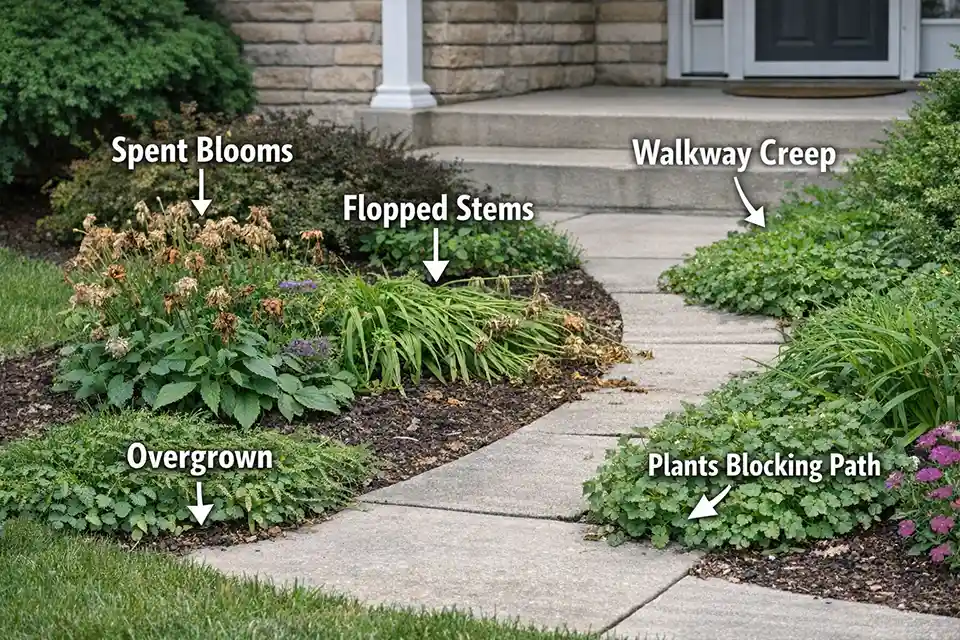
If your front bed still looks rough every time you come home, stop replacing one failing plant at a time. Replace the failing category.
If flowers always look spent, reduce bloom-heavy perennials. If plants keep crisping near pavement, reduce soft foliage and increase tougher shrubs or grasses. If growth keeps swallowing the walkway, the mature-size match is wrong.
That is the point where tweaking stops being efficient. A front yard for frequent travelers usually needs to be quieter, more selective, and more disciplined than a typical inspiration-board planting.
The payoff is simple: it still looks composed when nobody has been home to manage it.
For broader official guidance, see University of Massachusetts Amherst’s Right Plant, Right Place guide.