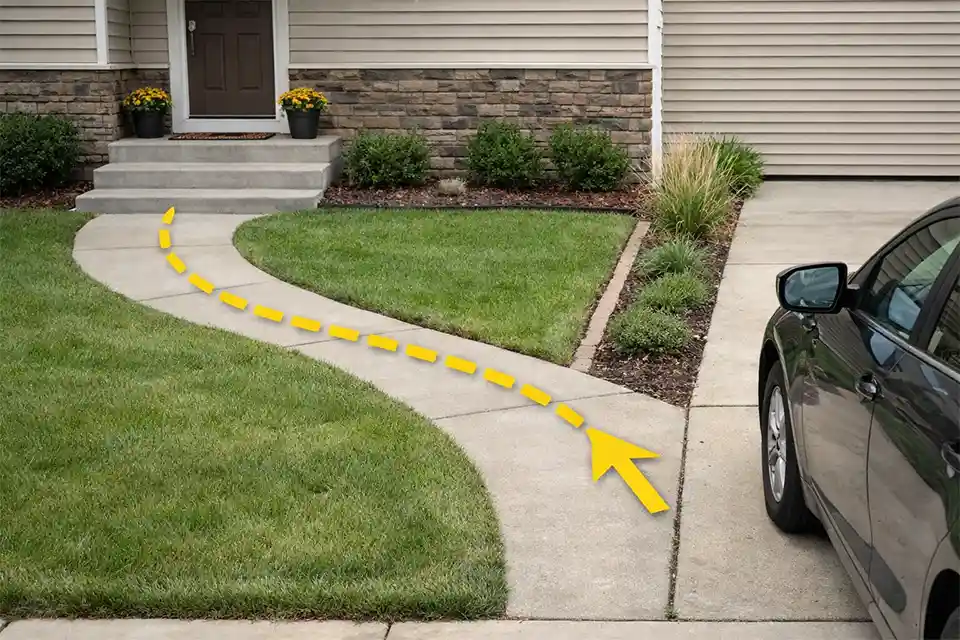
When a walkway has to connect an offset front door and driveway, the main constraint is usually not style. It is route geometry. People walk from where they step out of the car, not from the driveway centerline, and they will keep choosing the shortest comfortable line unless the installed path feels nearly as direct.
If the walkway swings more than about 2 to 3 feet away from that obvious route near the driveway connection or near the front landing, the yard usually starts showing it: worn lawn corners, trampled bed edges, or a path that looks fine on paper but wrong in use.
The first checks are the ones that actually change the layout: how many feet the door is offset from the practical parking edge, whether the main walk can stay at least 4 feet wide through the turn, and whether slope or runoff will distort the route later.
This is not the same as a small-yard problem where everything is simply tight. Here, the issue is directional conflict. The driveway pulls movement one way, the front door pulls it another, and the front yard has to absorb that turn cleanly.
Start with the walking line
The mistake people make first is designing the beds, then dropping in a walkway wherever space remains. In this scenario, the walkway should set the structure of the yard.
Stand where a car door usually opens and trace the line to the front steps. That is your real starting point. Most good solutions are either a shallow diagonal walk or a straighter run that makes one deliberate turn closer to the house. What usually fails is the decorative sweep across the lawn that adds distance without solving the offset.
A primary front walk should generally be at least 4 feet wide. Where the route bends, 4.5 to 5 feet works better because a turn effectively shrinks usable width. Once the path narrows below about 3.5 feet at the bend, it starts reading like a side path instead of the main arrival route.
If the driveway already dominates the frontage, the walkway has to restore order rather than compete with it. That is why sites with oversized paving often run into the same planning issues covered in Front Yard Design Constraints With a Large Driveway.
What people usually misread
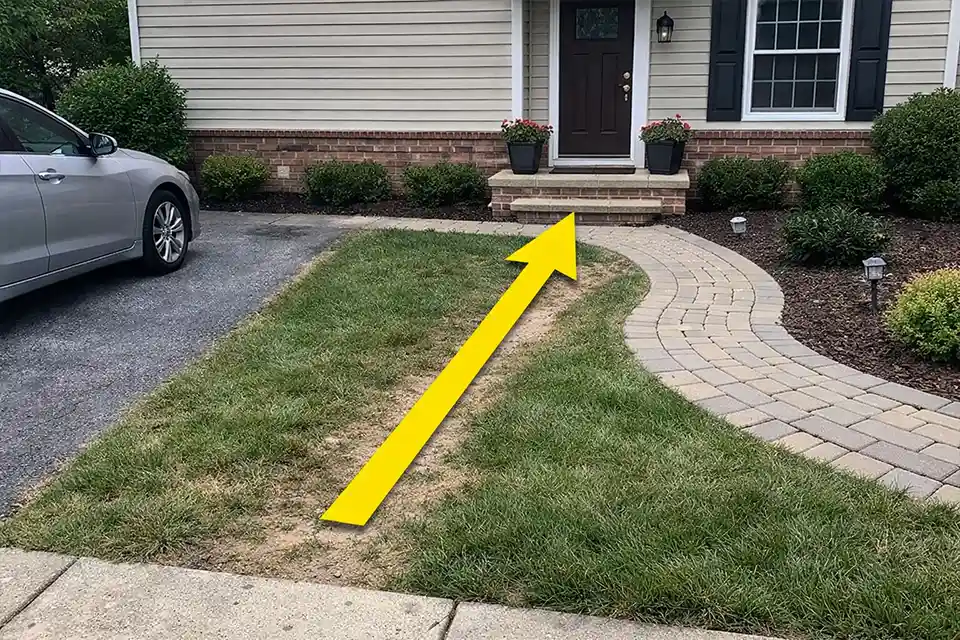
People often overestimate the value of a curve here. A curve can soften the front yard, but once it adds roughly 6 to 10 extra walking feet from the car to the door, it stops feeling graceful and starts feeling inefficient. That is especially obvious when carrying groceries, walking in rain, or moving at night.
They also underestimate the entry landing. If the path reaches the house at an odd angle and the landing is less than about 5 feet deep, the entry feels cramped even when the rest of the walkway looks generous. In other words, “the walk looks off” is usually a symptom. The mechanism is poor turning space at the door.
A common time-waster is cleaning up the edges of a bad route instead of fixing the route itself. People add steel edging, refresh mulch, or tighten the curve with a smaller bed, but that only sharpens the outline of the problem.
If the layout forces people or mower wheels into the edge, the edging will keep shifting and the bed will keep looking stressed, which is the same failure pattern behind Why Front Yard Edging Keeps Shifting.
Quick diagnostic checklist
- The installed walk adds more than about 25% extra distance versus the obvious route from driveway to door.
- The path drops below 4 feet wide where the direction changes.
- The front landing is under 5 feet deep.
- The strip between driveway and walk is under 30 inches wide and keeps getting stepped in or baked out.
- Water remains on the inside edge of the walk for more than 24 hours after rain.
- People step off the paving within the first 6 to 8 feet from the driveway connection.
The layouts that usually work
Not every offset condition deserves its own custom gesture. Most of the time, one of a few layout types solves it.
| Layout type | Best when | Strength | Failure point |
|---|---|---|---|
| Shallow diagonal walk | Door offset is moderate and the yard has decent depth | Direct and visually clean | Looks forced in very shallow setbacks |
| Straight walk with angled entry turn | House front needs a more orderly composition | Keeps the facade structured | Feels tacked on if the turn is too sharp |
| Broad arc | Yard is wide enough to keep the curve gentle | Softens a rigid frontage | Becomes a decorative detour |
| Shared arrival pad | Parking-side unloading matters more than lawn continuity | Improves real daily use | Grows into too much paving |
The best-performing option is usually the simplest one that absorbs the offset in one move. A diagonal walk or a straight run with one controlled turn does that. The least reliable option is the broad ornamental curve used to disguise the misalignment. It rarely disguises it for long.
When the setback is already shallow, geometry gets less forgiving. In those front yards, Front Yard Design Constraints in Minimal Setback Space is the better reference point than a generic walkway article.
Pro Tip: Mark the proposed route with hoses or marking paint and walk it for 3 to 7 days. A layout that looks elegant from the street can feel annoying the second you test it with groceries or in the dark.
The hidden constraints that actually change the plan
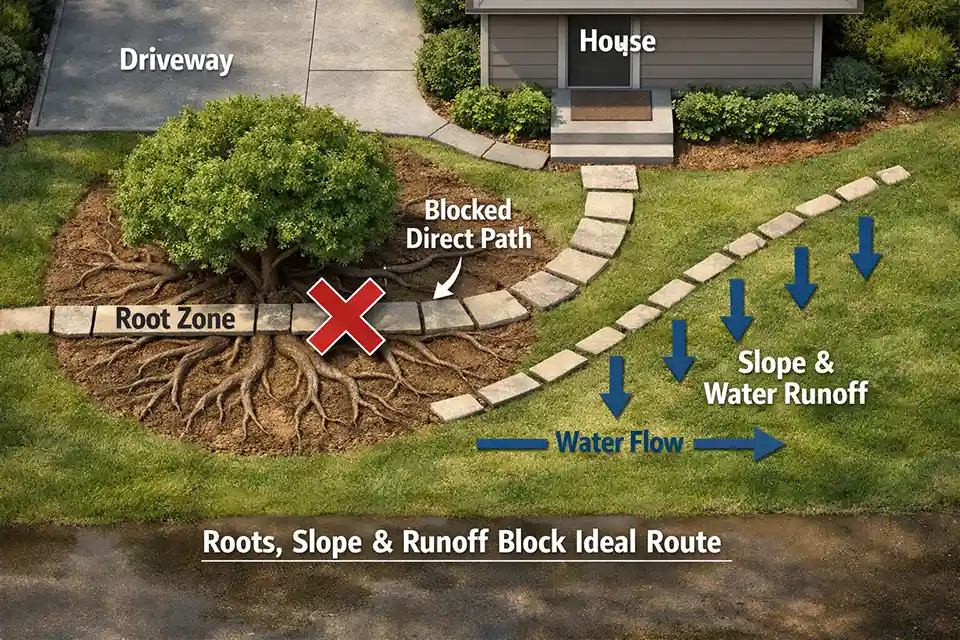
Once the route is roughly right, three site conditions usually decide whether it will keep working: grade, roots, and water.
Grade matters more than many homeowners expect. A running slope above about 5% starts requiring much more careful attention at the landing and transitions. A cross-slope above roughly 2% can already feel subtly awkward underfoot.
Once the route needs several retaining edges or three or more risers just to maintain the connection, this is no longer mainly a walkway-shape problem. It is a grading problem, and the logic shifts closer to Front Yard Design Constraints on Steep Sloped Yard.
Roots are another limit people often misread. They assume the path wanders because the designer wanted softness, when the real reason is that the direct route cuts through a major root zone.
If a mature tree sits within about 8 to 12 feet of the proposed line, that should be checked early. A nicer-looking curve is not a real solution if installation still slices through structural roots, which is why Front Yard Design Around Tree Root Zones becomes relevant fast.
Drainage is the one readers usually underestimate. A walk can look perfectly fine the day it is installed and still fail 6 to 18 months later if runoff crosses the inside of a bend or downspouts discharge near the landing.
The visible symptom may be algae, muddy splash, winter heaving in northern states, or settled pavers. The underlying mechanism is repeated water concentration at the weakest transition points.
If water is still sitting there the next day, the route is not your only problem. Front Yard Drainage Problems From Downspouts and Walkways covers that part of the failure pattern well.
A better design sequence
The cleaner way to solve this is to set the critical points first, then let the planting plan respond.
Start with the driveway connection where people actually exit the car. That point is often 3 to 5 feet away from where people instinctively place it on paper.
Then set the front landing. Around 5 by 5 feet is a solid baseline for a main entry. More space makes sense if the door swings outward, if guests tend to gather there, or if the walkway approaches at an angle.
Next, connect those two points with the shortest comfortable route the yard can support. Keep the geometry readable. One turn is fine. Two turns are usually a warning sign.
Then shape the beds around the walk. Thin leftover planting strips under about 24 to 30 inches wide usually become the highest-maintenance parts of the entire front yard, especially beside hot concrete or asphalt. In dry climates, they scorch. In wetter parts of the Midwest or Southeast, they often become splash zones or muddy pinch points.
Finally, look for leftover turf wedges. Tiny scraps of lawn are not just awkward to mow. They are one of the clearest signs the layout is forcing too many things into too little space.
Pro Tip: If solving the offset cleanly creates multiple leftover wedges under about 20 square feet each, stop refining the curve. It is usually smarter to simplify the hardscape and accept a larger arrival area.
When a separate walkway stops making sense
There is a point where trying to save a standalone front walk becomes the wrong goal. If the driveway takes up more than half the frontage, the front door sits well off to one side, and the setback is shallow, a separate ornamental walkway may no longer be the best answer.
At that point, the more honest fix is often a widened arrival area integrated with the driveway edge, a reworked landing, or a more direct paved connection that admits how people already use the site. Many homeowners keep chasing the perfect curve when the smarter move is to reduce gestures and make the entry sequence simpler.
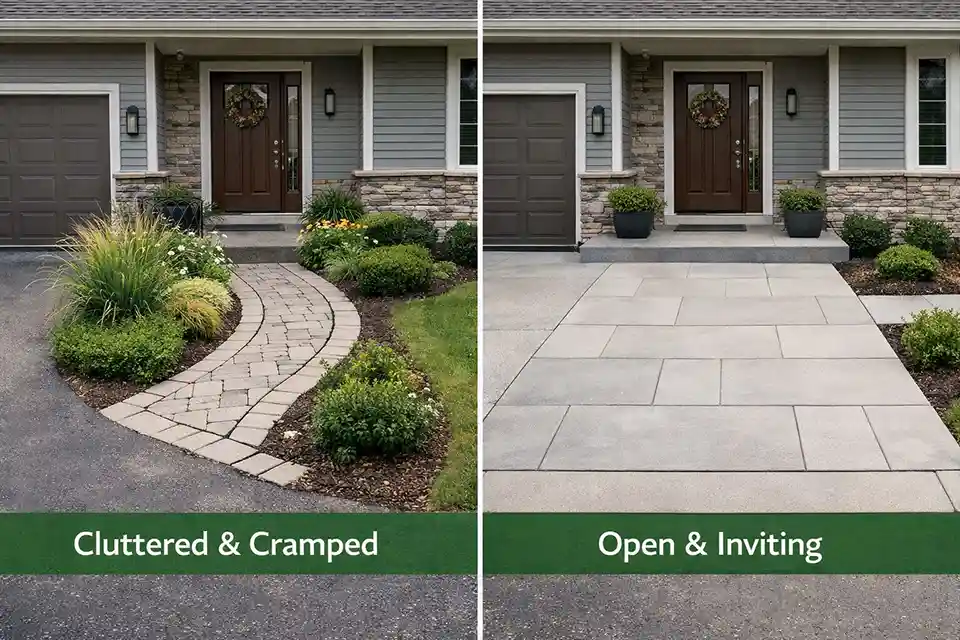
The best front-yard walkway designs in this situation do not try to hide the offset. They organize it. That usually means one clear route, enough width where the turn happens, a landing that can absorb the angle, and fewer decorative moves that add maintenance without improving use.
For broader official guidance on safe, usable site routes, see the ADA Standards for Accessible Design.