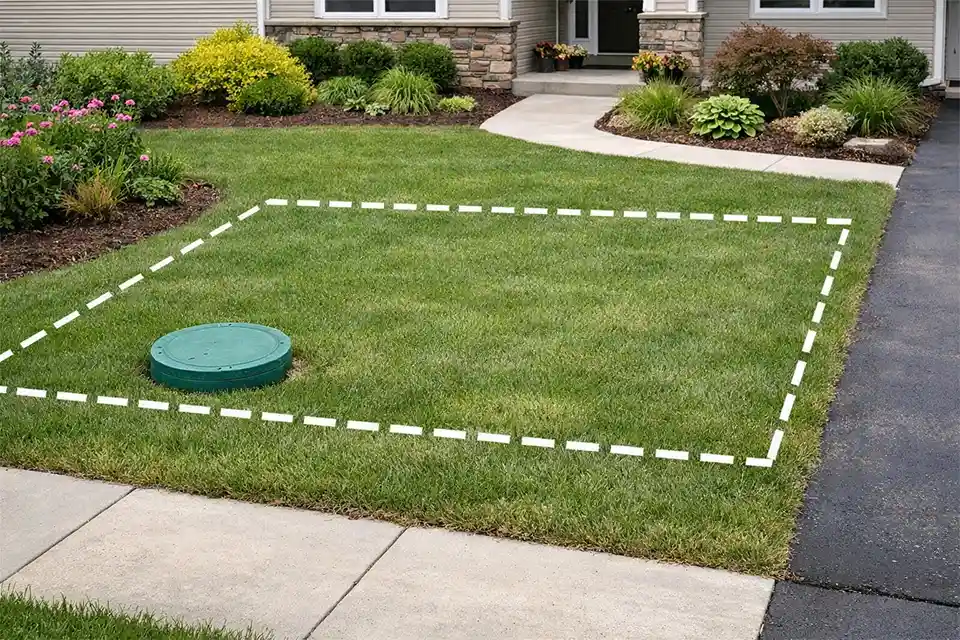
When a septic system sits in the front lawn, the real design constraint is usually not the lid you can see. It is the drain field you cannot. Start with three checks: confirm the tank and field layout, watch how long the surface stays wet after a heavy rain, and decide whether your design requires digging, irrigation, or added soil over the field.
If the area stays soggy longer than 24 to 48 hours after rain, that is not a minor lawn issue. If your plan adds more than 2 to 3 inches of soil, uses woody planting, or depends on built edging over the field, it has already crossed from curb-appeal improvement into septic-risk territory.
That is the key difference from an ordinary patchy-lawn problem. Thin grass in late summer is often cosmetic. A soft surface, persistent wetness, sewage odor, or one strip that stays damp while nearby turf dries is more diagnostic.
In most front yards, the safe planting depth directly above the field is shallow, roughly the top 6 to 12 inches, not the depth needed for a full ornamental bed.
A lot of homeowners spend energy trying to hide the riser lid and miss the bigger risk. The lid is visual. Compaction, trapped moisture, and root intrusion are functional.
Get that priority wrong, and the yard may look better for one growing season while becoming harder and more expensive to service for the next 5 to 10 years.
Quick diagnostic checklist before you redesign
- Locate the tank, drain field, and known laterals as accurately as possible.
- Treat wetness lasting longer than 48 hours after rain as a warning sign.
- Do not add more than 2 to 3 inches of soil over the field unless a septic professional approves it.
- Rule out trees, woody shrubs, patios, retaining walls, sheds, and vehicle parking over the field.
- Keep at least a 3-foot clear working zone around lids and risers.
- Reject any design that requires trenching, repeated digging, or routine irrigation over the field.
That last rule is where many front-yard plans fail. A design can look neat on paper and still be wrong if future inspection means pulling up edging, shifting stone, or digging through planted beds.
What people usually get wrong first
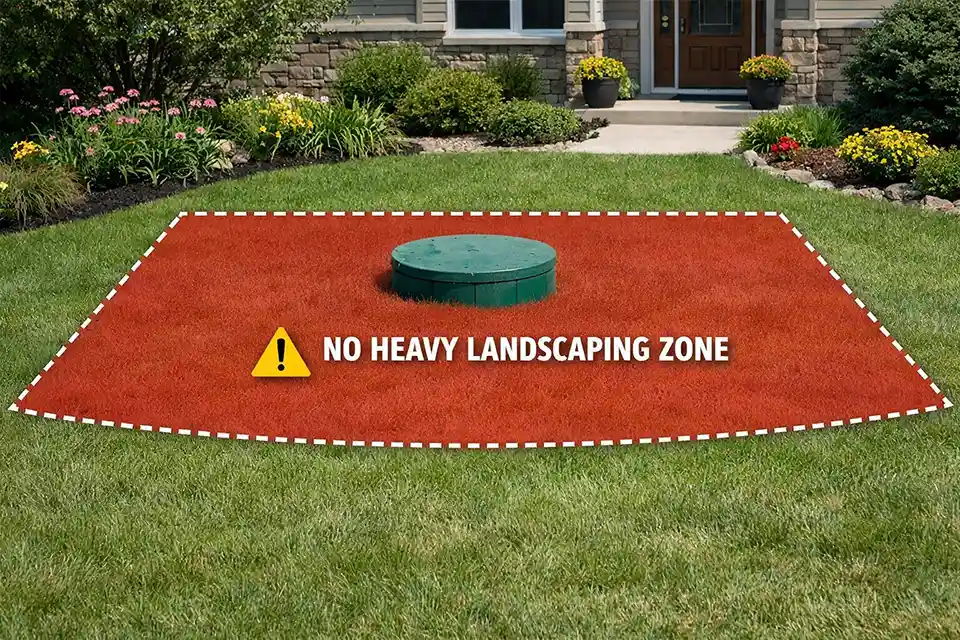
The first bad assumption is treating the septic area as spare lawn that needs more design. That pushes homeowners toward exactly the wrong improvements: raised beds, decorative gravel, dense shrubs, extra topsoil, or a small ornamental tree meant to make the yard feel finished.
Those ideas fail for the same reason. A drain field needs oxygen exchange and predictable moisture movement through the upper soil. Heavy materials and repeated traffic compress that soil. Added fill slows drying. Root systems complicate future excavation. The bad-looking lawn is a symptom. The restricted underground function is the mechanism.
This is why the design logic is closer to working around front-yard utility boxes than building a normal showcase bed. Access and underground service matter more than visual fullness.
What people usually overestimate is the visual cost of leaving the field simple. What they underestimate is the performance cost of “just one upgrade” placed in the wrong spot. In practice, one mower pivot path or one gravel section that hardens over time can do more harm than a sparse planting plan ever will.
The best design choice is usually the least ambitious one
Over a front-yard drain field, the safest design is usually turf or another shallow-rooted cover over the field, with the ornamental work pushed to the edges of the usable yard.
That distinction matters more than “plants versus lawn.” Herbaceous plants with root mass mostly in the top 8 to 12 inches behave differently from woody shrubs that thicken, spread, and become difficult to remove. The useful comparison is shallow and removable versus deepening and permanent.
| Design choice | Decision | Why | Best placement |
|---|---|---|---|
| Turfgrass | Yes | Shallow roots, easy inspection, low disruption | Best direct cover over field |
| Low herbaceous perennials | Only in limited cases | Acceptable only if shallow-rooted, lightly planted, and not irrigated routinely | Safer at outer edges, not over confirmed laterals |
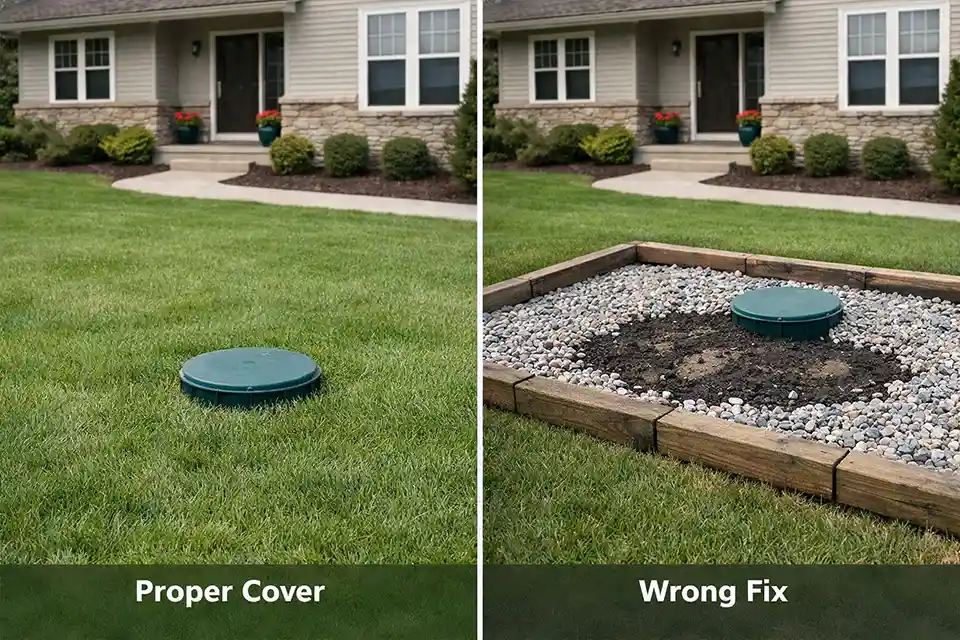
| Decorative gravel | No | Compacts surface, traps heat, makes access harder | Outside field only |
| Raised beds | No | Adds soil depth, invites edging, digging, and watering | Beyond field boundary |
| Woody shrubs | No over field | Root spread and future removal cost rise over time | Outside field and repair route |
| Trees | No | Highest long-term risk for roots and excavation conflict | Well away from tank and field |
That often means the rest of the yard has to carry the design. The same principle shows up in a front yard with a large driveway: the right move is usually to strengthen the unconstrained space instead of forcing a solution on the constrained one.
Pro Tip: If the drain field sits in the center of the yard, make that simplicity look intentional. A crisp mowing edge, two balanced outer beds, and a straight walk usually look more deliberate than trying to disguise the field itself.
Why raised beds and gravel usually waste time
Raised beds look logical because they seem to keep planting shallow and organized. Over a septic field, they usually fail for three predictable reasons.
First, even 4 to 6 inches of added soil can change how long the surface stays wet. Second, building the bed almost always means edging, anchoring, or digging in an area that should remain easy to service. Third, once the bed exists, people irrigate it. That extra water is often what turns a merely restricted zone into a persistently soft one.
Decorative gravel fails differently, but the result is not better. It tends to harden the surface, increase heat, reduce easy access, and encourage compaction from foot traffic. It solves a cosmetic complaint while creating a functional problem.
This is also where people misread wet spots. Water sitting for a few hours after a storm is not the same as chronic saturation. If the area dries with the rest of the yard within 24 hours, that points more toward normal storm response. If one band stays soft or wet past 48 hours, especially without new rain, the issue deserves more caution. That is why it helps to compare the pattern with front-yard drainage problems near downspouts and walkways before blaming every wet patch on septic failure.
Root risk matters, but repair access is what usually decides the layout
Tree roots deserve priority because they create the longest, most expensive problems. A fast-growing tree planted 10 feet from the field is usually a bad bet, not a borderline choice. At 25 to 30 feet away, the risk becomes much more site-dependent, but it is still a design decision worth making carefully.
Still, roots are only half the problem. The more useful question is this: if the field needed repair in 3 years, would the landscape be cheap to move or expensive to undo? That question usually produces better decisions than debating plant labels.
A front-yard septic field should be designed as if excavation may eventually happen. Once that becomes the standard, a lot of common landscape moves stop making sense: anchored stone borders, dense shrub masses, buried lighting lines, specimen trees, and layered planting that takes a weekend to dismantle.
That same long-view logic is why front-yard tree root zones matter here. The issue is not just whether a root can reach the field. It is whether the entire landscape plan quietly turns a serviceable front yard into a difficult dig site.
One detail that gets underestimated: even a technically “safe” plant mix stops being a good idea when it requires dividing, re-edging, mulching, and replanting every season. Over a septic field, low disturbance usually matters more than plant variety.
When a standard front-yard plan stops making sense
A normal landscape plan assumes you can shape grade, build beds, anchor the layout with shrubs, and improve the yard by layering more material into it. Once a septic system occupies the front lawn, that logic weakens fast.
This is the practical cutoff: if the design depends on woody planting over the field, routine irrigation, more than 2 to 3 inches of added soil, hardscape footings, or repeat digging, it is the wrong design. Not risky. Wrong.
That sounds stricter than most front-yard advice, but this is one place where soft language wastes money. Homeowners often spend on improvements that make the yard look more finished for a year and more fragile for the next service call. A septic field is restricted utility space first and visual space second.
The better strategy is simpler and usually cheaper: keep the field open, light, and easy to inspect, then place the real design weight at the porch edge, mailbox zone, driveway border, or the non-septic side of the yard. Similar tradeoffs show up in front-yard design constraints when HOA rules limit plants, but septic restrictions are usually tougher because they affect function, drainage, access, and future repair all at once.
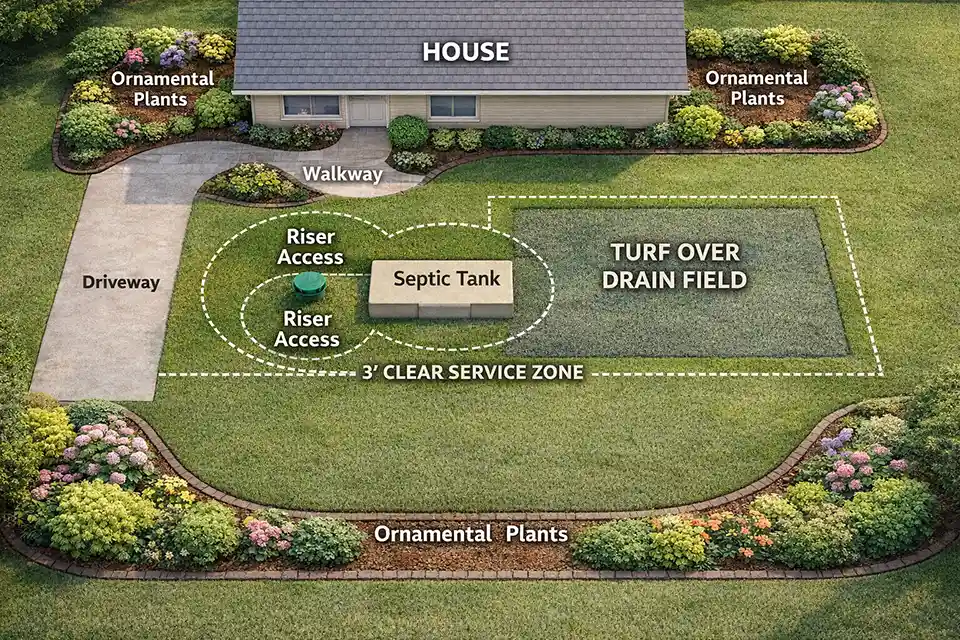
The front yards that hold up best with a septic system out front usually do not try to make the field disappear. They keep it simple, accessible, and lightly planted, then let the unrestricted parts of the yard do the visual work.
For official homeowner guidance on protecting a septic system, see the EPA septic systems page.