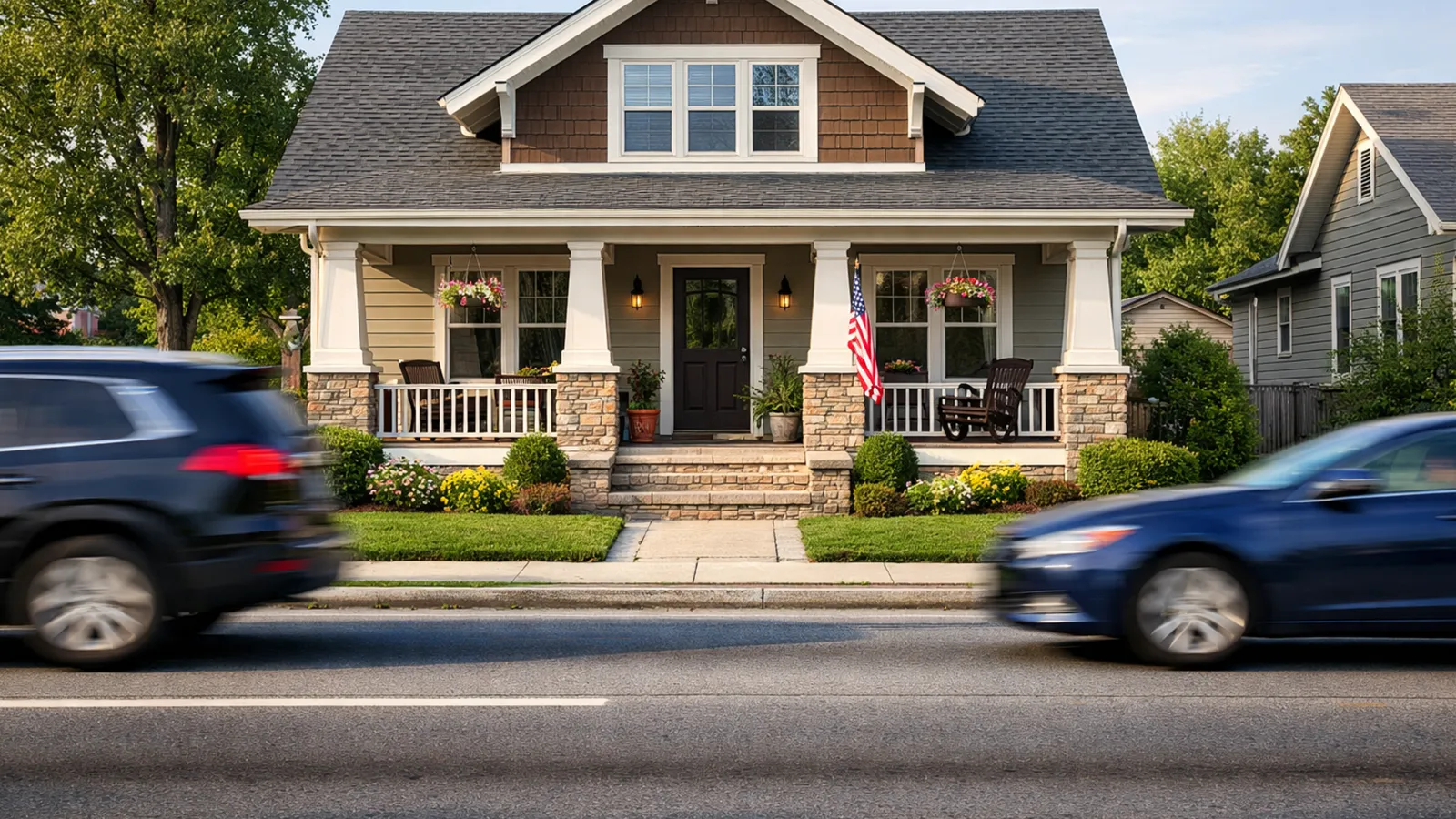
You step outside with your coffee and sit down for a minute. The lawn looks fine. The shrubs are there. Nothing feels obviously wrong. Still, you don’t stay long.
A car slows at the corner. Someone walks past and glances over. You shift slightly in your chair without thinking. The space hasn’t changed in size, but something about it feels exposed.
Front yard privacy problems on busy streets rarely start with missing elements. They usually begin with how movement, light, and sound travel straight through the space.
When Cars Keep Looking In
You’re sitting on the porch and notice how often headlights or quick glances sweep across the yard. No one stops. No one stares. But someone is always passing.
• A driver slows and looks sideways.
• A pedestrian scans the house while walking by.
• A parked vehicle sits with a clear view into the lawn.
Each moment is small. The repetition is constant.
The yard is not completely public. It is constantly visible.
What feels like being watched often comes from uninterrupted eye-level sightlines. Shrubs may frame the edge. Decorative borders may look full from above. But if the view from a car window runs straight to your chair, exposure continues.
The issue is not the absence of planting. It is the lack of interruption.
When It Feels Louder Than It Should
You start a conversation outside and pause mid-sentence as a truck accelerates. You lean forward slightly to hear better. You don’t plan it. It just happens.
• Engine hum never fully fades.
• Acceleration spikes at traffic lights.
• Tire noise reflects off pavement and hard surfaces.
The yard is not unusable because it is loud. It feels unsettled because the sound pattern never resets.
Concrete driveways and stone edges can bounce noise back toward the house. Even moderate traffic begins to feel constant when it repeats every few seconds.
The constraint is not volume. It is rhythm.
When Night Feels More Exposed
You step outside after sunset expecting calm. Then headlights sweep across the porch for a second. The light moves on, but your body reacts.
• A passing beam lights up the seating area briefly.
• Pale gravel reflects more glare than expected.
• Shadows stretch sharply and disappear.
Nothing permanent changes. The contrast keeps shifting.
The yard is not too bright. The light conditions are unstable.
Repeated flashes make the space feel exposed even if no one is standing there. It is not darkness that creates discomfort. It is sudden illumination.
When the Porch Feels Closer Than It Is
You pause at the door to unlock it and realize the sidewalk, walkway, and porch sit on one straight line. Anyone walking by can see directly through that corridor.
• The path runs straight from curb to entry.
• Seating faces directly toward the street.
• The lawn edge and porch align in one clear axis.
The yard is not necessarily too small. The alignment is direct.
Even extra depth does not change the feeling if the sightline remains uninterrupted. When movement at the curb lines up with where you sit, exposure feels closer than it measures.
A Pattern You Start to Notice
Across these moments, your reaction is similar. You move slightly inward. You shorten how long you sit. You angle your body away from the street.
| What You Notice | What You Assume | What Is Actually Happening |
|---|---|---|
| Cars keep looking in | The yard needs taller hedges | Eye-level sightlines are unbroken |
| It feels loud outside | Traffic is extreme | Sound repetition compresses use |
| Night feels exposed | Lighting is insufficient | Headlight contrast destabilizes space |
| The porch feels too close | The yard is too small | Straight alignment pulls the eye inward |
What look like separate issues often come from the same setup. Movement, light, and sound travel straight through the yard without being filtered.
Once you see that pattern, the space reads differently.
When the Yard Feels Smaller Even Though It Isn’t
You walk from the driveway toward the porch and slow down without meaning to. The lawn hasn’t changed. The measurements are the same. Yet standing in the middle feels less comfortable than it used to.
The space is not shrinking. Your attention keeps getting pulled to the edge.
Cars move past. Pedestrians glance over. Your eyes return to the sidewalk again and again. After a while, you start adjusting your position.
• You place chairs closer to the house wall.
• You angle the table slightly inward.
• You stand near the entry instead of mid-lawn.
The yard still has depth. It just doesn’t feel like a place to pause.
What looks like a size problem often comes from edge activity compressing how the center is used.
Why Does My Front Yard Still Feel Exposed Even After Planting More Shrubs?
You plant a thicker row along the sidewalk expecting relief. From inside the house, it looks fuller. When you sit outside, the exposure remains.
It’s easy to assume the shrubs aren’t tall enough or mature enough. But the discomfort usually shows up in specific viewing angles.
• Gaps between plants align with pedestrian eye level.
• The planting blocks ground views but not mid-height sightlines.
• Drivers in taller vehicles see directly over the top.
The yard is not bare. The view paths are still clear where you sit.
When privacy doesn’t improve after planting, the issue is often alignment rather than volume. If the visual path from curb to chair stays straight, adding density alone won’t change how it feels.
Why Do I Avoid Sitting in My Front Yard During Busy Hours?
Late afternoon arrives and you hesitate before stepping outside. Nothing dramatic is happening. Traffic just feels steady.
The discomfort builds from repetition, not a single event.
• A truck accelerates as you sit down.
• A conversation drifts in from the sidewalk.
• Headlights sweep across the porch at dusk.
The yard remains usable. It doesn’t feel settled when activity peaks.
Avoidance often gets blamed on layout or size. In reality, repeated interruptions shorten how long you’re willing to stay.