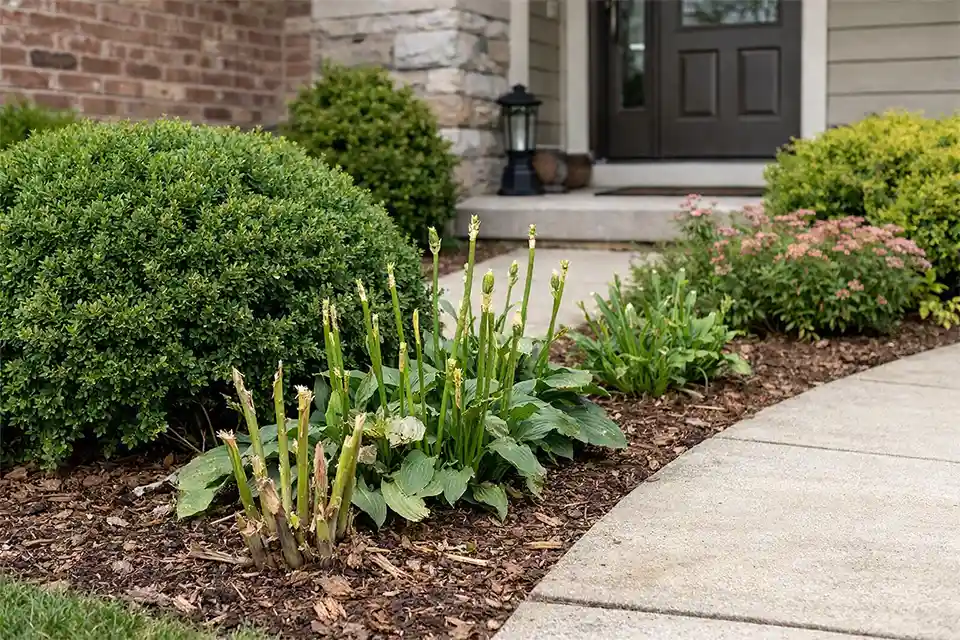
If deer are browsing the same front yard more than once every 2 to 3 weeks during active growth, the problem is usually not bad luck. It is plant selection under the wrong pressure level.
The first checks are simple: damage appears within 12 to 24 hours, the bite line often reaches about 4 to 6 feet high, and the same soft, visible plants keep getting hit while tougher ones nearby are mostly left alone.
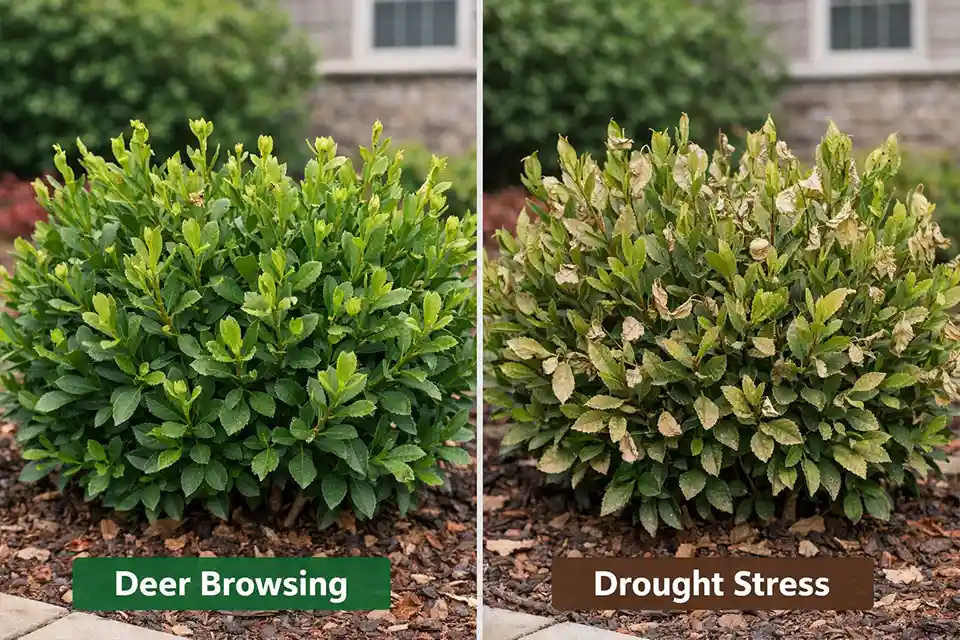
That pattern matters because deer damage gets confused with drought and transplant stress all the time. Drought usually shows wilting, scorch, or slow decline over several hot days. Browsing is faster, more uneven, and much more destructive to shape.
That difference matters more in a front yard than in the backyard. A plant that survives but looks hacked apart is still a bad front-yard plant. In this setting, the goal is not to find a mythical deer-proof list.
It is to choose plants that keep the bed looking intentional even when deer test it lightly, and to stop using plants that fail the same way over and over.
What deer-resistant really means in a front yard
Resistance is preference, not immunity
A deer-resistant plant is usually a lower-preference plant, not an untouchable one. Deer pressure changes with season, local population, nearby cover, and food scarcity.
A plant ignored in June can still be sampled in late winter, especially after several lean weeks. That is why label language often disappoints homeowners. “Resistant” sounds definitive. In real landscapes, it is conditional.
The more useful question is not whether a plant can ever be browsed. It is whether it is likely to be browsed often enough to ruin the visible structure of the bed.
Survival is not the same as front-yard success
This is the part people usually underestimate. A plant can stay alive, resprout in 7 to 14 days, and still be the wrong choice. In a front yard, shape matters. Repeated browsing distorts the outline, removes buds, creates asymmetry, and makes the whole planting feel unstable.
That is why the best front-yard plants in deer-prone areas are not just the ones that survive. They are the ones that still look acceptable after light browsing or are sampled less often in the first place.
What usually fails first in deer-prone front yards
Soft, broad-leaf favorites in visible beds
The first disappointments are usually predictable: broad, tender foliage; exposed flower buds; and lush plants used as front-row color. Hosta-type foliage, tulips, pansies, daylilies, and roses often create this problem. The issue is not just that deer like them. It is that one browsing event can remove most of the visible value at once.
That is especially costly in the most exposed parts of the yard. A front border can look half-empty after one overnight visit, even when the plants are technically still alive.
Lush regrowth that keeps getting hit again
A common waste of time is trying to fix browsing with more water and fertilizer. That can push soft new growth within 1 to 2 weeks, but that same fresh growth often becomes the next target. The plant may recover biologically while failing visually again and again.
Pro Tip: Fast rebound is not the same as a solved problem. If the new growth is soft, bright, and exposed, it may simply reset the browsing cycle.
Small starter plants that seem cheaper but fail faster
Small plants look economical on paper, but in deer-prone front yards they are often the more expensive choice. A 1-gallon plant usually sits fully inside the browsing zone.
It has less woody structure, less visual presence, and fewer reserves to absorb repeated damage. A somewhat larger plant with stronger branching often holds form better even if it is sampled once.
How to choose plants that still hold the bed together
Choose backbone plants before accent plants
Most front-yard failures start because the planting plan is built from accents first. That works poorly under deer pressure. Build the structure first, then add limited seasonal color. In practical terms, about 70 to 80 percent of the bed should be dependable framework: shrubs, grasses, and coarse or aromatic perennials that hold their place. The remaining 20 to 30 percent can carry more risk if the look is worth it.
This same prioritization matters in any exposed planting design, especially when the site already has multiple constraints, as in How to Choose Plants for Front Yard Landscaping.
Favor plants that stay acceptable after light browsing
The most reliable front-yard candidates usually share one or more of these traits: aromatic foliage, leathery leaves, fuzzy texture, coarse texture, resinous growth, or a naturally mounded form that is not ruined by the loss of a few tips. Many salvias, catmints, yarrows, lavenders, hellebores, junipers, boxwoods, inkberries, and ornamental grasses fit this logic better than soft flowering favorites do.
The point is not to memorize a list. It is to understand which traits make a plant less likely to be sampled heavily and less likely to look destroyed if it is.
Do not let deer favorites define the visible structure
A higher-risk plant can still be used, but it should not carry the visual weight of the bed. Do not make deer favorites your front edge, foundation line, or main repeated mass. If you want them, use them as small accents in spots where damage will not break the whole composition.
That same restraint often improves maintenance too, especially in front yards that already need to stay tidy when attention is inconsistent, as in Best Low-Maintenance Front Yard Plants for People Who Travel Often.
Best plant types for front yards with deer pressure
Shrubs that are more reliable for visible structure
In heavier deer pressure, the safest shrubs are usually the ones that create stable form without depending on tender flower display. Boxwood, inkberry, juniper, and some aromatic or resinous evergreens are typically more reliable for visible structure than softer, deer-favored flowering shrubs. These are usually the better candidates for the main framework of the bed.
In moderate pressure, some additional shrubs may still be workable, but they are better used away from the most exposed front edge and not as the plants carrying the whole look.
Perennials that rebound without ruining the bed
Perennials work best when they can take a little damage without making the bed look collapsed. Salvia, catmint, yarrow, lavender, and hellebore usually fit that role better than broad-leaf flowering plants with exposed buds. In moderate pressure, these often perform well as repeated masses. In heavier pressure, they are still more dependable than softer bloom-first choices.
The key is not just whether they live. It is whether they still read as intentional after light browsing.
Groundcovers and edging plants that lower front-edge risk
The front edge is one of the easiest places to make an expensive mistake. Use lower-risk spreaders and edging plants there, especially aromatic or tight-textured types.
Creeping thyme and other low aromatic groundcovers are often better edge choices than soft seasonal color that disappears after one pass.
In narrow strips along sidewalks or exposed curbside beds, durability matters even more than bloom, which is why the logic in Best Plants for Narrow Front Yard Strips Between Sidewalk and Street overlaps strongly with deer-aware selection.
Better options for shady front yards
Shade creates a different trap. Many popular shade plants look lush at planting time but are visually fragile under browsing. In deer-prone front yards, broad soft foliage often loses value faster in shade because once the leaves are chewed back, there is less structure left behind.
That is why shade planting usually needs to prioritize texture and form earlier than people expect. Hellebores and other leathery or coarse-textured shade plants usually make more sense than a mass of soft broad-leaf fillers.
Higher-risk shade plants are best kept as limited accents near the entry, not as the main visual layer.
That tradeoff becomes even clearer in spaces already limited by low light, as discussed in Best Front Yard Plants for House Shade.
Plants to avoid first when deer pressure is frequent
Plants that lose too much shape after one hit
Some plants are not just vulnerable. They are cosmetically fragile. One browsing event can take them from attractive to visibly damaged for weeks. Any plant whose value depends on intact buds, clean symmetry, or a soft full outline belongs in this category.
These are often the worst front-yard choices because they do not fail quietly. They make the whole planting look unfinished fast.
Plants deer often sample early and repeatedly
Hostas, tulips, pansies, daylilies, and roses are common examples, but the broader pattern matters more than the names. Deer often go after tender foliage, exposed buds, and heavily pushed spring growth first. That makes these plants especially risky in visible front-yard zones.
They are not just likely to be browsed. They are likely to lose most of their visual value in a single round of damage.
Plants that are only worth using in small, protected amounts
Some plants are not automatic failures. They are just poor candidates for repeated public-facing structure. If you love a higher-risk plant, keep it in small pockets near the entry, close to daily human activity, or in a protected microzone where losing a few stems will not unravel the whole bed.
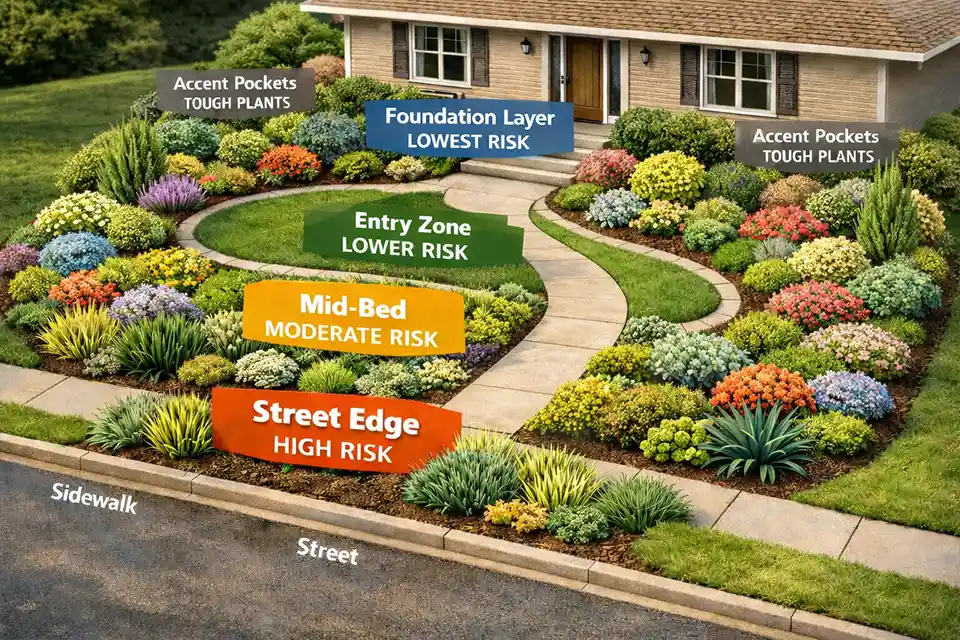
How deer pressure changes by front-yard zone
Street edge needs the toughest palette
The street-facing edge is often the wrong place for experimentation. It is visible, exposed, and commonly adjacent to deer travel routes. This is where repeated low-risk masses make the most sense: grasses, reliable shrubs, and tougher perennials that can hold a clean line between 12 and 36 inches.
Entry beds can handle some risk, but not much
Beds near the porch or front walk may get slightly more protection from daily activity, but they are not safe enough to justify building the whole look around deer favorites. Use this zone for moderate-risk accents only when the look is worth the effort and the rest of the bed is stable.
Foundation beds should protect the visual line of the house
A foundation bed has one main job: keep the house looking grounded and intentional. That means plants here should hold form year-round and recover gracefully.
Repeatedly distorted shrubs or flowering mounds that lose half their visible outline do not just damage themselves. They damage the whole front elevation.
When the standard fix stops making sense
Repellents help, but they should not carry the whole design
Repellents can reduce damage, especially if used before browsing starts and reapplied on schedule. But they are support tools, not the design strategy. Rain, irrigation splash, and normal weathering can weaken them fast. If the planting only looks acceptable with constant spraying every few weeks, the palette is too risky.
When to stop replanting the same species
This is where many front yards stay stuck. If the same plant has been replaced twice within 1 to 2 years, or if browsing repeats every 2 to 3 weeks during active growth, that is usually no longer a protection problem. It is a plant-choice problem. The same conclusion applies when the plant lives but never holds form long enough to look good.
At that point, replanting stops making sense. Change the species, not the spray schedule.
When a protected accent is reasonable and when it is not
A protected accent is reasonable when it is small in quantity, not carrying the structure of the bed, and located where occasional loss will not be obvious from the street. It is not reasonable when it forms the front edge, the main repeated color block, or the base layer that defines the entry sequence.
Pro Tip: If a plant only works when it is hidden, sprayed constantly, and replaced often, it does not work.
Quick front-yard decision guide
| Situation | Better choice | Riskier choice | Better decision |
|---|---|---|---|
| Frequent browsing in visible beds | Structural shrubs and grasses | Soft flowering masses | Build the backbone first |
| Front edge near street or sidewalk | Aromatic or coarse edging | Tender seasonal color | Keep the edge low-risk |
| Part-shade deer pressure | Tough shade structure | Broad soft foliage masses | Choose texture over lushness |
| Repeated damage on one plant | Replace with lower-risk type | Replant same favorite again | Stop retrying after repeat failure |
| Minor occasional browsing | Limited accents are workable | High-risk plants as structure | Keep risk small and controlled |
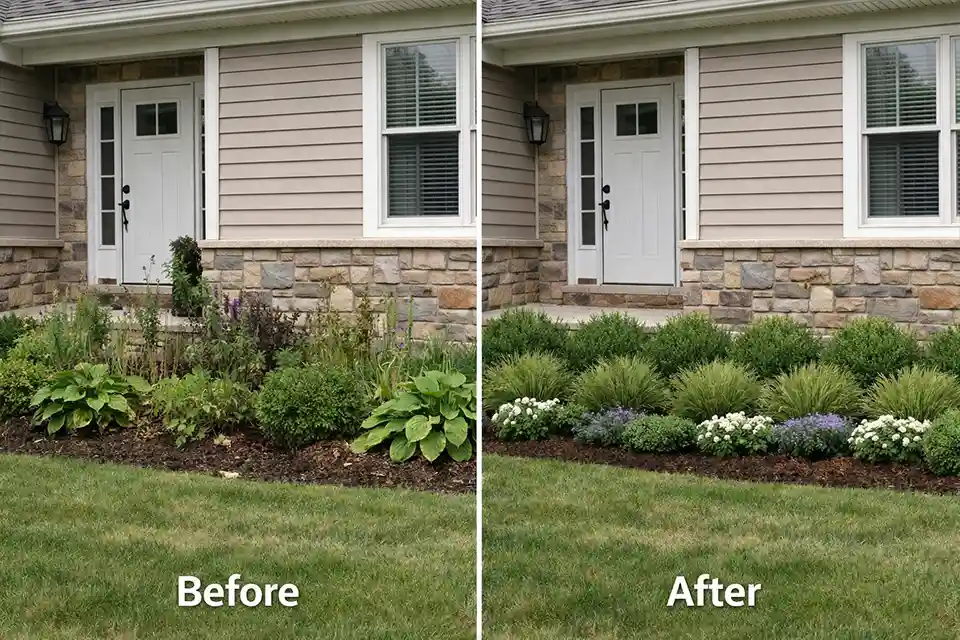
A successful front yard in deer country does not try to eliminate every bite. It protects the visible structure of the bed, limits how much damage one bad night can cause, and replaces repeat disappointments with plants that keep the yard looking intentional.
That is a better standard than simple survival, and a better goal than chasing a longer deer-resistant list.
For broader official guidance, see the Rutgers New Jersey Agricultural Experiment Station deer-resistant plants resource.