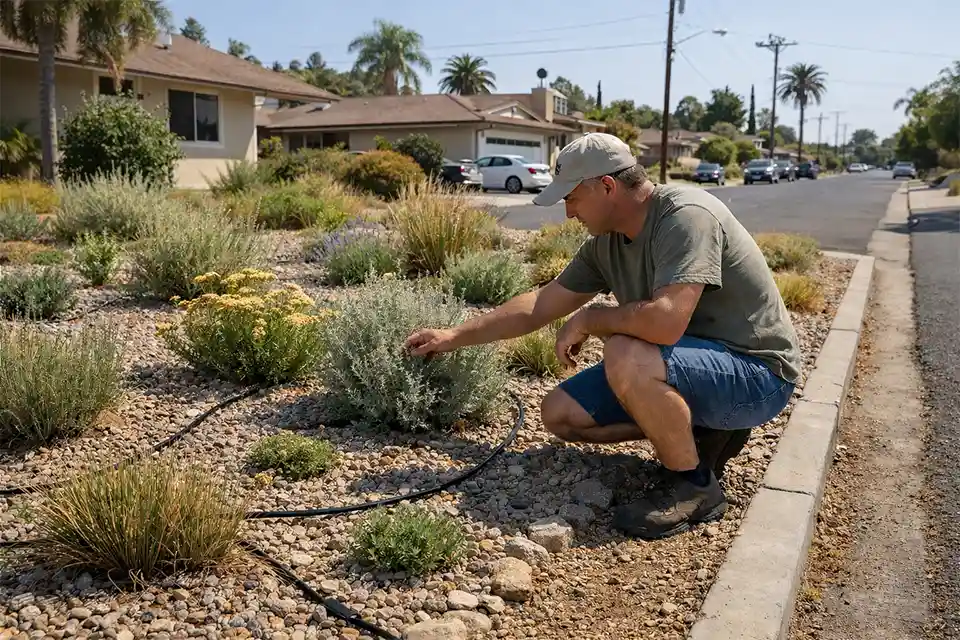
When front yard plants struggle under water restrictions, the main problem usually is not that homeowners forgot to buy “drought-tolerant” plants. It is that the plants were chosen for appearance before the site was read correctly.
Start with three checks: how many hours of direct afternoon sun the bed gets, whether the root zone has at least 12 to 18 inches of usable soil, and how long moisture lasts 4 to 6 inches below the surface after watering.
In a workable bed, the top inch may dry quickly, but that lower root zone should still feel slightly cool within 24 hours. If it is dry that deep by the next day, the site is harsher than the plant list suggests.
That is where people misread the situation. A plant can survive drought in a broad sense and still fail in a front strip beside concrete, against a west-facing wall, or under mature tree roots. A good water-wise front yard, whether you call it low-water landscaping or a xeriscape approach, rewards plants that fit the hardest part of the site, not the prettiest part of the design.
Choose for the toughest part of the yard
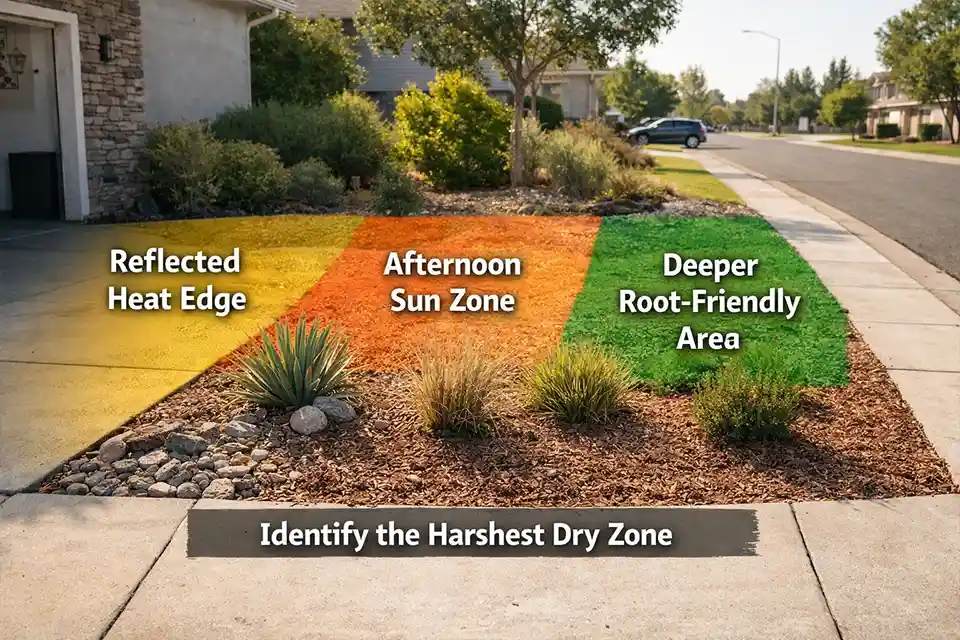
The fastest way to waste money is to choose plants from a nursery bench before understanding where the front yard is most demanding.
Measure afternoon sun honestly
Six hours of morning sun and six hours from noon to 6 p.m. do not create the same stress. In many US climates, especially the Southwest, inland California, or hot reflective suburban lots, pavement and masonry can make a planting edge feel 10 to 15°F hotter than the lawn area a few feet away. That is why plants that look fine on a tag can still crisp at the curb.
Beds that reflect heat from sidewalks and driveways need plants selected for heat plus low water, not low water alone. The same logic applies to front paths with heat buildup, which is why plant choice near hot concrete along a front walkway should be treated as its own problem.
Check root space before trusting the plant tag
Shallow soil is one of the most underestimated limits in front yard planting. Many small perennials can live in 8 to 12 inches of soil, but shrubs are more reliable when they have closer to 18 inches of penetrable soil and room to spread roots laterally. If you hit rubble, heavy compaction, or dense roots after 6 to 8 inches, watering more often may keep a plant alive, but it will not make the site suitable.
People often overestimate climate and underestimate root space. That mistake matters more under water restrictions because shallow beds dry fast between allowed watering windows.
Treat establishment as part of the choice
Even truly low-water plants are not low-water on day one. Many front yard shrubs and grasses need one full growing season to settle in, and some take 12 to 24 months before they can handle wider irrigation intervals without losing shape. Cutting water too early is one of the most common reasons new plantings get misjudged.
Pro Tip: In tough front beds, smaller nursery sizes often establish better than oversized specimens. A younger 1-gallon plant usually adapts faster than a large shrub dropped into hard, hot soil.
What to look for in a front yard plant when water is limited
This is the missing filter in a lot of front yard advice. The question is not just which plants are low water. It is which plant traits still make sense when irrigation is restricted.
Mature size matters more than nursery size
A plant that fits a 2- or 3-foot-wide strip at the nursery can still become a maintenance problem once it matures. Under water restrictions, oversized shrubs behave badly: they need repeated pruning, recover slowly, and often end up looking thirsty even when they are technically alive. Plants that naturally fit the width of the bed are usually the better long-term pick.
Summer structure matters more than bloom count
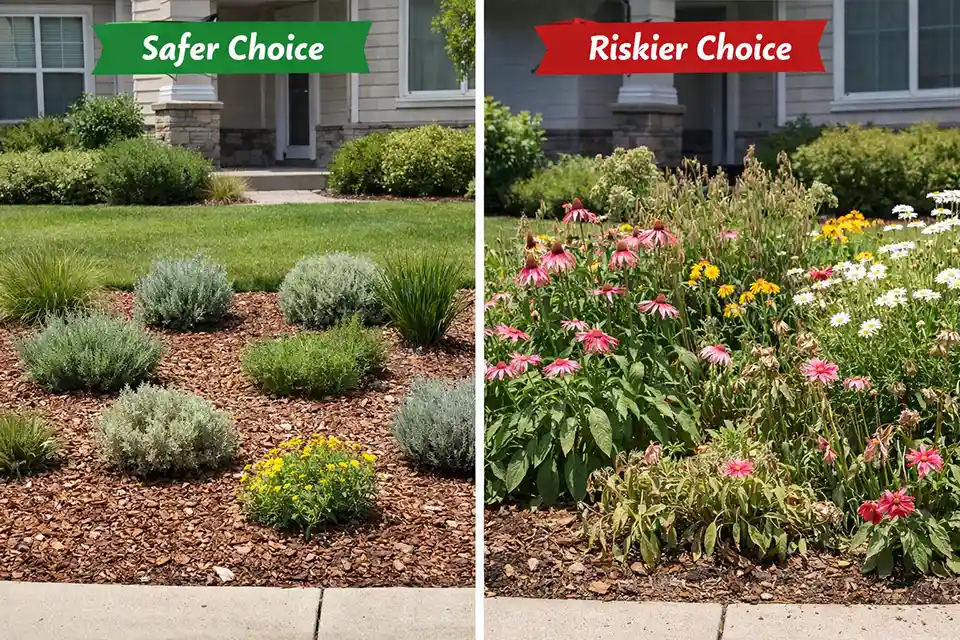
Spring bloom is easy to overvalue. What matters more is whether the plant still looks composed in July or August. In a front yard, visual stamina counts. Plants with good foliage, restrained habit, or evergreen structure usually carry a low-water design better than bloom-heavy choices that peak for six weeks and then fade.
That is also why front yard landscaping ideas using native plants work best when they focus on regional fit and structure, not just the word native. Native is helpful. Native-by-default is not a selection method.
Lean-soil tolerance is often safer than lush fast growth
Plants that tolerate lean soil and moderate growth usually perform better between watering cycles than soft, fast-growing plants chosen for instant fullness. This is one area homeowners commonly underestimate. The design that looks slightly sparse in month one often looks better by late summer than the one planted too densely for quick curb appeal.
Establishment demand is part of plant suitability
A plant is not a smart choice for a restricted-watering yard if it needs a long, fragile establishment period in a punishing bed. That is a practical threshold, not a theoretical one. If the plant needs frequent watering for months and your local rules only allow irrigation every 7 days, it is already a poor fit unless the bed is unusually favorable.
Best plant directions by front yard condition
Not every low-water plant type deserves equal space in a front yard. Some are simply safer bets.
For hot south- or west-facing beds
Favor compact shrubs, woody herbs, clumping grasses, and silver- or gray-leaved perennials that hold form under heat. In the right region, that often means plant directions such as lavender, rosemary, santolina, compact manzanita-type shrubs, blue fescue, or deer-resistant clumping grasses. Broad-leaved flowering shrubs chosen mainly for bloom are usually the riskier bet.
For narrow strips beside pavement
Treat narrow strips as high-risk zones. Upright plants, restrained growers, and lower-maintenance forms usually outperform anything that wants frequent shearing or soft summer growth. Good directions often include narrow grasses, compact evergreen shrubs, low mounding groundcovers, or tough herb-like perennials rather than fast, wide shrubs. This is also why plants for tree roots and very little soil overlap so strongly with water-restricted design logic: both problems are really about limited root opportunity.
For beds with shallow soil or tree-root competition
Sparse planting often works better than ambitious layering. This is where people lose time chasing a tougher plant instead of admitting the site is the main issue. If soil depth is under 12 inches and roots already dominate the bed, fewer plants, smaller root systems, and wider mineral mulch areas usually make more sense than packing in shrubs. Think selective groundcovers, compact perennials, and smaller accent grasses before trying to force a full shrub border.
For front yards that still need to look tidy
Use structure to do most of the visual work. Evergreen shrubs, compact grasses, and restrained accents age better than a design built around constant bloom.
That is especially important in visible front yards governed by HOA expectations or plain curb appeal pressure. If the design still has room for color, let it come from a small seasonal layer, not from the main structural planting.
If your area has strict watering rules
This is where standard plant advice usually gets too vague.
One watering day per week changes the plant palette
A yard watered every 7 days needs different plants from one that can be refreshed every 3 or 4 days in summer. Bloom-heavy, shallow-rooted, fast-growing choices become riskier as intervals widen. Slower summer growers and plants that tolerate deep, less frequent watering usually hold up better.
Group by water need, not just by height
Mixed beds often fail because the plants are arranged by appearance instead of irrigation need. If one part of the front yard can be watered every 7 days and another only every 10 to 14 days, those should function as separate hydrozones. Mixing medium-water and low-water plants in a single small bed usually makes both look mediocre.
A useful companion idea appears in low-water front yard landscaping practical solutions that last: the planting plan and irrigation pattern have to support each other, or the design becomes higher-maintenance than it looks on paper.
Efficient irrigation matters more once the palette gets tighter
This is the point where plant choice and irrigation method stop being separate decisions. In many front yards, drip irrigation or targeted low-volume watering makes more sense than broad spray coverage because it keeps water in the intended root zone instead of wasting part of the cycle on pavement, mulch, or empty gaps. If the plant palette is built for low-water performance but the irrigation pattern still acts like a lawn, the landscape will underperform.
Mulch helps, but it is not the miracle fix
A 2- to 3-inch mulch layer can reduce evaporation and moderate soil temperature. That helps. But mulch does not solve shallow soil, heat reflection, or a bad plant match. People often overestimate mulch and underestimate layout. Once the site is too shallow or too hot, the standard fix stops making sense and the design itself needs to change.
What changes by region
A plant that works in a dry California front yard may still be wrong in Florida, and a low-water success in Arizona may fail in a cold northern foundation bed. Regional fit still matters.
Dry Southwest and inland California
Heat reflection, long dry spells, and mineral soils make reduced turf, wider mulch zones, and a tighter plant palette more successful than lush mixed beds.
Humid Southeast
Low water is not the only filter. Humidity tolerance, disease resistance, and airflow still matter. A plant can be drought tolerant and still hate sticky, stagnant conditions.
Cold-winter states
Low-water performance has to sit alongside winter hardiness and freeze recovery. Some plants that handle summer dryness well still look rough after repeated freeze-thaw exposure.
Before buying anything, check your regional plant list, local extension guidance, or a reliable native-and-adaptive plant source for your area. The safest plant direction on paper can still be wrong if it is not regionally appropriate.
A quick way to choose what goes where
| Front yard condition | Better plant direction | Higher-risk choice | Why it changes the outcome |
|---|---|---|---|
| West-facing bed with reflected heat | compact shrubs, woody herbs, clumping grasses | thirsty flowering shrubs | heat load is higher than the label suggests |
| Narrow 2–3 ft strip by pavement | upright, restrained plants | fast growers needing constant pruning | root volume dries out too fast |
| Tree-root competition | sparse planting, selective fillers | dense layered shrub planting | roots compete through every watering cycle |
| Strict once-a-week watering | slower summer growers, deeper-rooting plant habits | soft, bloom-heavy, shallow-rooted plants | appearance drops faster between cycles |
| HOA-visible front yard | evergreen framework plus restrained accents | seasonal color as the main structure | the yard looks stressed sooner |
The main point is simple: under water restrictions, the right plant is usually the one that stays acceptable in the hardest week of summer, not the one that looks best at purchase.