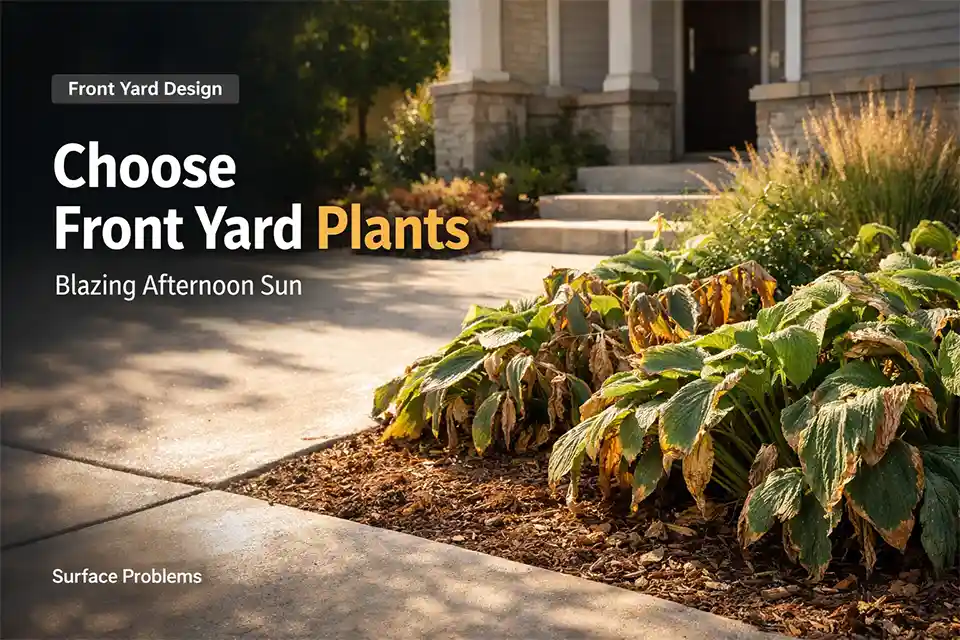
If your front yard gets direct sun from about 2 p.m. until evening, plant choice should be based on heat handling first and appearance second.
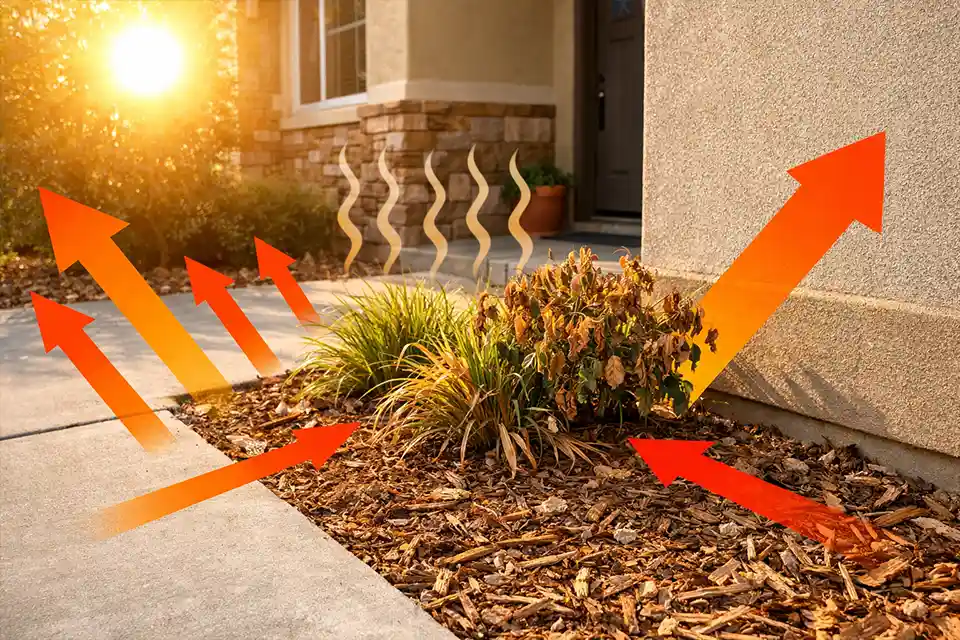
The first three checks matter more than the plant tag: how many hours of direct sun hit after noon, whether the top 2 to 3 inches of soil dry within 24 hours after a deep watering, and whether the bed sits next to concrete, gravel, stone, or a west-facing wall that can add another 5 to 15°F of radiant heat. In many front yards, that combination is the real problem.
That is also where people misread what they are seeing. A plant that droops at 4 p.m. but looks normal again the next morning is often reacting to heat load, not simple drought.
A plant that stays limp into the next day is more likely dealing with root stress or lack of water. Those look similar from the curb, but they are not the same problem, and they should not lead to the same fix.
Start by treating the bed as a hot zone
Most failures in blazing afternoon sun are not caused by unusual soil chemistry or bad luck. They start with the site being harsher than the buyer realizes.
Count afternoon exposure, not total sun
A bed with 6 hours of direct sun sounds straightforward until you notice that 5 of those hours land between 1 p.m. and 6 p.m. That is much tougher than 6 bright hours that end by early afternoon. As a practical threshold, any bed getting 4 or more hours of direct sun after noon should be treated as a higher-stress planting zone.
Beds near hardscape are harsher still. A shrub planted 2 feet from a driveway can struggle more than the same shrub planted 8 feet away in open soil. The sunlight may be identical, but the heat load is not.
That pattern shows up often in Front Yard Landscaping Problems in Hot Climates, where the site behaves more like a heat trap than a normal border.
What people usually overestimate
People often overestimate what “full sun” means on a nursery label. In practice, that label usually tells you a plant can take at least 6 hours of direct light. It does not tell you how the plant will look in a west-facing front bed boxed in by pavement and reflected glare. That is a much narrower test.
Choose plant traits before you choose plant names
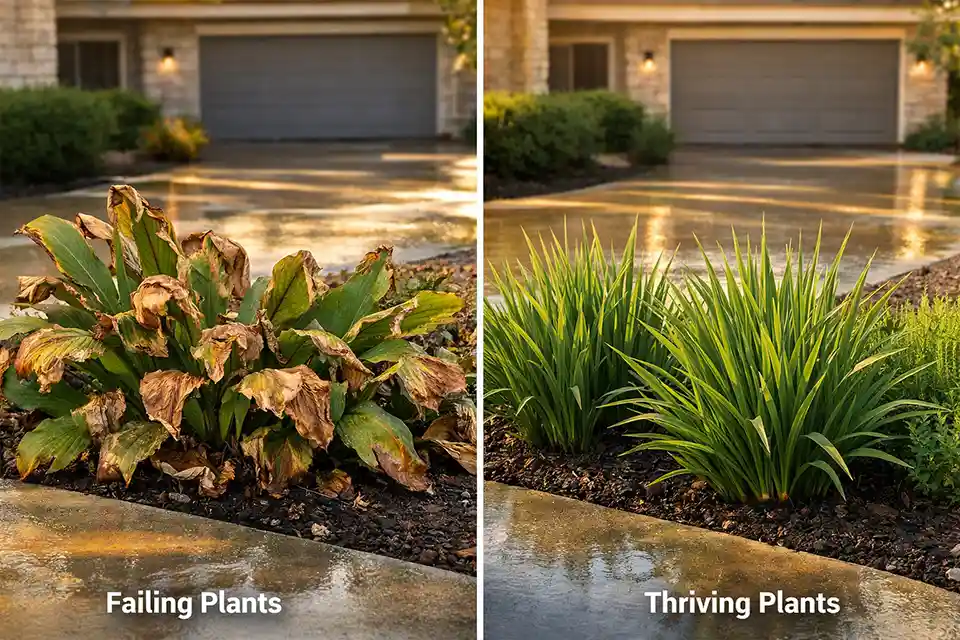
The plants that last in these beds usually share a few traits. They tend to have smaller leaves, thicker or waxier foliage, gray or silver surfaces, deeper root potential, or a naturally sturdy shape that does not collapse in heat.
Traits that usually perform better
This is why salvia, gaura, coreopsis, coneflower, red yucca, many junipers, rosemary, and lantana often hold up better than plants with large, soft foliage. In hot afternoon exposure, foliage structure matters more than bloom drama. Readers often underestimate that. They shop by flower color, then spend the rest of summer trying to keep the leaves alive.
Plants that keep disappointing in this spot
Hydrangea, hosta, impatiens, coleus, caladium, and other shade-leaning or moisture-hungry plants are common mistakes here. They can look fine in spring and still be the wrong choice by July.
That is one of the reasons some beds turn into a replanting cycle rather than a stable planting, a pattern closely related to Front Yard Flower Beds Keep Needing Replanting.
The fix people waste the most time on is fertilizer. When heat and exposure are the real problem, feeding often pushes soft new growth that scorches even faster. Unless you have a confirmed nutrient problem, fertilizer is usually a distraction in a bed like this.
A faster way to screen plants before you buy
The most useful question is not “Is this plant full sun?” It is “Can this plant stay attractive in reflected afternoon heat without constant rescue?”
Quick comparison table
| Site condition | Better choices | Usually weaker choices | Why it matters |
|---|---|---|---|
| 4 to 6 hours of sun mostly after noon | salvia, gaura, coreopsis, coneflower | impatiens, coleus, begonias | heat tolerance matters more than color impact |
| Bed beside driveway or walkway | juniper, rosemary, red yucca, dwarf abelia | hosta, hydrangea, caladium | pavement adds reflected heat |
| Fast-draining lean soil | lavender, penstemon, santolina | thirsty annual mixes | surface dries too fast for shallow-rooted thirstier plants |
| Humid southern climate | dwarf yaupon holly, abelia, heat-tolerant salvias | lavender in slow-draining soil | some “sun plants” hate heat plus humidity |
| Narrow bed against a warm wall | compact tough-foliage shrubs | floppy cottage perennials | trapped heat punishes soft growth |
One thing people usually miss in real front yards: if a plant only looks good when conditions stay even, it is a poor bet for a west-facing entry bed.
That is also why plant selection should be tied to bed layout instead of treated as a separate decision. How to Choose Plants for Front Yard Landscaping works well as a broader framework, but in blazing afternoon sun you need to filter even harder for heat response.
Installation still matters, but only up to a point
A good plant can still struggle if the setup is poor. A bad plant will still fail even with careful setup. That distinction matters.
Mulch depth and spacing
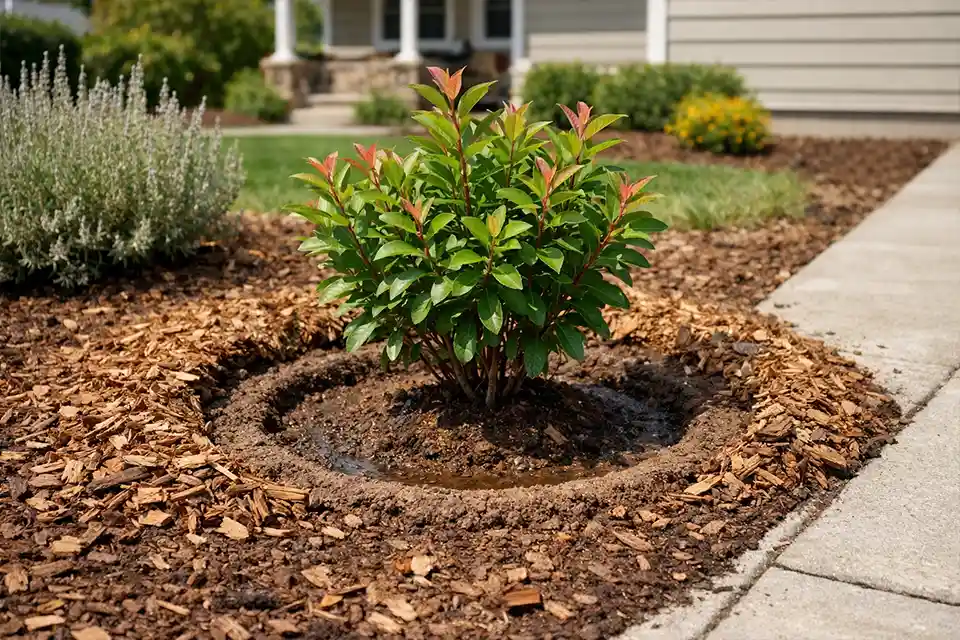
A 2- to 3-inch mulch layer is usually enough to slow evaporation and buffer soil temperature. Less than 1 inch barely changes anything. More than about 4 inches starts solving the wrong problem and can trap moisture around crowns. Keep mulch 2 to 3 inches away from stems.
Space for mature width, not nursery size. Many compact shrubs need 24 to 36 inches on center, not 12 to 18. Crowding makes the bed look finished early, but it reduces airflow and makes heat stress harder to manage later.
First-season watering versus chronic rescue
New plants with roots only 6 to 8 inches deep are far more vulnerable in their first 8 to 12 weeks than established shrubs with roots 12 to 18 inches down. During that first season, deeper watering once or twice a week is usually more useful than light daily sprinkling.
But there is a point where the standard fix stops making sense. If a plant is in its second summer, has proper mulch, gets deep watering, and still burns badly, replacing it is usually smarter than rescuing it. People commonly underestimate how much time they lose trying to nurse the wrong plant through the wrong site.
That same maintenance trap shows up in tighter entry plantings too, especially when the bed is designed to look full immediately rather than function well over time, as seen in Front Yard Small Plant Beds Upkeep.
Quick diagnostic checklist before you plant
Use these signals to rule plants in or out
- The bed gets 4 or more hours of direct sun after noon
- The top 2 to 3 inches of soil dry in 24 hours or less
- The planting area sits within 2 to 3 feet of concrete, stone, gravel, or a west-facing wall
- Previous plants looked fine in spring but declined by mid- to late summer
- You find yourself doing frequent rescue watering just to keep plants presentable
- Broad, soft leaves have failed there before while tougher shrubs nearby stayed acceptable
Pro Tip: At the nursery, the plant that looks slightly tougher is often the one that ends up looking better by August.
If the bed behaves like a heat trap, build the shortlist around durable foliage, root depth, and heat tolerance first. The design almost always looks better when you stop asking delicate plants to do a tough plant’s job.
For broader official guidance, see University of California Agriculture and Natural Resources.