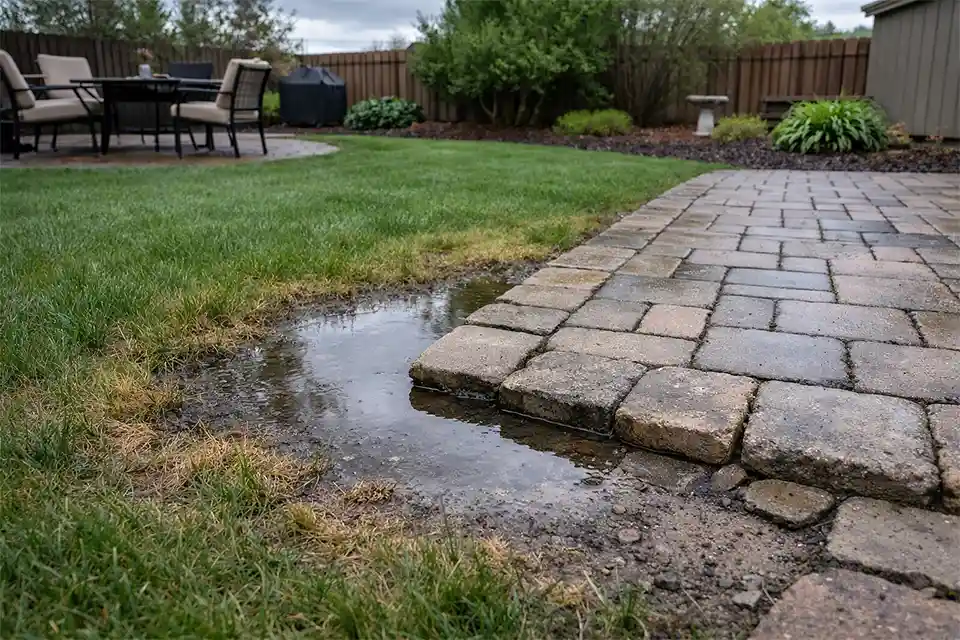
Most backyard landscaping problems do not begin with a dramatic failure. They begin when the yard gets a little harder to use each season.
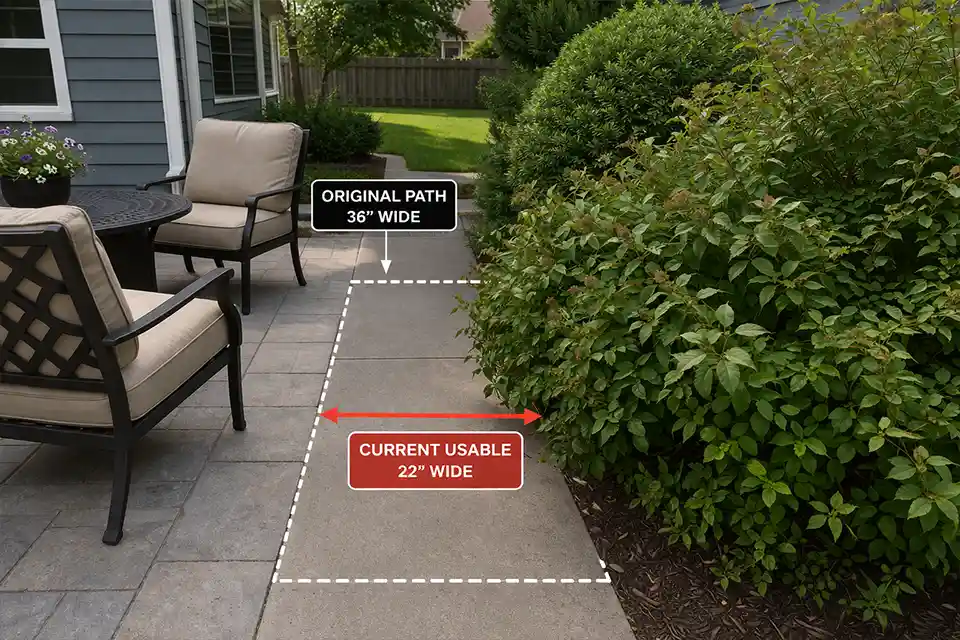
The first checks that matter are simple: does a wet spot still hold water after 24 hours, has a patio or path edge dropped more than about 1/2 inch, and has a once-comfortable route narrowed below roughly 36 inches because plants matured into it? Those are not cosmetic annoyances. They are early signs that the layout is losing tolerance.
That difference matters because people often misread slow decline as a maintenance problem. A few weeds, faded mulch, or a tired edge are not the main story.
The bigger pattern is usually one of four things: water moving where it should not, soil compacting where people repeatedly cut through, plants outgrowing the space they were given, or “low-maintenance” materials turning into high-intervention surfaces.
The symptom may be clutter, patchy grass, or overgrowth. The mechanism is usually water, scale, compaction, or layout.
Quick Diagnostic Checklist
- Water remains in the same area longer than 24 hours after an ordinary rain.
- Pavers, stepping stones, or edge restraints have dropped by about 1/2 inch or more.
- A backyard route that should feel easy now pinches below roughly 36 inches.
- Gravel or mulch needs to be pulled back into place more than 2 or 3 times per season.
- Turf that used to hold up now gets much less direct sun after trees leaf out.
- People keep creating a shortcut through beds instead of using the intended path.
What People Usually Misread First
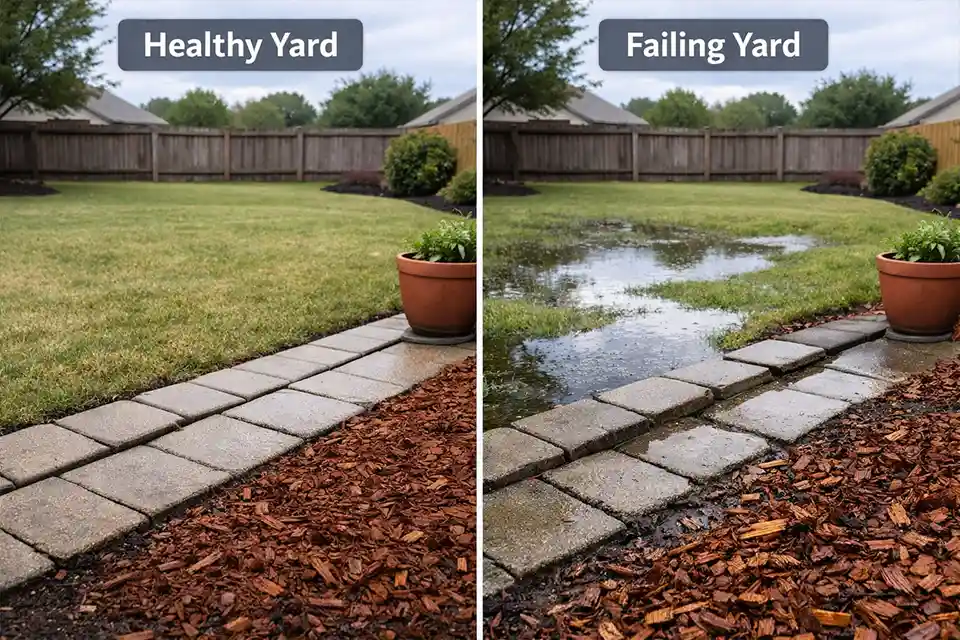
The most common mistake is blaming upkeep before blaming structure. Homeowners assume the yard looks worse because they have fallen behind on pruning, edging, or cleanup. Sometimes that is true. More often, maintenance became harder because the original plan had almost no margin for change.
That is why the obvious fix so often wastes time. Re-spreading mulch over a low spot does not change the grade. Cutting shrubs back harder does not solve a bed that was undersized from the start.
Adding more gravel does not fix migration when the edge restraint is loose or the base is too thin. If the same correction keeps returning every month or every season, the problem is usually not discipline. It is design tolerance.
A good example is drainage. People wait for an obvious swampy patch before treating it as serious, but that is late-stage thinking. Many backyards already have drainage trouble when water is simply slow to leave, repeatedly tracks to one patio corner, or keeps washing fines into the same low strip.
That is why the failure pattern in Backyard Drainage Problems Most Homeowners Ignore often starts looking like “mess” before anyone calls it drainage.
The Problems Most Likely to Get Worse
Slow drainage comes first
If one issue deserves first priority, it is water. Not because it is always the most visible, but because it creates the most secondary failures. Once water repeatedly uses the same route, you start getting algae on hardscape, mulch loss, shallow rooting, low-oxygen soil, settlement, and in colder states, more freeze-thaw stress.
People usually overestimate weeds and underestimate water movement. Weeds are irritating, but they are usually downstream. Water is the force that changes how the yard behaves.
A lawn area that stays soft underfoot two days after a moderate rain is more important than a few dandelions. A patio corner that settles twice in 12 to 18 months is not asking for more joint sand; it is usually pointing to a base or drainage problem below the surface.
On sloped sites, the problem is even easier to misread. The yard may not look wet at all. Instead, runoff speeds up, surface fines move, and the first visible sign is erosion or instability rather than puddling. That is where Sloped Backyard Problems With Drainage, Erosion, and Safety is more useful than a simple “wet yard” diagnosis.
Plants that succeed in the wrong place
The second big category is not plant death. It is plant success that the layout cannot absorb. A shrub bought at 24 inches wide can mature into a 5-foot or 6-foot object. Trees add canopy, deepen root competition, and quietly shift light conditions. A backyard that felt open in year one can feel cramped, damp, and patchy by year four or five.
This is where people often waste time trying to rescue turf that no longer has enough light. Lawns generally perform best with about 6 or more hours of direct sun, and many start thinning once that drops closer to 4 hours after nearby trees leaf out. Tree roots compound the problem by competing for water and nutrients at the same time.
Once shrubs are being cut back every 4 to 6 weeks just to keep a grill area, window, or circulation path usable, it is usually not a pruning issue anymore. It is a scale issue.
The better decision is often removal or relocation, not a tighter maintenance loop. That is also why Backyard Landscaping Problems in Shaded Areas helps more than generic lawn advice when the real change is maturing canopy.
Low-maintenance surfaces that age badly
This is the category homeowners often regret because it looked smart at installation. Gravel, fabric-heavy beds, and lawn-free zones can be useful, but they are often sold as if they remove maintenance. In reality, they usually replace broad simple maintenance with narrow repetitive maintenance.
A gravel area that loses depth, exposes fabric, or develops foot depressions is no longer acting like a stable surface. Even a roughly 1-inch edge shift can be enough to let stone move into turf or beds. When the same area needs touch-up three times in one season, stop buying more material and start checking confinement, runoff direction, and base depth instead.
This tends to show up differently by region. In northern states, freeze-thaw movement makes weak bases reveal themselves faster. In dry western climates, gravel and fabric systems collect dust and organic debris until weeds anchor in what was supposed to be a clean surface.
In wetter summer climates, edge failure often appears first because repeated runoff keeps pushing material out of place. The material is not always the problem. The system under it usually is.
That is the long-tail issue behind Backyard Landscaping Gravel Maintenance Problems.
It is also why Backyard Landscaping Without Grass Problems matters here: removing turf does not remove work. It often replaces mowing with sorting, blowing, resetting edges, and managing every leaf and twig one by one.
A Better Way to Prioritize Repairs
| What you see | What it usually means | What people waste money on first | Better next move |
|---|---|---|---|
| Wet area after 24 hours | Slow drainage, compaction, or bad grade | Seed, topsoil, fresh mulch | Trace runoff, test drainage, regrade before replanting |
| Repeated patio settlement | Base movement or water under hardscape | More joint sand | Lift and reset affected section after fixing water path |
| Grass thinning under maturing trees | Shade plus root competition | Extra fertilizer | Expand bed line or convert to shade-tolerant planting |
| Gravel drifting into lawn | Weak edge restraint or poor confinement | More gravel | Reset edge and restore proper depth/base |
| Path always overgrown | Plant size mismatch | More frequent trimming | Remove or relocate oversized plants |
The most useful prioritization is simple: urgent beats annoying. A few weeds are annoying. Repeated settlement, slow drainage, and narrowing circulation are urgent because they usually get more expensive if ignored. Cosmetic disorder can wait. Structure rarely gets cheaper.
When the Standard Fix Stops Making Sense
There is a real point where maintenance turns into denial.
If a soggy zone keeps returning after every moderate rain, stop treating it like a reseeding problem. If a patio edge settles again within about a year of being reset, stop treating it like a surface-finish problem.
If a lawn strip under trees now gets only partial light and never really recovers, stop treating it like a fertilizer problem. If shrubs must be reduced several times each growing season just to preserve access, stop treating it like a pruning problem.
Repeated repair is often the clearest sign that the material, plant, or layout choice is no longer right for the site. That is the same long-term pattern behind Why Low-Maintenance Backyards Become High-Maintenance.
Pro Tip: Track two numbers for one full season: how long water lingers after rain, and how often the same area needs correction. Those numbers usually tell you more than appearance does.
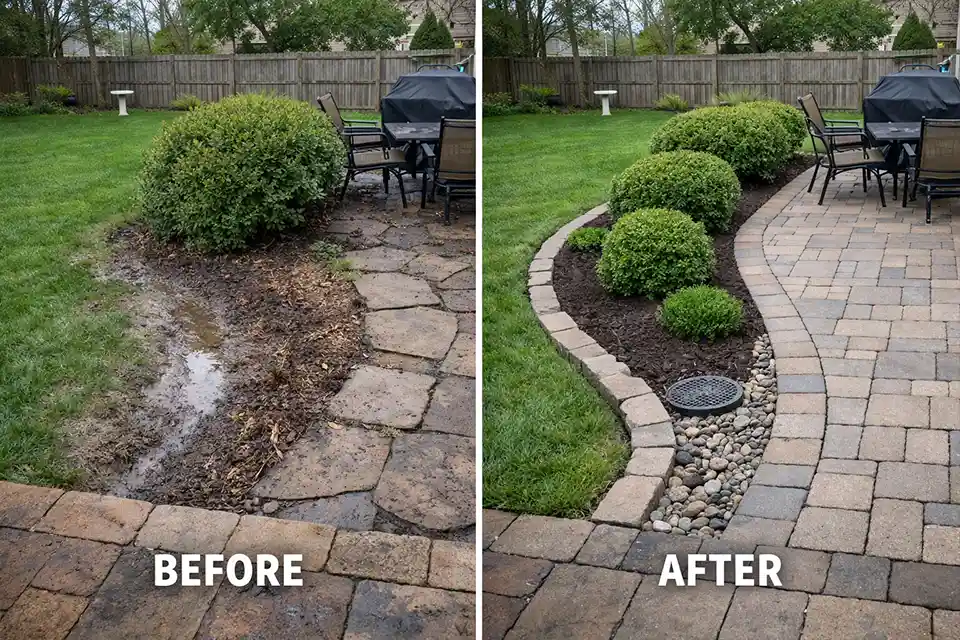
The backyards that age well are not the ones with the most features. They are the ones with enough margin built in for water, mature plant size, real circulation, and ordinary seasonal change.
That is usually the difference between a yard that needs occasional attention and one that quietly becomes a permanent correction project.
For broader official guidance, see the USDA Natural Resources Conservation Service.