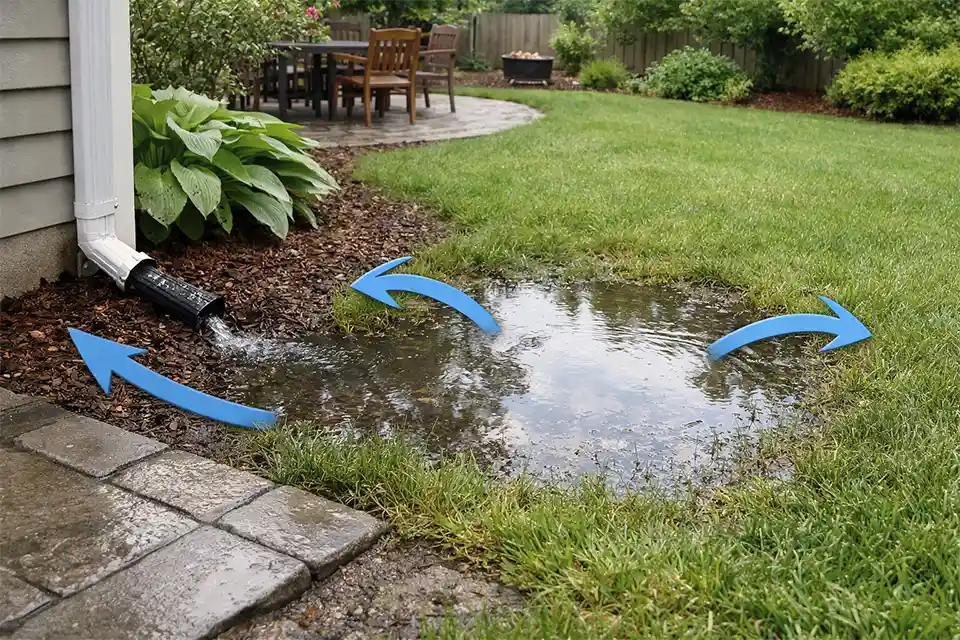
Mosquito-prone backyards usually do not fail because of one dramatic feature. They fail because the yard holds moisture longer than the layout suggests.
The first checks are simple and measurable: any spot that stays wet more than 24 hours after rain, any mulch bed that still feels damp 48 hours later, and any object or surface that quietly holds even a small amount of water for 7 days or more.
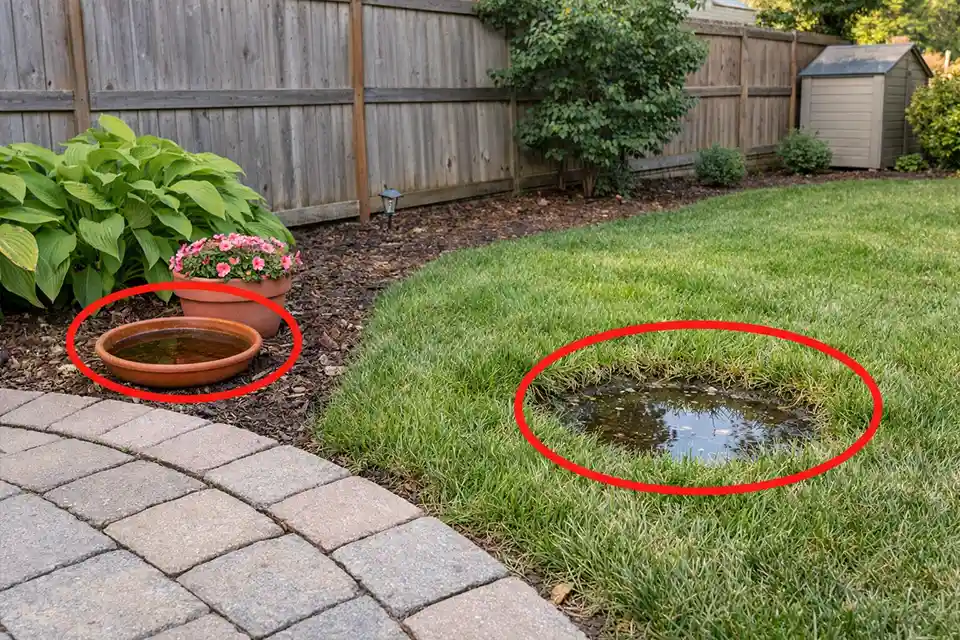
That includes low turf depressions, but also planter saucers, bird baths, clogged gutters, pool covers, and corrugated drain extensions that never fully empty.
That distinction matters because mosquitoes are often blamed on the wrong thing first. People overfocus on “mosquito-attracting plants” or patio lighting when the more useful divide is this: attraction is secondary, breeding and resting habitat are primary.
A lush backyard can perform well if it dries quickly and has airflow. A cleaner-looking yard can still produce mosquitoes if it combines trapped runoff, overwatering, shaded corners, and overlooked water containers.
The yard is usually not failing because it is too planted. It is failing because the moisture cycle never really breaks.
The mistakes that matter most
1. Letting water linger longer than the yard can recover from
This is the main design mistake because it creates the real breeding window. If a puddle is still visible 24 hours after a storm, or if one section of the yard stays soft underfoot for 2 to 3 days, that is not just a drainage annoyance. It is a site condition that supports mosquito development.
A healthier backyard sheds or absorbs water quickly enough that the surface dries within about 12 to 24 hours in warm weather. A failing one stays wet for 48 to 72 hours under the same conditions. That comparison is more useful than almost any plant-based explanation.
Many of the same patterns show up in Backyard Drainage Problems Homeowners Ignore, especially in yards where a minor grade error keeps reactivating the same wet strip after every rain.
2. Sending roof water and runoff into dense planting beds
A lot of mosquito issues start with concentrated discharge, not broad yard-wide sogginess. One short downspout extension, one patio edge, or one hardscape seam can feed the same shrub bed again and again. The result is often not a dramatic pool of water. It is a narrow strip of permanently damp soil hidden below foliage.
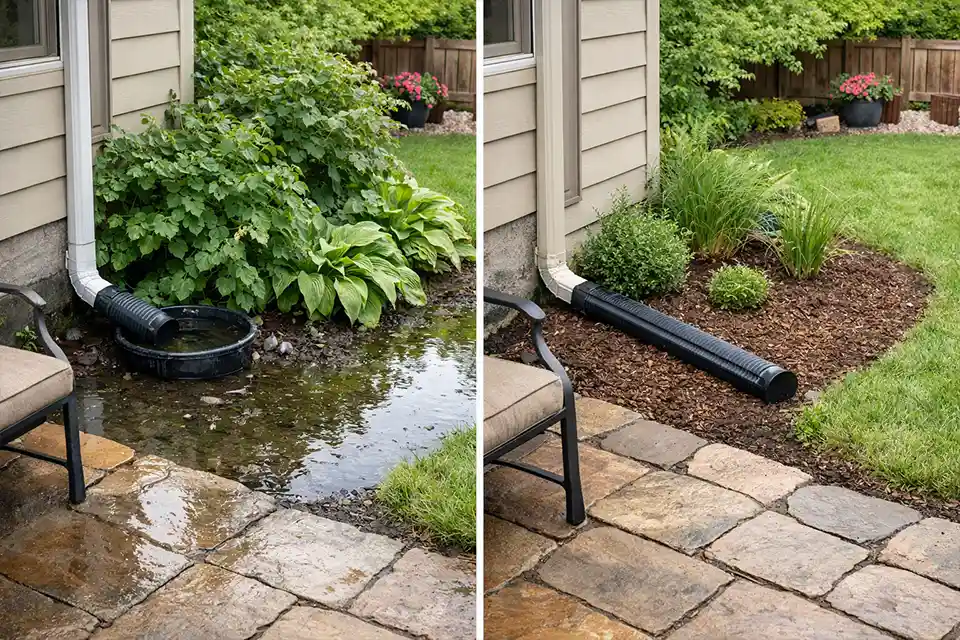
This is where people underestimate the problem. A downspout that ends only 12 to 18 inches from a mulch bed may look neat, but it can keep that area wet long after the rest of the yard has dried. Extending discharge 4 to 6 feet away from foundations and away from dense beds is often a better first fix than changing plants.
3. Building shaded dead-air zones that never really dry
Mosquitoes do not need a swampy yard. They do well in cool, humid daytime shelter. That usually forms in fence-line shrub masses, heavy screening near the patio, under-deck edges, and corners with weak airflow and less than 4 to 6 hours of direct sun.
Shade is not the mistake by itself. The mistake is combining shade, thick mulch, dense lower foliage, and frequent irrigation into one still pocket. That creates ideal resting habitat even when obvious standing water is hard to see.
This is part of why Backyard Landscaping Problems in Shaded Areas often turn into pest problems too. The planting issue is really a drying-speed issue in disguise.
What people usually misread first
Plants are usually blamed before water timing
Most backyards do not become mosquito-heavy because of one ornamental choice. They become mosquito-heavy because water stays on site too long and adult mosquitoes have protected places to rest during the day. Dense foliage can worsen that, but it is rarely the primary cause by itself.
Small containers are easy to dismiss and easy to miss
This is one of the biggest omissions in otherwise decent backyard plans. A well-designed lawn and patio can still underperform if the yard is full of small water-holding items: planter saucers, kids’ toys, buckets, tarps with sagging corners, trash can lids, wheelbarrows, watering cans, folded furniture covers, and pet bowls left untouched too long.
People tend to underestimate these because they look temporary. They are not. If they hold water through a weekly cycle, they can keep the problem alive even when the drainage design is mostly sound.
Bird baths and decorative water features often get treated too casually
A bird bath is not a problem if the water is emptied, scrubbed, and refilled regularly. In warm months, changing the water at least twice a week is a safer standard than treating it as occasional upkeep. The same applies to decorative fountains that are not circulating properly, pond edges with stagnant pockets, and pool covers that hold shallow rainwater.
The mistake is thinking these features are too small or too intentional to matter. They matter because they hold still water exactly where people want to spend time.
Quick diagnostic checklist
- Any puddle remains visible more than 24 hours after rain or irrigation
- A mulch bed still feels distinctly damp 48 hours later
- One low area sits 1 to 2 inches lower than the grade around it
- Planter saucers, toys, buckets, tarps, or lids hold water through a weekly check
- Gutters, splash blocks, or corrugated drain extensions trap water instead of moving it away
- Dense shrubs, deck edges, or fencing create a still, humid pocket near seating areas
Why the obvious fix often fails
More gravel may hide the problem instead of solving it
Gravel is often used as a quick cure for wet areas, but on compacted subsoil it can simply make saturation less visible. Water moves through the stone and then stalls below, so the surface looks cleaner while the damp zone remains.
That is why Backyard Landscaping Gravel Maintenance Problems overlaps with mosquito issues more than people expect. The surface can look improved while the moisture pattern underneath barely changes.
More mulch can improve the look and worsen the microclimate
A mulch depth around 2 to 3 inches is usually enough for moisture moderation. Once beds in wet shade regularly build up to 4 inches or more, mulch can hold humidity longer than the site can tolerate. The bed looks finished, but the yard dries more slowly.
Sprays, candles, and repellent plants do not fix an active breeding cycle
This is the fix that wastes the most time. If mosquitoes keep returning within a week, the yard is telling you something. You are not dealing with a one-off nuisance. You are supporting repeated local production or giving adults a stable resting zone nearby.
Repellent plants may support a seating area, and patio fans can make that space more usable, but neither one corrects a yard that still holds breeding water.
Pro Tip: Walk the yard at least once a week, and again within 24 hours after heavy rain. Those two checks usually tell you more than another product trial.
The hidden backyard sources that ruin otherwise decent designs
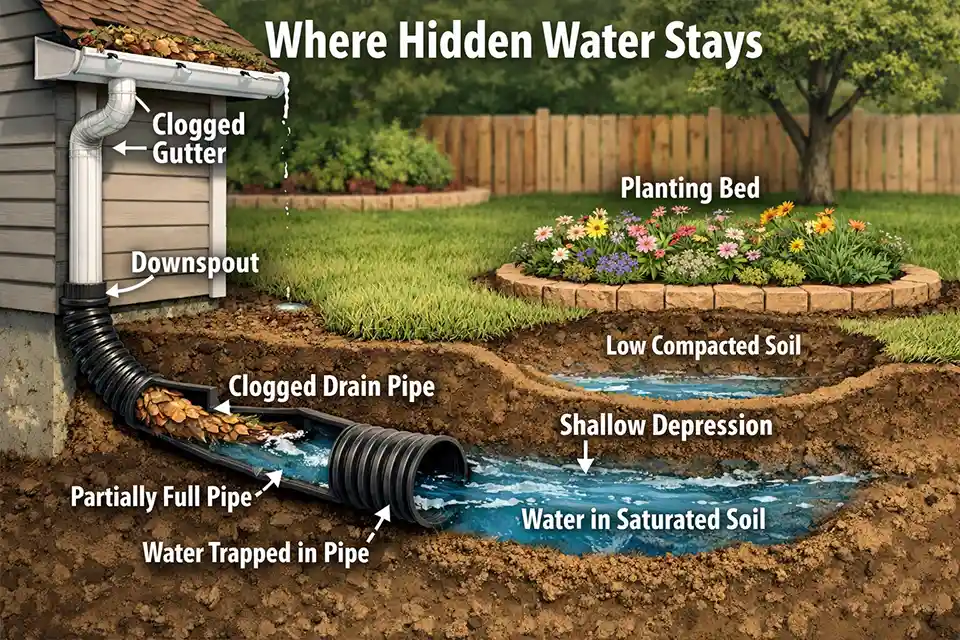
Gutters and corrugated drain extensions
This is a high-value check because it is easy to miss from ground level. Gutters that hold debris can keep water pooling after each rain, and corrugated flexible drain pipes often trap pockets of water internally if they sag or were installed without enough fall.
Homeowners often assume water has been “handled” because it disappears into the extension. Sometimes it has only been relocated into a darker breeding site.
If a drain extension does not fully empty or has low sections that stay full between storms, replacing it with a smoother, properly sloped run makes more sense than trying to compensate somewhere else in the yard.
Pool covers, splash zones, and decorative water
Pool covers are a common backyard blind spot because they are associated with maintenance, not landscaping. But shallow rainwater trapped on a cover can produce the same result as any other still-water surface. Decorative urns, neglected fountains, and bird baths fall into the same category.
This is where routine yard care and landscape design blur together. The yard can be visually well designed and still fail functionally because one water feature is being maintained like decor instead of monitored like habitat.
Saucers, tarps, and movable clutter
These are not glamorous design issues, but they matter because they defeat the whole system. Backyard mosquito problems are often sustained by the combination of one structural moisture problem and three or four small movable water collectors. If the layout encourages cluttered edges or storage zones where things sit exposed, the design is helping the problem persist.
The repair order that actually changes the outcome
First: shorten the water-holding window
Start with any place where water remains more than 24 hours. Regrade shallow depressions, redirect roof water, correct patio runoff, and stop feeding the same bed from multiple directions.
A surface slope of roughly 1% to 2% away from structures and activity zones is usually enough to reduce chronic standing water without creating a harsh-looking grade.
If a pool or spa is nearby, drainage errors become even more important because splash-out and maintenance discharge can keep adjacent areas wetter than expected. Pool and Hot Tub Drainage Design Mistakes connects well here for the same reason.
Second: fix irrigation frequency before redesigning the planting
A surprising number of mosquito-prone backyards are just being watered too often. Deep, less frequent watering is usually safer than shallow daily cycles because it allows the surface to dry between runs. For many lawns and mixed planting zones, around 1 inch of water per week is a more reasonable starting benchmark than automatic daily watering, though soil type and climate still matter.
If the top 2 inches of soil are still moist the next day, the issue is often frequency, not plant selection.
Third: open up the resting habitat
Thin lower branches, widen tight passages between shrubs, and keep some separation between mulch and the densest plant canopy. The goal is not to make the yard sparse. The goal is to stop building still, damp shelter right beside patios, walkways, and seating areas.
In hot climates this gets misjudged all the time because homeowners are trying to create cooling shade. That instinct is understandable, but Backyard Design Problems in Hot Summer Climates points to the same tradeoff: cooling the yard should not mean trapping humidity around the places people actually use.
Fourth: add comfort-layer measures only after the site is improving
This is where fans, targeted repellents, or seating-area adjustments can help. But they belong after the moisture and habitat problem is being reduced, not before. A patio fan may make a sitting area more usable, but it is not a substitute for fixing a yard that keeps breeding mosquitoes every week.
When the standard fix stops making sense
If the yard still stays wet after regrading and irrigation changes
At that point, surface-level advice is probably no longer enough. If the wet zone still lasts more than 48 hours after you corrected the obvious low spot, reduced watering, and redirected downspouts, the underlying issue is probably compacted soil, poor subgrade, or runoff entering from outside the area you are treating.
That is when routine fixes stop making sense. The answer may be broader soil correction, a drainage solution, or changing the location of the bed entirely.
Some no-lawn landscapes also disappoint here because the replacement surface does not absorb or shed water the way the owner expected.
Backyard Landscaping Without Grass Problems is useful because it shows how a “lower maintenance” surface can create a different moisture problem instead.
If your yard dries properly, the source may not be yours
This is the other boundary people miss. If the yard dries within about a day, irrigation is reasonable, and no containers or drains are holding water through a weekly check, the main source may be beyond the property line.
Nearby storm drains, neighboring clutter, drainage easements, or unmanaged standing water can all keep the pressure high even in a fairly well-corrected yard.
A practical comparison guide
| Backyard condition | What it usually means | What matters most | Lower-value fix |
|---|---|---|---|
| Puddle remains after 24 hours | Real breeding risk | Regrade and redirect water | Repellent products first |
| Bed stays damp for 48 to 72 hours | Chronic moisture trap | Reduce irrigation frequency and increase airflow | Adding more mulch |
| Gravel looks dry but soil below stays wet | Hidden saturation | Correct compaction or drainage path | More decorative stone |
| Small containers hold water for 7 days | Reliable breeding source | Empty, scrub, store, or cover them | Ignoring them as “temporary” |
| Corrugated drain or gutter holds water between storms | Hidden site-generated source | Replace or re-slope drain components | Treating only the patio area |
| Dusk mosquitoes remain but yard dries quickly | Off-site source more likely | Check nearby properties and drainage areas | Rebuilding the whole backyard |
A backyard that leads to mosquito problems is usually not failing because it is too green or too comfortable. It is failing because water lasts too long, surfaces do not dry on schedule, and the layout gives adult mosquitoes cool shelter close to people.
Fix the water-holding window first, then the hidden small sources, then the resting habitat. That order saves more time than chasing every possible cause at once.
For official at-home prevention guidance, see the CDC mosquito control at home guidance.