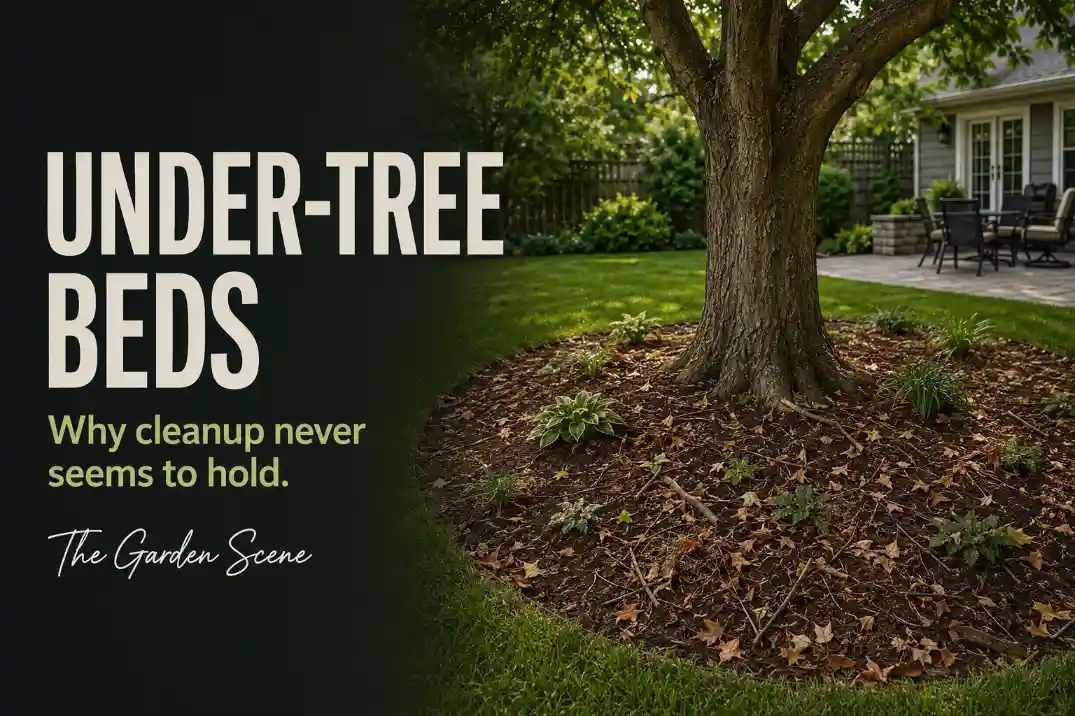
The bed looks finished immediately after cleanup. The mulch is even, the edge is visible, and the plants seem deliberate again. After another ordinary period of tree drop, leaves settle between the stems, twigs interrupt the surface, and the smallest plants appear to vanish.
The real problem is not that the bed contains debris. Beds beneath mature trees will always receive it. The problem begins when normal tree drop erases the three features that make the bed readable: its edge, its main planted forms, and its continuous surface.
That distinction changes the first check. Do not judge the bed only when it has just been cleaned. Look again after routine leaf, bark, or twig drop. If its structure disappears until every piece is removed, the bed has too little visible planting and too many debris-catching interruptions for its location.
The practical goal is therefore not a spotless bed. It is a bed that can absorb ordinary litter without immediately looking unmanaged.
Why Beds Under Trees Collect Debris Faster
The first diagnosis is not how much material the tree drops. It is where that material goes after it lands.
The Bed Sits Inside the Drop Zone
A mature tree rarely sheds only during one dramatic fall cleanup. Leaves may arrive in one concentrated season, but smaller material can fall over a much longer period: flower parts, bark fragments, dry branch tips, seeds, leaf stems, and pieces loosened by wind or wildlife.
An open lawn distributes that material across a broad surface. Mowing, wind, and foot traffic may move or break it down. A defined bed concentrates the same drop inside an edge. Material landing nearby can also blow toward the sheltered area beneath the canopy, where weaker airflow and uneven surfaces allow it to settle.
The bed may therefore appear to collect more debris than the rest of the yard even when the tree is shedding evenly. It is both a receiving zone and a holding zone.
Irregular Surfaces Hold What Open Lawn Releases
Plant stems, low foliage, exposed roots, edging, and pockets of loose mulch interrupt cleanup movement. A rake cannot pass through the bed as cleanly as it can across open turf. Natural airflow is broken by the same obstacles, so leaves catch around plant crowns and against the inner edge.
Hard tree litter creates a different pressure. Acorns and seed pods do not flatten into the surface like leaves. They remain visible, roll into low pockets, and can spread onto nearby routes. When that material dominates the problem, the more specific diagnosis is seed pod and acorn cleanup pressure, not simply a messy mulch bed.
Actual debris volume and visual mess are not the same. A bed with a strong edge, a few readable plant masses, and a continuous surface can hold some litter without looking abandoned. A fragmented bed can look untidy after a much smaller drop because every twig breaks an already weak pattern.
How Roots, Shade, and Leaf Drop Change Bed Maintenance
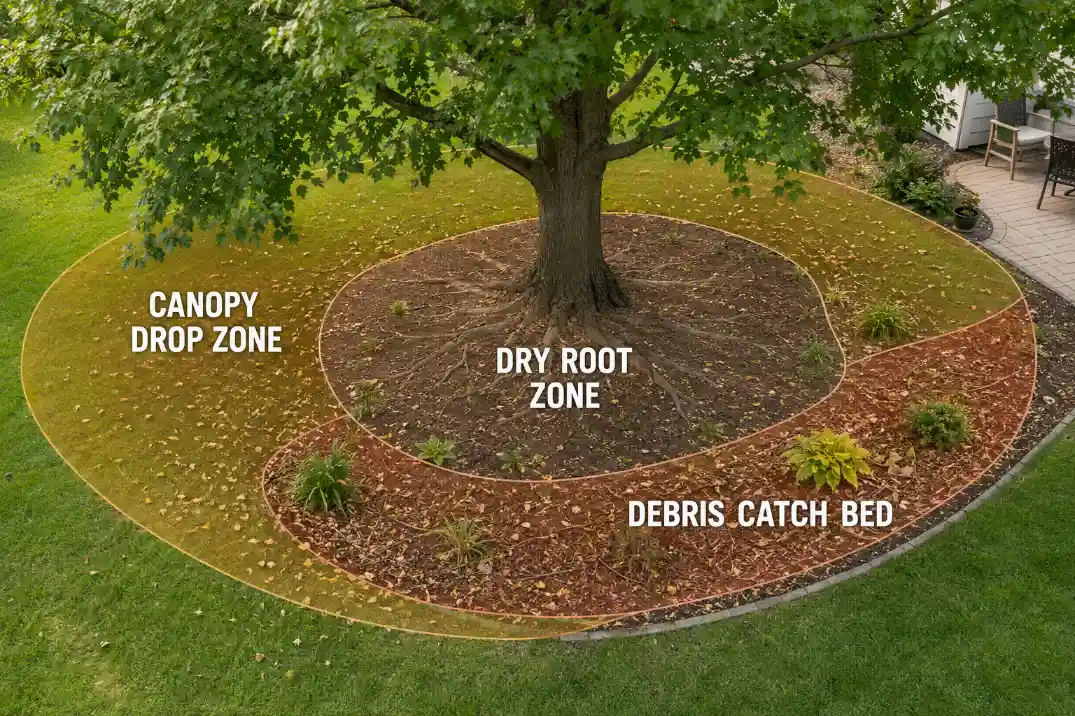
The stronger diagnosis is a pressure stack: the canopy deposits debris while shade and established roots weaken the planting that is supposed to remain visible beneath it.
Dry Shade Weakens the Planting Layer
A dense canopy intercepts some rainfall before it reaches the soil. At the same time, established roots draw from available moisture near the surface. The result can be dry shade—a location that feels cool but dries faster than its appearance suggests.
Plants under that pressure may survive without producing enough foliage to cover their assigned space. Growth becomes thinner, recovery slows, and bare areas remain visible. Leaves then settle into those openings rather than resting on a continuous planting layer.
Not every shaded backyard behaves this way. Some areas remain damp, while others shift from wet spring soil to dry summer soil. If moisture behavior is unclear, use the broader framework for diagnosing backyard landscaping problems in shade before assuming dryness is the only limitation.
Root-Filled Soil Limits Easy Replanting
Shallow or exposed roots reduce the workable soil available for new plants. This matters here as a maintenance constraint, not as a root-repair issue. When every apparent opening already contains fine roots, replacing weak plants does not change the site that made them weak.
Leaf drop magnifies that weakness. Sparse plants provide little resistance as litter settles, so debris falls deeper into the bed and becomes harder to remove without disturbing the remaining foliage. The homeowner ends up hand-cleaning a planting that still looks thin afterward.
Why Small Plants Disappear Under Tree Litter
The useful plant test is not whether a plant survives beneath the tree. It is whether that plant remains visually useful after the bed receives a normal amount of litter.
Survival Is Not the Same as Visibility
Fine foliage, low crowns, and isolated clumps are easily covered or visually broken by ordinary leaves and twigs. A technically living plant may contribute almost nothing to the bed’s structure from the patio, lawn, or nearby window.
This is most noticeable when small plants are scattered across a large mulch field. Immediately after cleanup, each one reads as an individual detail. Once debris returns, the eye sees dark gaps, scattered leaves, and disconnected fragments instead of an intentional planting pattern.
Step back to the distance from which the bed is normally viewed and make the judgment after an ordinary drop period. If the main planted forms cannot be identified without close inspection, those plants are not carrying enough visual weight for that location.
Isolated Plants Create More Cleanup Pockets
Every isolated crown creates another place where leaves can lodge. A bed containing numerous small plants can therefore require more careful cleanup than one with fewer, clearer masses, even when both contain similar planted area.
Simply removing plants is not enough. A wider empty mulch field may make every leaf more visible. The stronger adjustment is to reduce fragmentation while retaining enough repeated plant structure to keep the bed readable.
When the next decision becomes what can realistically grow in the available soil, route that question toward plants for shallow, root-filled soil. Plant selection should follow the site diagnosis rather than replace it.
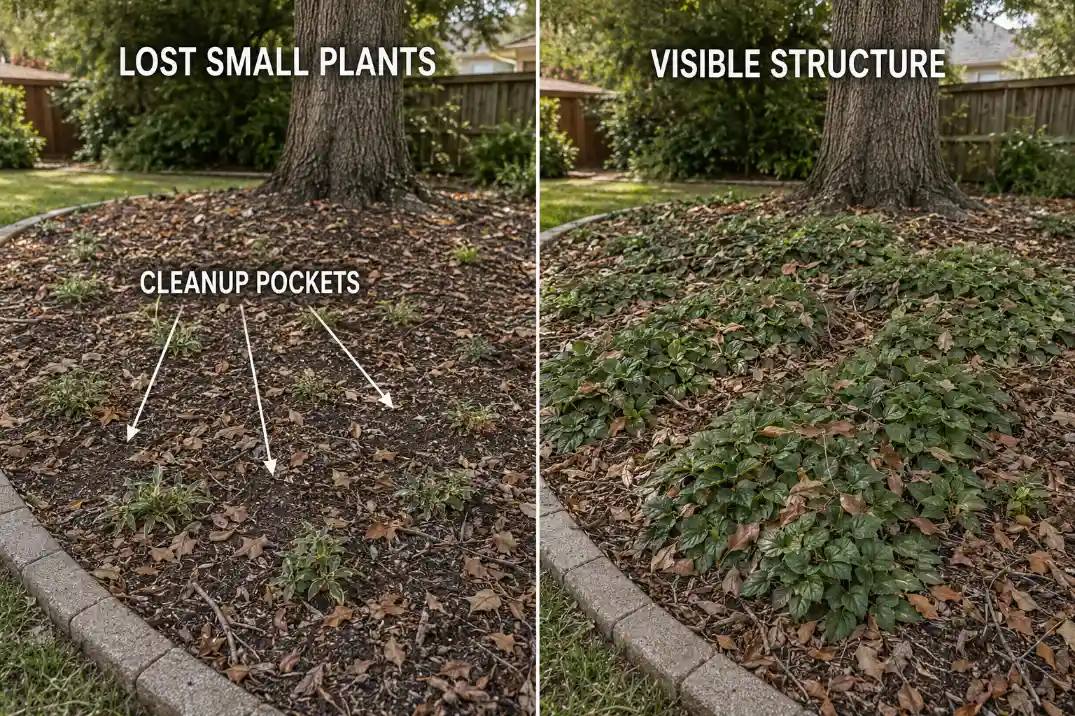
Editorial Note: The bed does not need to look leafless. Its edge, main plants, and surface need to remain readable while some natural litter is still present.
When Mulch Works and When It Becomes a Catch Basin
Do not add mulch until you know whether the existing layer is functioning as a stable surface or as loose storage for everything the tree drops.
Mulch Helps When It Acts as a Surface
A controlled mulch layer can soften the contrast of bare soil, slow moisture loss, and create visual continuity between plants. It gives fine litter somewhere to settle without making every exposed patch look unfinished.
That benefit depends on restraint. In an established, root-constrained planted area, roughly 1–2 inches may provide useful coverage where conditions permit. This is not a universal depth, and it should not be added automatically without checking what is already present.
Push aside a small area and inspect the material beneath the fresh-looking surface. If the bed already contains decomposed mulch mixed with leaves and fines, another top-dressing may improve its color briefly while making the bed deeper and harder to clean.
Too Much Loose Material Creates Another Layer to Clean
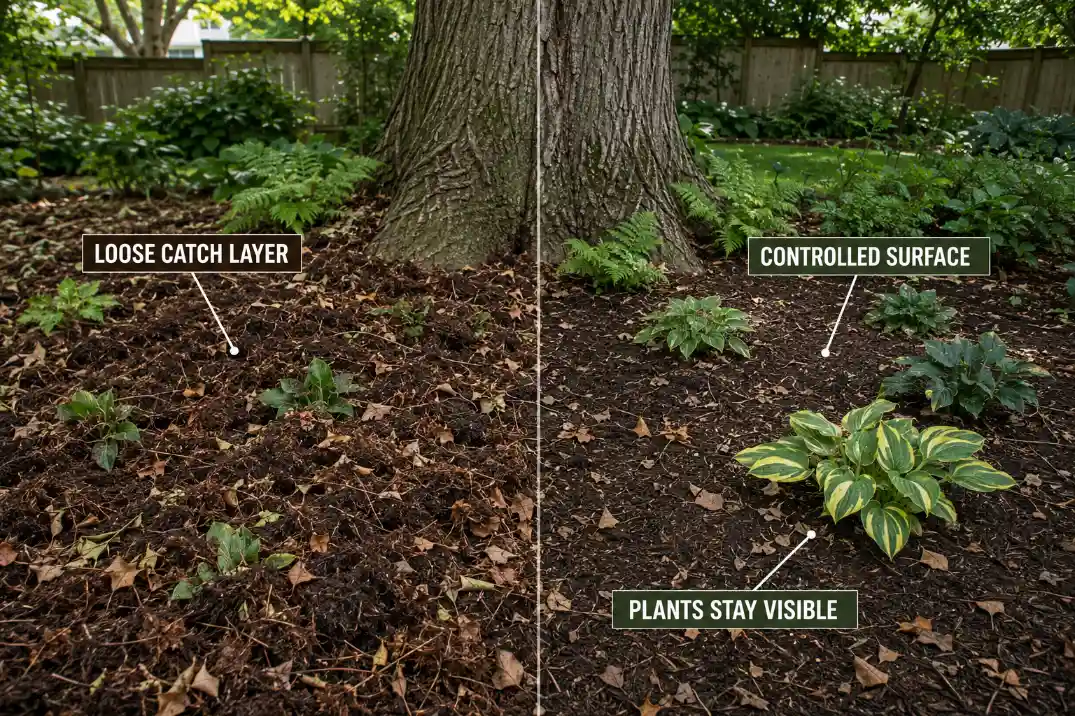
Fresh, fluffy mulch catches leaves instead of allowing them to remain near the surface. Twigs become partially buried, small plant crowns sit lower relative to the surrounding material, and cleanup starts removing mulch along with the litter.
Leaf litter also behaves differently from finished mulch. It collects in pockets, mats around stems, and breaks down unevenly. Leaving some fine litter can be reasonable; allowing it to bury crowns or erase the planting structure is a different condition.
Moisture changes the judgment as well. A restrained layer may support a dry root zone, while unnecessary buildup in a persistently damp pocket can slow surface drying. The bed’s actual moisture behavior should control the decision—not the assumption that fresh mulch always makes a shaded bed easier.
Before adding another layer, name the problem it will solve. If the real issue is invisible plants, trapped litter, or an unreachable interior, deeper mulch will only create a fresher-looking catch basin.
How to Simplify the Bed Without Fighting the Tree
Simplify the features the tree repeatedly hides first. Isolated small plants, narrow gaps, complicated edges, and inaccessible interior pockets create recurring work without producing lasting visual structure.
Keep planted forms that remain visible after normal drop. Reduce fragmented pockets that require hand-cleaning but still disappear from view. Where mulch remains exposed, consolidate it into a continuous, reachable surface rather than a series of small openings between delicate crowns.
Keep the Structure the Tree Cannot Easily Hide
A strong edge gives the bed a readable outline even when some litter remains inside it. Clearer plant masses keep the planting intentional. Open access allows concentrated debris to be removed periodically without turning every cleanup into detailed work.
This does not mean filling every gap or covering the area with deeper mulch. Simplification fails when one task is merely transferred into another hidden correction point. That wider pattern is explained in where low-maintenance backyard work actually moves.
Design for Periodic Reset, Not Permanent Perfection
Watch what disappears first after cleanup. If the edge and main plants remain clear while fine litter settles between them, the basic structure may already be working. If small plants vanish but the surface remains manageable, reduce fragmentation. If the interior becomes an unreachable mixture of mulch and debris, simplify the exposed surface and access pattern.
Prioritize the areas that determine whether the bed reads as maintained: the edge, nearby walking routes, visible plant crowns, and any drainage opening. Fine litter can remain in less visible interior areas when it is not matting over plants, blocking water, or erasing the intended structure.
Success is not zero debris. It is a bed that remains recognizable between periodic resets. Keep what stays visible, reduce what becomes a catch point, and leave a surface that can be reached without fighting the tree.
For conservative guidance on underplanting and mulch around established trees, see Penn State Extension’s underplanting guidance.