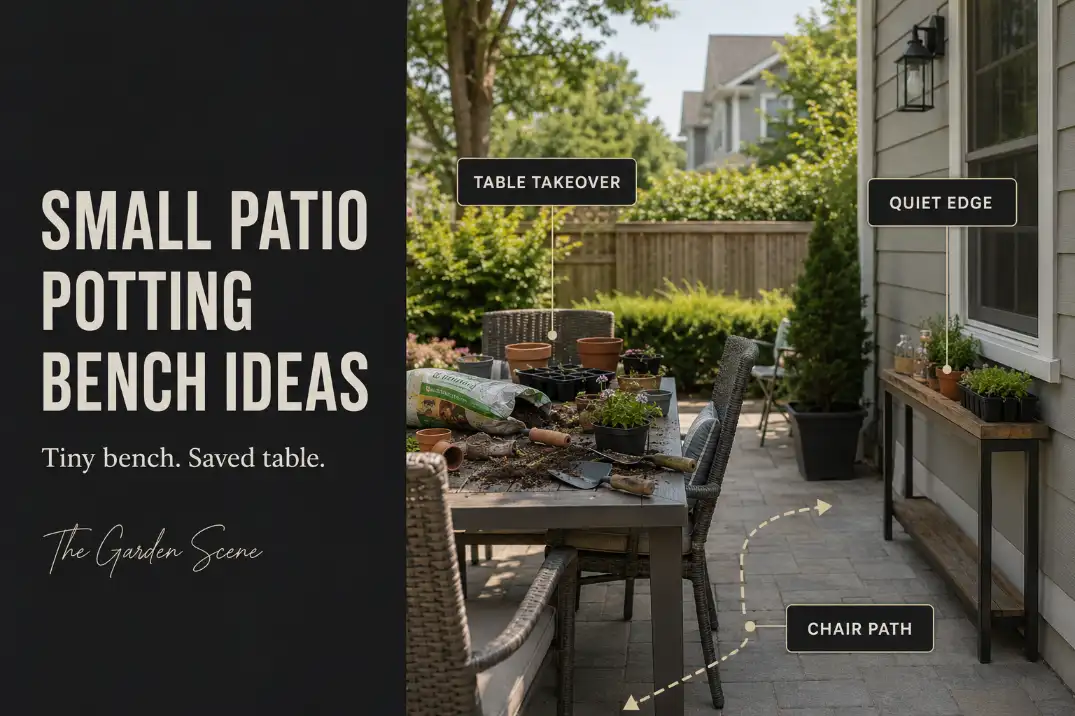
Small patio potting bench ideas only work when the bench protects the patio’s main job first.
The usual problem is not that there is “no gardening space.” It is that potting mix, seed trays, gloves, pruners, and half-watered containers slowly take over the dining table until the patio stops working for sitting, eating, or walking through.
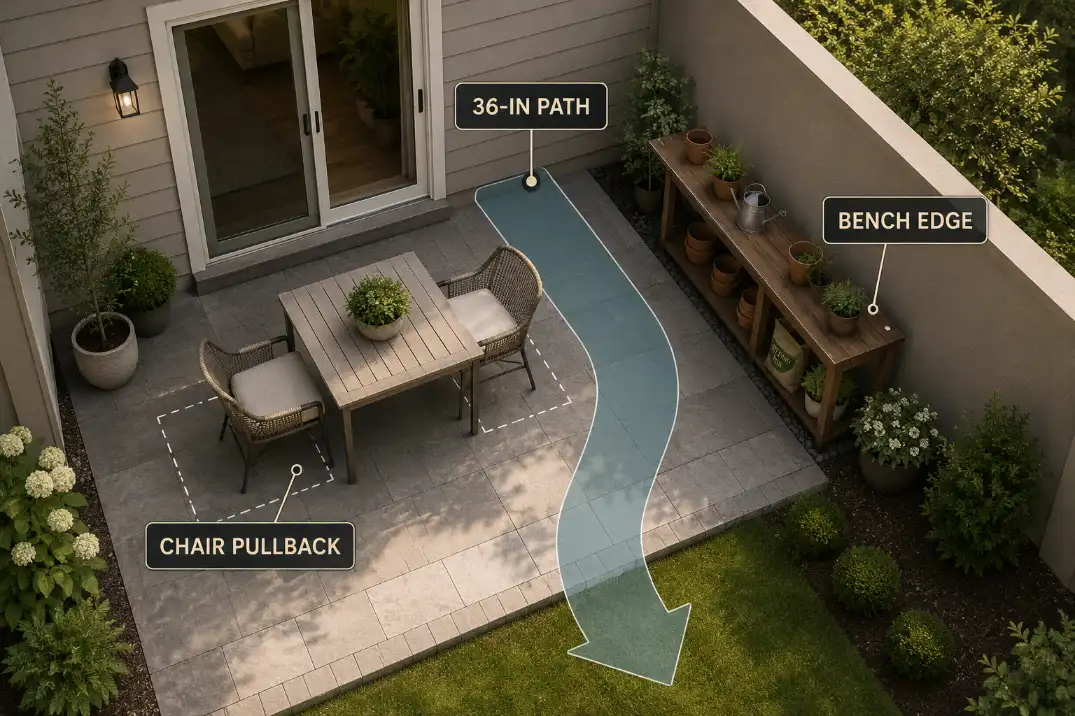
A good small patio setup starts with a few hard limits: keep a 30- to 36-inch walking path, leave at least 24 inches behind chairs, keep the bench about 16 to 18 inches deep when space is tight, and place it within roughly 10 to 15 feet of water if possible.
Once water is 25 feet away or the hose has to cross the seating area, the bench becomes less useful than it looked online.
The goal is not a bigger garden station. It is a contained work edge that keeps dirty work off the table.
The Table Gets Taken Over
Start with the surface that keeps failing
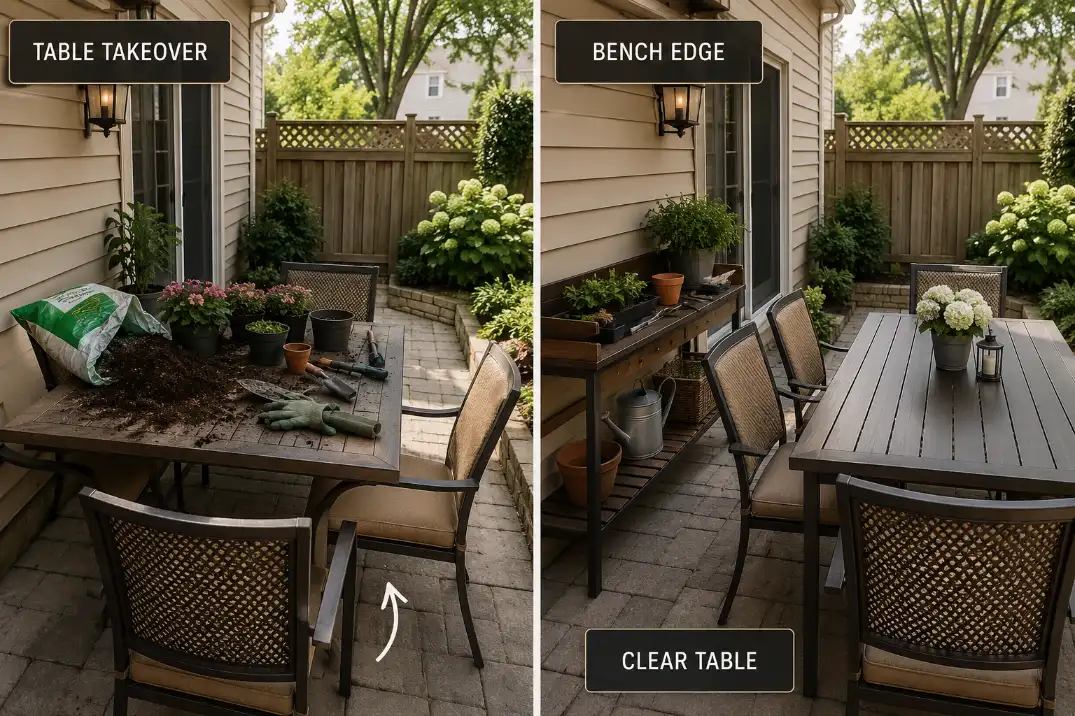
On a small patio, the dining table becomes the potting bench because it is flat, stable, and already at hand height.
That seems harmless when you are repotting one basil plant. It becomes a layout problem when the table stays dusty for 2 or 3 days after every small plant task.
A potting bench should interrupt that pattern. It does not need to dominate the patio. For many small spaces, a 30- to 42-inch-wide bench is enough if it gives you one flat work surface and one contained lower storage spot.
A wider bench may hold more, but if it steals the chair path, it has solved the wrong problem.
This is where people often misread the issue. The messy table is the symptom. The underlying mechanism is that the patio has no defined “dirty work” zone.
Do not organize the wrong surface
The fix that usually wastes time is adding more trays, caddies, and small bins to the dining table. Those can make the mess look intentional, but they do not restore the table’s real job.
If the table is still the only place to cut stems, fill pots, and stage seedlings, it will keep getting taken over.
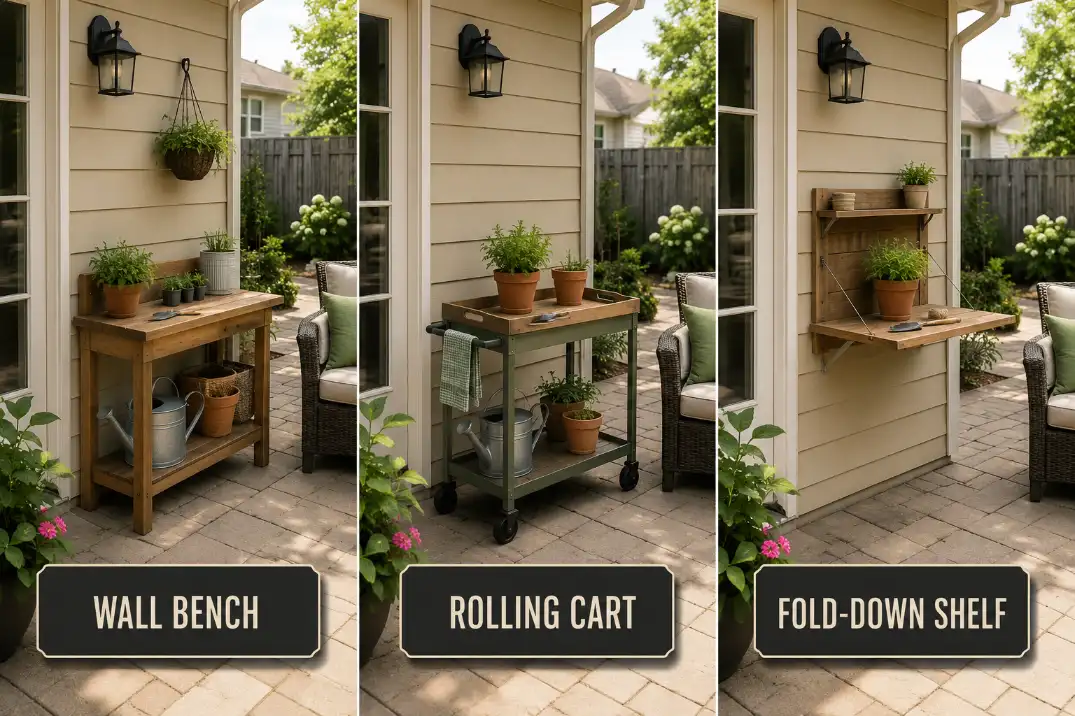
A better idea is a narrow bench against a quiet edge, a fold-down wall shelf, or a rolling potting cart that can leave the patio when the work is done.
The right choice depends less on style and more on whether the work surface stays separate from eating and sitting.
If the patio already feels crowded, the same space-saving logic behind Reduce Patio Clutter Without Losing Function applies here: remove the pressure from the main surface before adding another object.
Choose the Quiet Edge
The best edge is usually not the prettiest corner
A quiet edge is not just an empty spot. It is the part of the patio that does not interrupt the door route, chair pullback, or the natural path to the yard.
A blank wall beside a sliding door may look perfect, but if everyone has to step around the bench to get outside, it is the wrong location.
The strongest bench locations are usually the least dramatic ones: along a fence panel, against a side wall, beside a railing, or near a side return where people already do not sit. The bench should feel like a service strip, not a new furniture zone.
This is why a small side-wall bench can outperform a prettier corner bench. The corner may photograph better, but the side wall may keep the patio working.
Use the right small-space bench idea
For an 8×8 or 8×10 patio, depth matters more than decoration. A bench that is 16 to 18 inches deep can hold a potting tray, hand tools, gloves, and a few small containers.
Once the bench reaches 22 to 24 inches deep, it starts behaving like a cabinet or console table. That may be useful in a larger yard, but on a small patio it can create a squeeze point.
A narrow wall bench works when there is one unused edge and no need to move the bench often. A fold-down potting shelf works when the patio is extremely tight and the work happens only a few times a month.
A rolling cart works when the bench needs to disappear after a 30-minute planting session. A bench with one lidded soil bin works when the patio table is being used mostly for messy repotting.
A railing-side shelf can work on some apartment-style patios, but only if it does not violate rules, overload the railing, or block the sitting edge.
Pro Tip: On a patio under about 10 feet deep, choose the shallowest bench that can hold a standard potting tray before choosing extra shelves or display space.
If the patio is narrow or rectangular, the bench should usually run with the long edge rather than cutting across the short dimension.
The layout reasoning in Small Rectangular Patio Layout Flow is especially useful when a small object starts controlling the whole space.
Keep Chair Paths Clear
Chair movement outranks bench storage
A potting bench that blocks chair movement will not feel like a garden upgrade. It will feel like one more thing everyone has to move around.
Leave at least 24 inches behind a dining chair for basic pullback. If that chair backs into the main walking route, 30 inches is safer.
For the route from the back door to the yard, grill, or side gate, 30 inches is the practical minimum and 36 inches feels noticeably calmer when someone is carrying a tray, watering can, or bag of potting mix.
This is where homeowners often overestimate storage and underestimate motion. A bench can hold soil neatly and still fail if it makes the patio harder to enter.
The door route should win early
If the patio has a sliding glass door, hinged back door, or narrow step-down, the bench should not sit on that axis. Even a small 6-inch shift can matter because people do not walk through patios like floor plans. They move diagonally, carry things, pull chairs back, and pause near the door.
A potting bench belongs beside that movement, not inside it. If the doorway already controls the patio layout, Patio Layout Around Sliding Glass Doors and Walkways is a strong supporting read because the same path-first rule applies whether the object is a bench, grill cart, or dining chair.
| Small patio condition | Better bench move | What usually fails |
|---|---|---|
| Table collects soil and tools | Add one contained work edge | More trays on the dining table |
| Door opens directly onto patio | Place bench outside the door axis | Bench beside the main door route |
| Chairs already feel tight | Use a 16- to 18-inch-deep bench | Deep cabinet-style bench |
| Soil bags stay visible | Use one lidded lower bin | Open bags under the bench |
| Water is far away | Move bench closer to water route | Hose crossing the seating area |
Store Soil Below Carefully
Lower storage is useful until it becomes the mess
The lower shelf is the part of a potting bench that looks harmless and fails quietly. It starts with one bag of potting mix, then a stack of nursery pots, then a pair of gloves, then plant food, then a half-empty tray. After a month, the lower shelf becomes the same clutter problem the bench was supposed to solve.
Soil storage also has weight and moisture issues. A 1- to 2-cubic-foot bag of potting mix can be awkward to pull out, and if it absorbs moisture, it becomes even less pleasant to handle. In humid areas or shaded patios, the lower shelf can stay damp for 24 to 48 hours after watering or rain drift.
The better setup is one lidded container or one short bin that fits fully under the bench. If you have to kneel, drag a torn bag, and sweep loose mix every time, the storage plan is too fussy for daily use.
Open shelves are often overvalued
Open shelves look charming when they hold clean terracotta pots. They look less charming after they collect plastic nursery pots, faded labels, damp gloves, and spilled mix. For a small patio, one open shelf plus one closed bin usually beats three display shelves.
This is also where a bench and a storage unit should not be confused. A storage bench hides things. A potting bench supports work. If the patio’s bigger issue is loose cushions, tools, and seasonal supplies, Best Small Patio Storage Solutions may be the better next step than buying a decorative potting station.
Water Access Matters
A bench far from water becomes a shelf
Water access decides whether the bench gets used after the first few weekends. If the bench sits within about 10 to 15 feet of a hose bib, watering can refill point, or side-yard faucet, it can support real planting work. If it sits 25 feet away and the hose has to cross the sitting area, the bench often becomes a dry display shelf.
This is especially true for container-heavy patios. Small herb pots may only need a watering can. Larger planters, recently repotted containers, and summer annuals need more water volume. If every watering trip requires crossing the chair path twice, the setup will feel annoying during the season when plants need the most attention.
The water route should not punish the patio
Do not solve water access by dragging a hose through the center of the patio. A hose crossing the dining zone is a trip point, a chair snag, and a reason people stop using the bench correctly.
A better idea is to place the bench near the water edge, then keep the patio center clean. A compact hose reel, a narrow watering can station, or a side-yard faucet zone may matter more than the bench itself. If the water source is outside the patio, Side Yard Hose Reel and Faucet Zone connects well with this setup because the route matters as much as the station.
Pro Tip: Before buying the bench, carry a full watering can from the water source to the proposed bench spot. If the route feels irritating once, it will feel worse during hot July watering.
A Bench That Actually Gets Used
Match the bench to the real task
A useful small patio potting bench usually has four things: a flat worktop, one lower storage area, a narrow back ledge or rail, and enough open space around it to sweep. It does not need to look like a full garden shed.
For many adults, a 34- to 36-inch work height feels comfortable for repotting small containers. A much lower bench can still work as storage, but it often becomes awkward for actual potting. A tall shelf unit may hold plants nicely, but that does not make it a workbench.
If the main issue is choosing a compact bench that will not overwhelm the seating area, Best Patio Benches for Small Patios fits the buying decision more closely. The point is not to buy the largest bench that fits; it is to choose a bench that leaves the patio usable.
The healthier setup is a bench that can be cleaned in under 5 minutes after a small task. The failing setup is one that creates a second cleanup zone: table, floor, lower shelf, hose, and chair path.
Know when a cart beats a fixed bench
A rolling cart is better than a fixed bench when the patio is extremely tight, the work is seasonal, or the same edge is needed for entertaining. If you only repot plants once or twice a month, a cart that rolls to the side yard may protect the patio better than a permanent bench.
A fold-down shelf is better when the patio has wall space but no floor space. It is not ideal for heavy bags or large planters, but it can handle seed starting, light pruning, and small pot refreshes.
A fixed bench is best when the patio has a true quiet edge, nearby water, and enough clearance for chairs to stay where they belong.
Stop when the bench creates a new problem
A potting bench stops making sense when it forces chairs to move, blocks the door route, holds more stored items than active tools, or takes longer to clean than the table did. That is the point where the routine fix turns into another patio problem.
The best small patio potting bench idea is rarely the most elaborate one. It is usually one quiet edge, one shallow worktop, one contained soil bin, and one water route that does not cross the chairs.
That combination keeps the dining table clear, the patio usable, and the plant work close enough that you will actually do it.
For broader container watering guidance, see the University of Minnesota Extension.