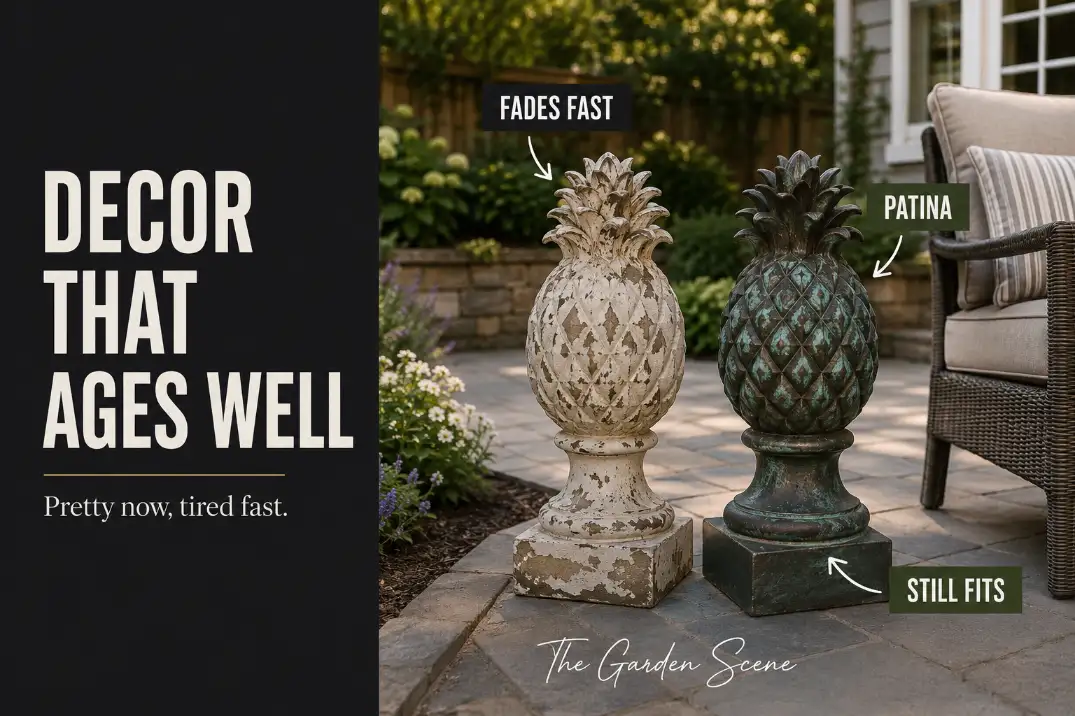
Garden decor that ages well is not simply decor that stays new-looking. It is decor that still looks chosen after sun, rain, dust, leaf stains, wind, and seasonal temperature changes have worked on it.
For most exposed yards, stone, concrete, fiber cement, aluminum, bronze, copper, and simple weathering metal are safer long-term choices than glossy resin, thin painted steel, bright plastic, or delicate painted wood.
The first checks are practical: will the piece sit in 6 or more hours of direct sun, can water drain away within 24 hours after rain, and is it heavy or stable enough to stay put in a 20–30 mph gust?
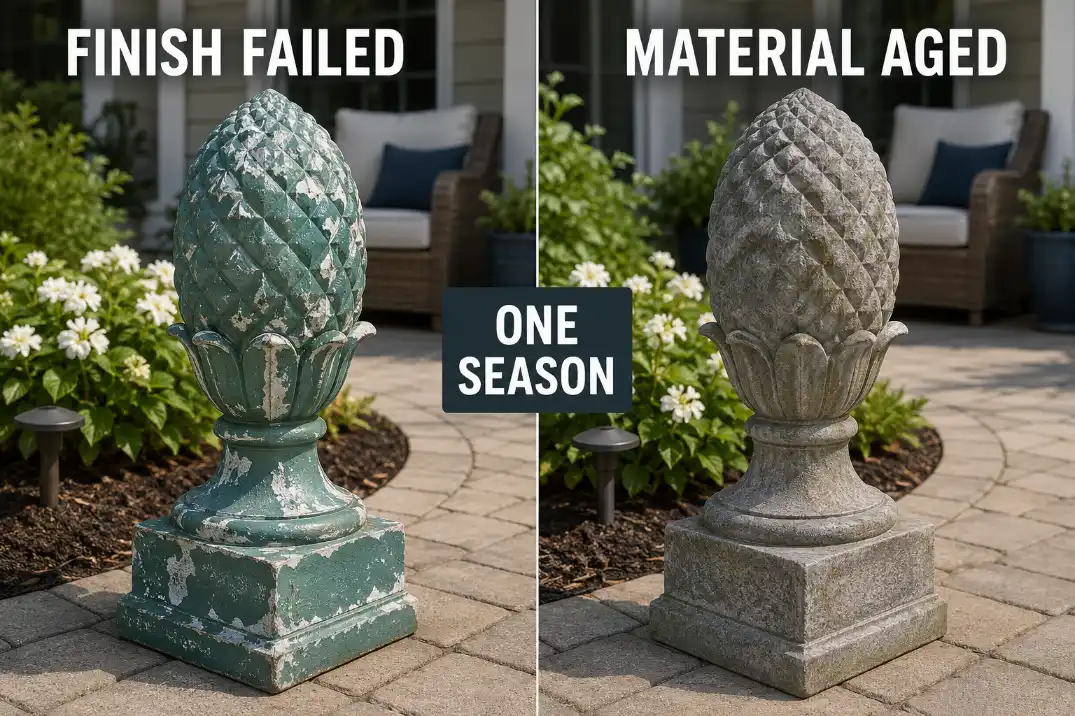
A piece that looks tired after one season usually did not fail because the yard was harsh. It failed because the finish was doing the work the material should have done.
Why Some Decor Looks Old Too Fast
Decor usually looks old too fast when the surface finish matters more than the material underneath. In real outdoor conditions, the finish takes the first punishment.
Sun fades color, moisture lifts coatings, dust settles into texture, and small chips expose weaker material below.
When the finish is the decoration, it ages faster
Painted resin, thin powder-coated metal, glossy ceramic, faux-stone plastic, and bright novelty pieces often depend on perfect color and shine. Once that surface dulls, chalks, flakes, or peels, the piece loses the reason it looked attractive in the first place.
That is different from stone darkening slightly, copper developing patina, or cedar turning gray. Those changes can still look natural because the material has depth. A cheap finish has only a surface.
The useful distinction is this: fading is a symptom, but finish dependence is the mechanism. Repainting may hide the symptom for a short time, but it does not change the weakness if the material, drainage, or exposure is wrong.
Small flaws get louder outside
Some outdoor pieces age poorly because every small mark becomes obvious. A black metal lantern with one rust streak, a white resin planter with one yellow stain, or a glossy ceramic sphere with one chip can make the whole area feel less cared for.
Texture hides weather better than shine. Matte stone, textured concrete, fiber cement, weathered metal, and simple wood forms usually tolerate dust and small marks more gracefully than polished, high-contrast pieces.
This is why too many small decor objects can make aging problems feel worse. When faded pots, lanterns, and ornaments compete in the same view, each flaw becomes louder.
The issue is not only durability; it is also visual weight, which is why garden decor can make small yards feel cluttered even before any single piece physically fails.
Materials That Hold Up Better Outside
The safest outdoor decor materials are the ones that do not need perfect color to look good. A simple stone bowl, concrete planter, metal obelisk, or fiber cement vessel can weather without looking instantly damaged.
Use material behavior, not product photos
A product photo shows the best day of the object’s life. Your yard shows the next 12 months. The smarter question is not “Does it look good now?” It is “What will this look like when the color dulls, the surface dries, or rain leaves a mark?”
| Material | Best outdoor use | How it usually ages | Use caution when |
|---|---|---|---|
| Stone or concrete | Exposed focal pieces | Darkens, stains slightly, develops surface variation | Water sits in bowls or bases for 24–48 hours |
| Fiber cement | Planters and simple sculptural pieces | Dulls gently and stays visually quiet | Thin rims or sharp edges chip easily |
| Aluminum | Humid or splash-prone areas | Finish may dull, but it avoids red rust | The piece is too light for wind exposure |
| Bronze, copper, or weathering metal | Accent pieces with patina | Color shifts and surface deepens | Runoff can stain pale pavers |
| Wood | Covered or semi-protected areas | Grays, dries, and opens slightly | You do not want 6–12 month maintenance |
| Resin or plastic | Shaded, low-stakes accents | Fades, chalks, or becomes brittle | It is used as a full-sun focal point |
Stone and concrete are safest when they drain
Stone and concrete are often the most forgiving choices for exposed decor because they have weight and visual depth. They may collect mineral marks or darken at the base, but those changes often look like normal outdoor weathering rather than failure.
Drainage is the limit. If water sits in a bowl, saucer, hollow foot, or uneven base for more than 24–48 hours, staining and freeze damage become more likely. In colder northern states, trapped water can freeze, expand, and turn a small weakness into a crack by spring.
Choose pieces with weep holes, raised feet, or a base that dries underneath. A heavy object can survive structurally and still leave a permanent-looking ring on the patio if it keeps the surface below it damp for days.
Metal is good when rust is controlled or intended
Metal can age beautifully, but “metal” is too broad to be a decision. Aluminum, powder-coated steel, cast iron, galvanized steel, bronze, copper, and weathering steel behave differently.
Aluminum is useful near moisture because it does not rust like steel. Powder-coated steel can work, but chips matter because rust can creep from exposed spots. Copper and bronze can develop attractive patina, but runoff should not cross pale concrete or light pavers.
The mistake is treating metal as automatically durable. A thin metal stake in wet mulch has a harder life than a heavier metal accent on a dry patio edge.
Wood and ceramic need the right level of protection
Wood can age well outside if the design allows it to change. Teak, cedar, cypress, redwood, and properly treated wood are better choices than fragile decorative wood with many joints and exposed end grain.
The problem is not that wood turns gray. The problem is buying a warm wood tone and expecting it to stay that way without maintenance. Oiled wood may need refreshing every 6–12 months in exposed sun. Painted wood should be checked at feet, joints, screw holes, and end grain because those are usually where moisture starts the failure.
Ceramic has a similar split. Thick, frost-safe ceramic can work in protected or mild locations. Thin glossy ceramic, especially pieces that hold water, chip easily, or sit through freeze-thaw cycles, is much less forgiving.
Pro Tip: For wood decor, inspect the bottom before the front face. Feet, bases, and end grain usually reveal outdoor failure first.
Maintenance Burden Most Homeowners Ignore
A piece that needs constant attention is not aging well. It is only staying acceptable because you are compensating for the wrong material or the wrong location.
Seasonal care is realistic; weekly rescue is not
For most exposed patios and garden beds, a realistic maintenance rhythm is light cleaning every 1–3 months, finish inspection twice a year, and a deeper clean before winter or before peak outdoor season. That is normal.
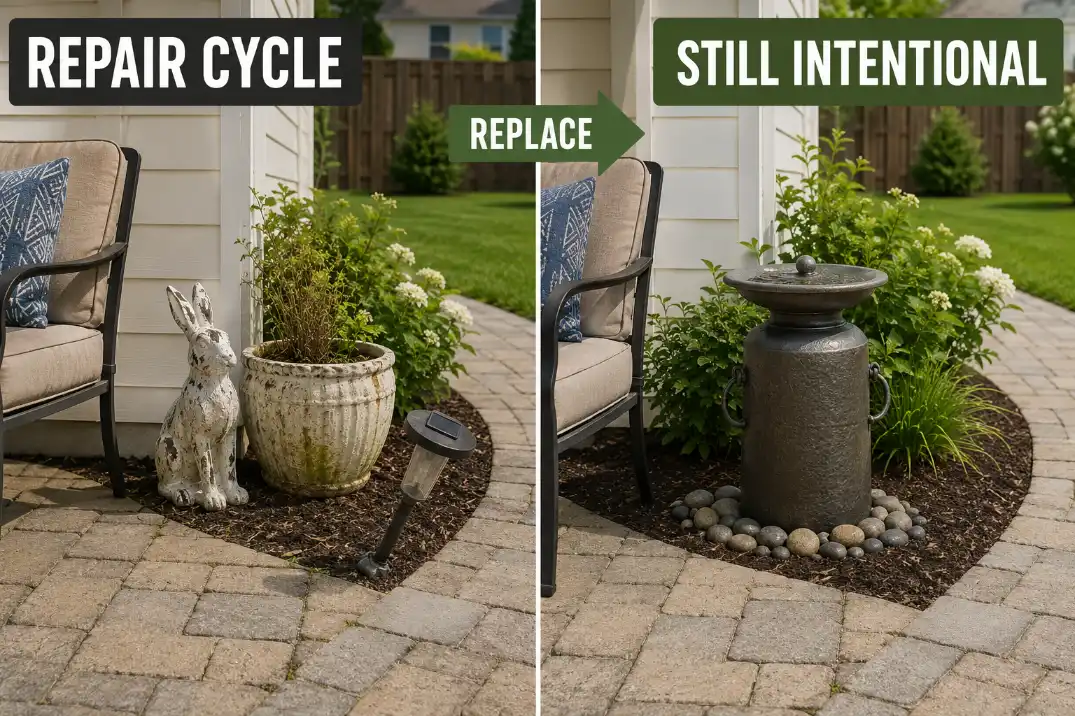
What is not normal is a piece that needs hand-wiping every week, repainting every few months, or repositioning after ordinary wind. If the repair cycle is shorter than the season, the piece does not fit that exposure.
This is where homeowners often underestimate exposure. A covered porch and an open southwest-facing patio are not comparable. A piece that looks fine under roof cover may fade quickly in 6–8 hours of direct afternoon sun.
Repainting weak decor often wastes time
The most common wasted fix is repainting a piece that was never built for the location. Paint can refresh the surface, but it cannot solve trapped water, brittle plastic, thin metal, loose seams, or poor weight.
If a piece peels in spring, looks patched by midsummer, and needs another touch-up before fall, the issue is not your paint technique. The decor is mismatched to the site.
The same logic applies to safety and movement. A faded object is cosmetic. A cracked base, rusted stand, or shifting planter near a daily route becomes a layout problem. Once decor starts narrowing a walking line or creating a trip-prone edge, it belongs in the same decision category as garden decor that blocks walkways, not just seasonal styling.
Before you buy, check this
Use this quick filter before choosing outdoor decor:
- Will it sit in 6 or more hours of direct sun?
- Can rainwater drain away within 24 hours?
- Does the base dry underneath after storms?
- Will small marks look like patina or failure?
- Can it look acceptable with seasonal cleaning, not weekly hand-cleaning?
- Is it stable enough for ordinary 20–30 mph gusts?
- Would you still like the form if the color faded?
If several answers are weak, the piece may still be fine for a covered porch or seasonal display. It should not be treated as a long-term exposed focal point.
Matching Decor to Climate and Exposure
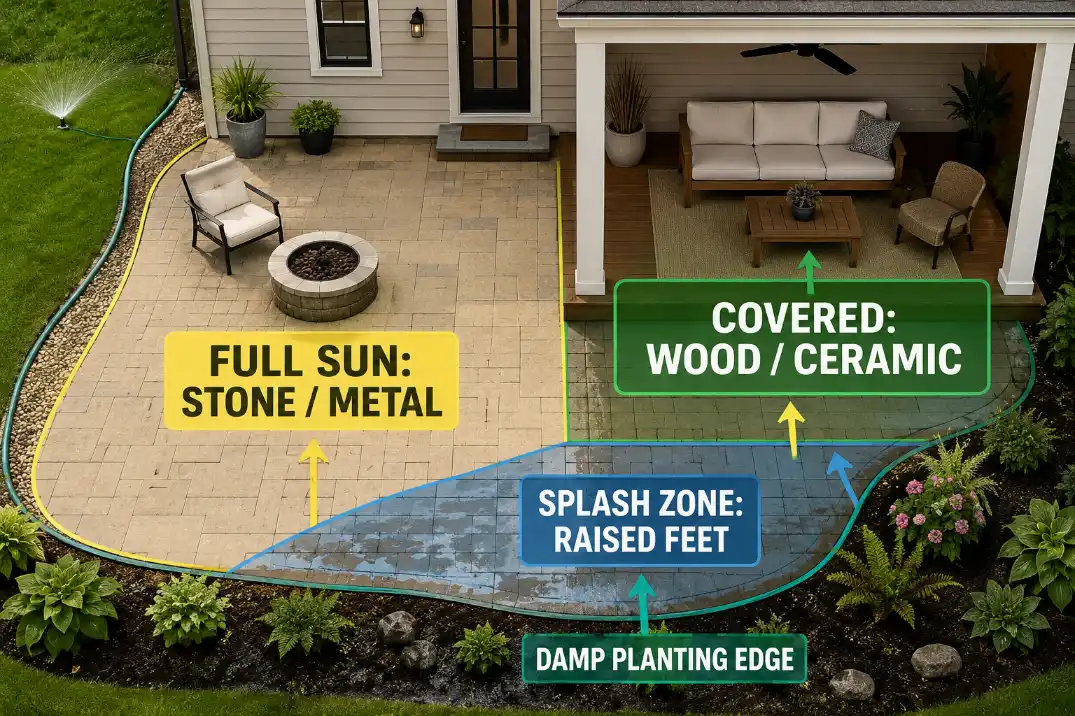
Exposure matters more than region alone. A covered porch in a humid state can be easier on decor than an open, south-facing patio in a milder climate. The exact location in the yard usually tells you more than the state name.
Full sun punishes color first
Full sun is hardest on bright color, thin plastics, glossy coatings, and painted finishes. In hot, dry areas, UV exposure and heat can make cheap resin fade, chalk, or become brittle. Dark objects on exposed patios can also absorb enough heat to stress coatings during peak summer.
For 6–8 hours of direct sun, choose subdued color, integral material color, matte texture, or a finish that can be renewed without looking patchy. Stone, concrete, fiber cement, aluminum, and simple weathering metal usually make more sense than bright plastic or glossy painted resin.
Moisture punishes seams, feet, and hollow bases
Humid climates, coastal air, sprinkler splash, and storm-heavy seasons are harder on hidden moisture points than on the visible face. Water collects in seams, saucers, hollow bases, feet, screw holes, and decorative grooves.
The practical threshold is simple: after rain, the piece should not hold water for more than 24 hours. If it does, expect mildew, algae, rust bleeding, staining, or cracking depending on the material and climate.
Thin metal feet are a common failure point. They can rust and stain the surface below while the upper part still looks fine. Raised feet, better drainage, or a drier placement often matter more than buying a larger version of the same weak object.
Freeze-thaw climates punish trapped water
In freezing climates, the issue is not simply cold. It is water entering small openings, freezing, expanding, thawing, and repeating the cycle. Hollow resin, thin ceramic, lightweight concrete, and water-holding bowls can look fine in fall and split by spring.
For freeze-prone yards, avoid leaving water-holding pieces exposed through winter unless they are rated for outdoor freezing conditions. Move delicate ceramic, lightweight resin, and sentimental pieces into a shed, garage, or covered area before repeated hard freezes.
Choosing Features That Improve With Time
The best long-term decor is usually simpler, heavier, quieter, and less dependent on perfect color. Choose the piece you would still want to see after the finish dulls.
Normal aging is not the same as failure
Patina is controlled, believable aging. Failure is damage that distracts from the yard.
Normal aging looks like softened color, a duller surface, light mineral marks, gentle wood graying, or metal color shifting over time. The piece still feels stable, intentional, and visually connected to the space.
Failure looks like peeling paint, chalky plastic, rust bleeding onto pavers, cracks, wobble, soft wood, mildew trapped in grooves, or water that never dries underneath. That kind of aging does not add character. It makes the surrounding patio or planting look less cared for.
Use this boundary: if a piece needs repainting, deep cleaning, or repair more than once per season to look acceptable, it no longer fits that exposure.
Simple forms survive weather better
Simple shapes hold their place better outdoors because they do not depend on tiny details. A plain urn, low stone bowl, metal obelisk, weathering steel screen, oversized planter, or clean-lined bench can tolerate surface change and still look deliberate.
Busy pieces are less forgiving. Tiny faces, painted details, faux cracks, scrollwork, and small raised patterns collect dust, algae, and peeling finish. The object may still be intact, but it starts to look messy.
This is why online inspiration can mislead homeowners. A close-up photo rewards color and detail. A real yard rewards scale, proportion, and how the piece reads from 10–20 feet away. If an item only works in a close photo, it may be one of those cases where garden decor looks good online but feels wrong once it has to live in the actual yard.
Replace when decor starts hurting the setting
Keeping outdoor decor too long can make the surrounding space feel older than it is. Replace or relocate a piece when it stains the patio, tips in ordinary wind, blocks a route, needs same-season repainting, or makes nearby planting look messier.
Aging well does not mean refusing change. It means choosing pieces that can stay useful, attractive, and believable as the yard matures.
The strongest garden decor does not fight the weather every day. It has enough material honesty, drainage, weight, and simplicity to let weather become part of the look.
For technical context on how outdoor exposure affects wood and finishes, see the USDA Forest Products Laboratory.